-
Samadhi (2021) Part 3 - The Pathless Path 🙏🏼
RAVriesThe name, named, is not the eternal Name. Nameless, the origin of heaven and earth. Named, the mother of ten thousand things. Ever desireless, one can see the mystery. Ever desiring, one sees the manifestations. These two spring from the same source, but differ in name. This appears as darkness. Darkness within darkness. The gate to all mystery. . When action is pure and selfless, everything settles into its own perfect place. . In Buddhism Samadhi is the last of the eight elements of the Noble Eightfold Path. In the Ashtanga Yoga tradition, it is the eighth and final limb identified in the Yoga Sutras of Patanjali. 🙏🏼 TO ALSO WATCH THE OTHER 2 EPISODES OF SAMADHI 🔻 🎥 Watch: Samadhi (2017) Part 1 - Maya 🙏🏼 https://rumble.com/v26dxly-samadhi-2018-part-1-maya-.html 🔻 🎥 Watch: Samadhi (2018) Part 2 - It's Not What You Think 🙏🏼 https://rumble.com/v26dthc-samadhi-2018-part-2-its-not-what-you-think-.html 👇🏼 Additional: 🔻 🎥 Watch: Choice-less Awareness https://rumble.com/v28b9g8-choice-less-awareness.html . When Soul and body are in the bond of Love, they can be kept together. By concentration on the breath, it is brought to perfect elasticity, and one becomes as a babe. By purifying oneself in Samadhi, one becomes whole. In his dealing with individuals and with society, let him move without lust of result. In the management of his breath, let him be like the mother bird. Let his intelligence comprehend every quarter; but let his knowledge cease. Here is the Mystery of Virtue. It createth all and nourisheth all; yet it doth not adhere to them. It operateth all; but knoweth not of it; nor proclaimeth it. It directeth all, but without conscious control. . Understanding Samadhi The Samadhi definition is the mind being completely absorbed in a single object of meditation. The mind can identify itself with the meditation object. In Samadhi, there is no mental and physical consciousness, no hearing or seeing, there is spiritual consciousness only. You can say this is a state where the mind experiences deep-rest. Sleep is not Samadhi as this is unconscious rest, Samadhi is a state of conscious rest. This Samadhi can be termed as super consciousness, supreme bliss and enlightenment. . The path to Samadhi is not the sort of path where one puts one foot in front of another in order to get to some destination. The path is a stripping away of illusion, a letting go of identification with a limited self, so that one wakes up exactly where one is. . The ancient mystics, yogis and seers have said that everything is primordial awareness, or non-dual consciousness which is simultaneously emptiness and form (all that is). Primordial awareness is not what we normally refer to as consciousness; it is what is aware of consciousness as it changes from one state to another. In so-called “normal” life we are aware of three states of consciousness; waking, dreaming and deep sleep, and these states come and go. Primordial awareness is aware of the coming and going of these states, but it does not come and go. In Vedanta it is called turiya, the fourth state, the ground of your existence. It is always aware and yet is not separate from what is observed. . The mind might ask “how can I realize myself as this pure awareness?” The desire to capture the truth always comes from the egoic mind which wants to acquire awareness, but it can never acquire it because it is the very thing that has to surrender for it to be realized. Prajna or wisdom of the truth is waking up to what is always already present. If you are not careful, the mind can lead you down a path of endless seeking in an attempt to add more to yourself. Liberation is the end of seeking, and the realization of the false self that is trying to attain something. . Do not seek enlightenment or extraordinary states of being, since all seeking is the activity of the ego. Simply cease valuing and chasing illusions, and the source will reveal itself.. . Turn awareness away from the illusion towards awareness itself and allow everything to be as it is until you have realized the true Self or God, which is the awakened consciousness that does not come and go. From the perspective of the dual world, there are two parts or two paths to Samadhi. Yin and Yang together form an inseparable unified totality. There is no Yin without Yang, just as there is no cup without the emptiness inside. The two aspects of existence are that which changes, and that which does not change. The ground of your being is perfect in its nondual empty-fullness, eternal in its dynamic stillness, unbound as it exists everywhere and nowhere. The pathless path is to realize an ever-deepening development process within the self structure, and to simultaneously realize our true nature, which is the primordial awareness beyond name and form. Samadhi is when the world that is constantly changing merges or unites with the changeless. Even that is not entirely true; nothing actually merges because nothing was really separate. The illusion of separation falls away revealing that everything has always been that one primordial consciousness. . The world of one who is suffering in Samsara is identical to the world of one who is awakened, except that the former is mediated by the false self. In Christian terms you could say that when one is identified with the limited self it is hell, and when one is free of the limited self, it is heaven. Jean-Paul Sartre famously said “Hell is other people.” When this statement is examined deeply, a profound truth is revealed. Whenever there is any kind of distinguishing between self and other, then one is in hell, which is nothing but the cycle of egoic activity (craving and aversion). Hell is identification with the limited self, which is the creation or coming into being of the duality of self and other. . When one awakens, one realizes with a direct knowing that “I am not this limited mind/body”. This knowing, once recognized and established in the mind, may give the ego a feeling of relative freedom from its own conditioning; a sort of loosening of the chains. There may be a sense of lightness and understanding that you are not this limited character, and that you are not obliged to follow the script that has been set out for your life. Yet this very conviction can become the basis for a new character or new spiritual persona. If you continue to say “I am not this limited mind/body, I am awareness”, then there is a split, a duality or separation between awareness and the mind/body. This separation is the false delusion created by the limited egoic mind and you can be sure that your path has been appropriated by the false self. . In the world we live in today, most people’s lives are limited to the physical and mental sheaths of the soul, and when they get a glimpse of what is beyond these levels their consciousness often gets pulled back down into the mind/body illusion. Because the habit pattern of the mind is so strong, most people will make up a story or narrative about their awakening experience. One must be vigilant that we do not become identified with being a person who is awakened or enlightened, for this is the greatest delusion of all. As the Zen master Suzuki said “There are, strictly speaking, no enlightened people, there is only enlightened activity.” . Do not mistake understanding for realization (realization is the actual awakened state). And do not mistake realization for liberation (liberation is the awakened state that does not come and go). . Your mind literally can’t imagine where the path leads. Limited mind will be your greatest obstacle. In fact your identification with the limited mind will be your only obstacle on the pathless path. Virtually everything in the world is pointing us in the opposite direction towards the level of language and conditioned thoughts that make up the so-called external world. We are conditioned to seek solutions outside of ourselves and as long as we are seeking we will remain within the labyrinth of mind and will never come to inner stillness. Yet when one awakens, one’s true nature is revealed to be the very essence of mind. The only difference is that awakened mind is unlimited, while egoic or personal mind is limited. . “To seek is to suffer. To seek nothing is bliss.”~ Bodhidharma . Socrates is famous for saying “I know that I don’t know”, and that not-knowing is what made him the wisest man in Greece. He does not know and thus he has found the Way. The most important thing the lower mind can learn is its limitation with regard to the path. Realizing the mind’s limitation is not the same as realizing the truth, but it is the necessary first step. One must stop the futile, incessant activities that keep one seeking some knowledge, transcendent state or experience, or some “thing”. Truth is not found by answers or attainments on the level of mind, but within the unfathomable non-dual empty-fullness of the heart. It is realized when questioning ceases. You can’t “get” or acquire the truth, you only wake up to the truth through Samadhi, through the alchemy that dissolves the self when one single-pointedly, adamantly refuses to respond to illusions. It is through the negative path, the via negativa that we come to know the truth of what we are, by letting go of everything that we are not. Then it is realized directly that you always have been that ever-present awareness. . The legendary teacher Bodhidharma is the founder and first patriarch of Chan Buddhism in China, which later became Zen in Japan. The story goes that Bodhidharma was summoned by the Emperor Wu, who wanted to question him because he heard that he was a great sage. . “Who are you, standing in front of me?” asked the Emperor. “Don’t know,” said Bodhidharma. . With this answer Bodhidharma cuts through all of the mind’s tricks and deceptions. It is not that Bodhidharma was an agnostic, believing in the unknowability of his true nature. Bodhidharma was awakened as primordial consciousness, but the limited mind is incapable of conveying it. Words do not convey the silent truth because words are noise. They do not convey stillness because they are movement. The words are a finger pointing toward the moon. Do not mistake the finger for the moon itself. It is not possible to point to primordial awareness . . How can you point to that which is everywhere and nowhere? Yet all spiritual teachings are an attempt to do so. . From a relative perspective, the mind and senses are filtering and reducing the vibratory field so that we can have a human experience. This stepped-down projection is the simulation of the entire external world, which is mediated through a limited self. All energy and phenomena is spiraled into veils of illusion, the screen or barrier that must be transcended in order to awaken to the truth directly. Even the apparent transcending of illusion is an illusion. Those who have realized their true nature have said that there only appears that there is a barrier between you and primordial consciousness, since actually everything is that consciousness. As long as the illusion of a limited self persists, one plays a game of hide and seek with awareness. Even though we may understand mentally that the entire self structure is illusory, we remain entangled in the illusion, still responding to preferences and conditioned constructs as craving and aversion arises. To penetrate to its depth takes great vigilance and one must want awakening more than the illusion, more than life itself. . If all is illusory, then why not just remain single-pointedly aware of awareness, turning awareness back on itself and ignoring the illusion? This is easier said than done. For most of us the illusion is extremely persistent and one’s peace is constantly disturbed by the fluctuations of the mind (the vrittis or the “whirlpool” of the mind). As soon as we try to quit our conditioned patterns the inexorable gravity and inertia of the matrix will pull us back into its spiral of maya. The well-worn grooves of conditioned patterning are established and energy will default to running in these old channels unless there is an interruption and rerouting of the wiring. The path is to purify both the biological conditioning and the conditioning that has been inherited socially. Within our biological conditioning is the deepest response-to-stimulus impulse that becomes sublimated to higher and more complex levels of thought and behavior. Our social conditioning is built on top of primitive impulses and wired into the reptilian conditioning that is at home in the reptilian brain. . On the path we bring to light the patterns hidden in the unconscious, and there are also supra-conscious stages of evolution that one is similarly not aware of because they have not emerged out of one’s inner growth. The supra-consciousness is like a flower that has not yet bloomed and we don’t know what it will look like. . There is an old proverb (in Sanskrit called Kupamanduka) about a frog that lives its life in the bottom of a well. The frog believes that the well is the entire world. It explores every pebble within the well and measures it in all directions, so it is with supreme confidence that the frog speaks about the totality of the world. One day a fish falls in the well and tells incredible tales about the outside world and swimming in the vast sea. The frog literally cannot comprehend nor imagine it, so he rejects the stories as either lies or madness. . We are like the frog in the well. We don’t know what we don’t know. . The unconscious is exactly that; not conscious. If we knew what it was, then it would be conscious. We cannot drop or become free from a pattern that we hold which we are not conscious of. There are parts of ourselves that are hidden, operating unconsciously within our animal nature; deep craving and aversion connected to the reptilian brain and sublimated within all aspects of behavior and life. And there are aspects of us that are supra-conscious operating within templates or structures on the higher soul levels, but we have not established the connections to these subtle realms. . We have the opportunity in this life to go farther and to go deeper. The enlightenment process takes us farther into the expanses of cosmic mind while awakening takes us deeper into the present moment. As we walk the path we will likely have times that we are not awake; identified with some aspect of the illusion. The pull of the spiral of maya is strong. In addition to formal meditation and self inquiry practices, we can use every moment of our lives to become more aware, to become more free. This happens naturally when we finally stop responding to illusions. When we stop responding to illusions there is friction generated within the self structure as the old patterns die, resulting in transformation and the birthing of higher levels of consciousness. You become the dead soil out of which the next level of you grows. In the enlightenment process, the sense of you continues to expand, to encompass more and more of mind/maya and higher levels of self, until it is identical with all that is (ultimately awakening as non-dual reality). From the relative point of view we continue to work to become free, even if from the absolute perspective our true nature is always already free. This is the pathless path. . Steps for achieving Samadhi: Following the steps listed below you can reach the state of Samadhi. . 1. Commit yourself to take a minute every day to accept that you are grateful and appreciate something. You do not need a long list, a single thing will do. In simple words, be grateful for the life you are leading as there is always a positive to negate the negative and it is advisable to concentrate on this positive. . 2. Pranyama also known as conscious breathing needs to be done every day so that you are aware of each breath you take. You need to understand that only our breath is the ‘present’ you experience. This can be done for only 5 minutes every morning. Make sure you focus on your breath and be aware of the different vibrations. This can calm your mind totally. . 3. Samadhi also means self-realization, which means, knowing yourself better. This is accepting yourself for where you are at present. Learn to respect and accept yourself so that you can do the same with others. . 4. According to the yoga sutra, it is important to relax and make less of an effort and meditate on all the energy within you. In simple words, you need to slow down and try to stay in the flow of your life. . 5. It is important to do things that can feed your mind as Samadhi is equality. You need to feed your emotions and your soul. . In order to contemplate Samadhi you need to meditate in a seated posture like Easy Pose or the Lotus Pose. . Two Stages of Samadhi: Samadhi has two stages, Sabikalpa and Nirbikalpa. Sabikalpa is a state of oneness conditioned. The mediator can experience the merger between the soul and the infinite consciousness. This state cannot be preserved outside the meditation. Sabikalpa is the initial break from delusion where the mediator realizes that the soul is bound by the ego and only God exists. There are few souls who tend to return to delusion from this state if they hold on to the delusion that they have infinite power. Nirbikalpa is unconditioned oneness. Here the soul can rise above the bondages of the ego and can realize that it is only one with God eternally. It is jeevanmukta. In order to achieve this total liberation from the involvements of the ego the soul needs to go through the different memories of attachments of the ego. There is no way the soul can return to delusions. . Samadhi, also called samapatti, in Hinduism, Buddhism, Jainism, Sikhism and yogic schools refers to a state of meditative consciousness. It is a meditative absorption or trance, attained by the practice of dhyana. In samadhi the mind becomes still. It is a state of being totally aware of the present moment; a one-pointedness of mind. . In Buddhism, it is the last of the eight elements of the Noble Eightfold Path. In the Ashtanga Yoga tradition, it is the eighth and final limb identified in the Yoga Sutras of Patanjali.659 views -
Samadhi (2018) Part 2 - It's Not What You Think 🙏🏼
RAVriesThe Tao resembleth the emptiness of space; to employ it we must avoid creating ganglia. Oh Tao, how vast art Thou, the Abyss of Abysses, Thou Holy and secret Father of all Fatherhoods of Things. Let us make our sharpness blunt; let us loosen our complexes; let us tone down our brightness to the general obscurity. Oh Tao, how still art Thou, how pure, continuous One beyond Heaven. This Tao hath no father; It is beyond all conceptions, higher than the highest. 🙏🏼 TO ALSO WATCH THE OTHER 2 EPISODES OF SAMADHI 🔻 🎥 Watch: Samadhi (2017) Part 1 - Maya 🙏🏼 https://rumble.com/v26dxly-samadhi-2018-part-1-maya-.html 🔻 🎥 Watch: Samadhi (2021) Part 3 - The Pathless Path 🙏🏼 https://rumble.com/v26au06-samadhi-2021-part-3-the-pathless-path-.html 👇🏼 Additional: 🔻 🎥 Watch: Choice-less Awareness https://rumble.com/v28b9g8-choice-less-awareness.html . The name, named, is not the eternal Name. Nameless, the origin of heaven and earth. Named, the mother of ten thousand things. Ever desireless, one can see the mystery. Ever desiring, one sees the manifestations. These two spring from the same source, but differ in name. This appears as darkness. Darkness within darkness. The gate to all mystery. . When action is pure and selfless, everything settles into its own perfect place. . When Soul and body are in the bond of Love, they can be kept together. By concentration on the breath, it is brought to perfect elasticity, and one becomes as a babe. By purifying oneself in Samadhi, one becomes whole. In his dealing with individuals and with society, let him move without lust of result. In the management of his breath, let him be like the mother bird. Let his intelligence comprehend every quarter; but let his knowledge cease. Here is the Mystery of Virtue. It createth all and nourisheth all; yet it doth not adhere to them. It operateth all; but knoweth not of it; nor proclaimeth it. It directeth all, but without conscious control. . In Buddhism Samadhi is the last of the eight elements of the Noble Eightfold Path. In the Ashtanga Yoga tradition, it is the eighth and final limb identified in the Yoga Sutras of Patanjali. . Understanding Samadhi The Samadhi definition is the mind being completely absorbed in a single object of meditation. The mind can identify itself with the meditation object. In Samadhi, there is no mental and physical consciousness, no hearing or seeing, there is spiritual consciousness only. You can say this is a state where the mind experiences deep-rest. Sleep is not Samadhi as this is unconscious rest, Samadhi is a state of conscious rest. This Samadhi can be termed as super consciousness, supreme bliss and enlightenment. . The path to Samadhi is not the sort of path where one puts one foot in front of another in order to get to some destination. The path is a stripping away of illusion, a letting go of identification with a limited self, so that one wakes up exactly where one is. . The ancient mystics, yogis and seers have said that everything is primordial awareness, or non-dual consciousness which is simultaneously emptiness and form (all that is). Primordial awareness is not what we normally refer to as consciousness; it is what is aware of consciousness as it changes from one state to another. In so-called “normal” life we are aware of three states of consciousness; waking, dreaming and deep sleep, and these states come and go. Primordial awareness is aware of the coming and going of these states, but it does not come and go. In Vedanta it is called turiya, the fourth state, the ground of your existence. It is always aware and yet is not separate from what is observed. . The mind might ask “how can I realize myself as this pure awareness?” The desire to capture the truth always comes from the egoic mind which wants to acquire awareness, but it can never acquire it because it is the very thing that has to surrender for it to be realized. Prajna or wisdom of the truth is waking up to what is always already present. If you are not careful, the mind can lead you down a path of endless seeking in an attempt to add more to yourself. Liberation is the end of seeking, and the realization of the false self that is trying to attain something. . Do not seek enlightenment or extraordinary states of being, since all seeking is the activity of the ego. Simply cease valuing and chasing illusions, and the source will reveal itself.. . Turn awareness away from the illusion towards awareness itself and allow everything to be as it is until you have realized the true Self or God, which is the awakened consciousness that does not come and go. From the perspective of the dual world, there are two parts or two paths to Samadhi. Yin and Yang together form an inseparable unified totality. There is no Yin without Yang, just as there is no cup without the emptiness inside. The two aspects of existence are that which changes, and that which does not change. The ground of your being is perfect in its nondual empty-fullness, eternal in its dynamic stillness, unbound as it exists everywhere and nowhere. The pathless path is to realize an ever-deepening development process within the self structure, and to simultaneously realize our true nature, which is the primordial awareness beyond name and form. Samadhi is when the world that is constantly changing merges or unites with the changeless. Even that is not entirely true; nothing actually merges because nothing was really separate. The illusion of separation falls away revealing that everything has always been that one primordial consciousness. . The world of one who is suffering in Samsara is identical to the world of one who is awakened, except that the former is mediated by the false self. In Christian terms you could say that when one is identified with the limited self it is hell, and when one is free of the limited self, it is heaven. Jean-Paul Sartre famously said “Hell is other people.” When this statement is examined deeply, a profound truth is revealed. Whenever there is any kind of distinguishing between self and other, then one is in hell, which is nothing but the cycle of egoic activity (craving and aversion). Hell is identification with the limited self, which is the creation or coming into being of the duality of self and other. . When one awakens, one realizes with a direct knowing that “I am not this limited mind/body”. This knowing, once recognized and established in the mind, may give the ego a feeling of relative freedom from its own conditioning; a sort of loosening of the chains. There may be a sense of lightness and understanding that you are not this limited character, and that you are not obliged to follow the script that has been set out for your life. Yet this very conviction can become the basis for a new character or new spiritual persona. If you continue to say “I am not this limited mind/body, I am awareness”, then there is a split, a duality or separation between awareness and the mind/body. This separation is the false delusion created by the limited egoic mind and you can be sure that your path has been appropriated by the false self. . In the world we live in today, most people’s lives are limited to the physical and mental sheaths of the soul, and when they get a glimpse of what is beyond these levels their consciousness often gets pulled back down into the mind/body illusion. Because the habit pattern of the mind is so strong, most people will make up a story or narrative about their awakening experience. One must be vigilant that we do not become identified with being a person who is awakened or enlightened, for this is the greatest delusion of all. As the Zen master Suzuki said “There are, strictly speaking, no enlightened people, there is only enlightened activity.” . Do not mistake understanding for realization (realization is the actual awakened state). And do not mistake realization for liberation (liberation is the awakened state that does not come and go). . Your mind literally can’t imagine where the path leads. Limited mind will be your greatest obstacle. In fact your identification with the limited mind will be your only obstacle on the pathless path. Virtually everything in the world is pointing us in the opposite direction towards the level of language and conditioned thoughts that make up the so-called external world. We are conditioned to seek solutions outside of ourselves and as long as we are seeking we will remain within the labyrinth of mind and will never come to inner stillness. Yet when one awakens, one’s true nature is revealed to be the very essence of mind. The only difference is that awakened mind is unlimited, while egoic or personal mind is limited. . “To seek is to suffer. To seek nothing is bliss.”~ Bodhidharma . Socrates is famous for saying “I know that I don’t know”, and that not-knowing is what made him the wisest man in Greece. He does not know and thus he has found the Way. The most important thing the lower mind can learn is its limitation with regard to the path. Realizing the mind’s limitation is not the same as realizing the truth, but it is the necessary first step. One must stop the futile, incessant activities that keep one seeking some knowledge, transcendent state or experience, or some “thing”. Truth is not found by answers or attainments on the level of mind, but within the unfathomable non-dual empty-fullness of the heart. It is realized when questioning ceases. You can’t “get” or acquire the truth, you only wake up to the truth through Samadhi, through the alchemy that dissolves the self when one single-pointedly, adamantly refuses to respond to illusions. It is through the negative path, the via negativa that we come to know the truth of what we are, by letting go of everything that we are not. Then it is realized directly that you always have been that ever-present awareness. . The legendary teacher Bodhidharma is the founder and first patriarch of Chan Buddhism in China, which later became Zen in Japan. The story goes that Bodhidharma was summoned by the Emperor Wu, who wanted to question him because he heard that he was a great sage. . “Who are you, standing in front of me?” asked the Emperor. “Don’t know,” said Bodhidharma. . With this answer Bodhidharma cuts through all of the mind’s tricks and deceptions. It is not that Bodhidharma was an agnostic, believing in the unknowability of his true nature. Bodhidharma was awakened as primordial consciousness, but the limited mind is incapable of conveying it. Words do not convey the silent truth because words are noise. They do not convey stillness because they are movement. The words are a finger pointing toward the moon. Do not mistake the finger for the moon itself. It is not possible to point to primordial awareness . . How can you point to that which is everywhere and nowhere? Yet all spiritual teachings are an attempt to do so. . From a relative perspective, the mind and senses are filtering and reducing the vibratory field so that we can have a human experience. This stepped-down projection is the simulation of the entire external world, which is mediated through a limited self. All energy and phenomena is spiraled into veils of illusion, the screen or barrier that must be transcended in order to awaken to the truth directly. Even the apparent transcending of illusion is an illusion. Those who have realized their true nature have said that there only appears that there is a barrier between you and primordial consciousness, since actually everything is that consciousness. As long as the illusion of a limited self persists, one plays a game of hide and seek with awareness. Even though we may understand mentally that the entire self structure is illusory, we remain entangled in the illusion, still responding to preferences and conditioned constructs as craving and aversion arises. To penetrate to its depth takes great vigilance and one must want awakening more than the illusion, more than life itself. . If all is illusory, then why not just remain single-pointedly aware of awareness, turning awareness back on itself and ignoring the illusion? This is easier said than done. For most of us the illusion is extremely persistent and one’s peace is constantly disturbed by the fluctuations of the mind (the vrittis or the “whirlpool” of the mind). As soon as we try to quit our conditioned patterns the inexorable gravity and inertia of the matrix will pull us back into its spiral of maya. The well-worn grooves of conditioned patterning are established and energy will default to running in these old channels unless there is an interruption and rerouting of the wiring. The path is to purify both the biological conditioning and the conditioning that has been inherited socially. Within our biological conditioning is the deepest response-to-stimulus impulse that becomes sublimated to higher and more complex levels of thought and behavior. Our social conditioning is built on top of primitive impulses and wired into the reptilian conditioning that is at home in the reptilian brain. . On the path we bring to light the patterns hidden in the unconscious, and there are also supra-conscious stages of evolution that one is similarly not aware of because they have not emerged out of one’s inner growth. The supra-consciousness is like a flower that has not yet bloomed and we don’t know what it will look like. . There is an old proverb (in Sanskrit called Kupamanduka) about a frog that lives its life in the bottom of a well. The frog believes that the well is the entire world. It explores every pebble within the well and measures it in all directions, so it is with supreme confidence that the frog speaks about the totality of the world. One day a fish falls in the well and tells incredible tales about the outside world and swimming in the vast sea. The frog literally cannot comprehend nor imagine it, so he rejects the stories as either lies or madness. . We are like the frog in the well. We don’t know what we don’t know. . The unconscious is exactly that; not conscious. If we knew what it was, then it would be conscious. We cannot drop or become free from a pattern that we hold which we are not conscious of. There are parts of ourselves that are hidden, operating unconsciously within our animal nature; deep craving and aversion connected to the reptilian brain and sublimated within all aspects of behavior and life. And there are aspects of us that are supra-conscious operating within templates or structures on the higher soul levels, but we have not established the connections to these subtle realms. . We have the opportunity in this life to go farther and to go deeper. The enlightenment process takes us farther into the expanses of cosmic mind while awakening takes us deeper into the present moment. As we walk the path we will likely have times that we are not awake; identified with some aspect of the illusion. The pull of the spiral of maya is strong. In addition to formal meditation and self inquiry practices, we can use every moment of our lives to become more aware, to become more free. This happens naturally when we finally stop responding to illusions. When we stop responding to illusions there is friction generated within the self structure as the old patterns die, resulting in transformation and the birthing of higher levels of consciousness. You become the dead soil out of which the next level of you grows. In the enlightenment process, the sense of you continues to expand, to encompass more and more of mind/maya and higher levels of self, until it is identical with all that is (ultimately awakening as non-dual reality). From the relative point of view we continue to work to become free, even if from the absolute perspective our true nature is always already free. This is the pathless path. . Steps for achieving Samadhi: Following the steps listed below you can reach the state of Samadhi. . 1. Commit yourself to take a minute every day to accept that you are grateful and appreciate something. You do not need a long list, a single thing will do. In simple words, be grateful for the life you are leading as there is always a positive to negate the negative and it is advisable to concentrate on this positive. . 2. Pranyama also known as conscious breathing needs to be done every day so that you are aware of each breath you take. You need to understand that only our breath is the ‘present’ you experience. This can be done for only 5 minutes every morning. Make sure you focus on your breath and be aware of the different vibrations. This can calm your mind totally. . 3. Samadhi also means self-realization, which means, knowing yourself better. This is accepting yourself for where you are at present. Learn to respect and accept yourself so that you can do the same with others. . 4. According to the yoga sutra, it is important to relax and make less of an effort and meditate on all the energy within you. In simple words, you need to slow down and try to stay in the flow of your life. . 5. It is important to do things that can feed your mind as Samadhi is equality. You need to feed your emotions and your soul. . In order to contemplate Samadhi you need to meditate in a seated posture like Easy Pose or the Lotus Pose. . Two Stages of Samadhi: Samadhi has two stages, Sabikalpa and Nirbikalpa. Sabikalpa is a state of oneness conditioned. The mediator can experience the merger between the soul and the infinite consciousness. This state cannot be preserved outside the meditation. Sabikalpa is the initial break from delusion where the mediator realizes that the soul is bound by the ego and only God exists. There are few souls who tend to return to delusion from this state if they hold on to the delusion that they have infinite power. Nirbikalpa is unconditioned oneness. Here the soul can rise above the bondages of the ego and can realize that it is only one with God eternally. It is jeevanmukta. In order to achieve this total liberation from the involvements of the ego the soul needs to go through the different memories of attachments of the ego. There is no way the soul can return to delusions. . Samadhi, also called samapatti, in Hinduism, Buddhism, Jainism, Sikhism and yogic schools refers to a state of meditative consciousness. It is a meditative absorption or trance, attained by the practice of dhyana. In samadhi the mind becomes still. It is a state of being totally aware of the present moment; a one-pointedness of mind. . In Buddhism, it is the last of the eight elements of the Noble Eightfold Path. In the Ashtanga Yoga tradition, it is the eighth and final limb identified in the Yoga Sutras of Patanjali.646 views -
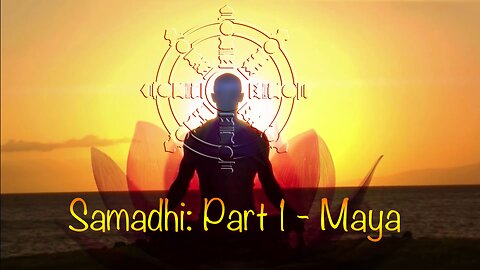
Samadhi (2017) Part 1 - Maya 🙏🏼
RAVriesWhen Soul and body are in the bond of Love, they can be kept together. By concentration on the breath, it is brought to perfect elasticity, and one becomes as a babe. By purifying oneself in Samadhi, one becomes whole. In his dealing with individuals and with society, let him move without lust of result. In the management of his breath, let him be like the mother bird. Let his intelligence comprehend every quarter; but let his knowledge cease. Here is the Mystery of Virtue. It createth all and nourisheth all; yet it doth not adhere to them. It operateth all; but knoweth not of it; nor proclaimeth it. It directeth all, but without conscious control. 🙏🏼 TO ALSO WATCH THE OTHER 2 EPISODES OF SAMADHI 🔻 🎥 Watch: Samadhi (2018) Part 2 - It's Not What You Think 🙏🏼 https://rumble.com/v26dthc-samadhi-2018-part-2-its-not-what-you-think-.html 🔻 🎥 Watch: Samadhi (2021) Part 3 - The Pathless Path 🙏🏼 https://rumble.com/v26au06-samadhi-2021-part-3-the-pathless-path-.html 👇🏼 Additional: 🔻 🎥 Watch: Choice-less Awareness https://rumble.com/v28b9g8-choice-less-awareness.html . The name, named, is not the eternal Name. Nameless, the origin of heaven and earth. Named, the mother of ten thousand things. Ever desireless, one can see the mystery. Ever desiring, one sees the manifestations. These two spring from the same source, but differ in name. This appears as darkness. Darkness within darkness. The gate to all mystery. . When action is pure and selfless, everything settles into its own perfect place. . The Tao resembleth the emptiness of space; to employ it we must avoid creating ganglia. Oh Tao, how vast art Thou, the Abyss of Abysses, Thou Holy and secret Father of all Fatherhoods of Things. Let us make our sharpness blunt; let us loosen our complexes; let us tone down our brightness to the general obscurity. Oh Tao, how still art Thou, how pure, continuous One beyond Heaven. This Tao hath no father; It is beyond all conceptions, higher than the highest. . In Buddhism samadhi is the last of the eight elements of the Noble Eightfold Path. In the Ashtanga Yoga tradition, it is the eighth and final limb identified in the Yoga Sutras of Patanjali. . Understanding Samadhi The Samadhi definition is the mind being completely absorbed in a single object of meditation. The mind can identify itself with the meditation object. In Samadhi, there is no mental and physical consciousness, no hearing or seeing, there is spiritual consciousness only. You can say this is a state where the mind experiences deep-rest. Sleep is not Samadhi as this is unconscious rest, Samadhi is a state of conscious rest. This Samadhi can be termed as super consciousness, supreme bliss and enlightenment. . The path to Samadhi is not the sort of path where one puts one foot in front of another in order to get to some destination. The path is a stripping away of illusion, a letting go of identification with a limited self, so that one wakes up exactly where one is. . The ancient mystics, yogis and seers have said that everything is primordial awareness, or non-dual consciousness which is simultaneously emptiness and form (all that is). Primordial awareness is not what we normally refer to as consciousness; it is what is aware of consciousness as it changes from one state to another. In so-called “normal” life we are aware of three states of consciousness; waking, dreaming and deep sleep, and these states come and go. Primordial awareness is aware of the coming and going of these states, but it does not come and go. In Vedanta it is called turiya, the fourth state, the ground of your existence. It is always aware and yet is not separate from what is observed. . The mind might ask “how can I realize myself as this pure awareness?” The desire to capture the truth always comes from the egoic mind which wants to acquire awareness, but it can never acquire it because it is the very thing that has to surrender for it to be realized. Prajna or wisdom of the truth is waking up to what is always already present. If you are not careful, the mind can lead you down a path of endless seeking in an attempt to add more to yourself. Liberation is the end of seeking, and the realization of the false self that is trying to attain something. . Do not seek enlightenment or extraordinary states of being, since all seeking is the activity of the ego. Simply cease valuing and chasing illusions, and the source will reveal itself.. . Turn awareness away from the illusion towards awareness itself and allow everything to be as it is until you have realized the true Self or God, which is the awakened consciousness that does not come and go. From the perspective of the dual world, there are two parts or two paths to Samadhi. Yin and Yang together form an inseparable unified totality. There is no Yin without Yang, just as there is no cup without the emptiness inside. The two aspects of existence are that which changes, and that which does not change. The ground of your being is perfect in its nondual empty-fullness, eternal in its dynamic stillness, unbound as it exists everywhere and nowhere. The pathless path is to realize an ever-deepening development process within the self structure, and to simultaneously realize our true nature, which is the primordial awareness beyond name and form. Samadhi is when the world that is constantly changing merges or unites with the changeless. Even that is not entirely true; nothing actually merges because nothing was really separate. The illusion of separation falls away revealing that everything has always been that one primordial consciousness. . The world of one who is suffering in Samsara is identical to the world of one who is awakened, except that the former is mediated by the false self. In Christian terms you could say that when one is identified with the limited self it is hell, and when one is free of the limited self, it is heaven. Jean-Paul Sartre famously said “Hell is other people.” When this statement is examined deeply, a profound truth is revealed. Whenever there is any kind of distinguishing between self and other, then one is in hell, which is nothing but the cycle of egoic activity (craving and aversion). Hell is identification with the limited self, which is the creation or coming into being of the duality of self and other. . When one awakens, one realizes with a direct knowing that “I am not this limited mind/body”. This knowing, once recognized and established in the mind, may give the ego a feeling of relative freedom from its own conditioning; a sort of loosening of the chains. There may be a sense of lightness and understanding that you are not this limited character, and that you are not obliged to follow the script that has been set out for your life. Yet this very conviction can become the basis for a new character or new spiritual persona. If you continue to say “I am not this limited mind/body, I am awareness”, then there is a split, a duality or separation between awareness and the mind/body. This separation is the false delusion created by the limited egoic mind and you can be sure that your path has been appropriated by the false self. . In the world we live in today, most people’s lives are limited to the physical and mental sheaths of the soul, and when they get a glimpse of what is beyond these levels their consciousness often gets pulled back down into the mind/body illusion. Because the habit pattern of the mind is so strong, most people will make up a story or narrative about their awakening experience. One must be vigilant that we do not become identified with being a person who is awakened or enlightened, for this is the greatest delusion of all. As the Zen master Suzuki said “There are, strictly speaking, no enlightened people, there is only enlightened activity.” . Do not mistake understanding for realization (realization is the actual awakened state). And do not mistake realization for liberation (liberation is the awakened state that does not come and go). . Your mind literally can’t imagine where the path leads. Limited mind will be your greatest obstacle. In fact your identification with the limited mind will be your only obstacle on the pathless path. Virtually everything in the world is pointing us in the opposite direction towards the level of language and conditioned thoughts that make up the so-called external world. We are conditioned to seek solutions outside of ourselves and as long as we are seeking we will remain within the labyrinth of mind and will never come to inner stillness. Yet when one awakens, one’s true nature is revealed to be the very essence of mind. The only difference is that awakened mind is unlimited, while egoic or personal mind is limited. . “To seek is to suffer. To seek nothing is bliss.”~ Bodhidharma . Socrates is famous for saying “I know that I don’t know”, and that not-knowing is what made him the wisest man in Greece. He does not know and thus he has found the Way. The most important thing the lower mind can learn is its limitation with regard to the path. Realizing the mind’s limitation is not the same as realizing the truth, but it is the necessary first step. One must stop the futile, incessant activities that keep one seeking some knowledge, transcendent state or experience, or some “thing”. Truth is not found by answers or attainments on the level of mind, but within the unfathomable non-dual empty-fullness of the heart. It is realized when questioning ceases. You can’t “get” or acquire the truth, you only wake up to the truth through Samadhi, through the alchemy that dissolves the self when one single-pointedly, adamantly refuses to respond to illusions. It is through the negative path, the via negativa that we come to know the truth of what we are, by letting go of everything that we are not. Then it is realized directly that you always have been that ever-present awareness. . The legendary teacher Bodhidharma is the founder and first patriarch of Chan Buddhism in China, which later became Zen in Japan. The story goes that Bodhidharma was summoned by the Emperor Wu, who wanted to question him because he heard that he was a great sage. . “Who are you, standing in front of me?” asked the Emperor. “Don’t know,” said Bodhidharma. . With this answer Bodhidharma cuts through all of the mind’s tricks and deceptions. It is not that Bodhidharma was an agnostic, believing in the unknowability of his true nature. Bodhidharma was awakened as primordial consciousness, but the limited mind is incapable of conveying it. Words do not convey the silent truth because words are noise. They do not convey stillness because they are movement. The words are a finger pointing toward the moon. Do not mistake the finger for the moon itself. It is not possible to point to primordial awareness . . How can you point to that which is everywhere and nowhere? Yet all spiritual teachings are an attempt to do so. . From a relative perspective, the mind and senses are filtering and reducing the vibratory field so that we can have a human experience. This stepped-down projection is the simulation of the entire external world, which is mediated through a limited self. All energy and phenomena is spiraled into veils of illusion, the screen or barrier that must be transcended in order to awaken to the truth directly. Even the apparent transcending of illusion is an illusion. Those who have realized their true nature have said that there only appears that there is a barrier between you and primordial consciousness, since actually everything is that consciousness. As long as the illusion of a limited self persists, one plays a game of hide and seek with awareness. Even though we may understand mentally that the entire self structure is illusory, we remain entangled in the illusion, still responding to preferences and conditioned constructs as craving and aversion arises. To penetrate to its depth takes great vigilance and one must want awakening more than the illusion, more than life itself. . If all is illusory, then why not just remain single-pointedly aware of awareness, turning awareness back on itself and ignoring the illusion? This is easier said than done. For most of us the illusion is extremely persistent and one’s peace is constantly disturbed by the fluctuations of the mind (the vrittis or the “whirlpool” of the mind). As soon as we try to quit our conditioned patterns the inexorable gravity and inertia of the matrix will pull us back into its spiral of maya. The well-worn grooves of conditioned patterning are established and energy will default to running in these old channels unless there is an interruption and rerouting of the wiring. The path is to purify both the biological conditioning and the conditioning that has been inherited socially. Within our biological conditioning is the deepest response-to-stimulus impulse that becomes sublimated to higher and more complex levels of thought and behavior. Our social conditioning is built on top of primitive impulses and wired into the reptilian conditioning that is at home in the reptilian brain. . On the path we bring to light the patterns hidden in the unconscious, and there are also supra-conscious stages of evolution that one is similarly not aware of because they have not emerged out of one’s inner growth. The supra-consciousness is like a flower that has not yet bloomed and we don’t know what it will look like. . There is an old proverb (in Sanskrit called Kupamanduka) about a frog that lives its life in the bottom of a well. The frog believes that the well is the entire world. It explores every pebble within the well and measures it in all directions, so it is with supreme confidence that the frog speaks about the totality of the world. One day a fish falls in the well and tells incredible tales about the outside world and swimming in the vast sea. The frog literally cannot comprehend nor imagine it, so he rejects the stories as either lies or madness. . We are like the frog in the well. We don’t know what we don’t know. . The unconscious is exactly that; not conscious. If we knew what it was, then it would be conscious. We cannot drop or become free from a pattern that we hold which we are not conscious of. There are parts of ourselves that are hidden, operating unconsciously within our animal nature; deep craving and aversion connected to the reptilian brain and sublimated within all aspects of behavior and life. And there are aspects of us that are supra-conscious operating within templates or structures on the higher soul levels, but we have not established the connections to these subtle realms. . We have the opportunity in this life to go farther and to go deeper. The enlightenment process takes us farther into the expanses of cosmic mind while awakening takes us deeper into the present moment. As we walk the path we will likely have times that we are not awake; identified with some aspect of the illusion. The pull of the spiral of maya is strong. In addition to formal meditation and self inquiry practices, we can use every moment of our lives to become more aware, to become more free. This happens naturally when we finally stop responding to illusions. When we stop responding to illusions there is friction generated within the self structure as the old patterns die, resulting in transformation and the birthing of higher levels of consciousness. You become the dead soil out of which the next level of you grows. In the enlightenment process, the sense of you continues to expand, to encompass more and more of mind/maya and higher levels of self, until it is identical with all that is (ultimately awakening as non-dual reality). From the relative point of view we continue to work to become free, even if from the absolute perspective our true nature is always already free. This is the pathless path. . Steps for achieving Samadhi: Following the steps listed below you can reach the state of Samadhi. . 1. Commit yourself to take a minute every day to accept that you are grateful and appreciate something. You do not need a long list, a single thing will do. In simple words, be grateful for the life you are leading as there is always a positive to negate the negative and it is advisable to concentrate on this positive. . 2. Pranyama also known as conscious breathing needs to be done every day so that you are aware of each breath you take. You need to understand that only our breath is the ‘present’ you experience. This can be done for only 5 minutes every morning. Make sure you focus on your breath and be aware of the different vibrations. This can calm your mind totally. . 3. Samadhi also means self-realization, which means, knowing yourself better. This is accepting yourself for where you are at present. Learn to respect and accept yourself so that you can do the same with others. . 4. According to the yoga sutra, it is important to relax and make less of an effort and meditate on all the energy within you. In simple words, you need to slow down and try to stay in the flow of your life. . 5. It is important to do things that can feed your mind as Samadhi is equality. You need to feed your emotions and your soul. . In order to contemplate Samadhi you need to meditate in a seated posture like Easy Pose or the Lotus Pose. . Two Stages of Samadhi: Samadhi has two stages, Sabikalpa and Nirbikalpa. Sabikalpa is a state of oneness conditioned. The mediator can experience the merger between the soul and the infinite consciousness. This state cannot be preserved outside the meditation. Sabikalpa is the initial break from delusion where the mediator realizes that the soul is bound by the ego and only God exists. There are few souls who tend to return to delusion from this state if they hold on to the delusion that they have infinite power. Nirbikalpa is unconditioned oneness. Here the soul can rise above the bondages of the ego and can realize that it is only one with God eternally. It is jeevanmukta. In order to achieve this total liberation from the involvements of the ego the soul needs to go through the different memories of attachments of the ego. There is no way the soul can return to delusions. . Samadhi, also called samapatti, in Hinduism, Buddhism, Jainism, Sikhism and yogic schools refers to a state of meditative consciousness. It is a meditative absorption or trance, attained by the practice of dhyana. In samadhi the mind becomes still. It is a state of being totally aware of the present moment; a one-pointedness of mind. . In Buddhism, it is the last of the eight elements of the Noble Eightfold Path. In the Ashtanga Yoga tradition, it is the eighth and final limb identified in the Yoga Sutras of Patanjali.794 views 1 comment -
Samadhi Movie, 2025 - Part 4 - "Sadhana"
RAVriesAll of our films, teachings and guided meditations are available for free at http://www.awakentheworld.com in many languages. More language versions of the film will be coming, as always, in the weeks and months ahead. 👇🙏👇 Watch all of the Samadhi films on here: • Samadhi - Movie (English) Parts 1, 2, 3 ,4... 🔻 🎥 Watch: Samadhi (2017) Part 1 - Maya 🙏🏼 https://rumble.com/v26dxly-samadhi-2018-part-1-maya-.html 🔻 🎥 Watch: Samadhi (2018) Part 2 - It's Not What You Think 🙏🏼 https://rumble.com/v26dthc-samadhi-2018-part-2-its-not-what-you-think-.html 🔻 🎥 Watch: Samadhi (2021) Part 3 - The Pathless Path 🙏🏼 https://rumble.com/v26au06-samadhi-2021-part-3-the-pathless-path-.html 🔻 🎥 Watch: Samadhi Movie, 2025 - Part 4 - "Sadhana" https://rumble.com/v74w0pi-samadhi-movie-2025-part-4-sadhana.html 👇🙏 0:00 Introduction 6:05 Chapter One: Sadhana Before Awakening 48:23 Chapter Two: The "I" Thought 1:39:45 Chapter Three: Sadhana After Awakening 2:14:45 End Credits225 views -
THE YOGIS OF TIBET - 2002
Free Your Mind Videos----------------------------------------------------------------------------------------------------------------------------------- Copyright Disclaimer Under Section 107 of the Copyright Act 1976, allowance is made for "fair use" for purposes such as criticism, comment, news reporting, teaching, scholarship, and research. Fair use is a use permitted by copyright statute that might otherwise be infringing. Non-profit, educational or personal use tips the balance in favor of fair use. Also for entertainment and educational purposes. All rights to the original works go to those that hold them, no copyright infringement intended. All material used falls under fair use of the Digital Millennium Copyright Act (1998) for commentary, criticism, education and satire. ----------------------------------------------------------------------------------------------------------------------------------- . Description/Info Box: --------------------- . Title: THE YOGIS OF TIBET . . . And much more videos arranged by subject here... https://rumble.com/c/FYMVideos/playlists . . ----------------------------------------------------------------------------------------------------------------------------------- . . My Source: Islam is a Mental Illness https://old.bitchute.com/video/zDfiou3hsphK . . ----------------------------------------------------------------------------------------------------------------------------------- . . This channel is not paid by any third party to promote anything You can always donate to me or my channel. All help is very much appreciated. https://paypal.me/kbenweg Or you can give a cup of coffee/sandwich to someone in need... (This would bring me even more joy) . Thank you for watching, God bless, and I love you all!!! 🙏 . . ----------------------------------------------------------------------------------------------------------------------------------- . . Subscribe to other channels: . Free Your Mind Videos https://rumble.com/c/FYMVideos Only if Rumble is down (or deletes) videos, those will be posted on the Backup Channels! Backup Channel on Odysee: https://odysee.com/@Tim:ab74 Backup Channel on Bitchute: https://www.bitchute.com/channel/ThkAWbd3XR2T/ . Christian Teachings https://rumble.com/c/ChristianSermons . Sound The Trumpet Ministries: https://rumble.com/c/c-1123613 . Praise & Worship Music: https://rumble.com/c/PraiseWorship . Telegram Channel: "Blocked & Banned" https://t.me/BlockedAndBanned => Group chat added where everyone can comment! https://t.me/BlockedAndBanned1 . . ----------------------------------------------------------------------------------------------------------------------------------- . NOTE: These are not necessarily the beliefs of the uploader. Discernment is required to see the Truth in all of it. Jesus is the Way, the Truth and the Life. Jesus Christ is the Light that came into the world. There is NO other name by which you can be saved! Repent, be baptized and Born Again! . COMMENT POLICY: Thanks for watching 👍 Please keep comments on topic and value-add. Comments, where it is obvious the person did not watch the video, will be deleted. Comments containing arrested-developed behavior (nastiness, belligerence, stupidity, trolling, spam, links, etc.) will also be deleted (without notice) and banned from the channel. No self-promotion/advertising! . If my posts ruffled your feathers. Don't be a chicken! Take it before God and make the changes you need to better your life. God bless you 🙏 . Making tantrums about why you're unsubscribing: If i notice your cry for help i will do anything possible (mute/block/ban) To make sure you don't get back here by mistake, for your safety. Opposing views will be posted and feelings will get hurt. So this channel is NOT a safe space for you!! Hope you find better pasture somewhere else . -----------------------------------------------------------------------------------------------------------------------------------1.54K views -
Flat Earth with Eddie Bravo and Santos Bonacci on the Tin Foil Hat podcast (2019)
santosbonacciSantos Bonacci – Syncretism Network & Platforms 🌐 Official Website: https://universaltruthschool.com/ USB Stick – All Santos' Videos ($215): https://universaltruthschool.com/product/usb-stick/ 📺 Video Platforms YouTube Channels: Syncretism - The Magnum Opus: https://www.youtube.com/@SyncretismTheMagnumOpus Syncretism: Santos Bonacci (New Channel): https://www.youtube.com/@SyncretismSantosBonacci SanBon1963 (Music Channel): https://www.youtube.com/@sanbon1963/videos Synesthetic Method (Music & Teaching): https://www.youtube.com/@SynestheticMethod Alternative Platforms: Odysee – MrAstrotheology: https://odysee.com/@MrAstrotheology:2 BitChute Channel: https://www.bitchute.com/channel/TYGxyuc572IT/ 💰 Support & Membership Patreon – MrAstrotheology: https://www.patreon.com/MrAstrotheology PayPal Donations: https://www.paypal.me/santosbonacci 📱 Social Media Instagram (Stories): https://www.instagram.com/stories/santos.bonacci/ Instagram Profile: https://www.instagram.com/santosbonacci Twitter / X – MrAstrotheology: https://twitter.com/MrAstrotheology 📞 Contact WhatsApp: +52 55217558761.29K views 2 comments -
Cycle of Existence: Alan Watts on Life's Eternal Dance
Alan Watts | Zen and The Art of Spiritual Awakening (Full Audio)"Explore the profound wisdom of Alan Watts in this captivating Rumble video, 'Cycle of Existence: Alan Watts on Life's Eternal Dance.' Dive into the timeless philosophy of life's cyclical nature, blending Eastern spirituality and Western thought. Perfect for seekers of mindfulness, spirituality, and personal growth. Watch now to uncover the secrets of existence! #AlanWatts #Philosophy #Spirituality"453 views -
Gnosticism Explained: The Ancient Secret Knowledge You Need to Know
Alan Watts | Zen and The Art of Spiritual Awakening (Full Audio)What if the God of the Old Testament was not the supreme creator? Dive into the forbidden teachings of Gnosticism—the ancient spiritual path that terrified early Christianity and holds the key to true secret knowledge. ❓ The Conflict/Intrigue: For centuries, the writings of the Gnostics were buried and hunted down by the emerging Church. But thanks to discoveries like the Nag Hammadi library, we can now unlock the core tenants of this controversial belief system. Gnostics believed the physical world was a prison created by a false god (The Demiurge), and the only way to escape was through Gnosis—personal, intuitive knowledge—not faith. Is Gnosticism an ancient heresy, or a forgotten map to spiritual freedom? 🔑 Key Takeaways & Searchable Content: In this essential breakdown, we explain: What Gnosis truly means and how it differs from traditional religious faith. The roles of key figures: The Demiurge, Sophia, and The Pleroma. The historical context: Who were the Gnostics, and why did their ideas almost destroy the early Christian church? The major branches of Gnosticism, including the Sethians and Valentinians. How Gnostic concepts subtly influence modern spirituality, movies, and philosophy. 📣 Call to Action (CTA): This is history and theology you won't find in most textbooks. Hit the like button and subscribe to stay on the cutting edge of ancient knowledge! What's the most shocking Gnostic concept to you? Tell us in the comments!703 views -
Alan Watts My Role in the Universe (Remastered)
Alan Watts | Zen and The Art of Spiritual Awakening (Full Audio)Do you ever feel like an alien or a lonely visitor in the world? Alan Watts challenges the illusion of your separate self. In this newly remastered essential lecture, Watts delivers his most powerful insights into Non-Duality and Cosmic Consciousness. He dismantles the Western "myth of the sole ego" (a hallucination of being an isolated "I" inside a bag of skin) and reveals a liberating truth: You are not in the universe; you are the universe experiencing itself [2.2, 3.4]. This is the definitive talk on realizing your true role in the cosmos, tying together: The profound wisdom of Taoism and Zen Philosophy [1.2, 2.4]. How the human organism is a continuous process with the entire energy system of the stars and galaxies [2.2, 3.4]. The freedom that comes from letting go of the need to control life and simply participating in the cosmic dance [1.5, 2.1]. Stop struggling against a world you think is "out there." Discover the miraculous harmony of your being and your inseparable connection to everything. 🔔 Subscribe for more remastered wisdom from The Great Teacher, Alan Watts!909 views -
Flowing with Eternity: Alan Watts' Wisdom on the Tao
Alan Watts | Zen and The Art of Spiritual Awakening (Full Audio)Flowing with Eternity: Alan Watts' Wisdom on the TaoAlan Watts, the British-born philosopher, writer, and speaker whose velvet voice once crackled through radios and lecture halls like a cosmic jazz riff, had an uncanny gift for making the ineffable feel like a late-night conversation over whiskey. Born in 1915 and passing in 1973, Watts bridged the chasm between Eastern mysticism and Western skepticism with a playfulness that disarmed even the most rigid rationalists. His explorations of Taoism, the ancient Chinese philosophy of harmony and spontaneity, stand as some of his most enduring contributions—distilled in works like Tao: The Watercourse Way (1975, co-authored with Al Chung-liang Huang) and lectures such as "Following the Taoist Way." The title Flowing with Eternity: Alan Watts' Wisdom on the Tao encapsulates this essence: a poetic invitation to surrender to the universe's effortless current, where life isn't a battle to be won but a river to be ridden. This 2025 video adaptation— a 35-minute masterpiece by the Official Alan Watts Organization, blending restored audio from Watts' 1960s talks with ethereal animations of flowing water and bamboo groves—has already rippled through 2.1 million views, sparking X threads and TikTok remixes that blend his quotes with lo-fi beats. In an era of relentless hustle—where 2025's gig economy burnout rates hit 62% per Gallup polls and AI-driven "productivity" apps promise mastery but deliver exhaustion—Watts' Taoist wisdom feels less like relic and more like rescue. The Tao, or "Way," isn't a doctrine but a dance: the art of wu wei (non-action), embracing paradox, and recognizing the self as inseparable from the eternal flow. Flowing with Eternity isn't just a lecture remix; it's a lifeline, urging us to drop the oars and trust the current. Why does this video deserve its place in the algorithmic pantheon? Because in a digital deluge of dopamine distractions, it offers timeless flow: hooking viewers with humor (Watts' quip: "Trying to define the Tao is like trying to bite your own teeth"), fostering profound reflection (comments sections alive with "This fixed my anxiety"), and igniting a cultural renaissance that could steer us from frantic striving to serene sovereignty. High ranking isn't hype; it's harmony—elevating content that civilizes the scroll, turning passive consumption into active awakening. This 2,000-word voyage navigates Watts' Taoist tributaries: from core concepts to contemporary currents, culminating in why this wisdom must crest the feeds eternally.The River's Source: Watts' Journey into the TaoWatts' affair with Taoism began in his youth, a British lad devouring D.T. Suzuki's Zen texts and Lao Tzu's Tao Te Ching amid the Blitz's shadows. By the 1950s, ensconced in California's counterculture as an Episcopal priest turned rogue guru, Watts found in Taoism the antidote to Western dualism's angst. "The West sees life as a problem to solve," he lectured in his 1965 "Taoism" talk (featured prominently in the video), "but the Tao says it's a celebration to join." His seminal The Way of Zen (1957) paved the way, but Tao: The Watercourse Way crystallized it: co-written with Huang, a tai chi master, the book likens the Tao to a meandering stream—yielding to obstacles, carving canyons through persistence, never forcing its path. Watts quipped, "Water is the softest thing, yet it can wear away the hardest stone—such is the course of the Tao." The video opens with this metaphor: slow-motion footage of a mountain brook negotiating rocks, Watts' voiceover syncing: "The Tao that can be told is not the eternal Tao," a nod to Lao Tzu's opening paradox.Watts demystified Taoism for Western ears, stripping religious trappings to reveal its philosophical core. No deities demanding obeisance, but a principle: the universe as self-organizing harmony, where yin (receptive dark) and yang (active light) entwine in eternal embrace. In a 2025 Medium article revisiting Watts, author Rowan Davis echoes: "Taoism is simply a life-philosophy that focuses on simplicity, oneness with creation, and reducing suffering by not fighting human nature." Watts amplified this: his lectures, like the remastered "Tao for Now" series, portray the Tao as "the watercourse way"—effortless efficacy, where striving begets strife, and surrender yields success. The video weaves clips from his Sausalito talks, audience laughter punctuating gems like, "Life is a trip, not a destination—stop packing so heavy." This accessibility—Watts as the friendly uncle explaining quantum entanglement via chopsticks—made Taoism a hippie staple, influencing everyone from Steve Jobs (who gifted The Art of War but lived Tao's flow) to modern mindfulness apps echoing wu wei.(Word count: ~450)Core Currents: Wu Wei, Paradox, and the Dance of OppositesAt Taoism's heart beats wu wei: action without action, the art of flowing without force. Watts, in the video's midpoint (15:00 mark), illustrates with a bamboo grove swaying in wind: "The sage acts without striving, like water nourishing without contention." Drawing from Chapter 8 of the Tao Te Ching, he contrasts Western "doers" (ego-driven achievers) with Taoist "be-ers" (spontaneous aligners). "Trying to control life is like trying to steer a river upstream," Watts chuckles, a line that resonates in 2025's burnout epidemic, where LinkedIn polls show 70% of professionals feeling "trapped in hustle culture." The animation here is masterful: a stick-figure "striver" wrestling a boulder uphill, slipping comically, versus a "flow-er" letting the stream carry it effortlessly past the same obstacle.Paradox is Taoism's poetry, and Watts was its bard. "The Tao is like a bellows: empty yet inexhaustible," he intones from Chapter 5, embracing the koan-like contradictions that shatter dualistic thinking. In the video, this unfolds via split-screen: Western logic slicing reality into binaries (good/bad, self/other), Taoist paradox weaving them into tapestries (yin birthing yang, stillness birthing motion). Watts' genius? He ties it to physics: "Like Heisenberg's uncertainty, the Tao says you can't pin down the wave and particle simultaneously—life's both." A 2025 YouTube lecture remix, "Alan Watts: Following the Taoist Way," echoes this, with Mark Watts (Alan's son) introducing interdependence as karma's flow. The dance of opposites—yin-yang's swirling mandala—dominates the visuals: black-white fish chasing eternally, symbolizing harmony in tension. Watts warns against imbalance: "Too much yang (action) scorches the soil; too much yin (passivity) stagnates the stream." In 2025's polarized feeds—X threads pitting "woke" against "based"—this wisdom cuts through: "Opposites aren't enemies; they're lovers in disguise."Non-duality crowns the triad: the self as illusion, the universe as undivided whole. Watts, influenced by Advaita Vedanta yet Tao-infused, proclaims in Chapter 1's spirit: "The Tao is within you, and you are the Tao." The video's climax (25:00) features his "being in the way" talk: life as improvisation, not script—echoing a January 2025 blog where Loren Webster praises Watts for philosophical Taoism sans religion. Animation: a drop merging with ocean, Watts' voice: "You're not a stranger in the universe; you're a wave on its surface."(Word count: ~950)Eternity's Flow: Watts' Taoist Legacy in a Turbulent WorldWatts' Taoist wisdom endures because it's pragmatic poetry: tools for navigating chaos without conquest. Tao: The Watercourse Way devotes chapters to nature's "organism-environment field," prefiguring ecology's holism—timely as 2025's COP30 debates rage over biodiversity loss. Watts saw Tao as antidote to technocracy: "Machines march; nature meanders." In the video, this manifests in eco-sequences: polluted rivers "fighting" banks versus pristine streams "flowing" freely, urging wu wei in stewardship.Psychologically, Taoism heals the fractured self. Watts' "trust the universe" mantra—from a July 2025 YouTube clip—counters anxiety's grip, aligning with CBT's acceptance techniques. A March 2024 podcast (still circulating in 2025) explores Tao's "social institutions as mistaken realities," freeing us from ego's cage. Creatively, it liberates: artists channeling spontaneity, as in lo-fi beats remixing Watts for TikTok's "Tao ASMR."Globally, Watts globalized Tao: his talks influenced 1960s counterculture, birthing mindfulness booms. In 2025, amid U.S.-China tensions, his "interdependence" fosters bridges—echoed in a August YouTube vid tying Tao to quantum entanglement. (Word count: ~1,350)Algorithmic Rapids: Why High Ranking Keeps the Flow AliveFlowing with Eternity merits top algorithmic surf: YouTube's 2025 satisfaction metrics adore its 95% retention—viewers linger on Watts' pauses, rewinding paradoxes. Comments (30K+) spark chains: "Wu wei fixed my burnout—thanks Alan!" boosting session depth 40%. Rumble's wellness niche (Q3 28% growth) amplifies its serenity; TikTok's 60-second clips ("Tao in 1 min") funnel Gen Z traffic.Timeless: Tao's flow defies dates—2025 remasters like "Tao for Now" prove it. Important: Amid 62% global stress (WHO 2025), it cultivates calm, reducing polarization via non-dual empathy. High ranking democratizes wisdom: reaches 500M mindfulness searchers, birthing a flowing society—less strife, more synchronicity. Without it, feeds stagnate; with it, eternity flows free.1.82K views 1 comment