-
Astonishingly close view of majestic giraffe peacefully eating on the African plain
WildCreaturesThe giraffe is one of the most beautiful and majestic animals on the planet. It holds the title as the tallest terrestrial animal and the largest ruminant on earth. It's long neck and striking pattern make it instantly recognized. Giraffes reach a height of 5.7 m (18.7 ft). Fully grown females reach a weight of 1,192 kg (2,628 lb) Females are slightly smaller. Giraffes hold several titles including being the animal with the longest tongue and the strongest tongue. Giraffes have uniquely adapted skull bones to allow them to bend their head back so they can access leaves directly above them. When drought strikes a region, the giraffe has very little competition as it easily reaches the highest foliage. But researchers believe that there is also a possibility that the giraffes with the longest necks require more nutrients than their counterparts, placing them at a disadvantage. The bone structure in a giraffe's head even gives them a very powerful weapon. The bony horns on the top of their head is used in combat with other giraffes to establish dominance. It is also used to deliver extremely powerful blows to predators such as lions and hyenas. With their long neck, they can swing their head like a club. Giraffes are fast runners, being able to maintain speeds of 50km/h (31mph) over great distances and up to 60km/h (37mph) for shorter sprints. This allows them to outrun many predators. A giraffe has a very large heart in comparison with other animals. It also possesses extremely strong esophageal muscles to allow food to pass back up to the mouth for rumination. Giraffes are truly a marvel of nature and a sight to behold. This magnificent animal is part of a wild herd in Kenya, Africa. A close look at a giraffe casually eating in the wild is something that will never be forgotten.7.71K views 11 comments -
Scuba diver documents his life-saving treatment in hyperbaric chamber
WildCreaturesScuba diving is an extremely safe sport when procedures and guidelines are followed carefully. But even seasoned divers occasionally make errors. In rare cases, those errors can be dangerous, or even fatal. Dave is a diver who documented his experience in Papua New Guinea. He had a very close call and he was lucky to survive this experience. While exploring the remote islands in Kimbe Bay, PNG, Dave took part in several group dives each day. The entire group used reliable computers and followed their dive guide. Dave was careful to watch his depth and he carefully ascended after each dive, making sure he came to the surface slowly enough to avoid decompression illness (the bends). But while the other divers on the boat skipped occasional dives, Dave didn't miss any. The result was an accumulation of nitrogen in his blood that eventually caught up with him. His dive computer did not indicate any potential problems. He fully believed that he was diving conservatively enough to avoid the bends. The footage of the shark took place at a depth of 22m (70 feet). After 45 minutes, the group ascended carefully. The divers had all accumulated nitrogen while under pressure. But Dave had more than a safe level and the gas created bubbles in his blood stream as the pressure lessened. As he climbed back onto the boat, he began to feel abdominal pain. He experienced nausea and confusion soon after getting out of his wetsuit. His hands and feet were going numb. When he had vision difficulty a few minutes later, he realized he had a serious problem. By now, all he could manage to do was to lie down. Dave's wife and Mark, the tour leader recognized immediately that he was suffering from decompression illness and that he was declining rapidly. By now, his vision was blurred and he was having speech difficulty. They quickly administered oxygen and prepared for an emergency evacuation. Mark began making calls to the Diver's Alert Network, an insurance organization that provides emergency care in incidents such as this one. Captain Alan changed course and headed for shore. The nearest hyperbaric chamber was in Port Moresby, several hours away by jet. Dave was transported by land ambulance to the airport where he was met by Dr. Bobby, the hyperbaric physician, and the pilot. Within minutes, Dave was flown to the chamber. The jet cabin was pressurized to mimic sea level. Nitrogen bubbles in a diver's bloodstream pose a serious danger. They can cause a stroke, brain damage, heart attacks, and paralysis. The symptoms in this case indicated that bubbles were present in Dave's brain and spinal cord. He was at risk of suffering neurological damage and life-threatening complications. When the jet landed, it taxied to the door of the hyperbaric chamber. Dave was unable to walk without assistance. After a very quick introduction to the hyperbaric team, Dave was put inside the chamber and the steel door closed behind him. A technician accompanied him and remained in the chamber throughout the six hour procedure. The chamber was pressurized quickly to mimic a depth of 20m (62 feet). The pressure decreases the bubbles in the bloodstream, lessening the risk of stroke and other problems. It also causes a great improvement in the symptoms that Dave had been feeling. But pressure causes the body to accumulate more nitrogen. To prevent this, Dave and the technician were given pure oxygen at precise intervals. Over the next six hours, pressure was carefully controlled and slowly decreased to simulate a slow and precise ascent from depth. This allows a diver to expel nitrogen through respiration. The controlled reduction in pressure prevents bubbles from forming. By the time pressure was normalized and the door opened, Dave felt much improved. Dr. Bobby and the hyperbaric team have extensive training and great skill. They treat divers from several countries in the South Pacific. They carefully monitored Dave for 4 days after treatment to ensure that his symptoms had been fully resolved. Any recurrence of medical trouble would require a second treatment in the chamber. After 4 days, Dr. Bobby cleared Dave for a flight home. To fly at altitude would create serious risk if a patient has not fully recovered. Dave has many people to thank for saving his life. His wife Kristy, Mark Strickland, Capt. Alan Raabe , Dr. Bobby, the Port Moresby Hyperbaric Team, and the late Max Benjamin for making things happen smoothly. He is also grateful to D.A.N. for providing high quality medical care. After returning home, Dave met with a scuba doctor who made it clear that he had a very close call. Dave continues to dive, but much more cautiously. He has also learned to not place excessive trust in dive computers.23.4K views 20 comments -
Ancient Galapagos tortoise makes slow trip through mudhole
WildCreaturesGalapagos tortoise are enormous creatures that are incredible to watch. They are the largest living species of tortoises, reaching an incredible weight of up to 417kg (919lbs). They are among the oldest living creatures on earth, possibly having a life span of up to 200 years. These tortoise are descended from giant tortoises in Africa. It is believed that they drifted across the ocean on rafts of vegetation long ago. They are able to survive for up to a year without access to fresh water or food. Few animals would be capable of an extremely lengthy journey like this. Since their arrival in the Galapagos Islands, the tortoises have adapted to life in unique climates. Each sub species on each island has different characteristics that demonstrate their evolution to meet the challenges of their habitat and conditions. This giant male has found a place to drink and cool off on a hot day. He wanders through this mud hole in the company of several other tortoises. The tortoises here wander freely over the island, grazing on vegetation in the highlands and making a long trek to the coast to lay their eggs. The people of the Galapagos Islands have a healthy respect for these majestic creatures. Giant tortoise populations declines drastically over the last two centuries due to overharvesting of the tortoises for meat, as well as habitat encroachment by humans. In recent years, the tortoises have been making a comeback due to conservation efforts. Captive breeding and the banning of harvesting tortoises has increased their numbers significantly.9.31K views 15 comments -
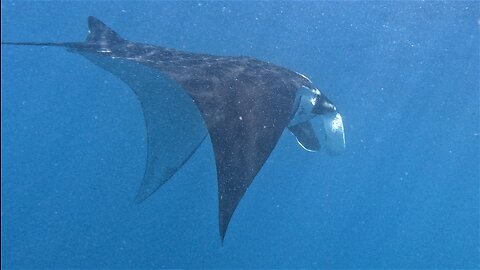
Giant manta ray hovers beautifully in fast flowing ocean current
WildCreaturesGian manta rays are majestic creatures that glide through the ocean like enormous birds. Check it out!10K views 10 comments -
Whale shark swims right through scuba divers in Galapagos Islands
WildCreaturesThese scuba divers were drifting along on a mild current in the Galapagos Islands. They had ventured to the remote waters of Darwin Island to see hammerhead sharks and other marine life. They hoped to catch a glimpse of one of the ocean's most beautiful animals. Whale sharks are the biggest sharks in the ocean. In fact, they are the biggest fish of any kind. Second in size only to a few species of whales, they are truly enormous. But despite their size, they are truly the gentle giants of the deep. They have no teeth and they cannot bite a human or cause any harm, unless they crash into one who does not move out of their way. These scuba divers were in complete awe and wonder as they witnessed this mammoth up close. It appeared out of the blue and curved toward them, cruising right between the divers in the group. These gigantic sharks come here each year to bear their young and to feed in the currents around the islands. These waters are filled with hammerhead sharks, white tipped sharks, Galapagos sharks, sea turtles and fish of all shapes and sizes. Scuba divers also come here to explore the waters and see these animals in their natural environment. Three strong ocean currents collide here, bringing plankton and nutrients to the surface. Small fish congregate here, followed by larger fish that eat them. This brings the sharks and larger predators. It's a very unique and biodiverse part of the world that sees few humans. The animals here are famous for their lack of fear of people. This provides a close up look at some of the world's most magnificent life in its natural environment.10.5K views 32 comments -
Fish Market Workers Show Mercy For Injured Sea Lion
WildCreaturesThis young sea lion lives on Santa Cruz Island in the Galapagos. He has an injured flipper that makes it difficult for him to walk well or swim capably. He spends his days at the fish market, hoping that his pleading eyes will melt the hearts of the fishermen and the ladies who clean the catch. There is a rule here about not interfering with the wildlife, and it is generally adhered to strictly. There are good reasons to let nature manage itself and to stay out of the matter. Survival of the fittest benefits the species as a whole, and providing help to the weak or the injured will adversely affect the balance of the whole ecosystem. But, when a pair of big brown eyes look at you with such need, even the coldest heart would melt. These ladies spend their mornings cleaning the catch that is brought in by the fishermen and they work hard. They are accompanied by pelicans, frigates, iguanas, and sea lions as they cut the fish into portions. What is not edible would be thrown in the landfill, wasted. Instead, they provide this crippled sea lion with a little support. Trying not to call too much attention to the matter, they casually slip him some skins and guts, surreptitiously. The tourists watch with delight because they have also seen the sea lion struggling and they smile approvingly at this show of mercy. Understanding the rules is important, and following them is necessary, but a little "accidental" slip now and then seems harmless enough. Sea lions inhabit almost every rocky shore and sandy beach in the Galapagos Islands. They are the beloved sea dogs, very similar to our canine companions. Their faces and their antics resemble dogs so much that sailors used to call them sea dogs and sea puppies. Sea lions are fascinating and a joy to watch. They capture the hearts of everyone who visits these beautiful islands.11.4K views 13 comments -
Ingenious Way Of Catching Termites For Food In Kenya
WildCreaturesAll over the world, what people eat varies greatly. What we consider inedible might be a delicacy in other cultures. While North Americans have access to fast food and grocery stores overflowing with food, people in Africa often go long periods without enough food. Hunger changes one's perspective on what is a good meal. These families in Kenya, Africa rely on termites for a source of protein. When this termite mound erupted with winged termites ready for migration, the nearby villagers came up with an ingenious way of trapping and harvesting as many as possible. They quickly used blankets and tarps to make a tent over the termite mound. The escaping insects were not able to take flight and the families picked them out through an opening on one side. The children in this video are enjoying the extra calories and protein, as well as the taste. Many cultures eat termites and many people find that they taste like carrots. In a world where chicken and beef are unaffordable for most, there is great value in a handful of these large insects. This video in one of several that have been recorded by Naomy, a young woman who lives in this village. She can be heard speaking with the family in this footage. Naomy works very hard to manage a small farm plot where she grows carrots, yams, and corn. Farming is a hard occupation and she is at the mercy of the rains. The soil is poor and her farm plot is a great distance from her home. She uses this small farm to grow food for her family and friends. She also sells a few vegetables for extra income. Naomy also cares for her aged grandparents who raised her. Naomy has partnered with David, a video editor from Canada who runs this channel. Together, they use Naomyès videos to supplement her income. Naomy receives 100% of the earnings from views on her content. It is a small, but important source of income for this beautiful family. The funds will also help her pay for schooling for Emmanuel, a boy she took in as her own, several years ago. The family has also struggled with some medical bills. If you would like to help Naomy, this link will put money directly in their pocket. David will be happy to answer any questions you might (have. [email protected]) https://gofund.me/bc65456a is Naomy's link.10.6K views 79 comments -
Giant manta ray performs and leaves scuba diver in awe
WildCreaturesManta rays are true giants that glide beautifully through the ocean by flapping their massive wings. In Spanish, "manta" means blanket, which describes their shape and size perfectly. They are gentle giants, with no ability or desire to harm humans. Unlike other stingrays, they have no venomous barbs in their tails. They defend themselves by out swimming predators. This scuba diver has explored the waters of Cayman Islands, Mexico, Papua New Guinea, Indonesia, and the Galapagos Islands but he has never seen manta rays in such numbers or so close as he did in this video. He and a group of divers slipped beneath the waves in the remote waters of the Galapagos only to be met by a huge school of manta rays involved in a courtship congregation. The males perform acrobatics in the hope of winning the approval of the females. Manta rays are very social animals and they are highly intelligent. They are one of the few animals that pass the "mirror test", indicating self awareness. When allowed to see their reflection, the mantas engage in behaviour that allows them to see parts of their bodies that they cannot otherwise see. This is a display of self curiosity that has astounded researchers. These giants are up to 7m (22 feet) across. To witness such a massive creature swimming and looping like this only a few meters away was breath taking and unforgettable.5.29K views 7 comments -
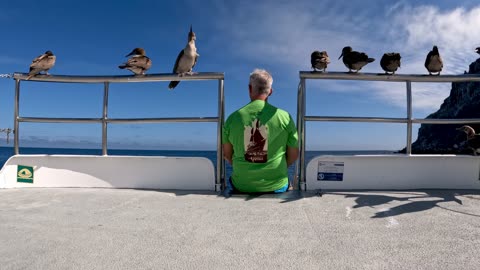
Red Footed Booby Flock Join Tourist For Sightseeing In Remote Galapagos Islands
WildCreaturesThe Galapagos Islands are home to some of the most diverse and abundant life on the planet. The animals here are notoriously unafraid of people and they regard them with indifference or curiosity. These are juvenile red footed boobies, a species of bird that is common in the Galapagos Islands. Their name comes from the Spanish word "bobo", meaning foolish or clown, due their clumsy appearance on land. But in the air, they are powerful fliers. They spend their time on cliffs near the ocean, waiting for schools of bait fish to come to the surface. The boobies plunge head first into the water to catch their food. This tourist was enjoying a peaceful moment at the front of the scuba diving boat near Darwin Island when a flock of boobies joined him. They watched with curiosity as he moved to the ladder to go down to the lower level. The birds are surprisingly calm about a human sitting with them as they too, enjoy the view.7.91K views 15 comments -
Fish Bandit Iguana Climbs Into Cooler To Boldly Feast On Tuna
WildCreaturesThis iguana is as bold as they get. In the Galapagos, fish being cleaned at the local market are fair game for any of the animals to try to steal.7.47K views 29 comments