-
Israeli Amb to the UN: Be Skeptical Of Iran
Mr Producer MediaDanny Danon: "I'm very skeptical because they continue to keep threatening Israel and the United States instead of actually understanding that they have to come with proposals and ideas and with compromises."516 views 1 comment -
Iran army reports fire at Tehran barracks
Question EverythingIran army reports fire at Tehran barracks https://x.com/TheInsiderPaper/status/2019882701936058743?s=20341 views -
Large fire at a reported cold storage facility under construction in northwestern Iran
Question EverythingLarge fire at a reported cold storage facility under construction in northwestern Iran235 views -
MUAMMAR GADDAFI’S SON SAIF AL-ISLAM GADDAFI ASSASSINATED
Question EverythingMUAMMAR GADDAFI’S SON SAIF AL-ISLAM GADDAFI ASSASSINATED https://x.com/afshinrattansi/status/2018792503840022541?s=20277 views -
Iranian MP Amir-Hossein Sabeti called for ending negotiations and urged pre-emptive strikes
Question EverythingIranian MP Amir-Hossein Sabeti called for ending negotiations and urged pre-emptive strikes on Israel and U.S. bases in the region. https://x.com/Osint613/status/2018739927282774304?s=20254 views -
Massive fire has broken out at the Jannat Market in west Tehran, Iran
Question EverythingMassive fire has broken out at the Jannat Market in west Tehran, Iran https://x.com/visegrad24/status/2018596454982721658?s=20347 views -
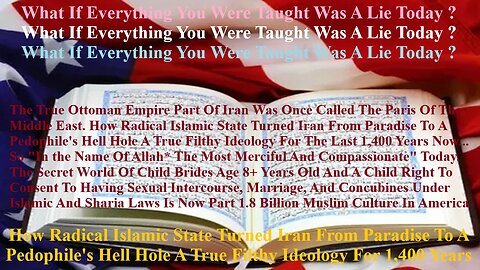
How Radical Islamic State Turned Iran From Paradise To A Pedophile Hell Hole A True Filthy Ideology
What If Everything You Were Taught Was A Lie?The Ottoman Empire Part Of Iran Was Once Called The Paris Of The Middle East. How Radical Islamic State Turned Iran From Paradise To A Pedophile's Hell Hole A True Filthy Ideology For The Last 1,400 Years Now... So "In the Name Of Allah* The Most Merciful And Compassionate" Today. Prophet Muhammad And Caravan Raids Killing And Sex Slaves And Concubines Under Islamic And Sharia Laws. The True Secret World Of Child Brides Age 8+ Years Old And A Child Right To Consent To Having Sexual Intercourse, Marriage, And Concubines Under Islamic And Sharia Laws And Is Now Part Of 20+ Million Muslim Culture In America Today. Before 1979, Tehran had nightclubs, Western universities, a booming middle class, and women walking freely through the streets. It was modern, ambitious, and rising fast. Then came the Islamic Revolution. This video breaks down how Iran fell from a promising global power into a rigid theocracy stripping women of their rights, crushing dissent, and collapsing the economy. From the Shah’s rule to today’s protests, this is a warning about what happens when ideology replaces freedom. A Jihadi Grape Are Teenage UK Or American Girl Muslim Grooming Rape Gangs Criminality Is Its A Filthy Ideology? - https://rumble.com/v724328-jihadi-grape-are-teenage-uk-or-american-girl-muslim-grooming-gangs-criminal.html - Yes Its True Ten Of Millions Muslim Pleasure Child Marriage And Temporary Marriage. So "In the Name Of Allah* The Most Merciful And Compassionate" Today. Legal Prostitution And Rape How Muslim Pleasure Marriage Work A Form Of Temporary Quran Marriage And Shared Wives "In the Name Of Allah* The Most Merciful And Compassionate" Today. The Secret World Of Child Brides Age 8+ Years Old And A Child Right To Consent To Having Sexual Intercourse, Marriage, And Concubines Under Islamic And Sharia Laws And Is Now Part Of 1.8 Billion Muslim Culture In America Today. Does the Quran permit temporary 'mutaa' marriages Temporary 'mutaa marriages' are practiced among some Muslims, especially among those of the Shia sect. These are marriages contracted for a specific period of time after which the marriage is automatically dissolved. The Quran contains at least 109 verses that call Muslims to war with nonbelievers for the sake of Islamic rule. Some are quite graphic, with commands to chop off heads and fingers and kill infidels wherever they may be hiding. Muslims who do not join the fight are called 'hypocrites' and warned that Allah will send them to Hell if they do not join the slaughter. https://web.archive.org/web/20150703113256/http://www.thereligionofpeace.com/quran/023-violence.htm The verse of the Holy Quran is often mentioned to malign Islam. The verse does not say infidels it says idolaters. (9:5) And when the forbidden months have passed, kill the idolaters wherever you find them and take them prisoners, and beleaguer them, and lie in wait for them at every place of ambush. But if they repent and observe Prayer and pay the Zakat, then leave their way free. Surely, Allah is Most Forgiving, Merciful. 'Kill Them Wherever You Find Them (2:191)': What Quran Actually Means By This Command? https://www.newageislam.com/islamic-ideology/by-ghulam-ghaus-siddiqi-new-age-islam/-kill-them-wherever-find-them-2-191-quran-actually-means-this-command/d/102604 The contract for 'mutaa marriages' usually includes a hefty sum of money to be paid to the bride. The money is paid upfront while in some cases half the money is paid upfront and the other half paid if sexual pleasure is attained. Too Young To Wed: But The Secret World Of Child Brides. Throughout the world, more than 51 million girls below the age of 18 are currently married, even though it is outlawed in many developing countries and international agreements forbid the practice. The harmful traditional practice of child marriage spans continents, language, religion and caste. Over an eight-year period Stephanie Sinclair investigated the phenomenon in India, Yemen, Afghanistan, Nepal and Ethiopia. Apart from India, where girls are typically matched with boys four or five years older, the husbands may be young men, middle-aged widowers or even abductors who commit rape first. Some marriages are little more than business transactions: a debt cleared in exchange for an 8-year-old bride; a family feud resolved by the delivery of a virginal 12-year-old cousin. Child marriage denies girls their right to education, restricts friendships with peers and perpetuates the cycle of poverty in their communities. In many cases, young married girls have little power in relation to their husbands and in-laws. They are therefore extremely vulnerable to domestic violence, which may include physical, sexual or psychological abuse. The experience of pregnancy is also traumatizing for a girl who is still a child herself. She is more likely to have obstructed labor as her small body may be compromised during childbirth. The pregnancy death rate for child brides is double that of women in their 20s. It's estimated that over the next decade, 100 million more girls or roughly 25,000 girls a day will marry before they turn 18 if this issue is not urgently addressed. https://christianconcern.com/wp-content/uploads/2018/10/CC-Resource-Report-Grooming-Gangs-Mark-Durie-2511112.pdf What No One Ever Told You About Muslim Women And Need To Know Shocking Hidden Facts - https://rumble.com/v716kya-what-no-one-ever-told-you-about-muslim-women-and-need-to-know-shocking-hidd.html What No One Ever Told You About Muslim Women And Need To Know Shocking Hidden Facts Addressing Misconceptions Women Under Islamic And Sharia Laws. See No Evil, Hear No Evil, Speak No Evil There Is No Freedom Of Religion In Islam Today? Do Men Dominate And Control Women Today? So You Can Not Leave Islamic Religion Or You Will Die Or Be Killed Today? Wake Up Women: A Rights Of A Husband Over His Wife In America Islamic And Sharia Laws Today! - https://rumble.com/v725yfm-wake-up-women-a-rights-of-a-husband-over-his-wife-in-america-islamic-and-sh.html Islam’s Biggest Problem Is? What Is The Islamic Dilemma? Its Own Jesus* Either Way, Islam Is False? - https://rumble.com/v72cxf6-islams-biggest-problem-is-what-is-the-islamic-dilemma-its-own-jesus-either-.html Iranian Woman Has A Fiery Message To The Inbreeding Of Muslim World On Sharia Law! - https://rumble.com/v72nbdm-iranian-woman-has-a-fiery-message-to-the-inbreeding-of-muslim-world-on-shar.html Inbreeding And Rape How 72.6% Cousin Marriages Are Tearing Muslim World Apart - https://rumble.com/v72051e-inbreeding-and-rape-how-72.6-cousin-marriages-are-tearing-muslim-world-apar.html Is it true that if a Muslim leaves or denounces his faith in Islam he will be killed? This is indeed a great question that needs a response because the subject of apostasy is mentioned time and again in the media. The short answer to this question is an emphatic “no”. Let me explain further. Apostasy, or denouncing one’s religion, is unfortunately taken as a punishable offense by many Islamic scholars, even though those who propound this view are unable to quote a single Quranic verse or Hadith to support it. The fact is that while recanting Islam is a sin, there is absolutely no worldly punishment prescribed by Islam for it. Islam places great stress on freedom of conscience, including the freedom to choose one’s religion, as one of the fundamental rights of all human beings. The Quran clearly states, “There should be no compulsion in religion” (2:257); and also “It is the truth from your Lord; wherefore let him who will believe and let him who will disbelieve” (18:30). These verses prove that man is free to choose the religion that makes him happy, and that rejecting Islam is not a crime. Unfortunately, the punishment of apostasy has now become death, even though this menacing concept does not claim a single Quranic verse as evidence. In fact, although the subject of apostasy has been brought up several times in the Quran, no mention has ever been made of its punishment. In verse 3 chapter 145 God states “He who turns back on his heels shall not harm Allah a whit” – a clear indication that apostasy has no need for punishment. Similarly, Chapter 2 verse 109 states: “Whoever takes disbelief in exchange for belief has undoubtedly gone astray from the right path” – again no mention of a punishment. Nor is there evidence of such punishments in the life and practice of the Prophet Muhammad, the one to whom the Quran was revealed and who portrayed a perfect example of Islamic teachings. The Prophet never ordered anyone to be killed for apostasy; the few capital punishments that occurred during his time were a result of treason and colluding with the enemy in matters of the state. The only punishment described in the Quran for denouncing Islam is that which rests with God Almighty: “Those who believe, then disbelieve, then again believe, then disbelieve and then increase in disbelief, Allah will never forgive them nor will He guide them to the right way. (4:138)”. Nothing else is needed. God would never advocate sin (7:28), not plain sin nor disguised sin (6:120). Anyone who writes a temporary marriage certificate for the sake of sexual activities is trying to disguise his sin. In fact, he would not be any different from someone who hires a prostitute for a period of time for sexual services. The only difference is that the first man is hiding behind a piece of paper that is no more than a sham marriage certificate. However, the two acts are identical in purpose and execution. This immoral type of marriage violates the concept, the rules and the purpose of marriage as designed by God. God ordained marriage to be a lasting union between man and woman. The lasting nature of marriage in God's eyes is made clear when we consider all the conditions which God placed before a divorce can be executed. The Quran places the following conditions before a divorce can be executed: 1- The couple must wait 4 months (cooling-off period) before committing to divorce (2:226) 2- The couple must seek a council from the 2 families and genuinely attempt to reconcile (4:35) 3- If the couple still wish to go ahead with the divorce, the divorce does not become lawful unless it is witnessed by two equitable people (65:2). 4- The wife should not be evicted from the marriage home unless she commits a gross sin (65:1) 5- The man must pay the divorced wife a divorce compensation (2:241) 6- The man must pay for his children's alimony and also for the divorced wife's food and clothing throughout the suckling period, which can be up to 2 years (2:233) https://christianconcern.com/wp-content/uploads/2018/10/CC-Resource-Report-Grooming-Gangs-Mark-Durie-2511112.pdf There is nowhere in the Quran that says that any of the above conditions can be broken under certain circumstances. In effect, it is impossible to fulfil all these conditions in the case of a temporary marriage. For example, how can a couple who draw a temporary marriage for the duration of two weeks after which the marriage is automatically dissolved wait for four months before being allowed to divorce? The terms of their temporary marriage state that it is dissolved after two weeks. Equally, will the couple who set up a temporary 'marriage for sex' arrangement for a week or two seek a council from their two families before they end the marriage as the Quranic rules dictate? The farcical automatically timed divorce drawn in a temporary marriage contract violates all the conditions which God placed before a divorce can be executed. In view of the above considerations, it can be said without any shadow of doubt that a temporary marriage for the purpose of sexual activities is immoral and in violation of the laws of marriage and the laws of divorce as designed by God. The 'mutaa marriages' are no more than a sly attempt to ascribe legality to an act of paid sex. In other words, it is an attempt to legalize prostitution. Whoever claims that this is made lawful by God is actually insulting God. God never advocates sin (7:28), thus God would never allow this arrangement. Those who claim legality to this act are saying nothing other than paying for sexual services is only haram when it is not accompanied by a contract. However, the same act is lawful as long as it is accompanied by a written contract. They attempt to deceive God and those who believe, but they deceive none but themselves, and they do not realize it. 2:9 In the Name of Allah, the Gracious, the Merciful Consent in lawful sexual relations (that is, a valid marriage) is an important moral consideration in Islam. After all, marriage should be based upon love and mercy, as stated in the Quran, and part of a healthy sexual relationship is the mutual pleasure experienced by both parties. Any form of sexual violence has been and always will be unlawful in Islam. The concept of ‘consent,’ however, has been transformed by modern developed secular liberal societies into not only a moral consideration, but the primary legal requirement that makes sex lawful. They no longer require a valid marriage contract for sex to be deemed legal and, in many places, adultery is no longer a crime. This transformation has not only contributed to the proliferation of sexual promiscuity and an epidemic of sexually-transmitted diseases, but also to legal confusion as ‘consent’ is often subjective and is difficult to define and establish as a matter of law. Consent may or may not be stated outright in any sexual encounter; it may be implicitly understood by one party and not another, it may be withdrawn after the fact upon reflection, or it may be lied about. Matters become all the more confusing when the consumption of alcohol and drugs is involved, placing liberal policy-makers in the difficult position of reconciling the legal protection afforded to extramarital sex and alcohol use with the vagueness of consent. Female genital mutilation (FGM) is a custom that is carried out to control girls' and women's bodies and their sexuality. Among other things, the abuse has to do with the notion that men's and families 'honor is linked to girls' and women's reputation and sexuality. In some countries, for example, it can be difficult for a girl to get married if she has not undergone female genital mutilation. In The Name Of Allah We The Muslim Of America All Female Most Get Clitoris Removal Per Quran? - https://rumble.com/v70844y-in-the-name-of-allah-we-the-muslim-of-america-all-female-most-get-clitoris-.html Historically, Muslims considered sex to be lawful in only two cases: marriage and concubinage. Concubinage is no longer valid due to the unanimous abolition of slavery, making marriage the only contemporary lawful outlet for sexual activity. These boundaries are clearly defined and more objective as a legal basis than ‘consent.’ Therefore, the discussion of consent as a matter of law is less relevant to Muslims who adhere to Islamic teachings. By confining sex to marriage and avoiding alcohol or drugs, Muslims are secure from the legal and moral anarchy that the sexual revolution has unleashed. And because ‘consent’ is a very modern issue in terms of the law, the early Muslims did not discuss it explicitly. Since mutual pleasure is one of the acknowledged purposes of lawful sex, it naturally cannot be attained by force, compulsion, or violence. Imam al-Shafi’i, may Allah have mercy on him, has an interesting passage that can possibly shed light upon the unstated views of the earliest jurists. They did not discuss the issue of consent as a legal matter, so we must ‘read between the lines,’ so to speak, to infer what they might have thought about it from a moral perspective. Al-Shafi’i was asked questions about a man’s responsibility to spend time with his wife or wives, and specifically whether he is required to have intercourse with her at regular intervals. He answered: وَهَكَذَا لَوْ كَانَتْ مُنْفَرِدَةً بِهِ أَوْ مَعَ أَمَةٍ لَهُ يَطَؤُهَا أُمِرَ بِتَقْوَى اللَّهِ تَعَالَى وَأَنْ لَا يضربهَا فِي الْجِمَاعِ وَلَمْ يُفْرَضْ عَلَيْهِمِنْهُ شَيْءٌ بِعَيْنِهِ إنَّمَا يُفْرَضُ عَلَيْهِ مَا لَا صَلَاحَ لَهَا إلَّا بِهِ مِنْ نَفَقَةٍ وَسُكْنَى وَكِسْوَةٍ وَأَنْ يَأْوِيَ إلَيْهَا فَأَمَّا الْجِمَاعُ فَمَوْضِعُ تَلَذُّذٍ وَلَا يُجْبَرُ أَحَدٌ عَلَيْهِ Likewise, if he has only one wife or an additional concubine with whom he has intercourse, he is commanded to fear Allah Almighty and to not harm her in regards to intercourse, although nothing specific is obligated upon him. He is only obligated to provide what benefits her such as financial maintenance, residence, clothing, and spending the night with her. As for intercourse, its position is one of pleasure and no one can be forced into it (la yujbaru ahadun ‘alayhi). Source: al-Umm 5/203 The main legal takeaway of this passage is that a husband cannot be forced by law to have intercourse with his wife on a consistent basis because a man does not necessarily have control over his ability to achieve an erection. A careful reading of this paragraph, however, reveals a little bit more about how sex was conceived. Al-Shafi’i commands the husband “to fear Allah” and “to not harm her in regards to intercourse” by abandoning her completely. Ibn Qudamah and others were more strict than him, saying a husband is obligated to satisfy his wife’s sexual needs on a regular basis. Al-Shafi’i and these jurists acknowledged that not being intimate with her at all would be emotionally harmful. Furthermore, Al-Shafi’i’s broad wording at the end of the paragraph (“no one may be forced into it”) seems to be a general observation on the nature of marital sex as a mutually pleasurable activity, especially since he acknowledges that a husband abstaining from sex completely would be harmful to his wife. It was not uncommon for jurists to make a wider point when discussing a specific case or relate it back to their social or moral values. Al-Shafi’i’s habit was to admonish men to treat women in the best way. When discussing the matter of divorcing a menstruating wife just a few pages earlier, for instance, he says: وَقَدْ أَمَرَ اللَّهُ تَعَالَى بِالْإِمْسَاكِ بِالْمَعْرُوفِ وَالتَّسْرِيحِ بِالْإِحْسَانِ وَنَهَى عَنْ الضَّرَرِ وَطَلَاقُ الْحَائِضِ ضَرَرٌ عَلَيْهَا Allah Almighty has commanded good conduct, to release in the best manner, and He has prohibited harm. Divorcing a menstruating woman is harmful to her. Source: al-Umm 5/193 He delivers the legal verdict not as an empty mechanical rule, but rather as one that is rooted in the values of good custom (al-ma’ruf), excellent behavior (al-ihsan), and avoiding harm. Similarly, we can infer that such values would have informed his answer if he had been asked point-blank about a man physically forcing an unwilling wife or concubine into intercourse. In fact, one of Al-Shafi’s’s successors, Imam Abu Abdullah al-Halimi, understood precisely this point in regard to concubinage, writing: وإن اشترى جارية فكرهت أن يمسها أو يضاجعها فلا يمسها ولا يضاجعها ولا يطأها إلا بإذنها If a female slave is purchased and she dislikes to be touched, or slept with, then he may not touch her, lie with her, or have intercourse with her unless she consents. Source: Minhāj fī Shu’ab al-Imān 3/267 Appreciating this point is important to the way we understand and characterize the historical institution of concubinage, which did not consider ‘consent’ as a matter of law. Some academics and anti-Muslim activists accuse Muslims of sanctioning ‘rape’ via concubinage, on the basis that modern notions of consent were absent, but to do so is to inaccurately transpose a very modern legal discussion, in a very modern libertine social context, onto a pre-modern society for whom these issues were not considered important. The classical jurists likely did not consider consent a legal issue for the same reasons that it is problematic in the modern period: it is notoriously difficult to properly define in law and establish as a fact in court. It is not surprising that jurists living hundreds of years ago did not develop legal answers to issues that did not arise until the last hundred years, under radically different cultural conditions, and are still unsettled to this day. Moreover, since classical Islamic legal sources say little about consent in sexual relations, it is likely that Muslim women in the pre-modern period did not consider their personal sexual autonomy as a priority, instead focusing on more relevant material issues such as equity in marriage, maintenance rights, protection from abuse and predation, and so on. The sanctification of personal sexual autonomy is itself a very modern concept that arose with the advent of irreligious political ideologies based upon individual fulfillment, which means such an idea of consent simply did not exist in pre-modern societies at all. We cannot realistically assume pre-modern women were as concerned about ‘consent’ as much as modern women living in an entirely different secular liberal social climate. Yet Islam, even in its earliest stages, had legal mechanisms to protect women from sexual violence without the need for enshrining consent into law. The principle of ‘no harm’ provided women with protection from male abusers ever since the Prophet (ṣ) decreed it, and it serves as a universal principle from which modern laws can be derived to confront uniquely modern abuses. Unlike consent, which modern societies still struggle to properly define, the prohibition of harm is an objective and comprehensive category that effectively outlaws rape and sexual assault and any future forms these violent crimes may take. Abu Sa’id al-Khudri reported: The Messenger of Allah, peace and blessings be upon him, said: لَا ضَرَرَ وَلَا ضِرَارَ مَنْ ضَارَّ ضَرَّهُ اللَّهُ وَمَنْ شَاقَّ شَقَّ اللَّهُ عَلَيْهِ Do not cause harm or return harm. Whoever harms others, Allah will harm him. Whoever is harsh with others, Allah will be harsh with him. Source: al-Sunan al-Kubrá 11070, Grade: Hasan It is unlawful for a Muslim man to harm his wife or his concubine, either physically or emotionally, particularly during sexual intercourse. Whoever harms another person, except in order to repel or prevent a greater harm, Allah will inflict him with harm equivalent to his sin on the Day of Judgment. Naturally, one should treat others as he or she would like to be treated in the Hereafter. On this basis, the jurists derived one of the five essential legal maxims of Islamic law as follows: الضَّرَر يُزَال Harm should be removed. Source: al-Ashbāh wal-Naẓāʼir 1/7 As such, acts of sexual violence and assault, or ‘rape,’ are unlawful in Islam as these are obviously harmful and unnecessary acts. This legal mechanism, and not consent in itself, was the route through which sex crimes, committed in otherwise lawful sexual relationships like marriage or concubinage, were forbidden by Islam. Al-Nawawi states this general princple: فان كان يمكن جماعها من غير ضرر بها كان له ذلك وان كان لا يمكن جماعها الا بالاضرار بها لم يجز له جماعها If it is possible to have intercourse with her without harming her, he may do that. If it is not possible for him to have intercourse with her except by harming her, he does not have permission to have intercourse with her. Source: al-Majmū’ Sharḥ al-Muhadhab 16/409 The Quran and Sunnah are not explicit about the issue of sexual consent with wives and concubines during individual encounters, whether affirming consent as morally necessary or not at all. In this case, we need to read the sources carefully for indications as to whether the Prophet (ṣ) would have allowed a man to coerce his wife or concubine into sex if she had refused or resisted. For marriage, every potential wife has the right to accept or deny a marriage proposal. The marriage contract is itself a clearly defined legal statement of consent. Aisha reported: I said, “O Messenger of Allah, should women be asked for their consent before marriage?” The Prophet, peace and blessings be upon him, said: نَعَمْ Yes. Source: Ṣaḥīḥ al-Bukhārī 6946, Grade: Muttafaqun Alayhi As a wife cannot be forced into marriage, she cannot be forced to have sexual relations in a marriage she rejects. But what if a wife refuses lawful sex with her husband after the marriage is already contracted? May he use force to have his way? While the principle of no harm outlaws such domestic violence, we can infer from other evidence that such permission has not been granted. https://christianconcern.com/wp-content/uploads/2018/10/CC-Resource-Report-Grooming-Gangs-Mark-Durie-2511112.pdf Abu Huraira reported: The Messenger of Allah, peace and blessings be upon him, said: إِذَا دَعَا الرَّجُلُ امْرَأَتَهُ إِلَى فِرَاشِهِ فَأَبَتْ فَبَاتَ غَضْبَانَ عَلَيْهَا لَعَنَتْهَا الْمَلَائِكَةُ حَتَّى تُصْبِحَ If a man calls his wife to bed and she refuses (without an excuse) and he spends the night angry with her, then the angels will curse her until the morning. Source: Ṣaḥīḥ al-Bukhārī 3065, Grade: Muttafaqun Alayhi Al-Buhuti commented on this tradition, writing: وَلِلزَّوْجِ الِاسْتِمْتَاعُ بِزَوْجَتِهِ كُلَّ وَقْتٍ عَلَى أَيِّ صِفَةٍ كَانَتْ … مَا لَمْ يُشْغِلْهَا عَنْ الْفَرَائِضِ أَوْ يَضُرُّهَا فَلَيْسَ لَهُ الِاسْتِمْتَاعُ بِهَا إذَنْ لِأَنَّ ذَلِكَ لَيْسَ مِنْ الْمُعَاشَرَةِ بِالْمَعْرُوفِ وَحَيْثُ لَمْ يَشْغَلْهَا عَنْ ذَلِكَ وَلَمْ يَضُرُّهَا فَلَهُ الِاسْتِمْتَاعُ A husband has the right to enjoy his wife at any time no matter her circumstances… as long as he does not distract her from her religious obligations or harm her. He may not enjoy her in that case, since that is not living with them ‘honorably’ (4:19). If he does not distract her from those duties, nor harm her, then he may enjoy her. Source: Kashāf al-Qinā’ 5/188 If a wife refuses sex with her husband without a good reason, and it causes him to spend the night angry with her, she is subject to moral condemnation by the angels but no allowance is given for him to force himself upon her. She is condemned by the angels if her unwarranted refusal causes her husband distress, but not if her refusal is benign. Scholars have noted that even though she is condemned by the angels, this does not give permission for the husband himself to condemn her. Ibn Hajar commented on this tradition, writing: وَأَمَّا حَدِيثُ الْبَابِ فَلَيْسَ فِيهِ إِلَّا أَنَّ الْمَلَائِكَةَ تَفْعَلُ ذَلِكَ وَلَا يَلْزَمُ مِنْهُ جَوَازُهُ عَلَى الْإِطْلَاقِ As for the tradition on this topic, there is nothing in it but that the angels do that (cursing). It does not necessitate permission for him in any respect. Source: Fatḥ al-Bārī 4897 Implicit in this interpretation is the prohibition of ‘marital rape’ or sexual violence against one’s wife. If it were lawful, one would presume that the Prophet (ṣ) or commentators like Ibn Hajar and Al-Buhuti would have explicitly allowed it as an option when discussing this very scenario. If he may not harm her or even curse her if she refuses to have sex, how then could he assault or rape her? On the other hand, some scholars said it is also an obligation for a man to reciprocate by fulfilling his wife’s sexual desires. Ibn Qudamah writes: وَلِأَنَّ النِّكَاحَ شُرِعَ لِمَصْلَحَةِ الزَّوْجَيْنِ وَدَفْعِ الضَّرَرِ عَنْهُمَا وَهُوَ مُفْضٍ إلَى دَفْعِ ضَرَرِ الشَّهْوَةِ عَنْ الْمَرْأَةِ كَإِفْضَائِهِ إلَى دَفْعِ ذَلِكَ عَنْ الرَّجُلِ فَيَجِبُ تَعْلِيلُهُ بِذَلِكَ وَيَكُون النِّكَاحُ حَقًّا لَهُمَا جَمِيعًا For marriage has been legislated for the welfare of both spouses and to repel harm from them both. It leads to the removal of harmful lusts from the wife, just as that removes it from the husband. Thus, its legal purpose is obligated by that and it is a right for them both in marriage. Source: al-Mughnī 7/304 The matter of concubinage is more troublesome, since a concubine does not necessarily provide written consent to her custodian like a wife does. As noted, Al-Shafi’i prohibited coerced sex on moral grounds. But what can we infer from the Quran and Sunnah? We must again look for indirect moral indications in the sources to determine if the Prophet (ṣ) would have permitted coerced sex with concubines. The Quran usually refers to slaves as ‘those whom your right hands possess,’ instead of other Arabic words in use at the time such as ‘abd or ‘abid or raqiq. This type of phrasing indicated that the master ‘owned’ his slaves (or perhaps more accurately, he was their ‘custodian’), but also that Allah was holding the master responsible for their care and good treatment. Al-Qurtubi writes: أَنَّ مِلْكَ الْيَمِينِ فِي الْعَدْلِ قَائِمٌ بِوُجُوبِ حُسْنِ الْمَلَكَةِ وَالرِّفْقِ بِالرَّقِيق وَأَسْنَدَ تَعَالَى الْمِلْكَ إِلَى الْيَمِينِ إِذْ هِيَ صِفَةُ مَدْحٍ وَالْيَمِينُ مَخْصُوصَةٌ بِالْمَحَاسِنِ لِتَمَكُّنِهَا The ownership of the right hand, in justice, provides maintenance by obligation of good custodianship and gentleness with slaves. The Almighty attributed ownership to the right hand as it is a praiseworthy attribute, and the right hand specifically has the best qualities to carry it out. Source: Tafsīr al-Qurṭubī 4:3 Even the use of the term ‘slave’ was discouraged, instead opting for terms that conveyed a sense of solidarity and familial relationship. Abu Huraira reported: The Messenger of Allah, peace and blessings be upon him, said: لَا يَقُولَنَّ أَحَدُكُمْ عَبْدِي فَكُلُّكُمْ عَبِيدُ اللَّهِ وَلَكِنْ لِيَقُلْ فَتَايَ وَلَا يَقُلْ الْعَبْدُ رَبِّي وَلَكِنْ لِيَقُلْ سَيِّدِي Do not refer to anyone as ‘my slave,’ for all of you are the slaves of Allah. Rather, you should refer to him as ‘my young man.’ The slave should not refer to anyone as ‘my lord,’ but rather he should refer to him as ‘my master.’ Source: Ṣaḥīḥ al-Bukhārī 2414, Grade: Muttafaqun Alayhi Slaves were also described as ‘servants’ (khuddam), ‘maid-servants’ (wasifah), and other terms that changed the social conception of the institution. The word ‘concubinage’ (al-sirr) itself is linguistically related in classical Arabic to ‘marriage’ (al-nikah): كَمَا قَالُوا سُرِّيَّةٌ والأَصل مِنَ السِّر وَهُوَ النِّكَاحُ As they say ‘a concubine,’ the origin is from the word ‘concubinage,’ which is marriage. Source: Lisān al-‘Arab 4/304 The legal relationship between a master and concubine, which made sexual intercourse lawful, was exclusive to them alone, as if it were a marriage. It was a binding social contract that legalized and regulated sexual activity in the same manner as a marriage contract. It was not even lawful for a man to engage in sexual intercourse with a slave girl owned by his wife or any other relative, as such a relationship was tantamount to adultery, just as it would be unlawful for him to have intercourse with another relative’s wife. Habib ibn Salim reported: A man had sexual intercourse with the servant girl of his wife, so the matter was referred to Al-Nu’man ibn Bashir, may Allah be pleased with him. Al-Nu’man said: لَأَقْضِيَنَّ فِيهَا بِقَضَاءِ رَسُولِ اللَّهِ صَلَّى اللَّهُ عَلَيْهِ وَسَلَّمَ لَئِنْ كَانَتْ أَحَلَّتْهَا لَهُ لَأَجْلِدَنَّهُ مِائَةً وَإِنْ لَمْ تَكُنْ أَحَلَّتْهَا لَهُ رَجَمْتُهُ I will judge him with the judgment of the Messenger of Allah, peace and blessings be upon him. If his wife had given him permission, I will lash him one hundred times. If she did not give him permission, I will stone him to death. Source: Sunan al-Tirmidhī 1451, Grade: Hasan Salamah ibn al-Muhabbiq reported: A man had intercourse with the servant girl of his wife, so the matter was referred to the Prophet, peace and blessings be upon him. The Prophet (ṣ) said: إِنْ كَانَتْ طَاوَعَتْهُ فَهِيَ لَهُ وَعَلَيْهِ مِثْلُهَا لَهَا وَإِنْ كَانَ اسْتَكْرَهَهَا فَهِيَ حُرَّةٌ وَعَلَيْهِ مِثْلُهَا لَهَا If she had done so willingly, she belongs to him and he must pay the likes of her price. If he had forced her, she is free and he must pay the likes of her price. Source: Musnad Aḥmad 19556, Grade: Hasan An insight in this tradition is that the man’s crime is compounded and his penalty more severe if he had forced his wife’s slave into sexual intercourse. If the first evil deed is made worse by the second deed, the second deed must be evil in itself. As such, forced intercourse by itself, which is sexual assault, is an immoral action. Ibn al-Qayyim commented on this tradition, writing: وَأَمَّا إذَا اسْتَكْرَهَهَا فَإِنَّ هَذَا مِنْ بَابِ الْمُثْلَةِ فَإِنَّ الْإِكْرَاهَ عَلَى الْوَطْءِ مُثْلَةٌ فَإِنَّ الْوَطْءَ يَجْرِي مَجْرَى الْجِنَايَةِ وَلِهَذَا لَا يَخْلُو عَنْ عُقْرٍ أَوْ عُقُوبَةٍ As for if he had forced her, then this is a type of abuse as compulsion into sexual intercourse is abuse. Indeed, such intercourse is carried out in the manner of a criminal offence, so for this reason he is not absolved from a fine or legal punishment. Source: I’lām al-Muwaqqi’īn 2/21 These narrations demonstrate that it is not simply ownership in itself that legalized sexual relationships with concubines, as if it were merely a matter of property law. Sexual relations were only authorized by custodianship and its accompanying responsibilities of maintenance and good treatment, which served as a legally-binding social contract analogous to a marriage contract. If a master abused, harmed, or injured his concubine, he would have violated his right to custodianship, the terms of his social contract. He would be required to set her free as a result and be subject to criminal punishment for his abuse. Ibn Umar reported: The Messenger of Allah, peace and blessing be upon him, said: مَنْ ضَرَبَ غُلَامًا لَهُ حَدًّا لَمْ يَأْتِهِ أَوْ لَطَمَهُ فَإِنَّ كَفَّارَتَهُ أَنْ يُعْتِقَهُ Whoever strikes his slave sharply or slaps him, then the expiation for the sin is to emancipate him. Source: Ṣaḥīḥ Muslim 1657, Grade: Sahih Malik reported: أَنَّ عُمَرَ بْنَ الْخَطَّابِ رضي الله عنه أَتَتْهُ وَلِيدَةٌ قَدْ ضَرَبَهَا سَيِّدُهَا بِنَارٍ أَوْ أَصَابَهَا بِهَا فَأَعْتَقَهَا Umar ibn al-Khattab, may Allah be pleased with him, was presented with a servant woman who had been struck by her master with a piece of hot iron or had been injured by it, so he ordered him to emancipate her. Source: al-Muwaṭṭa’ 2/403 Al-Shawkani comments on this tradition, saying: ذَهَبَ مَالِكٌ وَالْأَوْزَاعِيُّ وَاللَّيْثُ إلَى عِتْقِ الْعَبْدِ بِذَلِكَ وَيَكُونُ وَلَاؤُهُ لَهُ وَيُعَاقِبُهُ السُّلْطَانُ عَلَى فِعْلِهِ Malik, Al-Awza’i, and Al-Layth adhered to the opinion that a slave is freed on account of that abuse, he will have his loyalty inheritance, and the authorities will punish the master for what he did. Source: Nayl al-Awṭār 6/101 The key question is this: If a master may not harm or injure his concubine without losing his legal status as master, how then could he possibly rape her? Even small indignities, by comparison, were morally disapproved by the companions. The Caliph Umar once severely rebuked a man who forced his servants to stand while he sat to eat. Ibn Abbas reported: Umar ibn al-Khattab, may Allah be pleased with him, passed by some people one day who were eating while their servants were standing. Umar said, “Why do I not see your servants eating with you? Do you not desire them?” A man said, “No, by Allah, O leader of the faithful. Rather, we have preference over them.” Umar became very angry, then he said: ما لقومٍ يستأثرون على خُدَّامهم فَعَلَ الله تعالى بهم وفَعَلَ What is the matter with people who prefer themselves over their servants? Allah Almighty will deal with them and it is done! Source: Musnad al-Fārūq 582 It was further recommended for men to either marry their concubines or to give them in marriage to other suitable men, thereby upgrading her social status and ending his legal relationship with her as a concubine. In this way, concubinage was implicitly discouraged by the inverse recommendation to free and marry them. Allah said: وَأَنكِحُوا الْأَيَامَىٰ مِنكُمْ وَالصَّالِحِينَ مِنْ عِبَادِكُمْ وَإِمَائِكُمْ إِن يَكُونُوا فُقَرَاءَ يُغْنِهِمُ اللَّهُ مِن فَضْلِهِ وَاللَّهُ وَاسِعٌ عَلِيمٌ Marry the unmarried among you and the righteous among your male and female slaves. If they should be poor, Allah will enrich them from His bounty, for Allah is encompassing and knowing. Surat al-Nur 24:32 Abu Musa reported: The Messenger of Allah, peace and blessings be upon him, said: إِذَا أَدَّبَ الرَّجُلُ أَمَتَهُ فَأَحْسَنَ تَأْدِيبَهَا وَعَلَّمَهَا فَأَحْسَنَ تَعْلِيمَهَا ثُمَّ أَعْتَقَهَا فَتَزَوَّجَهَا كَانَ لَهُ أَجْرَانِ If a man teaches his servant girl good manners, educates her in the best manner, then emancipates her and marries her, he will have a double reward. Source: Ṣaḥīḥ al-Bukhārī 3262, Grade: Muttafaqun Alayhi The paramount importance that the Prophet (ṣ) placed upon treating concubines well can be seen in the fact that the very last thing he said on his deathbed was to issue a warning about mistreating slaves. Ali reported: The final statement of the Messenger of Allah, peace and blessings be upon him, was: الصَّلَاةَ الصَّلَاةَ اتَّقُوا اللَّهَ فِيمَا مَلَكَتْ أَيْمَانُكُمْ The prayer, the prayer! Fear Allah regarding those whom your right hands possess! Source: Sunan Abī Dāwūd 5156, Grade: Sahih Ibn al-Athir comments on this tradition, saying: يُرِيدُ الْإِحْسَانَ إِلَى الرَّقِيقِ وَالتَّخْفِيفَ عَنْهُمْ He means to treat slaves in the best manner and to lighten their burden. Source: al-Nihāyah fī Gharīb al-Ḥadīth 4/358 The ritual prayer is the most important right due to Allah, and neglecting it is one of the most dangerous forms of sin. Likewise, one of the most dangerous forms of sin against people is to exploit the weak or vulnerable among them, which at the time were slaves and concubines. To recap, it was unlawful to harm or torture a concubine and to commit such abuse resulted in their freedom, it was discouraged to use archaic and derogatory terms to describe concubines, the mistreatment of concubines was threatened with no less than banishment from Paradise, concubines were entitled to equality with their masters in terms of food and clothing, it was recommended for masters to free and marry their concubines or allow them to marry others, concubinage was more closely analogous in law to marriage than property, and the final warning of the Prophet (ṣ) in his last breath was to be good to concubines and slaves in general. Even the eminent Caliph Umar was incensed by the indignity of observing some servants standing while their masters sat to eat. In such a moral universe, how could a Muslim then in good conscience coerce a concubine into sex that harmed her emotionally, if not physically? Yet like the issue of marital rape, we can again infer from another tradition that an incompatible sexual relationship between a master and concubine should have been ended gracefully, not pursued violently. Abu Dharr reported: The Messenger of Allah, peace and blessings be upon him, said: مَنْ لَاءَمَكُمْ مِنْ مَمْلُوكِيكُمْ فَأَطْعِمُوهُ مِمَّا تَأْكُلُونَ وَاَكْسُوهُ مِمَّا تَلْبَسُونَ وَمَنْ لَمْ يُلَائِمْكُمْ مِنْهُمْ فَبِيعُوهُ وَلَا تُعَذِّبُوا خَلْقَ اللَّهِ Whoever is suitable for you among your slaves, then feed them from the same food you eat and clothe them from the same clothes you wear. Whoever is not suitable for you, then sell them off and do not torture the creation of Allah. Source: Sunan Abī Dāwūd 5161, Grade: Sahih In case a master and concubine cannot form an amicable relationship, he is to sell her to another man who can establish an appropriate relationship with her, with an aim of eventually elevating her social status. In no circumstances may he beat her or ‘torture’ her, physically or emotionally, because he must respect her inherent human dignity as ‘the creation of Allah.’ In sum, Islam has prohibited all forms of sexual violence against women, even if the sexual relationship has a lawful basis. It can be inferred from the Quran and Sunnah that consent was and is an important moral consideration in a healthy and lawful sexual relationship, as was understood by Al-Shafi’i and others. Consent, as a primary legal requirement, is a distinctly modern phenomenon born out of liberal societies’ abandonment of marriage as the defining pre-condition for lawful sexual intercourse. Transposing this new cultural conception of consent onto pre-modern societies and legal texts has led some writers, including some wayward Muslims, to inaccurately claim that sexual violence is approved by Islam. Success comes from Allah, and Allah knows best. Sexual relationships outside marriage: Fornication, Adultery and Pornography (Islam 5.6) Islam 5.6 Sexual relationships outside marriage Objectives: Know and understand the Muslim attitude to pre-marital sex (sex before marriage), adultery and pornography. Pre-marital sex: A sexual relationship which takes place before marriage. Adultery: Sex outside marriage where one or both of the couple are already married to someone else. Islamic view on pre-marital sex: Islam forbids pre-marital sex. It is called zinā or fornication. The Quran says that if an unmarried man or woman is found guilty of fornication, and they live in a country that practices Shari’ah law, they must be lashed one hundred times. This lashing is not meant to kill or maim (so that part of the body is permanently damaged) the recipient. الزَّانِيَةُ وَالزَّانِي فَاجْلِدُوا كُلَّ وَاحِدٍ مِّنْهُمَا مِائَةَ جَلْدَةٍ ۖ وَلَا تَأْخُذْكُم بِهِمَا رَأْفَةٌ فِي دِينِ اللَّهِ إِن كُنتُمْ تُؤْمِنُونَ بِاللَّهِ وَالْيَوْمِ الْآخِرِ ۖ وَلْيَشْهَدْ عَذَابَهُمَا طَائِفَةٌ مِّنَ الْمُؤْمِنِينَ – 24:2 “Those who fornicate, strike each one with a hundred lashes of the whip. Let not pity for the two hold you back from obedience to God, if you believe in God and the last day. And let a party of the believers witness their punishment.” (Quran 24:2) Anything that leads to pre-marital sex is also forbidden and strongly discouraged. The Prophet (peace and blessing be upon him) told his followers that if two unmarried people (a man and woman) were left secluded together, the devil would become the third, tempting them to sin; so, free mixing of the sexes is discouraged. Women have to dress modestly so that they are not a temptation for men. Sex before marriage is a major sin, disobedience to Allah and is punishable in the life after death. Muslim parents use sex education to make it clear that the only certain way of not getting pregnant is to avoid courtship and sex before marriage. There is no allowance in the Muslim religion for boyfriend and girlfriend relationships which are commonplace in Western societies. This type of courtship is forbidden because it leads to temptation and eventually fornication. Muslim parents also use sex education to warn of the danger of sexually transmitted infectious diseases like HIV/AIDS, etc. Practising Muslims strongly disapprove of anything that encourages pre-marital sexual relations between young people including GP prescription of contraception to teenagers. In British society, many people choose to live together rather than get married. Islam forbids these types of relationships. Activity 1: Two real-life scenarios. A) A Muslim teenager at university ends up sharing a house with two Muslim boys and two Muslim girls. Here are some opinions on his situation: “This is wrong. He is opposing Allah’s guidance and upsetting his parents who are practising Muslims.” “He is learning how to share with others, and how to get on with women. This will be useful when he gets married.” “This is OK; his parents don’t mind, that’s the main thing.” “He is facing too much temptation. He is showing disobedience to Allah. Islam teaches one to care about his honour and the honour of others.” B) A Muslim man and his partner Helen have chosen to live together rather than get married. They have a young son. Here are some opinions on this situation: “This is forbidden in Islam and is called fornication. He should have married first. He should have invited her to Islam. Also, Islam allows a man to marry a chaste Christian or Jewish woman; so he should not have taken her as a girlfriend as that is prohibited in Islam. Marriage gives rights to the husband, wife and children – it brings families and communities together.” “This is not a good example for a child as he grows up.” “A wedding is only words and only a formality, it doesn’t matter that they are not married. His parents wouldn’t have let him marry her, she’s not a Muslim. What matters is that they love each other. Religion surely cannot come in the way of love?!” Questions: Do you think the student is right? Explain which comment is most correct. Do you think the unmarried man is doing right? Explain which comment is most correct. Adultery: According to Muslim belief, if any married person has a sexual relationship with someone other than their spouse then they are committing adultery. Adultery is seen as something even more serious than pre-marital sex. This is because the person doing it already has a partner who can satisfy their sexual needs and has broken the trust to their spouse of loyalty that Allah commands in the Quran. They are also showing a total lack of respect for their partner. Muslims believe that Allah has forbidden sex outside of marriage for very good reasons. These relationships lead to many problems in society: disobedience to the Lord of the worlds who has wisely legislated marriage, a disregard for family values, lack of commitment and mutual respect for something that is very intimate, disrespectful to women (and men) who are used and then usually discarded, maintenance rights are taken away from women who are left alone, single mothers struggling to look after children on their own, many children who never know who their father is, mental anguish for children who feel unwanted, lack of comfort and security found in a loving family, increase in violence upon women who are left without the protection marriage offers, the break-up of extended family structures and communities because the mother lives with a series of different men having children with them, loss of lineage and parental lines that can be traced which provide an anchor for families. So pre-marital sex, adultery and loose sexual morals lead to exploitation of women and children as well as discord and breakdown in society. Allah’s Messenger (ﷺ) said: “Allah fixed the precise portion of fornication which a man will indulge in – there is to be no escape from it. The fornication of the eye is the lustful look, the fornication of the ears is listening to lewd talk, the fornication of the tongue is lewd speech, the fornication of the hand is the lustful grip (or embrace), the fornication of the feet is to walk to where he intends to commit fornication and the heart yearns and desires for what he may or may not put into effect.” (Sahih Muslim 2658) And he said: “A fornicator who fornicates is not a believer while he commits fornication, and the one who steals is not a believer while he commits theft, and the one who drinks alcohol is not a believer while he drinks it, and repentance may be accepted after that.” (Sahih Muslim 57) This explains that faith (imān) decreases because of disobedience and its perfection is diminished. The Prophet also stated: “Any man who fornicates with a woman then the child born from fornication does not inherit, nor is it inherited from.” (Tirmidhi 2113, sahih) In this situation, the child is attributed only to the mother and not the man she fornicated with. Messenger of Allah, may Allah bless him and grant him peace, asked his Companions about fornication and they said, “It is unlawful. Allah and His Messenger have made it unlawful.” He said, “It is less serious for a man to fornicate with ten women than for him to fornicate with his neighbour’s wife.” Then he asked them about stealing. They replied, “It is unlawful. Allah and His Messenger have made it unlawful.” He said, “It is less serious for a man to steal from ten houses than it is for him to steal from his neighbour’s house.” (Al-Adab Al-Mufrad 103, sahih) A woman confessed to adultery in the time of Allah’s Messenger and she was executed. So afterwards he prayed for her (the funeral prayer). The Companion, Umar said: “Are you praying for her even though she committed fornication?” He said: “She has repented such that if it were to be shared among seventy of the people of Madinah it would suffice them all. Have you ever seen repentance better than the one who sacrificed herself for the sake of Allah, the Mighty and Sublime?” (An-Nasā’i 1957, sahih) The decline in the Fabric Society and Health: Dr Chris Iliades, MD states: Having a large number of sexual partners has been linked to poor sexual health and decreased longevity. Why? The more sexual partners you have, the greater your risk for sexually transmitted diseases (STDs) like HIV/AIDS and other life-threatening conditions like prostate cancer, cervical cancer, and oral cancer. “Promiscuity is one example of a class of high-risk behaviors,” says Deirdre Lee Fitzgerald, PhD, assistant professor of psychology at Eastern Connecticut State University in Willimantic. The U.S. Centers for Disease Control and Prevention estimates that 19 million new STD infections occur each year. Among the most common STDs are chlamydia, gonorrhea, and syphilis, but the most common of all is the human papillomavirus (HPV). Additionally, research shows the couples who are in long-term relationships are much less likely to suffer from domestic violence. A report in 2004 stated: With few exceptions every month uncovers more evidence of the declining sexual health of the UK population. Levels of chlamydia have more than doubled in the past 10 years, nearly forgotten infections such as syphilis have returned to plague new generations and overall, sexually transmitted infections (STIs) are higher than at any time since the National Health Service began in 1948. Furthermore, while some reductions have been made in teenage pregnancy rates, these have been modest and still leave the UK with one of the highest rates in Europe. By and large our attempts to avoid a sexual health crisis and, more recently, to manage it have failed. In the United States, (a source of broadcast content for many countries), 64% of general television programmed contain some form of sexual activity. Equally, in the UK, adverts use strong sexual imagery to sell everything from alcohol to cars. History: Punishment for Fornication and Adultery in Elizabethan England (1558–1603): Fornication and incest were punishable by ‘carting’: being carried through the city in a cart, or riding backwards on a horse, wearing a placard describing the offence – an Elizabethan version of naming and shaming. Many offences were punished by the pillory – the criminal stood with his head and his hands through holes in a wooden plank. This could be as painful as public opinion decided, as the crowd gathered round to throw things at the wretched criminal. Stones were banned, in theory, but if the public felt deeply, the offender might not finish his sentence alive. Sometimes one or both of the offender’s ears were nailed to the pillory, sometimes they were cut off anyway. A sentence of whipping meant that the offender’s back was laid open raw and bloody, as he staggered along the appointed route through the city. The penalty for Adultery and Fornication in the Bible: Christians and Jews: Most practising Christians and Jewish people around the world strongly disagree with sex before marriage. Also, all three religions (Islam, Judaism and Christianity) completely forbid adultery. The penalty for adultery in the Bible is death: “And the man that commits adultery with another man’s wife, even he that commits adultery with his neighbour’s wife, the adulterer and the adulteress shall surely be put to death.” (Lev 20:10) (Deu 22:22) The act of Fornication and Adultery (between a man and a woman) is the same, but the death penalty is always prescribed for Adultery in the Bible, and at times for Fornication. The difference would be due to the fact that Adultery involves the wife of another man: “You shall not covet your neighbour’s wife… nor anything that is your neighbour’s.” (Exo 20:17) “Marriage is honourable in all, and the bed undefiled: but fornicators and adulterers God will judge.” (Heb 13:4); “You shall not commit adultery.” (Exo 20:14). The Bible prescribes the death penalty for other evil activities such as: Murder (Exo 21:12,14, Lev 24:17,21) Harming pregnant woman (Exo 21:22,23) Sorcery (Exo 22:18) Bestiality (Exo 22:19, Lev 20:15,16) Homosexuality (Lev 20:13) Blaspheming the name of the Lord (Lev 24:16) Worshipping false gods (Deu 13:6-10) Prostitution (Deu 22:24) and others. Pornography: A Gateway to Fornication, Adultery, Sexual Immorality and Depression From the greatest adverse effects of the growth of the internet and the spread of social media is the exponential rise in the production and viewing of online pornography. An article from the Reward Foundation stated: “Over time constant bingeing and seeking that dopamine reward hit, can lead to a deep habit that is hard to kick or cause ‘pathological’ learning in the form of addiction.” This means that the porn addict craves this behaviour despite its negative consequences. The negative feelings are experienced when he misses the habit, such as depression or feeling flat, so this drives him back to it, again and again, to try and restore feelings of pleasure. Consuming pornography tends to make people more prone to seeking new relationships and are more likely to become promiscuous and seek illicit and non-conventional sexual gratification (e.g. prostitution, group sex, rape (acting or real), etc). Research shows that consuming pornography correlates with a lack of commitment to one’s wife. In a study of university-age males, difficulties with social functioning increased as pornography consumption rose. This applied to psychosocial problems such as depression, anxiety, stress and reduced social functioning. Research also reported a strong link between high levels of pornography consumption and low sexual desire (for one’s wife for example). The 2008 Study of Sexuality in France found that 20% of men 18-24 have “no interest in sex or sexual activity”. In Japan in 2010: an official government survey found that 36% of males aged 16-19 “have no interest in sex or have an aversion to it” and they prefer virtual dolls or anime! Dr David J. Ley Ph.D. states: “When we hear people talk about starting with one form of pornography, like Playboy Magazine, and ending up later looking at some extreme forms of porn like rape porn or bestiality, it makes common sense for us to worry that porn could have a tolerance effect, that might lead people to pursue harder and harder forms of it, in order to reach the same level of stimulation. That need for greater stimulation could also make it so that men can’t get erect with real women, but only when faced by their fantasy images. If that slippery slope of porn tolerance might lead men to watch extreme porn like rape porn, then might it not lead them to act on those desires?” Summary: You should now know and understand the Muslim attitude toward pre-marital sex, adultery and pornography. All of these are forbidden in Islam and Muslims believe that they are forbidden by Allah for good reasons. I suspect that you’ll be quite disgusted when you find out what Islam really is, without the myriad of lies perpetuated by people who desperately try to make Islam look less evil by lying about it. The Quran would be banned as hate literature if it wasn’t a holy book for billions of people. Be forewarned, asking questions and arguing with the lies you’re told despite clear evidence to the contrary being clearly stated in the holy literature will get you called islamaphobic. That word isn’t representative of a real phenomenon, and has been weaponized to try and make people feel bad for seeing what’s right in front of them and suggesting Islam is a horrifying mess of a hate filled religion. You’re in the right place for answers; these people have lived it, left it, and will tell you the truth. Many if not all agree with this quote: “without lies, Islam dies”. It’s not just another Abrahamic religion; it’s the most disturbing religion you’ll find, and it’s growing. Islamic law (Sharia) emphasizes the sanctity of life. The Quran states: "Anyone who kills a believer deliberately will receive as his reward (a sentence) to live in Hell for ever. God will be angry with him and curse him, and prepare dreadful torment for him" (4:93).The Prophet Muhammad also declared that the lives and properties of people are sacred until they meet their Lord. Intentional murder is strictly prohibited except through due process of law, referred to in the Quran as "bi al-haqq" (with the truth). Islamic and Christian Religion are not compatible at all... its like oil and water do not mix at all today. No, it is not compatible. The Qur'an explicitly denies the divinity of Christ, which is one of the absolute bedrock tenets of the Christian faith. Without His divinity and associated sinlessness Christ's sacrifice and resurrection would carry no meaning or effect. One additional note: I ran across this article today and I thought it would round out this answer well. In it the author explains the doctrine of the Trinity and why it matters so much. The fact that Christ was divine and one part of a triune Godhead is critical to Christianity, and as I said the Qur'an denies it outright. A great summary of the Trinity from the article: The doctrine of the Trinity can be summarized in seven statements. (1) There is only one God. (2) The Father is God. (3) The Son is God. (4) The Holy Spirit is God. (5) The Father is not the Son. (6) The Son is the not the Holy Spirit. (7) The Holy Spirit is not the Father. All of the creedal formulations and theological jargon and philosophical apologetics have to do with safeguarding each one of these statements and doing so without denying any of the other six. Without a Trinity there is no Christianity, therein lies the direct conflict with the Qur'an. Capital punishment is permitted in Islamic jurisprudence only under specific legal conditions, such as for crimes like intentional murder (qisas), apostasy, adultery (zina), or banditry (hirabah), and must be carried out by a legitimate judicial authority, not by individuals. The death penalty is not a personal right but a legal sentence within a formal justice system. Even in cases of war or jihad, classical Islamic scholars have prohibited the killing of non-combatants, including women, children, and civilians. Some political figures have used inflammatory language, such as calling radical Shi'ite groups a "death cult," but these statements reflect personal opinions and do not represent mainstream Islamic beliefs or the views of the global Muslim community. Similarly, extremist interpretations that justify violence are widely rejected by Islamic scholars and institutions. In summary, Islam does authorize individuals to kill others under any so-called "right" derived from religious or Sharia law. The misuse of religious texts to justify violence is condemned by mainstream Islamic scholarship, and the legal mechanisms for capital punishment are strictly regulated and judicial in nature. Dr. Mark Durie, a Senior Research Fellow at the Arthur Jeffery Centre for the Study of Islam at Melbourne School of Theology, has published a detailed report titled "UK Grooming Gangs and Islam" through Christian Concern, which is a downloadable PDF. https://christianconcern.com/wp-content/uploads/2018/10/CC-Resource-Report-Grooming-Gangs-Mark-Durie-2511112.pdf The report argues that the religion of Islam is more strongly correlated with the grooming gang phenomenon in the UK than ethnicity, citing prima facie evidence that the majority of perpetrators are Muslims. The report identifies eight aspects of Islamic law and theology that are proposed to influence and enable the criminal behavior of grooming gangs, including the doctrine of Muslim superiority over non-Muslims, the concept of loyalty and disavowal, male dominance over women, mandated female seclusion, forced marriage, the perceived threat of female sexuality, the practice of sex slavery under jihad, and the treatment of conquered non-Muslims in Islamic law. Durie emphasizes that while these behaviors are strictly prohibited by Islamic teachings, religious motivations can still drive such actions. We at this channel would like to add this quote for everyone to open your own mind this year: Your body diet is not only what you eat. It is also what you watch, what you listen to, what you read, the people you hang out with and the things you subject your mind, body and soul too. Always be mindful of the things you put into your body emotionally, spiritually and physically. Thank You Everyone Who Watch Our 1188+ Video's To Help Other In 2026.1.32K views 3 comments -
-
-