-
The SURPRISING Link Between IVERMECTIN & Cancer | Dr. Paul Anderson Explains
Sun Fruit DanWorldwide Supplier For USP Grade Ivermectin, Fenbendazole, Mebendazole And More: http://www.sacredpurity.com Original Video Source: https://www.youtube.com/watch?v=Zt6V9OSgbFg Content Creator: https://www.youtube.com/@DrA-Online The SURPRISING Link Between IVERMECTIN & Cancer | Dr. Paul Anderson Explains This video explores the reasons behind the discussion of ivermectin in cancer treatment, despite being known as an antiparasitic drug. Dr. A explains how ivermectin may function as an immunomodulator and discusses its potential benefits and limitations in oncology. Discover the concept of drug repurposing and its application in cancer therapy. ____________________________ CHAPTERS 00:00 Introduction 00:18 – Ivermectin as an Anti-Parasitic with Extra Benefits 00:34 – Repurposed Drugs: Anti-Parasitics in Cancer 00:47 – Immunomodulation and Cancer Treatment 01:19 – Common Questions About Ivermectin's Use in Cancer 01:32 – Slowing Cancer Growth and Metastasis 02:02 – Boosting Apoptosis: The Cell’s Self-Destruct Switch 02:36 – Modulating Immune Signaling in Cancer 03:41 – Targeting Tumor Stem Cells with Ivermectin 04:24 – Overcoming Cancer’s Multidrug Resistance 05:07 – Enhancing Drug Sensitivity with Ivermectin 05:19 – Ivermectin and the Tumor Microenvironment 06:04 – Preventing Angiogenesis and Cancer Spread 06:32 – Making the Tumor Environment More Treatable 07:16 – Has Ivermectin Been Used for Cancer Long-Term? 07:44 – A Long History of Ivermectin in Cancer Support663 views 3 comments -
Vaccine Bias exposed: Deaths misclassified!
Dr. John CampbellDeaths in people vaccinated for covid were recorded as ‘unvaccinated deaths’. Talk with Italian research scientist Dr. Panageis Polykretis Classification bias and impact of COVID-19 vaccination on all-cause mortality: the case of the Italian region Emilia-Romagna https://panagispolykretis.substack.com/p/this-paper-will-shock-the-world-unveiling https://www.tandfonline.com/doi/full/10.1080/08916934.2025.2562972#d1e410 Link to percentages data for number of deaths https://www.laverita.info/morti-no-vax-studio-2674340339.html8.87K views 42 comments -
Midazolam and Euthanasia
Dr. John CampbellExcess Deaths in the United Kingdom: Midazolam and Euthanasia in the COVID-19 Pandemic https://www.researchgate.net/publication/377266988_Excess_Deaths_in_the_United_Kingdom_Midazolam_and_Euthanasia_in_the_COVID-19_Pandemic Macro-data during the COVID-19 pandemic in the United Kingdom (UK) are shown to have significant data anomalies and inconsistencies with existing explanations. This paper shows that the UK spike in deaths, wrongly attributed to COVID-19 in April 2020, was not due to SARS-CoV-2 virus, which was largely absent, but was due to the widespread use of Midazolam injections, which were statistically very highly correlated (coefficient over 90%) with excess deaths in all regions of England during 2020. Importantly, excess deaths remained elevated following mass vaccination in 2021, but were statistically uncorrelated to COVID injections, while remaining significantly correlated to Midazolam injections. The widespread and persistent use of Midazolam in UK suggests a possible policy of systemic euthanasia. Unlike Australia, where assessing the statistical impact of COVID injections on excess deaths is relatively straightforward, UK excess deaths were closely associated with the use of Midazolam and other medical intervention. The iatrogenic pandemic in the UK was caused by euthanasia deaths from Midazolam and also, likely caused by COVID injections, but their relative impacts are difficult to measure from the data, due to causal proximity of euthanasia. Global investigations of COVID-19 epidemiology, based only on the relative impacts of COVID disease and vaccination, may be inaccurate, due to the neglect of significant confounding factors in some countries. Graphs April 2020, 98.8% increase 43,796 January 2021, 29.2% increase 16,546 Therefore covid is very dangerous, This interpretation, which is disputable, justified politically the declaration of emergency and all public health measures, including masking, lockdowns, etc. Excess deaths and erroneous conclusions 2020, 76,000 2021, 54,000 2022, 45,000 This evidence of “vaccine effectiveness” was illusory, due to incorrect attribution of the 2020 death spike. PS Despite advances in modern information technology, the accuracy of data collection has not advanced in the United Kingdom for over 150 years, because the same problems of erroneous data entry found then are still found now in the COVID pandemic, not only in the UK but all over the world. We have independently discovered the same UK data problem and solution for assessing COVID-19 vaccination as Alfred Russel Wallace had 150 years ago in investigating the consequences of Vaccination Acts starting in 1840 on smallpox: The Alfred Russel Wallace as used by Wilson Sy “Having thus cleared away the mass of doubtful or erroneous statistics, depending on comparisons of the vaccinated and unvaccinated in limited areas or selected groups of patients, we turn to the only really important evidence, those ‘masses of national experience’...” https://archive.org/details/b21356336/page/n3/mode/2up Alfred Russel Wallace, 1880s–1890s 1840 Vaccination Act Provided free smallpox vaccination to the poor Banned variolation Vaccination compulsory in 1853, 1867 Why his interest? C 1885 The Leicester Anti-Vaccination demonstrations (1885) Growing public resistance to compulsory vaccination Wallace’s increasing involvement in social reform and statistical arguments Statistical critique of vaccination Government data on: Smallpox mortality trends before and after compulsory vaccination Case mortality rates Vaccination vs. sanitation effects Mortality trends before and after each Act, 1853 and 1867 “Forty-Five Years of Registration Statistics, Proving Vaccination to Be Both Useless and Dangerous” (1885) “Vaccination a Delusion; Its Penal Enforcement a Crime” (1898) Contributions to the Royal Commission on Vaccination (1890–1896) Wallace argued: Declining smallpox mortality was due to improved sanitation, not vaccination Official statistics were misinterpreted or biased Compulsory vaccination was unjust Re-vaccination did not reliably prevent outbreaks These views were strongly disputed, then and now. Wallace had a strong distrust of medical authority He and believed in: Statistical reasoning Social reform Opposition to coercive government measures The primacy of environmental and sanitary conditions in health16.1K views 97 comments -
PCR was usually wrong
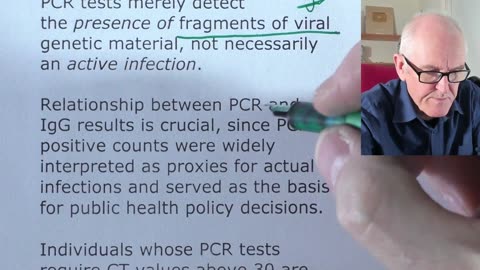
Dr. John CampbellA calibration of nucleic acid (PCR) by antibody (IgG) tests in Germany: the course of SARS-CoV-2 infections estimated https://www.frontiersin.org/journals/epidemiology/articles/10.3389/fepid.2025.1592629/full Germany, authority-accredited laboratories (ALM) Conducted 90% of SARS-CoV-2 polymerase chain reaction (PCR) tests (March 2020 until January 2023) AND Conducted serological mass tests for IgG antibodies, observed IgG seroprevalence trajectory. THEREFORE Test-positive fractions of PCR and IgG tests Value of 0.14 found for the fitted scaling parameter Therefore, 14% of those who were tested PCR-positively actually became infected with SARS-CoV-2. ALSO A quarter of the German population carried IgG antibodies from natural infections in their blood at the turn of the year from 2020 to 2021. Second, independent analysis Germany-specific ratio of 1:10 for ratio between one positive PCR test and the corresponding number of persons actually infected with SARS-CoV-2 Align well to perfectly with the IgG-positive fraction (92%) reported by the Robert Koch Institute at the end of 2021. More details Breaching the epithelial–mucosal barrier—“breach” meaning the invasion of a person’s organism by active viral material, it is common scientific terminology to say that “the person has become infected” Active viral material entering the mucus or epithelial cells may be bound and possibly already neutralized by IgA antibodies. In most infection cases, particularly when symptoms occur, IgG antibodies will also become detectable in the blood. The presence of IgG antibodies in the blood is representative of the body’s immunological memory of infections. IgG antibodies remained detectable for up to a year in at least 90% of naturally infected SARS-CoV-2-IgG-positive individuals PCR tests merely detect the presence of fragments of viral genetic material, not necessarily an active infection. Relationship between PCR and IgG results is crucial, since PCR-positive counts were widely interpreted as proxies for actual infections and served as the basis for public health policy decisions. Individuals whose PCR tests require CT values above 30 are commonly not to be considered infectious, whereas in practice, many tests were conducted with CT values up to 40 PCR assay produced positive results on water controls at cycle threshold (CT) values between 36 and 38 In short, a PCR test provides a snapshot of an individual’s current exposure to viral genetic material at the outermost layers of the body. Lancet, 2020 https://www.thelancet.com/journals/lanres/article/PIIS2213-2600%2820%2930453-7/fulltext RT-PCR assays in the UK have analytical sensitivity and specificity of greater than 95% UK Government, 2020 https://www.gov.uk/government/publications/gos-impact-of-false-positives-and-negatives-3-june-2020/impact-of-false-positives-and-false-negatives-in-the-uks-covid-19-rt-pcr-testing-programme-3-june-2020 Examining data from published external quality assessments (EQAs) for RT-PCR assays for other RNA viruses carried out between 2004 to 2019 Results of 43 EQAs were examined, giving a median false positive rate of 2.3% New England Journal of Medicine, 2024 https://www.nejm.org/doi/full/10.1056/NEJMc2313517 Among 11,297 participants who performed 76,610 days of testing, 1.7% had at least one false positive rapid antigen test.12K views 96 comments -
Vitamin D mistake
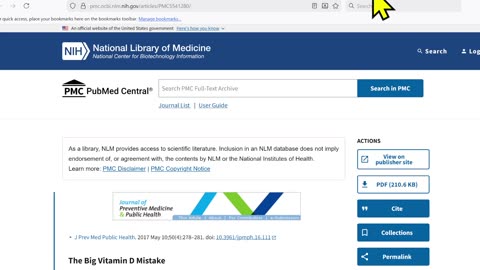
Dr. John CampbellA Statistical Error in the Estimation of the Recommended Dietary Allowance for Vitamin D (2014) https://pmc.ncbi.nlm.nih.gov/articles/PMC4210929/ US, nearly 15 times too low UK, 0ver 22 times too low IOM calculation 600 units (15 mcg), 97.5% of people will achieve 63 nmol/L (25.2 ng/ml) Correct calculation 600 units (15 mcg), 97.5% of people will achieve 26.8 nmol/L (10.7 ng/ml) Requirements based on correct calculation 8,895 IU of vitamin D per day may be needed to accomplish that 97.5% of individuals achieve serum 25(OH)D values of 50 nmol/L or more. The "Average" vs. "Individual" Mistake Canada studies Diet gives 232 IU of vitamin D per day Institute of Medicine (IOM), RDA vitamin D 600 IU per day, (aged 1 to 70 years) Now called the National Academy of Medicine https://nam.edu UK is even worse https://www.nhs.uk/conditions/vitamins-and-minerals/vitamin-d/ UK, 400 iu or 10 mcg 600 iu per day to achieve serum 25-hydroxyvitamin D (25(OH)D) levels of 50 nmol/L or more in 97.5% of healthy individuals. Levels of 50 nmol/L or more have been shown to benefit bone health and to prevent disease and injury. The IOM based their RDA for vitamin D on an aggregation of 10 supplementation studies, (32 dose protocols) carried out during winter months, at locations above 50th parallel IOM regressed the 32 study averages, dose: plasma ratio On the basis of this, IOM estimated that 600 IU of vitamin D would achieve an average 25(OH)D level of 63 nmol/L Requirements based on correct calculation 8,895 IU of vitamin D per day This dose is well in excess of the current RDA of 600 IU per day and the tolerable upper intake of 4000 IU per day. The public health and clinical implications of the miscalculated RDA for vitamin D are serious. With the current recommendation of 600 IU, bone health objectives and disease and injury prevention targets will not be met. We recommend that the RDA for vitamin D be reconsidered to allow for appropriate public health and clinical decision-making. The Big Vitamin D Mistake https://pmc.ncbi.nlm.nih.gov/articles/PMC5541280/ Explanation of the statistical error The "Average" vs. "Individual" Mistake The Institute of Medicine’s goal was to find a vitamin D dose that ensures 97.5% of individual people reach a healthy blood level (50 nmol/L). The statistical error occurred because the IOM analysed the averages of different studies rather than the data of individual participants. They looked at 10 studies and took the average blood levels achieved in those studies. They calculated a statistical range (Confidence Interval) based on those averages. They found that with 600 IU, 97.5% of the study averages would hit the target. The Problem There is much less variation between "averages" than there is between "individuals." By using the averages, the IOM accidentally "smoothed out" the data. They assumed that if the average person in a study was fine, then almost everyone was fine. The Classroom Analogy Imagine you want to ensure every student passes a test. The IOM method They looked at the average scores of 30 different classrooms. They set a curriculum so that 97.5% of classrooms would have a passing average. The Reality Even in a classroom with a passing average, there are students who fail. The Correction To ensure 97.5% of students pass, you have to look at the lowest-performing students, not the class average. The Consequence When the authors of this paper re-calculated the numbers using the variation of individuals (rather than study averages), they found that the current RDA of 600 IU does not cover 97.5% of the population. Instead, it only ensures that 97.5% of people reach a blood level of 26.8 nmol/L (far below the target of 50 nmol/L). To actually get 97.5% of the population to the healthy target of 50 nmol/L, the math suggests you would need a dose of 8,895 IU per day.15.1K views 154 comments