-
-
Researchers document startling golden cownose ray behaviour in Galapagos Islands
WildCreaturesGolden cownose rays are beautiful animals that are often found in schools. They inhabit the Pacific ocean in Costa Rica, Ecuador, Guatemala and a few other countries. These rays were observed in the Galapagos Islands at a depth of 30m (100ft). They circled and descended upon a sandy bottom and flapped, gulping the sand and debris. They lifted off and spat sand out and then circled back. This behaviour was repeated several times. Biologists who had come to this dive site to observe and study mola mola, the largest bony fish in the world got more than they expected when this school of rays appeared. The researchers had filmed mola mola minutes before and they were now moving to the rock wall to begin their ascent. They had seen the golden cownose school earlier in the dive, closer to the surface. At first glance, this behaviour seems like feeding. Golden cownose rays detect mollusks and shrimp with electro sensors and they dig into the sand to inhale their prey. But these rays were seen gulping large quantities of sand and rapidly spitting it out through their gills. It is believed that this specific behaviour may be a means of cleaning parasites out of their gills. More work will be done to learn what these rays were doing and why. These cownose rays are just one of the amazing species of animal that can be found in the Galapagos Islands.2.87K views 1 comment -
Scuba diver has close call with whale shark cruising right at him
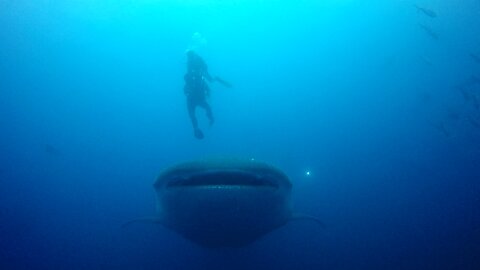
WildCreaturesWhale sharks are one of the most beautiful and magnificent creatures on the planet. They are the largest shark, and also the largest fish in the ocean. Only a few species of whales are larger. At up to 17m (55 feet) in length, and up to 45,000kg (100,000lbs) whale sharks are a truly enormous and awe-inspiring animal. To be in their presence is simply breath taking. These scuba divers are exploring the waters in the Galapagos Islands where whale sharks come each year. They cruise along with the currents in the waters around the more remote islands here. Scuba divers venture to the Galapagos from all over the world, hoping to catch a brief glimpse of these beautiful creatures. The lucky few will be able to capture a photograph or a video. But these scuba divers were fortunate enough to be in the water right in the path of a large, pregnant female as it swam straight through their group. They move gracefully, but they are not agile, and changing course seems to be something they cannot or will not do. Nearly bumping into one scuba diver, the shark maintains its course. To see a whale shark approaching is often a stunning experience. The first scuba diver that the shark reaches is frozen in place, directly in its path. His dive partner assists by gently pulling upwards on his tank and to lift him up a few feet. It is very important that these animals are not disturbed or stressed by the presence of humans in their world. Contact with whale sharks is to be avoided whenever possible. The scuba diver with the camera has been surrounded by small fish, and they part respectfully and move out of the way, giving our cameraman a sudden view of the majestic shark coming right toward him. He stares in complete awe but keeps the camera pointed at the shark. Unable to move, he remains perfectly still and records the world's largest shark smoothly gliding just inches over his head. The fins pass on either side of his camera and he moves carefully to the side to avoid one of the biggest and most powerful tails in the world. As the shark swims past, the diver is now able to move and he swims up and over the shark to record it from above. He allows it to pass and then he turns the camera to the rest of the scuba divers who are also in complete awe of what they have just seen. This shark is completely unconcerned with the scuba divers and it makes no effort to avoid them. It is believed that they may even have some curiosity about humans, recognizing them as being no threat. Once full grown, a whale shark fears only large Galapagos sharks, which it can easily outswim if needed.7.2K views 8 comments -
Galápagos Island are so mysterious, hostile and beautiful
WildCreaturesThe Galapagos Islands are one of the world's most beautiful and magical places. Part of Ecuador, much of these islands form a wildlife sanctuary and national park, protecting the unique plant and animal species, as well as the complex ecosystems here. These islands are young in Geological terms, possibly having formed as recently as 8 million years ago. Isabela and Fernandina, the youngest of the main islands are still being formed due to active volcanos that still spew lava, causing further growth. These islands were formed when molten lava forced its way up through the tectonic plates far below the surface of the ocean. As the lava cooled, islands were born, giving rise to the name "Islands born of Fire". The land here is mostly hostile and dry, with fresh water being scarce in many places throughout the islands. Rain is sparse on the coastland, but plentiful in the highlands during the wet season. The animals have had to adapt to water being unreliable, which makes the islands uninhabitable for all but the hardiest. Humans likely found these islands long ago, but until the 1500s, lack of water made it impossible for them to settle. The animals here have all arrived on the air or ocean currents. The journey from the mainland is a long one and most would perish in the attempt. Those that made the crossing developed new means of finding food and staying hydrated or else they too, perished. Join these explorers as they visit Santa Cruz, San Cristobal, Fernandina, Wolf Island, Darwin Island and other places, taking you on a journey over land and beneath the waves to meet some of the world's most incredible animals up close. You'll see giant Galapagos tortoises, brown pelicans, sally lightfoot crabs, blue-footed boobies, male frigates, land iguanas, a newly hatched frigate, massive whale sharks, curious dolphins, playful sea lions, and surgeon fish. A school of golden rays explodes from the sandy bottom, penguin on the hunt passes by, an orca, the world's most accomplished predator fills the camera, and a Pacific green turtle glides past. Spotted eagle rays, hammerhead sharks, and Galapagos sharks drift on the current. A massive school of big eyed jacks pins a diver against the rock wall. A marine iguana frantically gathers algae before the cool water drives it to the surface to reheat. Take a glimpse of the recently fallen Darwin's arch, one of the most recognizable dive sites in the world.4.94K views 5 comments