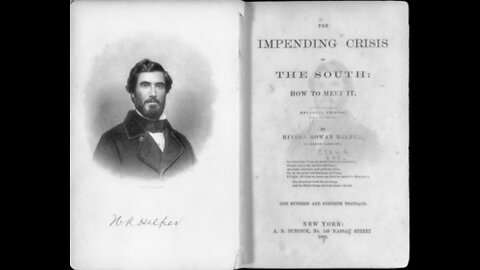
The Impending Crisis of the South - Hinton Rowan Helper - 1857
1 video
Updated 10 days ago
Listen to the book that made - Hinton Rowan Helper (a North Carolinian and former Southerner) flee the South—or at least could not safely return there—after publishing The Impending Crisis of the South.
For his own safety, he moved to New York City shortly after publication and remained in the North (later serving as U.S. consul in Buenos Aires under Lincoln). Southern hostility made returning home impossible during that era.
The Impending Crisis of the South: How to Meet It is a socio-political treatise written by Hinton Rowan Helper, a native of western North Carolina, and first published in 1857.
The book argues that slavery was economically inefficient and a major barrier to the progress of the Southern United States, particularly harming non-slaveholding whites who constituted the majority of the Southern population.
Helper contends that slavery impoverished the South by stifling industrialization, urbanization, and innovation, and that the region’s economic and demographic decline was directly attributable to the institution of slavery.
He supports his argument with extensive statistical comparisons drawn from the 1850 U.S. Census, showing that Northern states outperformed Southern states in agriculture, population growth, literacy, and land value.
-
The Impending Crisis of the South - Hinton Rowan Helper - Preface - Start of Chapter 1.
UnearthingListen to the book that made - Hinton Rowan Helper (a North Carolinian and former Southerner) flee the South—or at least could not safely return there—after publishing The Impending Crisis of the South. For his own safety, he moved to New York City shortly after publication and remained in the North (later serving as U.S. consul in Buenos Aires under Lincoln). Southern hostility made returning home impossible during that era. The Impending Crisis of the South: How to Meet It is a socio-political treatise written by Hinton Rowan Helper, a native of western North Carolina, and first published in 1857. The book argues that slavery was economically inefficient and a major barrier to the progress of the Southern United States, particularly harming non-slaveholding whites who constituted the majority of the Southern population. Helper contends that slavery impoverished the South by stifling industrialization, urbanization, and innovation, and that the region’s economic and demographic decline was directly attributable to the institution of slavery. He supports his argument with extensive statistical comparisons drawn from the 1850 U.S. Census, showing that Northern states outperformed Southern states in agriculture, population growth, literacy, and land value.46 views