-
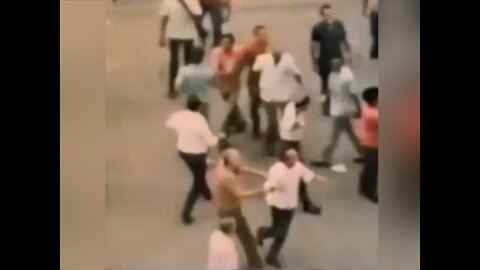
Cuba- Repression at the US Interest Section Building, Havana 1980
CubaPoliceAbuse⸻ #Repression | Havana, 1980 — Filmed clandestinely from the United States Interests Section in Havana (today the U.S. Embassy). The footage shows Cuban State Security (DSE) agents disguised as civilians attacking unarmed Cubans—many former political prisoners waiting for U.S. exit visas—using clubs hidden inside newspapers and magazines. On May 2, 1980, The Washington Post reported that around 800 Cubans were attacked at the U.S. mission while seeking visas (archived source: https://web.archive.org/web/20170828151632/https://www.washingtonpost.com/archive/politics/1980/05/03/cuban-group-attacks-800-seeking-us-visas/07f62a0a-e464-4617-8074-7b1f61537ea3/?utm_term=.e4a5509451b6). This was a coordinated state operation, not a riot. Castro did not expect this violence to be documented. Weeks later, repression escalated into the Mariel exodus of 125,000+ Cubans. #Cuba #Havana1980 #Mariel1980 #PoliceBrutality #HumanRights #CubaHistory #USCuba Video courtesy: J. Martinez / Cuba360 #Represión | La Habana, 1980 — Imágenes filmadas clandestinamente desde la Sección de Intereses de Estados Unidos en La Habana (hoy Embajada de EE. UU.). El video muestra a agentes de la Seguridad del Estado cubano (DSE) actuando disfrazados de civiles, atacando a cubanos desarmados —muchos de ellos ex presos políticos que esperaban visas para salir del país— utilizando garrotes ocultos dentro de periódicos y revistas. El 2 de mayo de 1980, The Washington Post reportó que alrededor de 800 cubanos fueron atacados frente a la misión estadounidense mientras aguardaban visas. Fuente archivada (Wayback Machine): https://web.archive.org/web/20170828151632/https://www.washingtonpost.com/archive/politics/1980/05/03/cuban-group-attacks-800-seeking-us-visas/07f62a0a-e464-4617-8074-7b1f61537ea3/ Este ataque no fue un disturbio espontáneo, sino una operación coordinada del Estado. Fidel Castro no esperaba que esta violencia quedara documentada. Semanas después, la represión desembocó en el Éxodo del Mariel, donde más de 125 000 cubanos huyeron del país. Mismo régimen. Mismo método. Misma represión. #Cuba #LaHabana1980 #Mariel1980 #AbusoPolicial #DerechosHumanos #HistoriaDeCuba #USCuba 🎥 Video cortesía: J. Martínez / Cuba360 ⚠️ Contenido sensible: violencia estatal documentada8 views -
From Medellín to Havana: The Trial That Exposed Cuba’s Drug Corridor
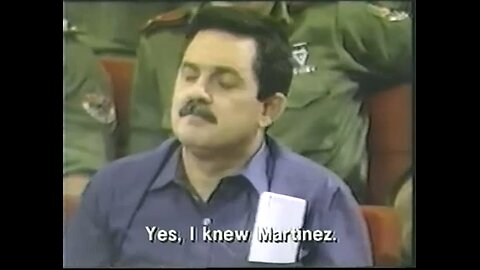
CubaPoliceAbuse#Cuba #Drugs #Escobar #Ochoa #RaulCastro This clip comes from the 1989 Cuban military tribunals known as the Ochoa drug trials, a tightly controlled political purge presented as a criminal prosecution. The man seen in the clip is Miguel Ruiz Poo, a Cuban Army captain who testified during the trials. In this moment, Ruiz Poo is visibly shaken and struggling to speak as the testimony enters extremely dangerous territory. His breakdown occurs as he references facts that pointed beyond the accused officers and toward the real centers of power. The trials centered on Arnaldo Ochoa, a highly decorated general, along with senior Interior Ministry and military officers. They were accused of drug trafficking, corruption, and abuse of power. During the proceedings, testimony and prior interrogations referenced statements by Carlos Lehder, who was a key leader of the Medellín Cartel alongside Pablo Escobar. Lehder stated that Cuba functioned as a cocaine transit corridor in the 1980s and that operations of that scale required approval at the highest levels of power. He explicitly named Raúl Castro, asserting that such trafficking could not occur without his knowledge—implicitly pointing toward the regime’s top leadership, including Fidel Castro. What happened next: Ochoa and several other generals and officers were convicted and executed by firing squad in 1989. Others received long prison sentences. Testimony that approached the highest levels of power was abruptly cut off. What happened to Ruiz Poo: After his testimony, Miguel Ruiz Poo disappeared from public view. Like other witnesses who crossed invisible lines during the trials, he was removed from public life, with no transparent judicial record or later accountability. His fate remains a warning inside the Cuban system. What did not happen: No member of the ruling family or senior political leadership was ever investigated or prosecuted. The real decision-makers behind the drug operations inside the Cuban regime were protected and remain free. Why this matters today: The same power structure exposed in 1989 now operates beyond Cuba’s borders. The Cuban regime is deeply embedded in Venezuela, where state-linked drug trafficking networks—often referred to as the Cartel de los Soles—have been formally accused by the United States. While Venezuelan officials aligned with Nicolás Maduro face indictments and sanctions, Cuban intelligence and military leadership that helped build and shield these networks remain untouched, continuing a decades-long pattern of impunity.7 views -
#Cuba A timeline of #repression
CCommunist Repression in Cuba#Cuba | A timeline of #repression and #humanrights violations by the Castro revolution against the Cuban people 1959- today 🇨🇺🌻 #Freedom4Cuba #LlegoLaHora #ElCambioEsYa #Ni1Mas8 views -
#Cuba #TheBrothersToTheRescue 🇨🇺🌻
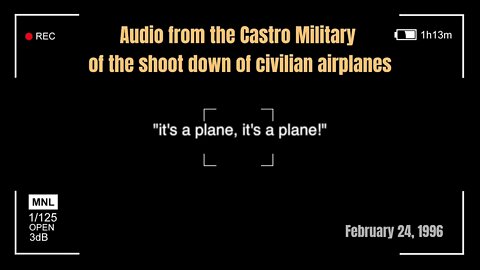
CCommunist Repression in Cuba#Cuba 🇨🇺 #Florida Remembering the #BrothersToTheRescue 25 years ago on February 24, 1996 a Cuban MiG-29UB Fulcrum and a MiG-23ML intercepted three US civilian registered Cessna 337s (N2456S, N5485S and N2506), operated by the Brothers to the Rescue while they were engaged on a humanitarian search and rescue mission over the Florida Straits for Cuban rafters in international airspace. At 3:21pm EST the Brothers to the Rescue Cessna 337 (N2456S) was destroyed by an air-to-air missile fired by the Cuban MiG-29 military aircraft. At 3:27pm EST the Brothers to the Rescue Cessna 337 (N5485S) was destroyed by an air-to-air missile fired by a Cuban MiG-29 military aircraft. Immediately killed were Armando Alejandre Jr.,45 years old, Carlos Alberto Costa, age 29, Mario Manuel de la Peña, age 24, and Pablo Morales, age 29. This was a premeditated act of state terrorism carried out by Havana on the orders of both Fidel and Raul Castro. The third Brothers to the Rescue Cessna 337 (N2506) was able to escape and the survivors Jose Basulto, Arnaldo Iglesias, Silvia Iriondo and Andres Iriondo were able to set the record straight on the propaganda offensive already underway from Havana to misrepresent what had happened. Members of Brothers to the Rescue risked their lives in the Florida Straits to rescue Cuban rafters and they challenged the Cuban exile community to abandon both violent resistance and appeasement as approaches in order to embrace strategic nonviolence. Brothers to the Rescue had elements of civil disobedience but it was primarily a constructive program. https://www.cubacenter.org/archives/2021/2/23/cubabrief-truth-justice-memory-and-the-brothers-to-the-rescue-shoot-down-at-25-and-orlando-zapata-tamayo-at-1112 views -
#Cuba #WeRemember Capitan Tondike
CCommunist Repression in Cuba#Cuba 🇨🇺 #WeRemember Today #CubaArchive : Margarito Lanza Flores , better known by his war name "Captain Tondique," was a legendary guerrilla leader operating in the area north of Las Villas, from Sagua La Grande and Corralillo , 1962 against the Castro regime. He was a farmer who never had trouble with the law, or was violent. His story begins when the communists came over to intervene his farm under the so called Agrarian Reform ( one of the lies of the Revolution that left thousands of humble farmers without their property). With a man named Macho Mora, Tondique quickly took up arms and went to the jungle. His guerrilla was one of the most active throughout Cuba. They participated in countless battles and were among the most persecuted. Communists resented that a poor black peasant was one of the main rebels against Castro and his revolution. So they took it out on him, and chased him more than other guerrilla groups in Escambray. On one occasion, Tondique's guerrilla took the Military Camp, La Paloma, the main base of the militias in the north of Las Villas located in the town of Quemado de Guines. One of the guerrilla tactics of Tondique, was walking backward , conversely, to confuse the enemy. But in February 1962, two government helicopters, tracked down Tondique and his men. There were thousands of men surrounding the farmer guerrilla in a cane field in Quemado de Guines area. The battle lasted two or three days, in which the military cowardly set the field on fire. Tondique and his men dug holes to escape the fire, but could not resist anymore. Injured, burned, without water and ammunition they were captured. That same day, March 2, 1962, with the terrible pain from burns, seen in his mugshot here, Margarito Lanza Flores (Tondique), Macho Mora, and the remaining men were executed by Castro commander Victor Dreke, under a bridge, located on the fields of Quemado de Guines. He was 23 years old. This is one of the war crimes that has not gotten any justice. @cubaarchive #Tondike #Freedom4Cuba37 views -
Remembering Orlando Zapata Tamayo #Cuba 🇨🇺
CCommunist Repression in Cuba#Cuba #Rip #Remembering #OrlandoZapataTamayo 🇨🇺 A beloved son, and political activist. Eleven years ago on February 23, 2010 Cuban prisoner of conscience Orlando Zapata Tamayo died after years of physical and psychological torture that began in 2003 that drove him to repeatedly protest prison conditions and beginning on December 3, 2009 to undertake a water only hunger strike that ended in his death. Aggravating this already extreme situation, was that prison officials repeatedly denied him water in an effort to get him to end the strike. Amnesty International condemned the death at the time and urged Raúl Castro "to immediately and unconditionally release all prisoners of conscience after a political activist died following a hunger strike." Eleven years later and the prisoners of conscience are still there, and the International Red Cross has not had access to Cuban prisons, save for one brief period over 30 years ago in 1989. #FreeAllPoliticalPrisoners #Freedom4Cuba #PatriaYVida #Justice #communismkills Source: @centerforfreecuba @johnjsuarez From #AmnestyInternational : Orlando Zapata Tamayo was arrested in March 2003 and in May 2004 he was sentenced to three years in prison for “disrespect”, “public disorder” and “resistance”. He was subsequently tried several times on further charges of “disobedience” and “disorder in a penal establishment”, the last time in May 2009, and was serving a total sentence of 36 years at the time of his death. “Faced with a prolonged prison sentence, the fact that Orlando Zapata Tamayo felt he had no other avenue available to him but to starve himself in protest is a terrible indictment of the continuing repression of political dissidents in Cuba. “The death of Orlando Zapata also underlines the urgent need for Cuba to invite international human rights experts to visit the country to verify respect for human rights, in particular obligations in the International Covenant on Civil and Political Rights.”22 views -
The Tugboat Massacre #Cuba Remolcador 13 de marzo
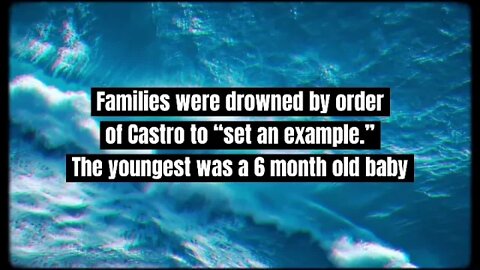
CCommunist Repression in Cuba#Cuba 🇨🇺 #HavanaBay July 14, 1994 26 years ago, these families were killed by order of the Castro communist tyranny. The crime shook our nation, and its one of the reasons that as a kid, my family and I left the country. This is known as the Tugboat 13 of March Massacre, #remolcador13marzo “Among the most flagrant atrocities committed by the Castro regime in its long history of human rights’ abuses, two incidents stand out that took place in the month of July —the Canimar River Massacre of 1980 and the Tugboat Massacre of 1994. Perpetrated by the Cuban regime still in power, they illustrate its profound disregard for human life and fundamental freedoms. On this anniversary, we remember the victims —their tragic loss is compounded by the continued impunity the Cuban dictatorship enjoys for these and many other crimes against humanity. On July 13, 1994, a group of around seventy family members and friends boarded the tugboat “13 de marzo” in the middle of the night hoping to escape to the United States. As they made their way out of Havana’s harbor, three tugboats that had been waiting in the dark took up a chase. Soon, they began to relentlessly spray the boat with high-pressure water jets, ripping children from their parents’ arms and sweeping passengers off to sea. Finally, the tugboat was rammed to make it sink. Passengers who had taken refuge in the cargo hold were pinned down; they desperately pounded on the walls and the children wailed in horror as the boat sank and they all drowned. The three pursuing tugboats circled around survivors who clung to life, creating wave turbulence to make them drown. The attack stopped suddenly, apparently to conceal the crime, when a merchant ship with a Greek flag approached Havana Harbor. Cuban Navy ships standing by began picking up survivors and took them to shore. The traumatized women and children were interrogated and sent home, the men imprisoned for months and given psychotropic drugs. 37 perished, including eleven children. None of the bodies were returned to their families for burial. Survivors and relatives of the dead were denied information and put under surveillance.” - Canada Free Press #VictimsOfCommunism #Massacre #Castro #Cuba #Justice #HumanRights39 views -
Brigada 2506 | Brigade 2506 #Cuba 🇨🇺 April16, 1961 #Documentary
CCommunist Repression in Cuba#Cuba #Documentary about the Brigade 2506. Its been 60 years since these brave Cubans decided to take a stand and free our country of the new communist totalitarian regime aided by the Soviets and headed by Castro. Among these warriors were a lot of young men ( 16- early 20’s). https://www.cubacenter.org/archives/2021/4/15/cubabrief-brigade-2506-the-bay-of-pigs-at-sixty-and-some-historical-context-castro-loosens-internal-blockade-cattle-slaughter-beef-dairy-sales-permitted-after-58-yrs #Brigada2506 #BahiaDeCochinos25 views