-
Sir Hugh
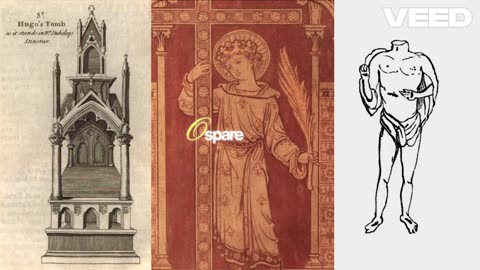
duncanonzog"Little Saint Hugh" (c. 1246–1255) was a nine-year-old boy whose death became the center of a notorious anti-semitic "blood libel" legend. The story and early verses were written in the 1200s, but the popular songs and ballads recorded by collectors are generally viewed as later derivations that were transmitted orally for centuries. Some experts believe the "ur-ballad" (the original prototype) was composed in the late 13th century while public interest in the event was high. https://sacred-texts.com/neu/eng/child/ch155.htm 155L https://en.wikipedia.org/wiki/Little_Saint_Hugh_of_Lincoln The picture on the left is the shrine that was made for Hugh and the statue on the right, which no longer exists shows the wounds on his body. 'The Shrine: His remains are located in a tomb in the South Choir Aisle. The original grand 13th-century shrine featured a statue of the boy showing "Christ-like wounds," but it was largely destroyed during the Reformation. Present State: Only the stone base of the monument remains today. In 1955, the Cathedral added a plaque to the site explicitly apologizing for the "trumped-up stories" of ritual murder that led to the execution of 18 innocent Jews.' The "Sir Hugh" Song (Child Ballad 155): While the story is medieval, most modern scholars argue that the specific folk song versions we know today—often titled "Sir Hugh," "The Jew’s Daughter," or "The Fatal Flower Garden"—were likely composed or significantly reshaped in the 17th or 18th centuries. The Annals of Waverley entry for 1255 tells the story of Little Saint Hugh's murder in prose. The narrative, a classic example of the blood libel, describes: The child being crucified by Jews in contempt of Christ, with various preliminary tortures. The body being thrown into a running stream to conceal the act, but the water ejecting it onto dry land. The body then being buried, but found above ground the next day. As a last resort, the body being thrown into a well, which then became filled with a brilliant light and sweet odor, leading to its discovery. The King ordering an inquiry, which led to eighteen Jews confessing, being convicted, and eventually hanged. He disappeared July 31, 1255, and his body was discovered on Aug. 29 following in a well belonging to the house of a Jew named "Jopin" or "Joscefin." the child had been crucified by a number of the most prominent Jews of England, who had gone to Lincoln on the pretext of a wedding. The remains of the lad were taken to the cathedral and were buried there in great pomp. Henry III., on arriving at Lincoln about a month afterward, revoked the pardon of Jopin, and caused him to be dragged around the city tied to the tail of a wild horse, and then hanged. The remaining Jews of Lincoln, including some who were there as visitors—probably to attend the marriage of Bellaset, daughter of Berechiah de Nicole—were carried, to the number of ninety-two, to London, where eighteen of them were executed for refusing to plead. Berechiah was released, and the remainder lingered in prison until Richard, Earl of Cornwall, who was in possession of the Jewry at the time, made terms for them. The Annals describe the alleged ritual murder of the boy, stating the body was repeatedly miraculously found after attempts to hide it (in a river, buried, then a well), which led to the arrest and execution of numerous Jews in Lincoln. The well-known lyrics to the "Sir Hugh or the Jew's Daughter" ballad (Child Ballad 155), such as those beginning "It rains, it hails in merry Lincoln," were written down much later, primarily from the 18th century onward, but are believed to derive from compositions made around the time of the 1255 accusations. Geoffrey Chaucer famously referenced the "yonge Hugh of Lincoln" at the end of the Prioress's Tale in his Canterbury Tales (c. 1380s Anglo-French verses regarding the death of Hugh of Lincoln date back as early as 1259. These contemporaneous accounts, such as those found in the Annals of Waverly (1255) and the chronicles of Matthew Paris, provided the narrative foundation for the later ballads. Yet while the story was old, there is no record of this particular ballad text until Thomas Percy printed a copy, supposedly from a Scottish manuscript, in his Reliques of Ancient English Poetry: Consisting of Old Heroic Ballads, Songs, and Other Pieces of our Earlier Poets (1765). Thereafter, the ballad has been recorded frequently, in Scotland, England, Ireland and the United States; it has 295 entries in the Roud Folksong Index. Lacemakers continued to sing this song while making lace well into the later nineteenth century, for Thomas Wright (1859-1936) of Olney, in The Romance of the Lace Pillow (1919) recorded versions from Weston-under-Wood and Haddenham, both in Buckinghamshire, which were used as lace tells in the lace schools. https://laceincontext.com/lacemakers-songs-the-ballads-of-sir-hugh-and-long-lankin/ https://files.catbox.moe/yp20im.jpg https://files.catbox.moe/vjkmb6.jpg https://files.catbox.moe/dnab65.jpg https://files.catbox.moe/4cogw5.webp https://www.youtube.com/watch?v=lh-zzyoSAOU https://en.wikipedia.org/wiki/The_Prioress%27s_Tale53 views 3 comments -
-
NNR Stole Christmas (Video)
duncanonzogMost clips are from last Christmas (2024) **fair use report pig**117 views 6 comments