What is worth dying for?
3 videos
Updated 1 month ago
One aspect of history that every student needs to consider to have a meaningful life, along with "What is worth living for?" -- What is worth dying for?
Western Civilization has addressed this in many ways over the ages -- materially, aspirationally, and finally, as a cautionary tale (In Flanders Fields.) Students, teachers, adults, citizens, should all consider these things.
-
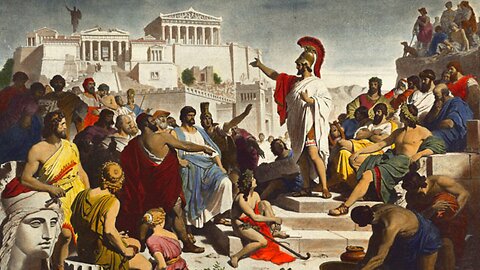
Pericles' Funeral Oration
Voice of the AgesPericles’ Funeral Oration, recorded by Thucydides in History of the Peloponnesian War (Book II), is Athens’ most famous self-portrait. Spoken over the first dead of the war with Sparta, it becomes less a eulogy for fallen soldiers than a meditation on the city they died to defend. Pericles praises a daring, open, law-governed democracy that blends freedom with discipline and honors both courage in battle and usefulness in peace. This oration asks what makes a community worthy of sacrifice—and challenges listeners to live so that their city deserves such loyalty, honor, and remembrance across generations and in every crisis.11 views 1 comment -
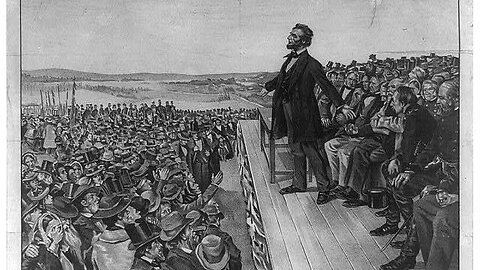
Lincoln's Gettysburg Address
Voice of the AgesAbraham Lincoln’s Gettysburg Address, delivered on November 19, 1863, at the dedication of a soldiers’ cemetery, is a brief but towering reflection on why a nation might be worth dying for. Where Pericles praised the glory and cultural excellence of Athens, Lincoln roots American sacrifice in a moral “proposition” — that all men are created equal — and in the hope of a “new birth of freedom.” In just a few sentences, he shifts the focus from honor and fame to equality, self-government, and unfinished work. The dead at Gettysburg, he insists, consecrate the nation’s resolve that “government of the people, by the people, for the people, shall not perish from the earth.”6 views 1 comment -
In Flanders Fields
Voice of the Ages“In Flanders Fields” was written in May 1915 by Lieutenant Colonel John McCrae, a Canadian physician serving during the Second Battle of Ypres in the First World War. Composed after the burial of a friend amid the poppy-covered graves of Belgium, the poem gives voice to the dead themselves, speaking across the silence of the battlefield. Published widely during the war, the poem was quickly embraced as a call to perseverance. Its direct appeal to the living helped sustain public resolve at a time of mounting casualties, and it was frequently used in recruitment and war-bond campaigns to reinforce the sense that the fallen had passed a solemn duty on to those still at home and at the front.8 views