-
No Reconciliation Without Truth with Monika Schaefer
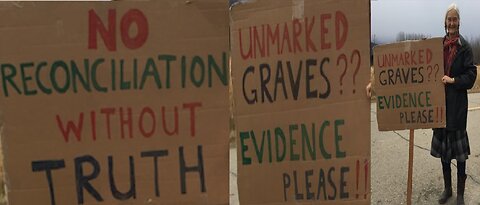
We The People - Constitutional ConventionsFree Speech Monika~ Exercising My Human Right to Speak Freely! https://freespeechmonika.com/no-reconciliation-without-truth/ War Before Civilization: the Myth of the Peaceful Savage by Lawrence H. Keeley https://rumble.com/v71ohge-war-before-civilization-the-myth-of-the-peaceful-savage-by-lawrence-h.-keel.html Grave Error - No evidence of ‘mass graves’ or ‘genocide’ in residential schools https://rumble.com/v71oh52-grave-error-no-evidence-of-mass-graves-or-genocide-in-residential-schools.html Not Stolen - The Myth of New World Genocide - Jeff Fynn-Paul https://rumble.com/v71ogji-not-stolen-the-myth-of-new-world-genocide-jeff-fynn-paul.html 10 Hours of Holohoax- Great Quality re-mix - Must Share as its happening right NOW AGAIN !!! https://rumble.com/v6s24mf-10-hours-of-holohoax-great-quality-re-mix-must-share-as-its-happening-right.html?e9s=src_v1_s%2Csrc_v1_s_o&sci=19a8723b-2d2e-4200-8641-7c5fd17f051b Truth and Justice for Germans Society https://truthandjusticeforgermans.com/ Comprehensive list of holocaust victims (1933=1945) https://rumble.com/v6pxiga-comprehensive-list-of-holocaust-victims-19331945.html Veritas Radio - Mike King - Hour 1 of 2 - The Bad War_ The Truth Never Taught About World War 2 https://rumble.com/v5zd2dh-veritas-radio-mike-king-hour-1-of-2-the-bad-war-the-truth-never-taught-abou.html 6 million lie https://rumble.com/v5zcljn-6-million-lie.html No Reconciliation Without Truth 8 November 2025 by Monika Schaefer Truth and Reconciliation is an expression well known not just in relation to South Africa, but in Canada as well, over the last couple of decades. On the 7th of November, 2025, I did a one-woman protest action in front of the community centre in my little hometown in north-eastern British Columbia, where there was a large gathering of Aboriginal folks from other areas of this province. There are many names for the Aboriginal peoples of Canada. They generally have been called Indians, or they are referred to as Native, Indigenous, or First Nations (which they are NOT, but that is a whole other topic). Before relating to you my little event, some background to Truth and Reconciliation in Canada is necessary. The Truth and Reconciliation Commission of Canada (TRC) was established in 2008, and the final report of the seven-year process of gathering testimonies all across the country from thousands of people associated with the Indian Residential School (IRS) system was published in 2015. Many recommendations were made as a result of the TRC. This 75-minute video has valuable reference material with regards to UNDRIP (United Nations Declaration on the Rights of Indigenous Peoples) and the graves story. On May 27, 2021, the Kamloops Indian band announced to the world that they had discovered 215 unmarked graves at the site of the former Indian Residential School in Kamloops. Headlines quickly turned to “mass graves” and flags were lowered to half mast, remaining there for the longest period in Canadian history during peace-time. The anti-White hatred went into super-charge, and White guilt took on whole new dimensions. We are no longer just “colonizers” or “settlers” who “stole the land”, but now we are being called “uninvited guests” in the country that our ancestors built. Court cases are currently causing all kinds of uncertainty about the status of people’s private property, some public areas such as provincial parks are being declared off-limits to non-native people during certain periods of time, and streets and plazas are being renamed to names which nobody can pronounce. Over 100 churches were burnt or vandalized during the year following that announcement, but that was “understandable” according to then Prime Minister of Canada Justin Trudeau. The only trouble with the Kamloops unmarked graves story is that none of these so-called graves have been investigated. The original claim was made after ground-penetrating radar found anomalies. Nothing has been excavated, in spite of 12 million dollars having been given to the Kamloops band specifically to investigate the graves. Why have they not done any digging? I have heard them say that the spirits should not be disturbed, and that they would rather carry out ceremonies to guide the children’s spirits home. However, could it be that they, the Natives, simply do not want to dig, because they fear they will not find any skeletons? Could those anomalies detected by the ground penetrating radar be old tree roots from the orchard? or old septic field lines? How can we know, if nobody digs? I have been talking quite a lot about these issues over the past few years, as it concerns me greatly that we in Canada are being accused of having committed genocide, and laws have even been introduced which, if passed, will land you in jail for questioning these graves or for questioning their atrocity stories about the schools or for saying anything positive about the schools. This sounds very much like the Holocaust denial laws! Even the language is similar – “Residential School Denial” – that is what they are in the process of criminalizing. In these “the Flipside with Monika” broadcasts on RBN the Republic Broadcasting Network, here, here, here, and here, this was the main topic. Also, these interviews with Jim Rizoli, here and here. **************************************** The above background gives context to my little action. I made a two-sided sign, and strolled along the public side-walk in front of the community centre with my sign. The action lasted about 45 minutes. The photo here was taken on the edge of town, before going on location. Just four words. No Reconciliation without Truth. Does that sound offensive to you, dear reader? Are there any problems there? Is it logical? Can we have reconciliation without truth? Likely you think, why on earth is she asking these silly questions. The answers are self-evident are they not? Well, evidently, some people do get very offended, and I witnessed it first hand. The other side of the sign also had just four words: Unmarked Graves?? Evidence Please!! Here is a quick summary of some of my encounters today. I wish I had had a videographer along to document the whole event, but here it is from memory. The first Native man who saw me (I’ll call him Man#1) approached with a big smile on his face and thumbs up. I expressed my delight that he liked my sign. I had the “no reconciliation without truth” side facing him. He liked it a lot. I then showed him the other side with “unmarked graves?? evidence please!!” and he really liked that too. He was beaming ear-to-ear. Again I expressed my joy that he was with me on these simple but important messages. He asked if he could give me a hug, and of course I accepted his big bear-hug. This was such a heart-warming start to my little action. Over to my left I could see that people were peering curiously at us from the other side of the glass windows of the entrance lobby. People were milling about, walking in and out of the doors, as well as going to and fro, between the Legion across the street where some of their activities were taking place, and the community centre. Children were playing off to one side near the big wall tent that the organizers had set up next to the building. The children saw me and they waved and smiled. I waved and smiled back. It was all very pleasant. Alas, that was about to change. From the entrance lobby, a Native man (I’ll call him Man#2) came marching over to me, and looked my sign up and down (the “Truth” side) and demanded in a hostile tone, “what are you doing here?! what is this?! why are you here?!” I simply responded by pointing at the message and saying that it was important to have truth in order to have reconciliation. I do not remember his precise words back, but something to the effect of “What! Your truth!? What are you talking about?!” He was clearly VERY offended by those four words, “no reconciliation without truth”. I calmly turned the sign to show him the other side, and asked if there was evidence to support the unmarked graves story. I told him that I was interested in seeing evidence. His hostility grew. I was regaled with “We have our memories! We have our stories – these things happened! We have Elders and – are you accusing them all of being liars?!?!” This he practically screamed in my face. At some point during his ranting and raving, I couldn’t help but to chuckle a little, and that really got him hopping mad! “And you are laughing at us!” When things were calmer again, I asked why do they not use the money that the government gave to them, earmarked for the investigation, and do an excavation and find the evidence. He was extremely hostile in response to that suggestion. He repeatedly talked about their memories and their stories, and demanded an answer from me regarding his accusation that we are calling the Elders and the “survivors” all liars if we do not believe them. This discussion was clearly going nowhere. Man#1 was still standing there next to Man#2, and he was looking bewildered and uncomfortable. I told Man#2 that this man (motioning towards Man#1) had really liked my sign and had given me a hug, and had no hostility towards me at all. Then Man#1 stammered that he hadn’t really understood my meaning, but he couldn’t explain what he meant by that. He was now siding with Man#2, but was clearly confused. He was not overtly hostile at all, just had a very troubled look on his face. At this point I must say I felt sorry for him. Man#2 took his cell phone out to take a picture of me in an intimidating manner as though he expected that I should want to run and hide from his desire to document my presence. I think I took a bit of the wind out of his sail when I stood proud, and smiled beside my sign, posing for the photo. and said, “I’m proud of my sign.” After he snapped the photo, I turned the sign to show the other side and posed again with an even bigger smile. What I witnessed happening there between Man#1 and Man#2 was a small but extremely important example of how “group think” works, and how peer pressure will affect people’s perceptions, memories, feelings, the very way that they think and behave. The video linked above – and here again – is called ‘UNDRIP and the Graves. Reference Material‘. In it, there is a description of the TRC sign which was prominently displayed at the entrance of the hearing rooms as the IRS testimonials were gathered across Canada. That sign would set the stage for the participants, suggesting that these schools were terrible places, where terrible things happened. There is little doubt that this would have had a dampening effect on anyone who might possibly have wanted to tell about their positive experiences, and it would certainly have helped them “remember”, even if by hearsay, that these were terrible places. That specific topic discussion beginning at approximately minute 9 in the video lasts for about six minutes. (Incidentally, immediately following that section, comes an interesting fact about Robert Carney, the father of the current Prime Minister. This video was made before Mark Carney became PM.) The entire video is well worth the hour and a quarter to watch, but if you are strapped for time, you might like to check out those bits, especially in relation to the peer pressure which I just described above. Back to my little action. Other Natives started coming over to take a closer look. Many short conversations took place. Some just told me that I was not welcome there and that I was trespassing and should go away. I responded that I was on public property and had no intention of interfering with their event or activities. Some talked with me, but none were friendly like Man#1. I pointed out to the growing throng that they were being instrumentalized by the government who was actually at war against the Caucasian Race, and that they were being used as instruments of that war. The government was trying to divide us all and get us all to hate one another, I told them. I explained that they would not likely be better off with the replacement population who were being brought into the country. One native fellow accompanied a woman who passed closely by me and loudly sputtered that he was there to protect her from my verbal abuse. I smiled at them. An elderly native woman approached me with her walker and with glowering eyes told me that she attended the Kamloops school! She paused in such a way as though awaiting my shocked gasp, like as if she had just told me she got struck by a fire-breathing dragon. When the expected gasp of horror did not come, she continued, “there was abuse there!” I asked her why the Indian band had lobbied the government to keep the school open when it was to be closed. I also asked her why so many former students attended the school reunion several years after the school closed. Would they really have wanted to attend a joyful reunion if it was such a traumatic – and genocidal – place? Several Natives accosted me with statements like “there are chiiiillllldren here!” drawing out that word in such a dire tone, that a blind passerby might have thought I was engaging in a violent freak show or perhaps pornography! [Oh, but wait, a pornographic display might have been okay with them, given what is being fed to our children (presumably their children too) right in the public schools – but I digress.] A White woman walked by and practically spit her words at me “you are a HATER!” A White man was the most upset of all, and he just yelled at me. “We stole their land! And my wife was a 60’s scoop baby! We stole their land! And then we stole their babies! And we’re still stealing their babies!” I told him (or tried to speak in between his outbursts, at least for the benefit of other people nearby who might have been listening) that I personally know a “60’s scoop” woman who is very grateful that she was adopted and raised by a White family, because she was aware that she had a much better upbringing than she could ever have had with her biological family, who were completely dysfunctional. She was doing very well in life, because of her loving adoptive family, who happened to raise her with a deep appreciation and knowledge of her people and their traditions and culture. Does that sound like it was genocide? Why would White families adopt these children that are in precarious situations, where perhaps the parents are either absent or drunk or abusive? Could it be because our people care? Another sidebar: I personally know of several White families who have adopted native children who came out of terrible circumstances, and in each and every case the adopting family did it out of love and care. These children were not stolen! And in many cases these loving White families are rewarded for their care with life-long difficulties associated with their FAS-affected (Fetal Alcohol Syndrome) adopted children. That is of course blamed on the “evil White man” as well. They will blame the parents’ alcoholism on their school experiences, and that they are “survivors”. When does the blaming stop, and when should a people assume responsibility? Do the German people assume victimhood status and whine to the world about being bombed and burned during that long war also known as WW1 and WW2? No! Instead, the Germans are industrious and are still paying reparations to a certain group of people who are ALWAYS the victim while perpetrating war and destruction and genocide on others, and if we notice, then we are called anti-semitic. But I digress again. I will never say that there was never an abuse. Of course not, because one cannot say that about any institution or any group or any school! But systemic abuse? Genocide? Murder? Secret burials by night? These are serious allegations, and it behooves us to demand evidence, and it behooves the accusers to provide that evidence. Thus far, there has been obfuscation and non-stop wailing about the evil White man and multi-generational trauma. About those children who were allegedly being traumatized by my mere presence, I must say, the cheerful and carefree smiles and waves were a most interesting display of trauma. They did not even run away when I smiled and waved back. I cannot help but wonder if the trauma inflicted upon those sweet innocent children was to come afterwards when their elders would have corralled them into their meeting spaces and infected them with the victim mentality that pervades their entire existence these days. Perhaps THAT is, in reality, the multi-generational trauma of which they speak. It was no surprise at all to me, when the RCMP (Royal Canadian Mounted Police) showed up after about 25 minutes, as I could see that several people were glancing furtively back and forth, over at me and then down on their phones, punching numbers. It was not hard to guess that they were calling the police. I fully expected them to arrive at any minute, and I had no intention of running away. When the police did finally arrive on the scene, I greeted them cordially. They asked what my purpose was and why I was there, and I pointed at my sign, the messages, affirming to them that I was on public property, and asked them if what I was doing was illegal. Basically they had to show up because they were called. Fine. One of them went over to the group of Indians there, and the other stood near me and said nothing at that point. He simply had to keep watch, while the other officer went over to the complainants and talked with them. I could hear one of the Natives telling the officer in dramatic fashion that there were children here and that I was a threat to them. When the two officers were back together again in my presence, we had a nice little chat. I was forthright with my messages on the sign. They simply told me that they did not want any problems, and they were there because they had received the calls from these Natives. Of course I was not causing any problems. I was on the sidewalk. Nobody has to pay attention to me on the sidewalk if they don’t want to. We carried on the discussion. I even told them openly that many people advise that one should never talk to the cops in a situation like this, but I told them that I do talk to them because I consider them to be actual people too. I mentioned that surely they are noticing that there is a war against our people (and this included them as they were both Caucasian men). I mentioned to them about the Hate Crimes unit visiting me just over two years ago, (article here) because of an anonymous complaint about contents on the Truth and Justice for Germans Society website. I told them that I do a lot of interviews and shows and broadcasts online, and work very hard at getting the truth out there. I gave them my business card which contains my websites and social media and my weekly radio show on the Republic Broadcasting Network. At some point during our discussion I assured them that I was not planning on staying here all night, and it was going to be dark soon anyway. They were visibly relieved! I think that they had been quite concerned with how they would handle the situation about my unwanted presence there, while clearly I was not breaking any laws. Now they would not have to grapple with that dilemma any more. We moved a few steps over and I put the sign in my car. Then I told them an important part of my background, and that is about my upbringing in a family who loved the natives. I explained why my parents immigrated to Canada, to go live among the Eskimos in the far north, which they did in the 1950’s. Later, our home in Edmonton where I grew up was full of Inuit art which my father had purchased from soapstone carvers and print makers. We often had visitors from the north staying with us in Edmonton, and we loved the natives! That is an important part of my background, I told them, because they needed to know that I come from a place of love, not hate. However, I despise the lie. I hate the lie. Lastly, I told them that soon we could go to jail for the words on my sign. With broad smiles they assured me that I was NOT going to jail that night. With an equally broad smile I said I was happy about that, however, this is becoming seriously problematic, referring to the laws which are being drafted. Indeed, the MP from Winnipeg Centre has re-introduced her “Residential School Denial” law into the House of Commons. Dear reader, you can view her announcement here. ************************************* On a completely unrelated topic, I must make a brief comment about the ostrich “cull” which culminated the same day as my little action above, and so it is timely. Ostriches on the Universal Ostrich Farm near Edgewood BC were killed the evening of November 6th into the morning of November 7th, 2025. This was an 11-month battle, after some of the ostriches died from illness in December 2024. The remainder of the flock recovered and was healthy ever since. The Canadian Food Inspection Agency (CFIA) deemed it necessary to kill (they say “cull”) the flock to “stop the spread” as they say. I say that is about as logical as murdering all the remaining villagers in a town where some of their people died last winter, in order that these healthy people don’t spread whatever it was that made some of their friends die a year ago. Thank you for reading.653 views 12 comments -
War Before Civilization: the Myth of the Peaceful Savage by Lawrence H. Keeley
We The People - Constitutional ConventionsIn War Before Civilization: The Myth of the Peaceful Savage, Lawrence H. Keeley conducts an investigation of the archaeological evidence for prehistoric violence, including murder and massacre as well as war. He also looks at nonstate societies of more recent times — where we can name the tribes and peoples — and their propensity for warfare with surprisingly deadly cumulative effects. This investigation is necessary and timely. Keeley's clear analysis counters much recent popular history and other writing which takes for granted that mankind lived in some Golden Age of Peace before civilizations arose and began to make war. This peace of the primitives is a very old myth. Our desire for peace is natural, but we should not use erroneous pre-history to slur our hard-built civilization while giving a false pedigree to human peacefulness. Friedrich Nietzsche inferred this widespread, darkly savage violence in pre-Homeric Greece: Homer's Contest (1872). But this all is prehistory, you say? Certainly, and that's what the archaeological and ethnographical evidence can clarify for us. Two concepts are critical: the very small populations, and their very thin margin of productivity. In civilized wars, because modern states have larger territories, redundant transportation networks, and a broad margin of productivity above the bare subsistence level, years of destruction and blockade may be necessary to reduce one to starvation. But ... prestate societies had small territories and much slimmer margins of productivity. Primitive social units could be reduced to a famine footing by the consequences of a few days of raiding or even of a single surprise attack. Because the infrastructure and logistics of small-scale societies were more vulnerable to looting and destruction, the use of these methods was almost universal in primitive warfare. ... Pre-Columbian Indian village slaughter Here's one of Keeley's striking examples from pre-Columbian North America: In some regions of the American Southwest, the violent destruction of prehistoric settlements is well documented and during some periods was even common. ... For example, the large pueblo at Sand Canyon in Colorado, although protected by a defensive wall, was almost entirely burned; artifacts in the rooms had been deliberately smashed; and bodies of some victims were left lying on the floors. After this catastrophe in the late thirteenth century, the pueblo was never reoccupied. Another, from the upper Midwest: Contrary to Brian Ferguson's claim that such [inter-tribal] slaughters were a consequence of contact with modern European or other civilizations, archaeology yields evidence of prehistoric massacres more severe than any recounted in ethnography. For example, at Crow Creek in South Dakota, archaeologists found a mass grave containing the remains of more than 500 men, women, and children who had been slaughtered, scalped, and mutilated during an attack on their village a century and a half before Columbus's arrival (ca. A.D. 1325). The attack seems to have occurred just when the village's fortifications were being rebuilt. All the houses were burned, and most of the inhabitants were murdered. This death toll represented more than 60 percent of the village's population, estimated from the number of houses to have been about 800. The survivors appear to have been primarily young women, as their skeletons are underrepresented among the bones; if so, they were probably taken away as captives. Certainly, the site was deserted for some time after the attack because the bodies evidently remained exposed to scavenging animals for a few weeks before burial. In other words, this whole village was annihilated in a single attack and never reoccupied. Neolithic fortified camps in England overrun Lawrence Keeley discusses in several places the importance of fortification in prehistory. Neolithic villagers did not build ditches backed with palisades as symbolic structures for ritual or status, as asserted by writers referencing their own wish-fulfillment rather than archaeology. These barriers were built by the inhabitants out of fear for their lives, and this too often was justified: A far different impression is conveyed by the reports of the archaeologists who have conducted extensive excavations of some of these enclosures. At several camps, the distribution of thousands of flint arrowheads, concentrated along the palisade and especially at the gates [Keeley gives a diagram of arrowheads at a Neolithic causewayed camp in England], provides clear evidence that they "had quite obviously been defended against archery attack" ... Moreover, the total destruction by fire of some of these camps seems to have been contemporaneous with the archery attacks. At one such site, intact skeletons of two young adult males were found at the bottom of the ditches, buried beneath the burned rubble of the collapsed palisade-rampart. In one poignant instance, the young man had been shot in the back by a flint-tipped arrow and was carrying an infant in his arms who had been "crushed beneath him when he fell." Whatever ritual or symbolic functions the enclosures might have had, they were obviously fortifications, some of which were attacked and stormed. Cave paintings of archery battles; "primitive" versus "civilized" tactics War Before Civilization is a much richer book than we might guess from its title. It includes several striking archaeological and ethnographic photographs, as well as tracings of Neolithic cave paintings of archery battles. For more recent ethnographical examples of warfare, Keeley ranges over much of the world, discussing Modoc Indians of America's Pacific Northwest; Kalahari Bushmen of Southern Africa (featured in the movie The Gods Must Be Crazy); Tahitians of Polynesia. (The index of War Before Civilization could usefully have been several times as detailed as it is.) It may be surprising that "primitive" tactics often are effective against "civilized" tactics, even with advanced weaponry in the balance. American versus British troops in the American Revolution, the Zulu War contrast between the battles of Isandlwana and Rorke's Drift, the U.S. Army campaigns against Indians in the West, are instructive in various ways. Keeley shows the importance of flexibility, fortification, and logistics to victory — whether "primitive" or "civilized". Deadly & frequent raids; mobilization rates & casualty rates Why are primitive raids and wars wishfully seen as unimportant or marginal to the health of tribes and nonstate societies? Because the numbers involved are much smaller than for inter-state wars, it is natural to assume that the effects of battle on the primitive populations and economies are trivial. This is incorrect. Inter-tribal raids often broke off after a handful of casualties, so their raids seem much less harmful than inter-state warfare; but the cumulative effect of frequent raids on small populations was devastating: The high war death rates among most nonstate societies are obviously the result of several features of primitive warfare: the prevalence of wars, the high proportion of tribesmen who face combat, the cumulative effects of frequent but low-casualty battles, the unmitigated deadliness and very high frequency of raids, the catastrophic mortalities inflicted in general massacres, the customary killing of all adult males, and the often atrocious treatment of women and children. For these reasons, a member of a typical tribal society, especially a male, had a far higher probability of dying "by the sword" than a citizen of an average modern state. Keeley's charts of relative mobilization rates and casualty rates among tribes and modern nations are fascinating. He suggests that the terrible Twentieth Century wars would have had a death-rate twenty times higher "if the world's population were still organized into bands, tribes, and chiefdoms": the typical tribal combat casualty rate of .5 percent per year, during the course of the century would translate to "more than 2 billion war deaths". No "peace of the primitives" War Before Civilization is a valuable contribution to understanding human nature, good and bad as we may call it, before and beside the spread of civilization. We cannot judge human progress without awareness of prehistory, including peace and war. The inhabitants of those fortified Neolithic villages which were attacked, stormed, and burnt will not have died entirely in vain if we learn something from their life and fate. Our civilization allows us to conceive and establish social structures within which freedom, prosperity, and good-will may be extended in time and space. These conceptions may never lead us to a modern Golden Age of Peace, a real vanishing away of the use for weapons and defenses. But nostalgia for an imaginary peace of the primitives or of nonstate societies does not contribute factually to the discussion of constitutions, laws, and how best to get along with each other. The peace of the primitives before civilization is false to fact, contradicted by the archaeological and ethnographical evidence.275 views 1 comment -
Not Stolen - The Myth of New World Genocide - Jeff Fynn-Paul
We The People - Constitutional ConventionsJeff Fynn-Paul is a Lecturer in History at Universiteit Leiden. His research interests include the economic and social history of Europe and the Mediterranean from 1300 to the present, and urban institutions, state formation, public debt, class and slavery in relation to economic growth. The myth of New World genocide is a radical take on European colonialism based on systematic abuse and suppression of the historical record for the purpose of scoring political points with modern social media audiences. Genocide scholars imagine that they are helping modern-day victims of “systemic racism” in the United States. But it is arguable that—as many Native leaders have asserted throughout the decades—the genocide scholars’ tale of perpetual victimization does more harm than good to modern Native populations. Such tales encourage Native youth to drop out of mainstream society in despair, rather than participate in it with an aim to self-improvement. But as long as only one side is allowed to air their views of Native history, then the real, potentially lifesaving data about the true causes of modern Native social ills will be submerged—to the detriment of the very people that the Left claims to be defending. At the global level, it is arguable that instead of helping the victims of past genocides, self-appointed genocide scholars are facilitating the real-world, real-time oppression of tens of millions of people. They do this in part by helping to convince autocratic leaders that the West’s moral posturing is nothing more than hypocrisy of the highest order—just as they always suspected. Autocrats, in turn, broadcast the hyperbole churned out by genocide scholars because its veneer of academic rigour lends it that much more credence as propaganda. According to a post called “The American Genocide of the Indians—Historical Facts and Real Evidence,” posted to the website of the Ministry of Foreign Affairs of the People’s Republic of China: Peter Burnett, the first governor of California, proposed a war of extermination against Native Americans, triggering rising calls for the extermination of Indians in the state… From 1846 to 1873, the Indian population in California dropped to 30,000 from 150,000. Countless Indians died as a result of the atrocities. One does not need to look too far to figure out where the Chinese authorities found this story. For all of these reasons both local and global, it is a moral imperative that historians who specialize in the subfields of early Spanish Colonial history, nineteenth-century American and Canadian history, and other relevant fields robustly challenge writeups that claim “genocide” where no historian saw it before. Specialists must be allowed the freedom to challenge these new interpretations: they must be given this freedom—even actively encouraged—both by the historical establishment at large, and by university administrators. About History Reclaimed Our Mission The abuse of history for political purposes is as old as history itself. In recent years, we have seen campaigns to rewrite the history of several democratic nations in a way that undermines their solidarity as communities, their sense of achievement, even their very legitimacy. These ‘culture wars’, pursued in the media, in public spaces, in museums, universities, schools, civil services, local government, business corporations and even churches, are particularly virulent in North America, Australasia and the United Kingdom. Activists assert that ‘facing up’ to a past presented as overwhelmingly and permanently shameful and guilt-laden is the way to a better and fairer future. We see no evidence that this is true. On the contrary, tendentious and even blatantly false readings of history are creating or aggravating divisions, resentments, and even violence. We do not take the view that our histories are uniformly praiseworthy—that would be absurd. But we reject as equally absurd the claim that they are essentially shameful. We agree that history consists of many opinions and many voices. But this does not mean that all opinions are valid, and certainly none should be imposed as a new orthodoxy. We intend to challenge distortions of history, and to provide context, explanation and balance in a debate in which dogmatism is too often preferred to analysis, and condemnation to understanding. Who We Are We are an independent group of scholars with a wide range of opinions on many subjects, but with the shared conviction that history requires careful interpretation of complex evidence, and should not be a vehicle for facile propaganda. We have established the History Reclaimed group as a non-profit making company limited by guarantee.322 views 4 comments -
Grave Error - No evidence of ‘mass graves’ or ‘genocide’ in residential schools
We The People - Constitutional ConventionsThe following is a summary of the 2023 book Grave Error: How the Media Misled Us (and the Truth About Residential Schools) by C.P. Champion and Tom Flanagan. On May 27, 2021, Rosanne Casimir, Chief of the Tk’emlúps te Secwepemc (Kamloops Indian Band), announced that ground-penetrating radar (GPR) had located the remains of 215 “missing children” in an apple orchard on the site of a former residential school. Politicians and media seized on the announcement, and stories of “mass unmarked graves” and “burials of missing children” ricocheted around Canada and indeed much of the world. Prime Minister Justin Trudeau set the tone of the public response by ordering Canadian flags to be flown at half-mast on all federal buildings to honour the “215 children whose lives were taken at the Kamloops residential school,” thus elevating the possible burials to the status of victims of foul play and making Canada sound like a charnel house of murdered children. According to Canadian newspaper editors, the discovery of the so-called unmarked graves was the “news story of the year.” And the World Press Photo of the Year award went to a “haunting image of red dresses hung on crosses along a roadside, with a rainbow in the background, commemorating children who died at a residential school created to assimilate Indigenous children in Canada.” These events created a narrative about the genocidal nature of residential schools, which were established in the 19th and 20th centuries by churches and the government to educate Indigenous children and assimilate them into Canadian society. That narrative went unchallenged at first. Yet substantial pushback gradually developed among a group of retired judges, lawyers, professors, journalists and others who have had careers in researching and evaluating evidence. It’s no accident that most are retired, because that gives them some protection against attempts to silence them as “deniers.” In the words of Janis Joplin, “Freedom’s just another word for nothin’ left to lose.” I published a book, which has been an Amazon Canada bestseller, proving Canadians’ desire for accurate information on this topic. The book is a collection of some of the best pushback essays published in response to the Kamloops mythology. They analyze and critique the false narrative of unmarked graves, missing children, forced attendance and genocidal conditions at residential schools. The book’s title, Grave Error, summarizes the authors’ view of the Kamloops narrative. It is wrong, and not just wrong, but egregiously wrong. It deserves our sardonic title. And our book shows in detail just why and where the narrative is wrong. Several of these authors, as well as others who have helped research and edit these publications, had for many years been writing for major metropolitan dailies, national magazines, academic journals, university presses and commercial publishers. However, they quickly learned that the corporate, legacy or mainstream media—in addition to religious leaders and politicians—have little desire to stand up to the narrative flow of a moral panic. They thus wrote about residential schools mainly in specialized journals such as The Dorchester Review, online daily media such as True North and the Western Standard, and online journals such as Unherd and History Reclaimed whose raison d’être is to challenge conventional wisdom. For example, the first essay—“In Kamloops, Not One Body Has Been Found,” by Montreal historian Jacques Rouillard—has done more than any other single publication to punch holes in the false narrative of unmarked graves and missing children. Other essays punch more holes. Academic provocateur Frances Widdowson shows how the legend of murdered children and unmarked graves was spread by defrocked United Church minister Kevin Annett before it popped up at Kamloops. Retired professor Hymie Rubenstein and collaborators examine the “evidence” of unmarked graves, such as the results of the GPR, and find there’s nothing—repeat, nothing—there. Journalist Jonathan Kay explains how the media got the story completely wrong, generating the worst fake news in Canadian history. Retired professor Ian Gentles examines health conditions in the schools and shows that children were better off there than at home on reserves. My contribution criticizes the prolific but weak body of research purporting to show that attendance at residential schools created a historical trauma that’s responsible for the social pathologies in Indigenous communities. Retired professor Rodney Clifton recounts from personal experience how benign conditions could be in residential schools. And other essays explore other fallacies. Our book demonstrates that all the major elements of the Kamloops narrative are either false or highly exaggerated. No unmarked graves have been discovered at Kamloops or elsewhere—not one. As of August 2023, there had been 20 announcements of soil “anomalies” discovered by GPR near residential schools across Canada; but most have not even been excavated, so what, if anything, lies beneath the surface remains unknown. Where excavations have taken place, no burials related to residential schools have been found. In other words, there are no “missing children.” The fate of some children may have been forgotten with the passage of generations—forgotten by their own families, that is. But “forgotten” is not the same as “missing.” The myth of missing students arose from a failure of the Truth and Reconciliation Commission’s researchers to cross-reference the vast number of historical documents about residential schools and the children who attended them. The documentation exists, but the commissioners did not avail themselves of it. Media stories about Indian residential schools are almost always accompanied by the frightening claim that 150,000 students were “forced to attend” these schools, but that claim is misleading at best. Children were not legally required to attend residential school unless no reserve day school was available; and even then, the law was only sporadically enforced. For students who did attend residential schools, an application form signed by a parent or other guardian was required. The simple truth is that many Indian parents saw residential schools as the best option available for their children. Prior to 1990, residential schools enjoyed largely favourable media coverage, with many positive testimonials from former students. Indeed, alumni of residential schools comprised most of the emerging First Nations elite. But then Manitoba regional Chief Phil Fontaine appeared on a popular CBC television show hosted by Barbara Frum and claimed he had suffered sexual abuse at a residential school. He did not give details nor specify whether the alleged abusers were missionary priests, lay staff members or other students. Nonetheless, things went south quickly after Fontaine’s appearance, as claims of abuse multiplied and lawyers started to bring them to court. To avoid clogging the justice system with lawsuits, the Liberal government of Paul Martin negotiated a settlement in 2005, which was accepted shortly afterwards by the Conservative government of Stephen Harper. Ultimately about $5 billion in compensation was paid to about 80,000 claimants, and in 2008 Prime Minister Harper publicly apologized for the existence of residential schools. Harper might have thought that the payments and his apology would be the end of the story, but instead it became the beginning of a new chapter. The Truth and Reconciliation Commission (TRC) that he appointed took off in its own direction after the initial set of commissioners resigned and were replaced on short notice. The TRC held emotional public hearings around the country where “survivors” told their stories without fact-checking or cross-examination. The TRC concluded in 2015 that the residential schools amounted to “cultural genocide.” Cultural genocide is a metaphor, an emotive term for assimilation or integration of an ethnic minority into an encompassing society. The next step, in turned out, was to start speaking with increasing boldness of a literal physical genocide involving real deaths. The claims about missing children, unmarked burials and “mass graves” reinforced a genocide scenario. Perhaps sensing the weakness of their evidence-free position, purveyors of the genocide narrative are beginning to double down, demanding that criticism of their ideology be made illegal. For example, in 2022, Winnipeg NDP MP Leah Gazan, introduced a resolution declaring residential schools to be genocidal—the House of Commons gave unanimous consent. So, there we are—a narrative about genocide in residential schools firmly established in the public domain while unbelievers are called heretics (“denialists”) and threatened with criminal prosecution. But don’t believe the hype, no matter how often the propositions are repeated. As the little boy said in Hans Christian Andersen’s fairytale, “The Emperor has no clothes.”389 views 3 comments