Mechanics (Physics, AP, VCE, JEE, NEET, IB) Full Course Playlist
47 videos
Updated 10 days ago
This physics playlist covers topics from Mechanics that may be useful for the AP, VCE, JEE, NEET, IB exams, including Kinematics, Newton's Laws of Motion, Work, Energy and Power, Systems of Particles and Linear Momentum, Rotation, Oscillations, Gravitation.
-
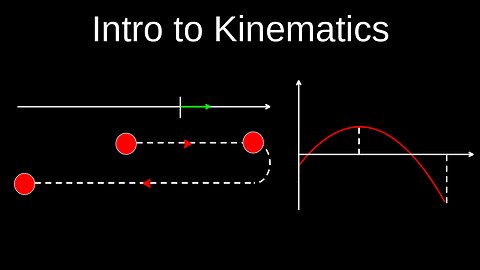
Vectors Vs Scalars, Displacement, Distance, Velocity, Speed, Acceleration - Physics (Mechanics)
DrOfEngKinematics quantities are the fundamental concepts used to describe the motion of objects, including position (or displacement), velocity, acceleration, and time. They can be related through kinematic equations to analyze motion without considering the forces causing it. A more advanced quantity is jerk, which is the rate of change of acceleration. 💡Key kinematics quantities • Displacement (\(s\) or \(\Delta x\)): The change in an object's position. It is a vector quantity, meaning it includes both magnitude and direction. • Velocity (\(v\)): The rate of change of displacement with respect to time. It is a vector quantity that describes both speed and direction. • Acceleration (\(a\)): The rate of change of velocity with respect to time. It is also a vector quantity. • Time (\(t\)): The duration of the motion being analyzed. • Initial velocity (\(u\) or \(v_{0}\)): The velocity of an object at the beginning of the time interval being studied. • Final velocity (\(v\) or \(v_{f}\)): The velocity of an object at the end of the time interval being studied. • Jerk: The rate of change of acceleration with respect to time, which becomes relevant when forces are changing. 💡Relationship to forces Kinematics describes motion on its own, separate from the forces that cause it. However, acceleration is directly caused by the net force acting on an object, according to Newton's laws of motion. 💡Worksheets are provided in PDF format to further improve your understanding: • Questions Worksheet: https://drive.google.com/file/d/1FZHK2lvewIfauVNmVxQprxLvhBZfVv02/view?usp=drive_link • Answers: https://drive.google.com/file/d/1h8pFAHvhQo5qqSPsfYA9GETrdjMQg8z8/view?usp=drive_link 💡Chapters: 00:00 Vectors vs scalars 01:30 Displacement, distance 03:13 Average speed and velocity 04:39 Instantaneous speed and velocity 05:59 Acceleration 07:51 Worked examples 🔔Don’t forget to Like, Share & Subscribe for more easy-to-follow Calculus tutorials. 🔔Subscribe: https://rumble.com/user/drofeng _______________________ ⏩Playlist Link: https://rumble.com/playlists/d3cTgspk0Ro _______________________ 💥 Follow us on Social Media 💥 🎵TikTok: https://www.tiktok.com/@drofeng?lang=en 𝕏: https://x.com/DrOfEng 🥊: https://youtube.com/@drofeng30 views 1 comment -
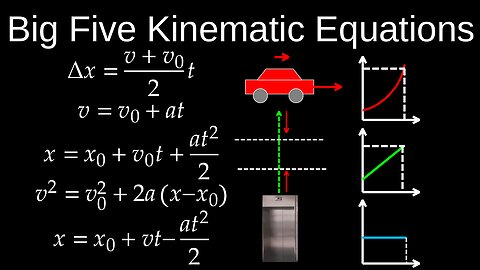
Big Five Kinematics, Uniform Acceleration, How to Select, Intervals, Objects - Physics (Mechanics)
DrOfEngThe "big five" in kinematics refers to the five key quantities used to describe motion with constant acceleration: displacement (\(\Delta x\)), initial velocity (\(v_{i}\)), final velocity (\(v_{f}\)), acceleration (\(a\)), and time (\(t\)). These five quantities are interconnected by five fundamental kinematic equations, allowing you to solve for an unknown variable if you know the other four. 💡The five kinematic quantities • Displacement (\(\Delta x\) or \(s\)): The change in an object's position, measured in meters (m). • Initial velocity (\(v_{i}\) or \(u\)): The velocity of an object at the beginning of a time interval, measured in meters per second (m/s). • Final velocity (\(v_{f}\) or \(v\)): The velocity of an object at the end of a time interval, measured in meters per second (m/s). • Acceleration (\(a\)): The rate at which velocity changes, measured in meters per second squared (\(m/s^{2}\)). • Time (\(t\)): The duration of the motion, measured in seconds (s). 💡The five kinematic equations These equations apply when acceleration is constant. • \(v_{f}=v_{i}+at\) • \(\Delta x=v_{i}t+\frac{1}{2}at^{2}\) • \(v_{f}^{2}=v_{i}^{2}+2a\Delta x\) • \(\Delta x=\frac{1}{2}(v_{i}+v_{f})t\) • \(v_{avg}=\frac{v_{i}+v_{f}}{2}\) and \(\Delta x=v_{avg}t\) (when acceleration is constant, average velocity is the arithmetic mean of the initial and final velocities) 💡How to use the big five • Identify the known and unknown variables in a given problem. • Select the equation that contains the known variables and the one you want to find. • Solve the equation for the unknown variable. 💡Worksheets are provided in PDF format to further improve your understanding: • Questions Worksheet: https://drive.google.com/file/d/1FZHK2lvewIfauVNmVxQprxLvhBZfVv02/view?usp=drive_link • Answers: https://drive.google.com/file/d/1h8pFAHvhQo5qqSPsfYA9GETrdjMQg8z8/view?usp=drive_link 💡Chapters: 00:00 Big five kinematic equations 02:26 Selecting kinematic equations, multiple intervals 04:34 Selecting kinematic equations, multiple objects 06:02 Worked examples 🔔Don’t forget to Like, Share & Subscribe for more easy-to-follow Calculus tutorials. 🔔Subscribe: https://rumble.com/user/drofeng _______________________ ⏩Playlist Link: https://rumble.com/playlists/d3cTgspk0Ro _______________________ 💥 Follow us on Social Media 💥 🎵TikTok: https://www.tiktok.com/@drofeng?lang=en 𝕏: https://x.com/DrOfEng 🥊: https://youtube.com/@drofeng15 views -
Reference Frames, Relative Motion, Velocity, Vectors, Questions, Examples - Physics (Mechanics)
DrOfEngRelative motion is the concept of describing how an object's position or velocity changes from the perspective of another moving object or a specific frame of reference. Motion is not absolute; it is always relative to an observer's chosen point of reference, which can be a stationary point or another moving object. For example, a person walking on a moving train is stationary relative to someone on the train but appears to be moving relative to someone standing on the ground outside the train. 💡Key concepts • Frame of reference: A coordinate system or point of view used to measure motion. The concept of relative motion is about how a change in position is measured from different frames of reference. • Relative velocity: The velocity of an object as measured by an observer in a different reference frame. This can be calculated by finding the difference between the velocities of the two objects relative to a third, common reference frame. • Vector quantities: Velocity and displacement are vector quantities, meaning they have both magnitude and direction. When calculating relative motion, these vector directions must be considered, often using vector diagrams or equations. • Example: Imagine a car moving at \(60\) mph and a person walking inside it at \(5\) mph in the opposite direction of the car's travel. The person's velocity relative to the ground is \(55\) mph, while their velocity relative to the car is \(5\) mph in the opposite direction. 💡Worksheets are provided in PDF format to further improve your understanding: • Questions Worksheet: https://drive.google.com/file/d/1FZHK2lvewIfauVNmVxQprxLvhBZfVv02/view?usp=drive_link • Answers: https://drive.google.com/file/d/1h8pFAHvhQo5qqSPsfYA9GETrdjMQg8z8/view?usp=drive_link 💡Chapters: 0:00 Reference frames and relative motion 3:45 Worked examples 🔔Don’t forget to Like, Share & Subscribe for more easy-to-follow Calculus tutorials. 🔔Subscribe: https://rumble.com/user/drofeng _______________________ ⏩Playlist Link: https://rumble.com/playlists/d3cTgspk0Ro _______________________ 💥 Follow us on Social Media 💥 🎵TikTok: https://www.tiktok.com/@drofeng?lang=en 𝕏: https://x.com/DrOfEng 🥊: https://youtube.com/@drofeng104 views 1 comment