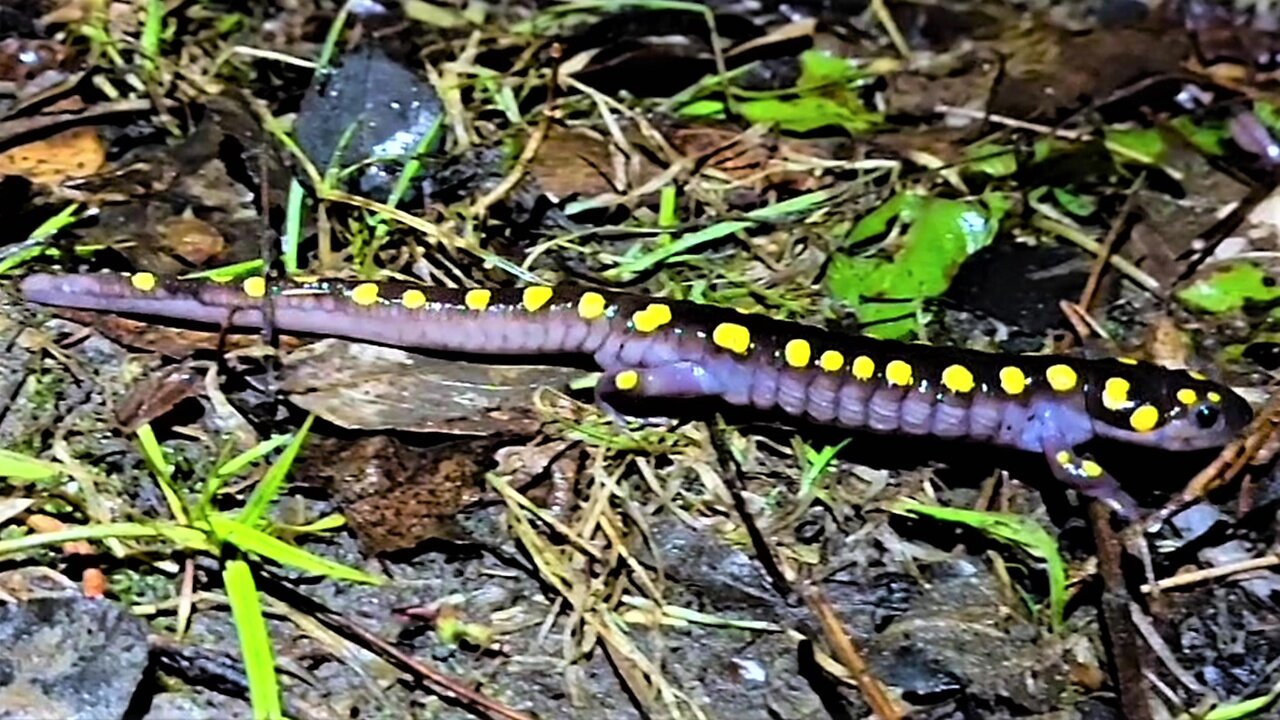
Spotted salamander spring migration is an incredible event to witness
Spotted salamanders are fascinating creatures that live in most forests throughout central and eastern United States and Canada. They are abundant yet we rarely see them. Like other salamanders, they live under leaves and logs, and in the burrows of small rodents and mammals, spending a great deal of the year underground. They eat worms and insects and keep to themselves.
But every year, these salamanders move in unison in great numbers, seeking the closest pond or vernal pool for breeding.
They prefer small bodies of water without fish, which would eat their eggs. The salamanders can journey considerable distances to find their breeding grounds. This migration takes place at night in the early spring when the snow and ice have just begun to melt. Signaled by their hormones, they wait for the first rainy night that is more than 7°C (45°F) to make their trek to the water. The males arrive first and deposit sperm on the leaf litter in the pond. The females arrive soon after and gather the sperm pouches, taking them inside their bodies to fertilize their eggs. They lay the eggs in masses of up to 100 eggs, attached to submerged sticks near the water's edge.
Salamanders have an amazing regenerative ability that allows them to regrow limbs, organs, and even portions of their brains if they are injured. Scientists are particularly interested in understanding this ability and how it might benefit humans.
Spotted salamanders are unique from other species in several ways. They are the only vertebrate animal in the world that hosts another organism in a symbiotic relationship. Typically, when a vertebrate is a host to another organism, it is a parasitical relationship, having no benefit to the host. In this case, the salamander eggs contain an algae that uses sunlight to create energy and oxygen. This benefits the eggs by helping to sustain them as they grow and develop. The algae benefits from the stability and protection of the egg and also from the carbon dioxide that it consumes, which is produced by the eggs.
The spotted salamander also lays eggs that are coated with a unique outer jelly to prevent the eggs from drying out. On some eggs, the jelly morphs into a water soluble, protein based substance, and on other eggs, it becomes a crystalline protein that repels water. The fact that it develops into two different types allows for the survival of eggs when wood frog larvae are present. The wood frogs would eat the water soluble eggs and deplete the population of salamanders. This is where the algae in the eggs is crucial because the crystalline jelly prevents oxygen absorption from the water.
Nature can be complex and fascinating beyond our expectations. The world around us is more of a wonder than we once realized and we would not even realize it if we did not take a close look at some of the small creatures that are right under our feet.
-
 0:43
0:43
WildCreatures
1 month ago $8.44 earnedDiver is swallowed up by a passing bait ball at Darwin Island
23.5K4 -
 3:03:11
TimcastIRL
7 hours agoRob Reiner MURDERED, Son Arrested, Trump Faces Backlash Over Comments | Timcast IRL
273K142 -
![ON THE SUBJECT: Top Christmas Movies That Raised Millennials [Part 1]](https://1a-1791.com/video/fww1/d4/s8/1/M/E/t/I/MEtIz.0kob-small-ON-THE-SUBJECT-Top-Christma.jpg) 1:46:20
1:46:20
megimu32
6 hours agoON THE SUBJECT: Top Christmas Movies That Raised Millennials [Part 1]
46.5K8 -
 57:22
57:22
Flyover Conservatives
1 day agoChina and India are Draining Silver — Prices Are Responding Fast - Dr. Kirk Elliott; Natural Remedy You Don't Know About - Dr. Troy Spurrill | FOC Show
48.9K6 -
 LIVE
LIVE
MissesMaam
6 hours agoARC NOOBS 💚✨
287 watching -
 2:30:28
Anthony Rogers
13 hours agoEpisode 393 - Psychic Readings
24.7K3 -
 44:52
44:52
Donald Trump Jr.
10 hours agoShip Outta Luck, Plus FBI Foils LA Terror Plot and Much More | Triggered Ep.300
247K120 -
 12:50
12:50
Dr. Nick Zyrowski
4 days agoThe AMAZING Health Benefits of NAC ( N-Acetyl Cysteine) - Must See!
47.3K20 -
 1:15:43
We Like Shooting
19 hours ago $5.79 earnedDouble Tap 440 (Gun Podcast)
26.3K -
 59:03
59:03
BonginoReport
10 hours agoEvil Terrorists Target Jewish Celebration - Nightly Scroll w/ Hayley Caronia (Ep.197)
69.3K79