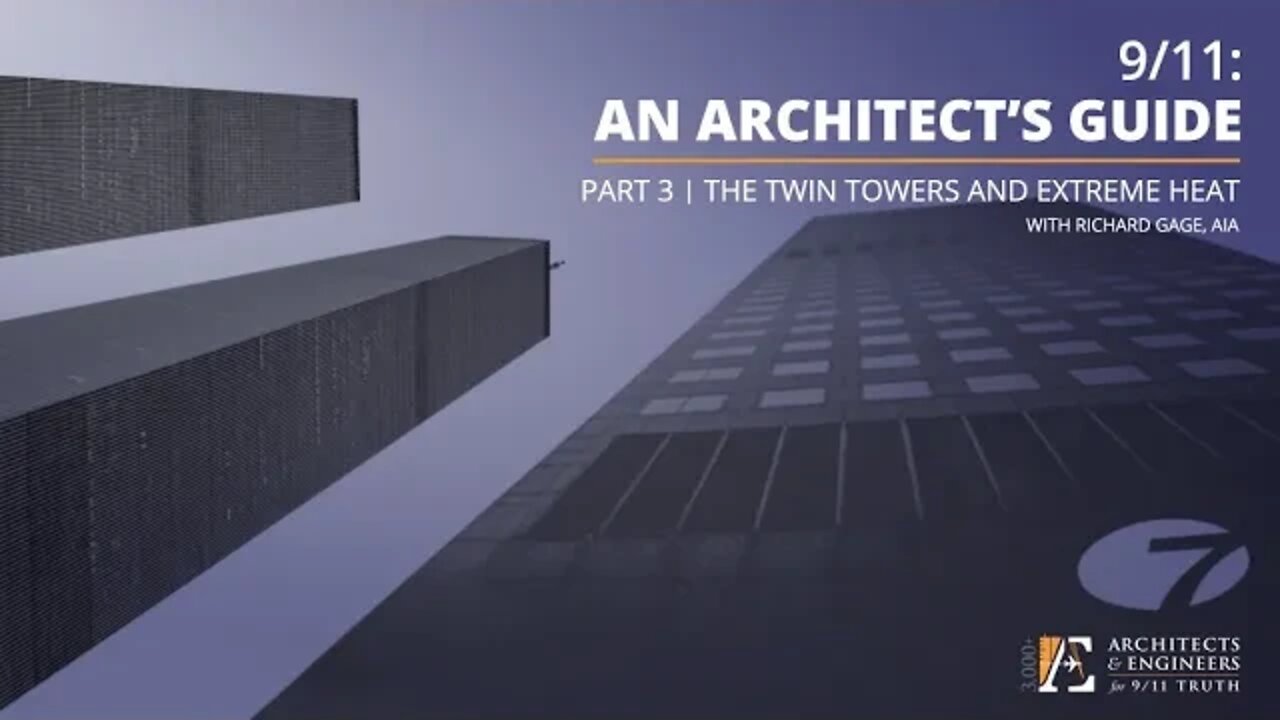
9/11: An Architect's Guide - Part 3: The Twin Towers and Extreme Heat (5/20/21 Webinar - R Gage)
9/11: An Architect’s Guide | Part 3: The Twin Towers and Extreme Heat
Course Number: AE911-AAG-L3
Live three-part webinar series. Each part is about 1 1/2 hours long.
As a 501(c)(3) nonprofit organization dedicated to conducting research and providing education about the complete destruction of the three World Trade Center skyscrapers, our courses give architects the technical knowledge and analytical framework with which to evaluate the most likely cause of those building failures.
Course Description:
Never before has a steel-framed high-rise collapsed from fire. Why, then, did three such buildings collapse on September 11, 2001?
In Part 3 of “9/11: An Architect’s Guide,” Richard Gage, AIA, provides an overview of the most important evidence related to the extreme heat observed both before and after the Twin Towers’ destruction.
As documented extensively in the report issued by the National Institute of Standards and Technology (NIST), molten metal was seen pouring out of the South Tower during the seven minutes leading up to its collapse. Molten metal was also observed in the debris of both buildings, while various other evidence of extreme heat and incendiary chemical reactions have been documented since.
In 2005, NIST concluded that the Twin Towers’ destruction resulted from the combined effects of the airplane impact damage and ensuing fires, both of which are phenomena that fail to account for the extreme heat observed before and after the Twin Towers’ destruction.
Does NIST’s explanation for these unprecedented structural failures explain all of the evidence? Together, we will study the collapses and evaluate which of the two leading hypotheses — fire-induced failure or controlled demolition — is more consistent with the evidence. Participants will be encouraged to decide for themselves if a new investigation is warranted.
Learning Objectives:
Participants will be able to:
1. Describe the characteristics of building fires and the aspects of high-rise design that contribute to make fire-induced failure in steel-framed high-rise buildings a rare occurrence.
2. Recognize the distinct features associated with fire-induced failure and the distinct features associated with the procedure of controlled demolition.
3. Describe step-by-step the series of structural failures that the National Institute of Standards and Technology found to be the most likely cause of the collapse of World Trade Center Twin Towers.
4. Analyze the physical evidence and the dynamics of the collapse of the Twin Towers according to how consistent it is with the competing hypotheses of fire-induced failure and controlled demolition.
Visit http://AE911Truth.org/Continuing-Ed.html for more information.
-
 6:50
6:50
Architects & Engineers for 9/11 Truth
2 years agoProgressive Comedian Jimmy Dore: “Building 7 was a hoax”
5.84K14 -
 17:47
17:47
Degenerate Jay
22 hours ago $0.97 earnedThis Game Deserved 2025 Game Of The Year - Dispatch
4.29K1 -
 25:55
25:55
Welker Farms
17 hours ago $0.46 earnedI'd Say We Make A Pretty Good Team Fix'n These Tractors
3.92K2 -
 8:01
8:01
Gun Owners Of America
15 hours ago40+ Members of Congress Warn DOJ & ATF To Stop Defending the NFA!
4.91K1 -
 LIVE
LIVE
BEK TV
22 hours agoTrent Loos in the Morning - 12/19/2025
147 watching -
 18:47
18:47
stateofdaniel
2 days agoJD Vance DESTROYS Twisted Vanity Fair HIT PIECE Against President Trump and Susie Wiles
57.1K20 -
 15:42
15:42
Actual Justice Warrior
1 day agoWealthy New Jersey School District Goes BROKE Overnight
19.2K22 -
 29:15
29:15
James Klüg
1 day agoI Crashed An ANTI-ICE March In Portland
35.9K31 -
 45:40
45:40
Surviving The Survivor: #BestGuests in True Crime
18 hours agoLIVE Hearing: Kentucky Sheriff Mickey Stines Back in Court; Murder of Judge Kevin Mullins
20.6K1 -
 1:17:00
Man in America
15 hours ago6G Is Coming — And Your Body Will Be Part of the AI-Run Network w/ Kim Bright
308K79