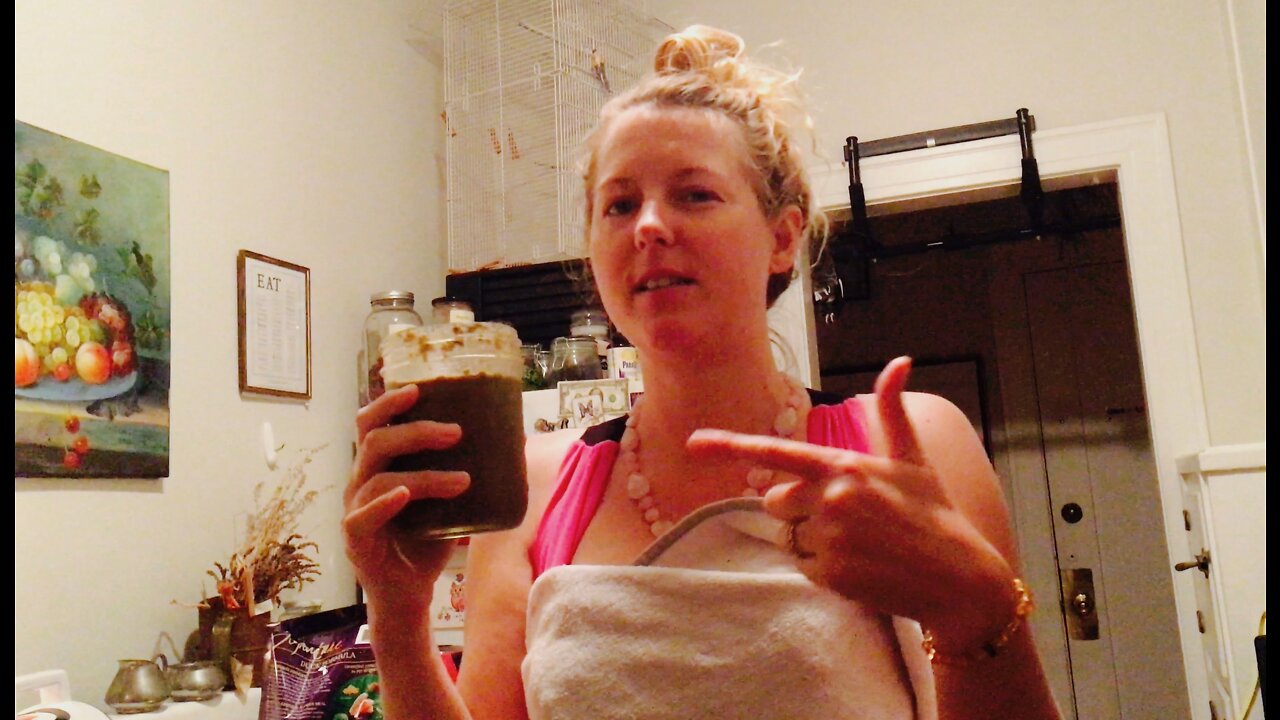
Placenta Smoothie ...That's right
My friend had me consume some of her placenta 5 days after giving birth. Anything for youtube. My friend had me consume some of her placenta 5 days after giving birth. Anything for youtube. Celebrities like January Jones and the Kardashians are doing it. But is the practice of placentophagy simply a fad, or are there actual health benefits to consuming one’s own placenta? According to one cookbook on the subject, you can mix your raw placenta with yoghurt and fruit in a blender and make a smoothie. Or add it to ground beef in a lasagna recipe. Or make chocolate truffles out of it. Dice it, slice it, sauté it with onions, dehydrate it and grind it up – it seems there’s no wrong way to eat placenta.
The practice of placentophagy – the formal name for eating the placenta for health benefits – has been having a moment. What was once an extremely fringe movement has been given a boost by celebrity endorsements from January Jones to the Kardashians. Articles describing personal experiences have popped up everywhere from XOJane to the New York Times. Advocates cite its ability to boost milk production, fight postpartum depression, reduce pain and increase energy in new mothers.
"I ate my wife's placenta raw in a smoothie and cooked in a taco" said one adventurous journalist.
Businesses offering to dry and encapsulate the placenta for those who are too squeamish to eat it with a side of vegetables have sprung up all over the US, generally charging around $250 for the service. Since the encapsulation process is typically done in the home of the new mother, and is for her own consumption, there is no FDA regulation or other oversight of the practice. There are also no uniform laws around releasing a placenta from the hospital with most states allowing hospitals to set their own individual rules.
Eating a human organ might trigger a gag reflex in some, but advocates point to the near ubiquitousness of the practice among mammals. While the exact reasons animals eat their own placentas is not known, scientists speculate one major reason may be to avoid having a bloody enticement to predators next to the new mother and baby. Unlike the modern practice of eating a placenta in dehydrated pill form over a length of time or cooking it for later consumption, animals eat their placentas raw and immediately after giving birth.
Animals may have been doing it before it was cool, but for humans the practice is relatively recent. Daniel Benyshek, associate professor of anthropology at the University of Nevada Las Vegas is one of a few researchers who is studying the practice. He says the first published references to the practice of maternal placentophagy are tied to the home birth and natural birth movement in the US during the 60s. “It is really only in the last ten years that it has become a well-known – if rare – practice,” he says.
The recent popularity of placentophagy may be due in part to greater awareness of it from the media. It may also be finding converts because alternative treatments are becoming more popular as people seek out healthier lifestyles, says Crystal Clark, associate professor in psychiatry and behavioral sciences at the Northwestern University Feinberg School of Medicine. A number of doulas and midwives advocate the practice, which may be another factor driving its popularity. Clark, a psychiatrist, also points out that there remains a stigma around mental health, and with an estimated one out of every seven women experiencing postpartum depression, an alternative to traditional mental health treatments can be appealing.
Because of its relative newness, placentophagy is only now coming to the attention of scientists. Clark and colleagues published a literature review of the practice in the Archives of Women’s Mental Health in June 2015. They found that research into the practice has so far been very sparse, with no placebo-controlled studies in humans to show if consuming a placenta really does have the benefits claimed. Benyshek and his team just completed a pilot study with a placebo that they hope to publish later this year.
With research still in its infancy, it is hard to get an estimate of how many women actually consume their own placentas for the purported benefits. Anecdotally, Clark has heard that the practice is well established in certain areas of the US like San Francisco and Denver. While it is hard to pinpoint the typical demographic, from his survey research, Benyshek has found that most are “women in their late twenties, Caucasian, with at least some college education and with a middle to upper-middle class family income”. However, he cautions that his research may not be representative of all women who practice placentophagy. The practice may be more common amongst mothers who chose a homebirth, says Benyshek, though mothers giving birth in hospitals also practice it.
-
 9:10
9:10
Millionaire Mentor
14 hours agoGAO Exposes the Dirty Obamacare Secret Democrats Ignored for Years
11.1K5 -
 50:51
50:51
Mike Mac - Say Something
14 hours agoSay Something Beyond w/MikeMac: TIM LEE - Ep.18
11.5K1 -
 LIVE
LIVE
BEK TV
2 days agoTrent Loos in the Morning - 12/15/2025
108 watching -
 8:04
8:04
MattMorseTV
15 hours ago $26.70 earned10,000,000 of THEM just got SHUT DOWN.
66.9K58 -
 22:48
22:48
Nikko Ortiz
21 hours agoShooting Up The Kitchen...
132K8 -
 24:39
24:39
GritsGG
14 hours agoWe Are The Regain Kings! We Refuse to Lose On Warzone!
32.3K3 -
 2:04:53
Sam Tripoli
14 hours ago $8.37 earned#949: Beware Of The Red Shoes With Shannon Rowan
24.1K6 -
 22:11
22:11
The Pascal Show
22 hours ago $4.74 earned'TPUSA IS LYING!' Candace Owens DOUBLES DOWN On Charlie Kirk Theories! Is Erika Kirk Lying?!
29.7K9 -
 1:53:05
TruthStream with Joe and Scott
1 day agoNick Alvear: The positive and negative of AI, it's use in film and his new animated series Lucky Larry on GoodLion.TV other topics, Roxiva Light Therapy, Yoga Nidra: Live 12/14/25 #527
21.6K6 -
 3:11:53
The Shuli Network
17 hours agoEXCLUSIVE Hidden Camera Footage Of Stuttering John | The Uncle Rico Show
39.4K18