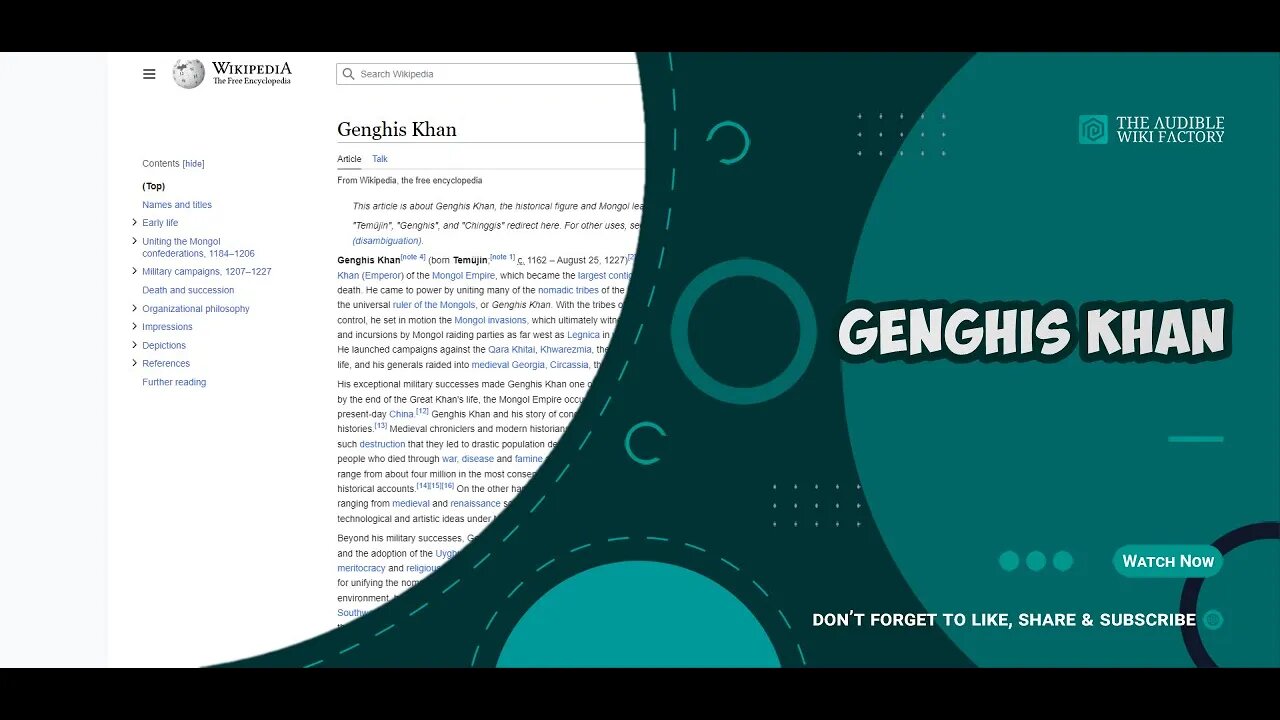
Genghis Khan was the founder and first Great Khan of the Mongol Empire, which became the
Genghis Khan (born Temüjin) was the founder and first Great Khan (Emperor) of the Mongol Empire, which became the largest contiguous empire in history after his death. He came to power by uniting many of the nomadic tribes of the Mongol steppe and being proclaimed the universal ruler of the Mongols, or Genghis Khan. With the tribes of Northeast Asia largely under his control, he set in motion the Mongol invasions, which ultimately witnessed the conquest of much of Eurasia, and incursions by Mongol raiding parties as far west as Legnica in western Poland and as far south as Gaza. He launched campaigns against the Qara Khitai, Khwarezmia, the Western Xia and Jin dynasty during his life, and his generals raided into medieval Georgia, Circassia, the Kievan Rus', and Volga Bulgaria.
His exceptional military successes made Genghis Khan one of the most important conquerors of all time, and by the end of the Great Khan's life, the Mongol Empire occupied a substantial portion of Central Asia and present-day China. Genghis Khan and his story of conquest have a fearsome reputation in local histories. Medieval chroniclers and modern historians describe Genghis Khan's conquests as resulting in such destruction that they led to drastic population declines in some regions. Estimates of the number of people who died through war, disease and famine as a consequence of Genghis Khan's military campaigns range from about four million in the most conservative estimates to up to sixty million in the most sweeping historical accounts. On the other hand, Genghis Khan has also been portrayed positively by authors ranging from medieval and renaissance scientists in Europe to modern historians for the spread of technological and artistic ideas under Mongol influence.
Beyond his military successes, Genghis Khan's civil achievements included the establishment of Mongol law and the adoption of the Uyghur script as a writing system across his vast territories. He also practiced meritocracy and religious tolerance. Present-day Mongolians regard him as the founding father of Mongolia for unifying the nomadic tribes of Northeast Asia. By bringing the Silk Road under one cohesive political environment, he also considerably eased communication and trade between Northeast Asia, Muslim Southwest Asia, and Christian Europe, boosting global commerce and expanding the cultural horizons of all the Eurasian civilizations of the day.
NAMES AND TITLES
According to The Secret History of the Mongols, Genghis Khan's birth name Temüjin came from the Tatar chief Temüjin-üge whom his father had just captured. The name Temüjin is also equated with the Turco-Mongol temürči(n), "blacksmith", and there existed a tradition that viewed Genghis Khan as a smith, according to Paul Pelliot, which, though unfounded, was well established by the middle of the 13th century.
Genghis Khan is an honorary title meaning "universal ruler" that represents an aggrandization of the pre-existing title of Khan that is used to denote a clan chief in Mongolian. The appellation of "Genghis" to the term is thought to derive from the Turkic word "tengiz", meaning sea, making the honorary title literally "oceanic ruler", but understood more broadly as a metaphor for the universality or totality of Temüjin's rule from a Mongol perspective.
When Kublai Khan established the Yuan dynasty in 1271, he had his grandfather Genghis Khan placed in official records and accorded him the temple name Taizu and the posthumous name Emperor Shengwu. Genghis Khan is thus also referred to as Yuan Taizu (Emperor Taizu of Yuan) in Chinese historiography. Külüg Khan later expanded Genghis Khan's title to Emperor Fatian Qiyun Shengwu.
EARLY LIFE
LINK TO ARTICLE: http://en.wikipedia.org/wiki/Genghis_Khan
TAGS: Genghis Khan, Founding monarchs, Medieval slaves, Medieval military leaders, Mongol Empire people, Genocide perpetrators, Deaths by horse-riding accident, Year of birth uncertain, 13th-century Chinese monarchs, 12th-century Mongol rulers, 13th-century Mongol rulers, Great Khans of the Mongol Empire, People from Khentii Province, Genghis Khan
#GeneralKnowledge #AudibleWikiFactory #Audible #Wikipedia #GenghisKhan
-
 13:12
13:12
The Audible Wiki Factory
2 years agoThe Carnival of Venice is an annual festival held in Venice, Italy. The carnival ends on Shrove
563 -
 44:52
44:52
Donald Trump Jr.
5 hours agoShip Outta Luck, Plus FBI Foils LA Terror Plot and Much More | Triggered Ep.300
215K94 -
 12:50
12:50
Dr. Nick Zyrowski
4 days agoThe AMAZING Health Benefits of NAC ( N-Acetyl Cysteine) - Must See!
24.4K12 -
 LIVE
LIVE
We Like Shooting
13 hours ago $1.11 earnedDouble Tap 440 (Gun Podcast)
250 watching -
 59:03
59:03
BonginoReport
4 hours agoEvil Terrorists Target Jewish Celebration - Nightly Scroll w/ Hayley Caronia (Ep.197)
51.2K52 -
 1:02:27
The Nick DiPaolo Show Channel
6 hours agoRob Reiner, Wife Slaughtered | The Nick Di Paolo Show #1828
42.4K29 -
 22:03
22:03
Jasmin Laine
9 hours agoCBC Host Left SPEECHLESS as Poilievre Uses Their OWN Words Against Them
23.4K24 -

LFA TV
1 day agoLIVE & BREAKING NEWS! | MONDAY 12/15/25
214K53 -
 1:18:27
Kim Iversen
5 hours agoShould Muslims Be Allowed in the West? | Candace and Erika Kirk FACE OFF
100K202 -
 1:59:22
The Mike Schwartz Show
9 hours agoTHE MIKE SCHWARTZ SHOW Evening Edition 12-15-2025
20K3