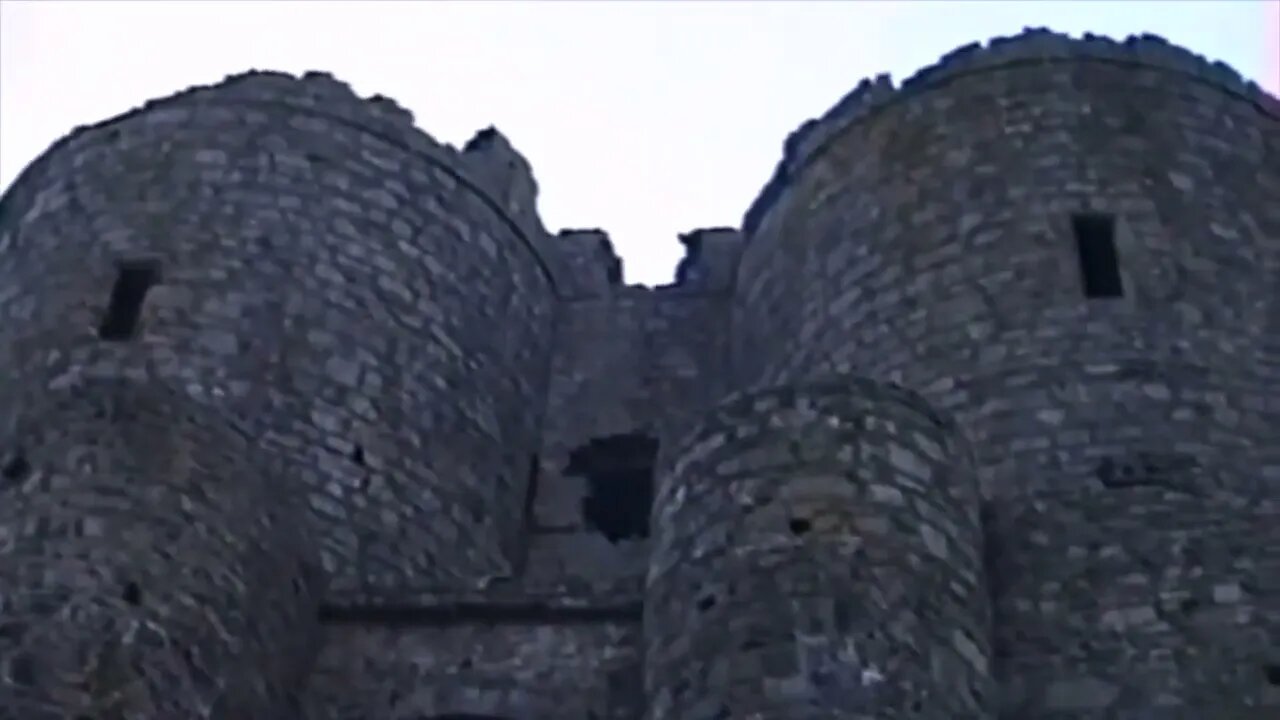
Harlech castle North Wales Christmas 1991.
#wales #castles #caernarfon #harlech #menofharlech
Caernarfon Castle (Welsh: Castell Caernarfon Welsh pronunciation: [kastɛɬ kaɨrˈnarvɔn]) – often anglicised as Carnarvon Castle or Caernarvon Castle – is a medieval fortress in Caernarfon, Gwynedd, north-west Wales cared for by Cadw, the Welsh Government's historic environment service. It was a motte-and-bailey castle from the late 11th century until 1283 when King Edward I of England began to replace it with the current stone structure. The Edwardian town and castle acted as the administrative centre of north Wales, and as a result the defences were built on a grand scale. There was a deliberate link with Caernarfon's Roman past, and the Roman fort of Segontium is nearby.
While the castle was under construction, town walls were built around Caernarfon. The work cost between £20,000 and £25,000 from the start until the work ended in 1330. Although the castle appears mostly complete from the outside, the interior buildings no longer survive and many of the building plans were never finished. The town and castle were sacked in 1294 when Madog ap Llywelyn led a rebellion against the English. Caernarfon was recaptured the following year. During the Glyndŵr Rising of 1400–1415, the castle was besieged. When the Tudor dynasty ascended to the English throne in 1485, tensions between the Welsh and English began to diminish and castles were considered less important. As a result, Caernarfon Castle was allowed to fall into a state of disrepair. Despite its dilapidated condition, during the English Civil War Caernarfon Castle was held by Royalists, and was besieged three times by Parliamentarian forces. This was the last time the castle was used in war. The castle was neglected until the 19th century when the state funded repairs. The castle was used for the investiture of the Prince of Wales in 1911 and again in 1969. It is part of the World Heritage Site "Castles and Town Walls of King Edward in Gwynedd".
Harlech Castle (Welsh: Castell Harlech; Welsh pronunciation: [kastɛɬ ˈharlɛχ]) in Harlech, Gwynedd, Wales, is a Grade I listed medieval fortification built onto a rocky knoll close to the Irish Sea. It was built by Edward I during his invasion of Wales between 1282 and 1289 at the relatively modest cost of £8,190. Over the next few centuries, the castle played an important part in several wars, withstanding the siege of Madog ap Llywelyn between 1294 and 1295, but falling to Prince Owain Glyndŵr in 1404. It then became Glyndŵr's residence and military headquarters for the remainder of the uprising until being recaptured by English forces in 1409. During the 15th century Wars of the Roses, Harlech was held by the Lancastrians for seven years, before Yorkist troops forced its surrender in 1468, a siege memorialised in the song "Men of Harlech". Following the outbreak of the English Civil War in 1642, the castle was held by forces loyal to Charles I, holding out until 1647 when it became the last fortification to surrender to the Parliamentary armies. In the 21st century the ruined castle is managed by Cadw, the Welsh Government's historic environment service, as a tourist attraction.
UNESCO considers Harlech, with three others at Beaumaris, Conwy, Caernarfon, to be one of "the finest examples of late 13th century and early 14th century military architecture in Europe", and it is classed as a World Heritage Site.
Beddgelert (Welsh: [bɛðˈgɛlɛrt] (listen)) is a village and community in the Snowdonia area of Gwynedd, Wales. The population of the community taken at the 2011 census was 455, and includes Nantmor and Nant Gwynant. It is reputed to be named after the legendary hound Gelert. The community is large and sparsely populated and covers 86 square kilometres.
Location
The village stands in a valley at the confluence of the River Glaslyn and the River Colwyn. Just above the confluence of the rivers, in the centre of the village, is an old stone bridge with two arches. The River Gwynant also exists in the area, coinciding with the River Colwyn under what locals know as ‘Pont Bren’, creating the River Glaslyn. Many of the houses and hotels are built of local dark stone. To the west is Moel Hebog and its neighbours to the north and a series of hills rising to the top of Snowdon. A lane of the A4085 between Caernarfon (13 miles north) and Porthmadog (8 miles south) runs through the village.
Join this channel to get access to perks:
https://www.youtube.com/channel/UCZYzeFLY7XPn88MDsePlDBw/join
#learntoflyinVR
-
 LIVE
LIVE
Matt Kohrs
12 hours agoLive Day Trading, Breaking Market News & Options Analysis || Stock Market Open
563 watching -
 LIVE
LIVE
Wendy Bell Radio
6 hours agoTime To Take Out The Trash
7,581 watching -
 1:09:52
Chad Prather
14 hours agoHow God Turns Pressure Into Purpose
68.6K29 -
 LIVE
LIVE
LFA TV
12 hours agoLIVE & BREAKING NEWS! | WEDNESDAY 12/03/25
3,005 watching -
 1:05:24
Crypto Power Hour
13 hours ago $5.95 earnedVanguard Finally! XRP ETF’s
54.3K7 -
 13:40
13:40
ARFCOM News
19 hours ago $2.51 earnedHis Wife Got Cancer So They Took His Guns + DoJ's 2A Rights Division + Trump Slump Continues
35.2K15 -
 13:19
13:19
Degenerate Jay
19 hours ago $2.86 earnedThis Fallout: New Vegas Discovery Could Change Everything
37.9K -
 33:35
33:35
ArturRehi
22 hours agoNERVES OF STEEL - American Fighters Are not Easy to Frighten in Ukraine
35.6K5 -
 2:05:17
BEK TV
1 day agoTrent Loos in the Morning - 12/03/2025
36.8K1 -
 4:01:59
The Bubba Army
1 day agoTRUMP SAYS NO MORE INCOME TAX? - Bubba the Love Sponge® Show | 12/03/25
48.5K7