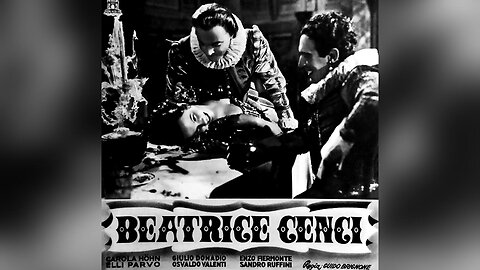
Beatrice Cenci (Film 1941)
Adaneth - Cinema&TV
Beatrice Cenci è un film del 1941 diretto da Guido Brignone.
Delle sette pellicole narranti la tragica vicenda della nobildonna romana vissuta nel '500, questa è la prima del periodo sonoro (escludendo la pellicola del 1926 di Baldassarre Negroni girata muta, ma in seguito sonorizzata e ridistribuita nel 1930).
L'azione del film si svolge alla fine del XVI secolo tra Roma e l'Abruzzo. Il conte romano Francesco Cenci, uomo dissoluto e violento, è condannato per debiti a sette mesi di esilio da trascorrere in una lontana rocca dell'Abruzzo. Vero tiranno, esige che i membri della propria famiglia lo accompagnino, il che addolora soprattutto la figlia Beatrice costretta a lasciare il proprio fidanzato per seguire il padre.
Interpreti e personaggi:
Carola Höhn: Beatrice Cenci
Giulio Donadio: Francesco Cenci
Tina Lattanzi: Lucrezia Cenci
Osvaldo Valenti: Giacomo Cenci
Elli Parvo: Angela
Luigi Pavese: Catalano
Arturo Bragaglia: don Lorenzo
Sandro Ruffini: giudice Moscato
Gualtiero De Angelis: Curzio
Marcello Giorda: presidente del tribunale
Enzo Fiermonte: Olimpio Calvetti
Emilio Petacci: Prospero Farinacci
Roberto Pasetti: l'usuraio
Carlo Duse: capitano dei gendarmi
Pina Gallini: governante di don Lorenzo
Nino Marchetti: contadino alla taverna
Nino Marchesini: castellano
Giovanni Onorato: primo bandito
Angelo Dessy: secondo bandito
Marino Girolami
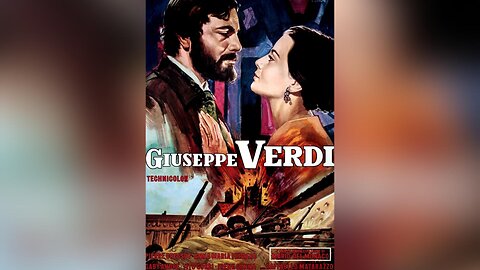
Giuseppe Verdi (Film 1953 - AUD ENG)
Adaneth - Cinema&TV
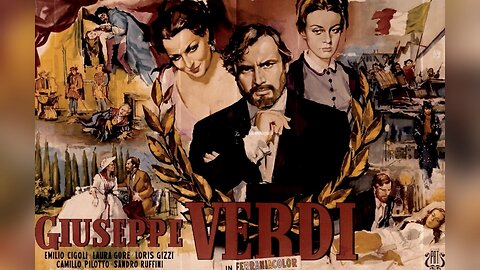
Giuseppe Verdi, released theatrically in the US as The Life and Music of Giuseppe Verdi and on video as Verdi, the King of Melody, is a 1953 Italian biographical musical melodrama film starring Pierre Cressoy and directed by Raffaello Matarazzo. It is based on adult life events of the composer Giuseppe Verdi. Audio (dubbed) in English.
The life and loves of great composer Giuseppe Verdi are played against a background of the great operas of the 19th Century. A tender love story of his successful and turbulent life, with more than 20 excerpts from his acclaimed operas.
Cast & Characters:
Pierre Cressoy as Giuseppe Verdi
Anna Maria Ferrero as Margherita Barezzi
Gaby André as Giuseppina Strepponi
Irene Genna as Violetta
Laura Gore as Berberina Strepponi
Camillo Pilotto as Antonio Barezzi
Emilio Cigoli as Gaetano Donizetti
Loris Gizzi as Gioachino Rossini
Mario Del Monaco as Francesco Tamagno
Tito Gobbi as Domenico Ronconi
Aldo Bufi Landi as Alexandre Dumas, fils
Guido Celano as Victor Hugo
Franca Dominici as Rossini's Wife
Mario Ferrari as Austrian Official
Enrico Glori as Stage Director
Turi Pandolfini as Bank Teller
Teresa Franchini as Old Lady
Gianni Agus
Olga Vittoria Gentili
Liana Del Balzo
Lola Braccini
Anna Vivaldi
Lucia Banti
Giuseppe Verdi (Film 1953 - AUD ITA)
Adaneth - Cinema&TV
Giuseppe Verdi è un film del 1953 diretto da Raffaello Matarazzo, con sceneggiatura di; Leonardo Benvenuti [Leo Benvenuti], Liana Ferri, Mario Monicelli, Piero Pierotti, Giovanna Soria, Raffaele Matarazzo.
Si tratta della biografia romanzata del celebre compositore Giuseppe Verdi.
Il film ebbe molto successo tra il pubblico. Risultò il terzo maggior incasso in Italia della stagione cinematografica 1953-1954, preceduto solamente da Pane, amore e fantasia di Luigi Comencini e da Il ritorno di don Camillo di Julien Duvivier.
Nel 2016 è stato presente nella sezione Festa Mobile / Festa Vintage del 34° Torino Film Festival in una versione restaurata e colorizzata (la pellicola originale fu realizzata in bianco e nero) dalla Cineteca Nazionale.
Interpreti & Personaggi:
Pierre Cressoy: Giuseppe Verdi
Anna Maria Ferrero: Margherita Barezzi
Gaby André: Giuseppina Strepponi
Laura Gore: Berberina Strepponi
Camillo Pilotto: Antonio Barezzi
Emilio Cigoli: Gaetano Donizetti
Loris Gizzi: Gioachino Rossini
Mario Del Monaco: Francesco Tamagno
Tito Gobbi: Giorgio Ronconi
Aldo Bufi Landi: Alexandre Dumas figlio
Guido Celano: Victor Hugo
Irene Genna: Violetta
Franca Dominici: moglie di Rossini
Mario Ferrari: ufficiale austriaco
Enrico Glori: direttore teatro
Turi Pandolfini: impiegato del banco dei pegni
Sandro Ruffini: impresario Varelli
Enzo Biliotti: impresario Martini
Gianni Agus
Olga Vittoria Gentili
Liana Del Balzo
Lola Braccini
Anna Vivaldi
Teresa Franchini
Lucia Banti
Eugenia Grandet (Film 1946-ENG SUB)
Adaneth - Cinema&TV
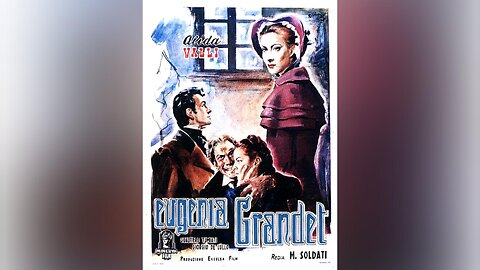
Eugenia Grandet (also known as Eugenie Grandet) is a 1946 Italian historical drama film directed by Mario Soldati. It is based on the 1833 novel Eugénie Grandet by Honoré de Balzac. Audio in Italian with English subtitles (click on CC for subtitles).
The novel has been adapted into films on a number of occasions. The film's sets were designed by art director Gastone Medin.
The film entered the competition at the 7th Venice International Film Festival. For her performance Alida Valli won the Nastro d'Argento for Best Actress. The film also won the Nastro d'Argento for Best Scenography.
Cast & Characters: Alida Valli as Eugenia Grandet
Giorgio De Lullo as Charles Grandet
Gualtiero Tumiati as Felix Grandet
Giuditta Rissone as Eugenia's mother
Maria Bodi as Madame Des Grassins
Giuseppe Varni as Mr. Des Grassins
Pina Gallini as Nanon
Lina Gennari as Marquise D'Aubrion
Enzo Biliotti as Notary Cruchet
Liana Del Balzo
Pane, amore e…/Scandal in Sorrento (Film 1955 - MULTISUB)
Adaneth - Cinema&TV
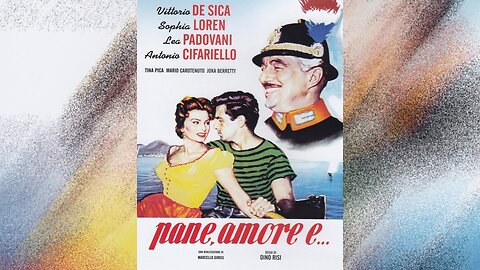
Pane, amore e...(English title: Scandal in Sorrento) is a 1955 Italian comedy film directed by Dino Risi. Audio in Italian with subtitles in; Italian, English, German, Russian, Frenach and Spanish (Click on CC for subtitles).
This is the third film of the trilogy, formed by Bread, Love and Dreams in 1953, Bread, Love and Jealousy in 1954. Innovations include the use of color rather than black and white, as well the location of Sorrento instead of the small village of the previous films of the series. At the 6th Berlin International Film Festival it won the Honorable Mention (Best Humorous Film) award.
Cast & Characters:
Vittorio De Sica as Maresciallo Carotenuto
Sophia Loren as Donna Sofia, a Smargiassa
Lea Padovani as Donna Violante Ruotolo
Antonio Cifariello as Nicola Pascazio, Nicolino
Tina Pica as Caramella
Mario Carotenuto as Don Matteo Carotenuto
Virgilio Riento as Don Emidio
Pane, amore e gelosia/Bread, Love and Jealousy (Film 1954 - MUSLTISUB)
Adaneth - Cinema&TV
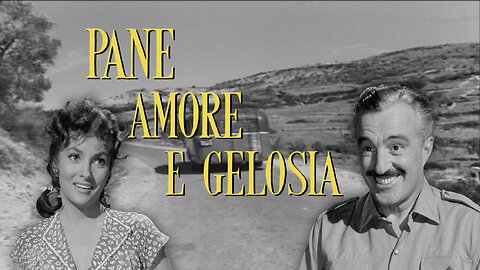
Pane, amore e gelosia known as Frisky in the US, is a 1954 Italian romantic comedy film directed by Luigi Comencini. Audio in Italian with subtitles in; Italian, English, Russian and French (click on CC for subtitles).
It is the second part of the Italian trilogy, preceded by Bread, Love and Dreams and followed by Scandal in Sorrento.
Cast & Characters:
Vittorio De Sica as Antonio Carotenuto
Gina Lollobrigida as Maria De Ritis
Marisa Merlini as Annarella Mirziano
Maria-Pia Casilio as Paoletta
Virgilio Riento as Don Emidio
Tina Pica as Caramella
Tecla Scarano as Teresinella
Saro Urzì as Don Nicola, il capocomico
Roberto Risso as Pietro Stelluti
Memmo Carotenuto as Sirio Baiocchi
Vittoria Crispo as Maria Antonia De Ritis
Pane, amore e fantasia/Bread, Love and Dreams (Film 1953 - MULTISUB)
Adaneth - Cinema&TV
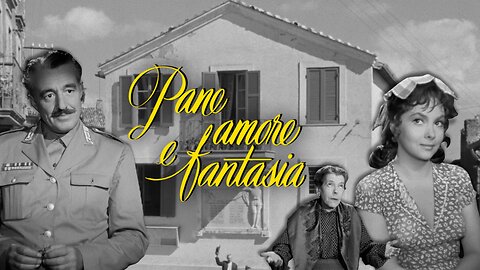
Pane, amore e fantasia (English Title: Bread, Love and Dreams) is a 1953 Italian romantic comedy film directed by Luigi Comencini. Audio in Italian with subtitles in; English, Russian and Italian (click on CC for subtitles).
At the 4th Berlin International Film Festival it won the Silver Bear award. In 2008, the film was included on the Italian Ministry of Cultural Heritage’s 100 Italian films to be saved, a list of 100 films that "have changed the collective memory of the country between 1942 and 1978".
The film is set in Sagliena, an imaginary small town in central Italy; Marshal Antonio Carotenuto, an elderly womanizer who will have to adapt to the monotonous and quiet life of the village, is transferred here immediately after the war. Supported by the maid Caramella, the marshal runs the local Carabinieri station. Here he meets "Pizzicarella la Bersagliera", a young local girl secretly in love with the carabiniere Stelluti.
Audace colpo dei soliti ignoti/Fiasco in Milan (Film 1959 - ENG SUB)
Adaneth - Cinema&TV
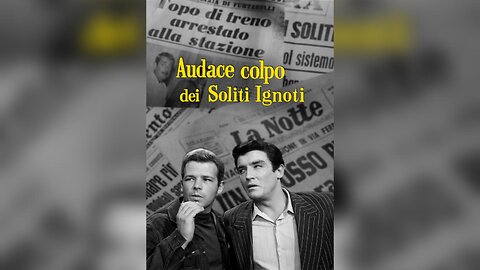
Audace colpo dei soliti ignoti (also known as Fiasco in Milan or Hold-up à la milanaise) is a 1959 Italian comedy crime film directed by Nanni Loy. Audio in Italian with English and Italian subtitles (click on CC for subtitles).
The film stars Vittorio Gassman, Renato Salvatori and Claudia Cardinale.
It is the sequel to Mario Monicelli's I soliti ignoti (1958) and is followed by Big Deal After 20 Years (1985).
I soliti ignoti/Big Deal on Madonna Street (Film 1958-ENG SUB)
Adaneth - Cinema&TV
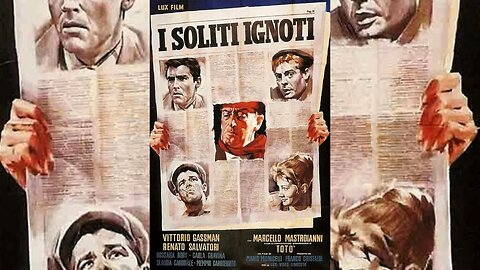
I soliti ignoti (released as Big Deal on Madonna Street in US and as Persons Unknown in the UK) is a 1958 Italian comedy caper film directed by Mario Monicelli. Audio in Italian with English subtitles (click on CC for subtitles).
Regarded as one of the masterpieces of Italian cinema, the film received an Academy Award nomination for Best Foreign Language Film.
The plot revolves around the comedic mishaps of a group of small-time thieves attempting to burgle a pawn shop in Rome. The main characters are portrayed by Vittorio Gassman, Renato Salvatori, Carlo Pisacane, Tiberio Murgia, and Marcello Mastroianni. The film contributed significantly to the careers of Gassman and Mastroianni, with the former breaking into comedic roles previously considered unsuitable for him.
Claudia Cardinale makes a minor appearance as a chaste Sicilian girl constrained by her overprotective brother, portrayed by Murgia. Cardinale achieved fame for her subsequent work. The film's breezy jazz score by composer Piero Umiliani contributed to the development of the jazz soundtracks characteristic of European films in the 1960s and 1970s.
Initially doubtful about the film's potential success, the producers strategically featured the comedian Totò on the original poster to generate audience attention. Totò's character serves as a consultant to the heist gang instead of directly joining them.
In 2008, it was included in the Italian Ministry of Cultural Heritage's list of 100 Italian films to be saved, acknowledging its impact on the collective memory of the country between 1942 and 1978.
The film's original Italian title literally translates as "the usual unknown ones," which is roughly equivalent to the English phrase "the usual suspects." The name of the Roman street in the English title is a slight mistranslation, as the Italian name of the fictional Roman street where the burglary takes place is the Via delle Madonne ("The Street of the Madonnas") rather than "Madonna Street." Compounding the confusion is the fact that the real Roman street on which the scene was filmed is the Via delle tre cannelle ("The Street of the Three Spouts"), rather than the Via delle tre Madonne ("The Street of the Three Madonnas").
According to director Mario Monicelli, while the film was intended as a parody of neorealism, "by then neorealism was already a thing of the past, something that was surpassed. It was more a parody that was aligned with a certain realism around us, with the poverty, and with people who had to do the best they could with whatever means possible to survive, with petty crimes."
Asked if it was also a parody of Jules Dassin's film Rififi, Monicelli said: "Yes because we saw this as a film shot in a very harsh, realist style. Very scientific, as the Peppe character continually says. So we wanted to do the same thing, but the characters didn't have the means. The way they worked was quite the contrary actually."
Monicelli and cinematographer Gianni Di Venanzo agreed on a photographic tone that was not comedic or brightly lit. "On the contrary," Monicelli said, "harsh and dramatic, because the film has a dramatic side in that it is about poor people. But Di Venanzo understood the tone. To make people laugh with a story that was dramatic rather than comic. But seen with a comic eye."
The film was shot in ten weeks on locations throughout Rome. Monicelli said: "The only interior that was shot in a studio was the wall that gets broken into at the end, because I couldn't break a wall in an actual apartment! But all the other interiors were shot on location. Which of course was a particular trait of Italian cinema, to shoot on location."
According to Monicelli, the film adhered to the script, without improvisations.
The film was a hit in Italy when it was released and won two Italian Nastro d'Argento awards: Best Leading Actor (Gassman) and Best Screenplay. It also garnered the prestigious Silver Shell for Best Director at the San Sebastián Film Festival in Spain. The film won Best Comedy at the 12th annual Locarno Film Festival in Switzerland. The film was also Italy's Oscar nominee for Best Foreign Language Film at the 31st Academy Awards. It lost to Jacques Tati's Mon Oncle.
Two remakes of the film were shot in the United States: the 1984 film Crackers by Louis Malle (set in San Francisco) and the 2002 film Welcome to Collinwood by Anthony Russo and Joe Russo (set in Cleveland).
Bob Fosse created a Broadway musical titled Big Deal based on the film. Set in 1930s Chicago with an African-American cast and using popular songs of the era, the show opened at the Broadway Theatre on April 10, 1986, and closed on June 8, 1986, after 69 performances. It received five Tony Award nominations, with Fosse winning for his choreography.
1
comment
Arrivederci amore, ciao/The Goodbye Kiss (Film 2006 - ENG & FRE SUB)
Adaneth - Cinema&TV
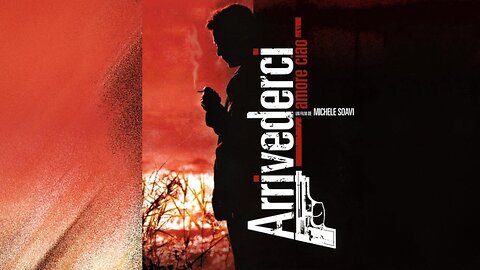
Arrivederci amore, ciao (English Title: The Goodbye Kiss, also known as Goodbye My Love, Goodbye) s a 2006 Italian neo-noir film directed by Michele Soavi. It is based on the pulp novel Arrivederci amore, ciao by Massimo Carlotto. Audio in Italian with English & French subtitles.
After fifteen years spent as a terrorist in the Central American jungle, former left-wing activist Giorgio Pellegrini decides to return to Italy.
The film won the David di Donatello for best original song ("Insieme a te non ci sto più", performed by Caterina Caselli and written by Paolo Conte and others).
Cast & Characters:
Alessio Boni as Giorgio Pellegrini
Michele Placido as Ferruccio Anedda
Isabella Ferrari as Flora
Alina Nedelea as Roberta
Carlo Cecchi as Sante Brianese
Antonello Fassari as Sergio Cosimato
Max Mazzotta as Ciccio Formaggio
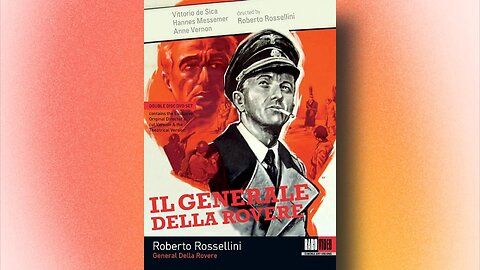
Il generale Della Rovere (Film 1959 - MULTISUB)
Adaneth - Cinema&TV
Il General Della Rovere (English title: General Della Rovere) is a 1959 Italian–French drama film directed by Roberto Rossellini. Audio in Italian with subtitles in; English, French and Russian (click on CC for subtitles).
The film is based on a story by Indro Montanelli which was in turn based on a true story. The film on the Golden Lion at the 1959 Venice International Film Festival.
Genoa, 1944, during the era of the Italian Social Republic. Petty thief Emanuele Bardone is hired by the German occupation forces to impersonate an Italian Resistance leader, General Della Rovere, and infiltrate a group of resistance prisoners in a Milan prison. Gradually, Bardone loses himself in his role and not merely pretends to be a hero of the resistance but actually becomes one.
Cast & Characters:
Vittorio De Sica: Vittorio Emanuele Bardone/Grimaldi
Hannes Messemer: SS Colonel Müller
Vittorio Caprioli: Aristide Banchelli
Sandra Milo: Olga
Giovanna Ralli: Valeria
Maria Greco: Madama Vera
Herbert Fischer: German sergeant
Anne Vernon: Clara Fassio
Franco Interlenghi: Antonio Pasquali
Ivo Garrani: Partisan Chief
Linda Veras: German Attendant
The film is based on a story by Indro Montanelli which was in turn based on a true story.
Il Trovatore - Salvarezza, Sacchi, Mascherini, Pederzini - Santini, Gallone (Opera Film 1949)

Adaneth - Arts & Literature
Il trovatore è un film del 1949 diretto da Carmine Gallone. Trasposizione cinematografica dell'omonima opera lirica di Giuseppe Verdi.
Interpreti & Personaggi
Vittorina Colonnello: Leonora
Gino Sinimberghi: Manrico
Gianna Pederzini: Azucena
Enzo Mascherini: conte di Luna
Enrico Formichi: Ruiz
Cesare Polacco: Ferrando
Leonora Amaya: zingarella
Giuseppe Varni: vecchio conte di Luna
Raimondo van Riel: vecchio zingaro
Mario Besesti: narratore
Interpreti Lirici:
Franca Sacchi: Leonora
Gianna Pederzini: Azucena
Antonio Salvarezza: Manrico
Enzo Mascherini: conte di Luna
Enrico Formichi: Ruiz
Maestro Concertatore & Direttore d'Orchestra: Gabriele Santini
Orchestra & Coro: Teatro dell'Opera di Roma
Adattamento & Sceneggiatura: Mario Corsi, Tullio Covaz, Ottavio Poggi, Carmine Gallone
Fotografia: Aldo Giordani
Scenografia: Gastone Medin
Costumi: Dario Cecchi
1
comment
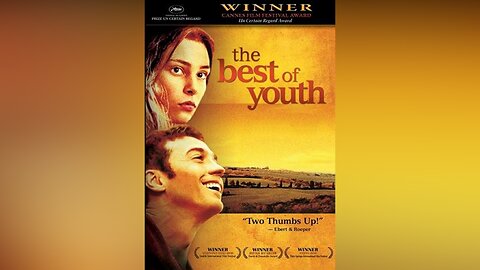
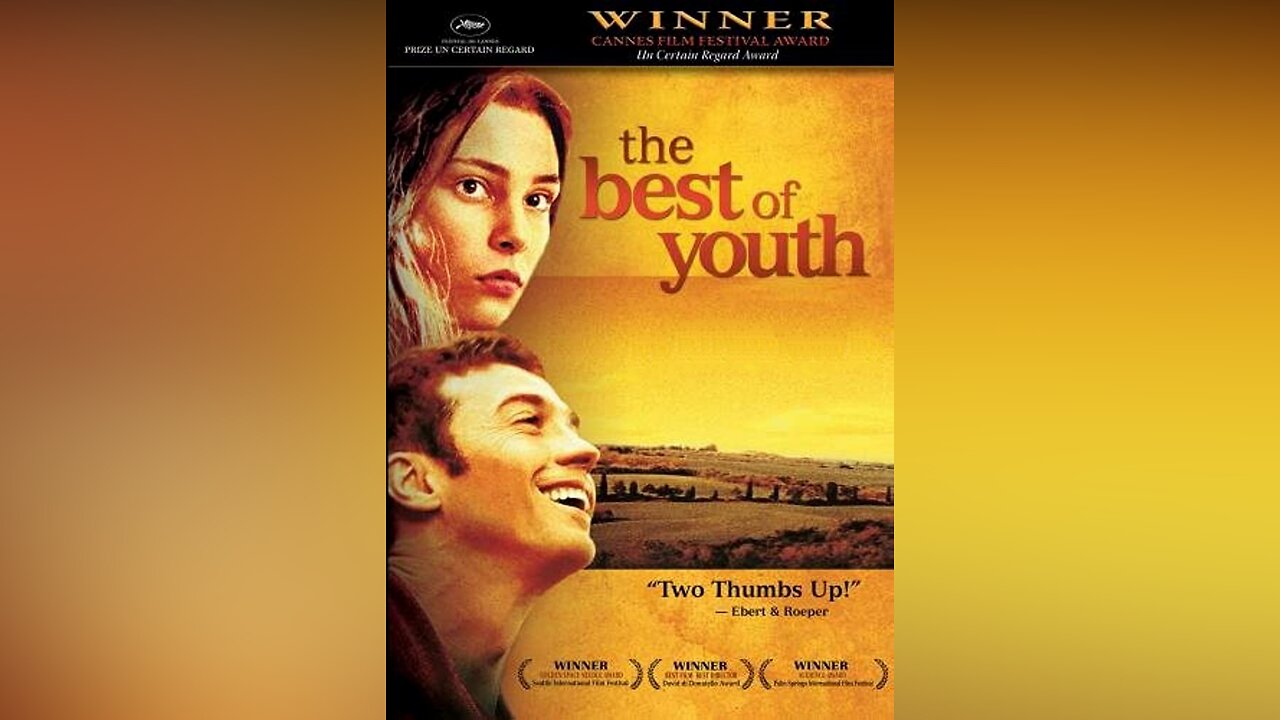
La Meglio Gioventù/The Best of Youth (Act I - ENG SUB)
Adaneth - Cinema&TV
The Best of Youth (Italian: La meglio gioventù) is a 2003 Italian historical drama film directed by Marco Tullio Giordana and written by Sandro Petraglia and Stefano Rulli. Audio in Italian with English subtitles.
Act II: https://rumble.com/v2gh4w2-la-meglio-giovent-the-best-of-youth-act-ii.html
A family saga set in Italy from 1966 through 2003, it chronicles the life of the middle-class Carati family, focusing primarily on brothers Nicola (Luigi Lo Cascio) and Matteo (Alessio Boni) as their life paths separate during youth, encompassing major political and social events of Italian history from 60s to early 2000.
Originally conceived as a Rai television miniseries, it premiered at the 2003 Cannes Film Festival, where it won the Prize Un Certain Regard. It was then given a theatrical release in Italy as two 3-hour films (titled Act I and Act II), before being aired with broader success on Rai 1 in a slightly longer four-episode television version later that year. In the U.S., the film was released by Miramax in its theatrical version.
The title of the film, an ungrammatical rendition of La miglior gioventù ("the best youth/young people"), comes from the title of a 1954 Friulian language poetry collection by Pier Paolo Pasolini, who in turn borrowed it from a line of Alpini World War II song Sul ponte di Perati; here, Giordana uses it to refer to his generation, which is also the main characters' one, made up of those young people who participated in the Sessantotto (1968 movement in Italy.)
1.25K
views
3
comments
Investigation of a Citizen Above Suspicion (Film 1970 - ENG SUB)
Adaneth - Cinema&TV
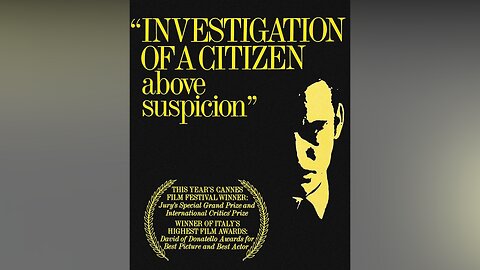
Investigation of a Citizen Above Suspicion (Italian: Indagine su un cittadino al di sopra di ogni sospetto) is a 1970 Italian crime thriller film directed by Elio Petri, starring Gian Maria Volonté and Florinda Bolkan. It is a psychological, black-humored satire on corruption in high office. Audio in Italian with English subtitles (Click on CC for subtitles).
The film was released in Italy by Euro International Pictures on 9 February 1970, to widespread acclaim from critics. It won the Jury Prize at the 1970 Cannes Film Festival, and the David di Donatello Awards for Best Film for Best Actor (Gian Maria Volonté). In the United States, it won the Oscar for Best Foreign Language Film. Petri and his co-writer Ugo Pirro were nominated for Best Original Screenplay.
In 2008, the film was included on the Italian Ministry of Cultural Heritage’s 100 Italian films to be saved, a list of 100 films that "have changed the collective memory of the country between 1942 and 1978."
Investigation of a Citizen Above Suspicion was well received by critics and is widely considered one of the best international films of the 1970s. The film won the Academy Award for Best Foreign Language Film, and both the FIPRESCI Prize and the Grand Prize at the 1970 Cannes Film Festival. Also it won the Edgar Award for Best Motion Picture from the Mystery Writers of America.
Cast & Characters:
Gian Maria Volonté as "Il Dottore" ('the Doctor'), the Police Inspector
Florinda Bolkan as Augusta Terzi
Gianni Santuccio as the Police Commissioner
Orazio Orlando as Brigadier Biglia
Sergio Tramonti as Antonio Pace
Salvo Randone as the Plumber
Arturo Dominici as Mangani
Aldo Rendine as Nicola Panunzio
Massimo Foschi as Claudio Terzi
Vittorio Duse as Canes
Aleka Paizi as the Housekeeper
Pino Patti as the Wiretapping Supervisor
Gianfranco Barra as Agent Giusti

Buongiorno, notte/Good Morning, Night (Film 2003 - ENG SUB)
Adaneth - Cinema&TV
Buongiorno, notte (Good Morning, Night) is an Italian film released in 2003 and directed by Marco Bellocchio. Audio in Italian with English subtitles.
The title of the feature film, Good Morning, Night, is taken from a poem by Emily Dickinson.
A small group of terrorists of the Red Brigades rent an apartment. They kidnap Aldo Moro, former prime minister of Italy and leader of the Democrazia Cristiana (Christian Democracy) party. Moro writes many letters to politicians, Pope Paul VI, and his family, but the Italian government refuses to negotiate. A female member of the group, played by Maya Sansa, suffers doubts about the plan.
The plot is freely adapted from the 1988 book The Prisoner by the former Red Brigades member Anna Laura Braghetti, which tells of the 1978 kidnapping of Aldo Moro by the Red Brigades. In addition to the book by Anna Laura Braghetti, the director took inspiration from other sources; for example, the sentence pronounced by the leader of the brigadists, Mariano, to motivate his followers, namely that the imminent killing of Moro "is the highest act of humanity possible in a society divided into classes", is taken directly from a press release on May 10 in the courtroom at the La Marmora barracks in Turin, by the imprisoned founders of the BR, Renato Curcio and Alberto Franceschini: «...This is why we claim that the revolutionary act of justice exercised by the Red Brigades against the criminal Politician Aldo Moro, (...), is the highest act of humanity possible for the communist and revolutionary proletarians, in this class-divided society».
The original music of the film was composed by Riccardo Giagni. The film's soundtrack also includes compositions by Franz Schubert, Giuseppe Verdi and Jacques Offenbach, as well as two of the most famous songs by Pink Floyd, The Great Gig in the Sky and Shine On You Crazy Diamond
Cast & Characters:
Maya Sansa - Chiara
Luigi Lo Cascio - Mariano
Roberto Herlitzka - Aldo Moro
Paolo Briguglia - Enzo
Pier Giorgio Bellocchio - Ernesto
Giovanni Calcagno - Primo
Giulio Bosetti - Pope Paul VI
A Ciascuno il Suo/We Still Kill the Old Way (Film 1967-ENG SUB)
Adaneth - Cinema&TV
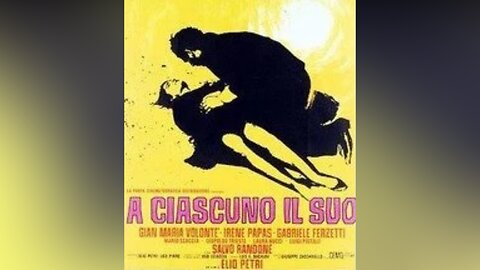
We Still Kill the Old Way (Italian: A ciascuno il suo; lit. 'To each his own') is a 1967 Italian crime film directed by Elio Petri. It is based on the novel "A ciascuno il suo" (To Each His Own) by Leonardo Sciascia. Audio in Italian with English subtitles.
It is one of the first Italian films about the mafia. It won the Best Screenplay Award at the 1967 Cannes Film Festival. Nastro d'Argento for Best Director, Best Actor (Gian Maria Volonté) and Best Supporting Actor (Gabriele Ferzetti).
Cast & Characters:
Gian Maria Volonté as Professor Paolo Laurana
Irene Papas as Luisa Roscio
Gabriele Ferzetti as Advocate Rosello
Salvo Randone as Professor Roscio
Luigi Pistilli as Arturo Manno
Laura Nucci as Roscio's mother
Mario Scaccia as curate of Sant'Amo
Luciana Scalise as Rosina
Leopoldo Trieste as communist city council member
Giovanni Pallavicino as Ragana
Franco Tranchina as Dr. Antonio Roscio
Anna Rivero as Mrs. Manno
Orio Cannarozzo as Inspector La Marca
Carmelo Oliviero as Archpriest Rosello
2
comments
La muta di Portici (Film 1952)
Adaneth - Cinema&TV
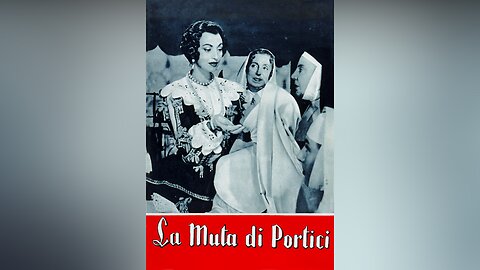
La muta di Portici è un film del 1952 diretto da Giorgio Ansoldi, tratto dall'omonimo romanzo di Eugène Scribe. E' un film appartenente al genere romantico popolare che narra una vicenda assai nota, già in precedenza portata sullo schermo.
Nel 1647, il duca d'Arcos, nuovo viceré di Napoli, uniformandosi agli ordini di Madrid, impone gravose gabelle sul pesce e sulla frutta. I nuovi balzelli colpiscono soprattutto il popolo minuto, provocando vivo malcontento: dei sentimenti del popolo si rende interprete un giovane pescatore di Portici, Tommaso Aniello, detto Masaniello, il quale coi suoi discorsi contribuisce ad eccitare la ribellione. La polizia cerca di mettere le mani addosso a Masaniello, che vive con la sorella Lucia. La fanciulla è innamorata d'Alfonso, ch'ella crede sia un popolano come lei, mentre in realtà è il figlio dello stesso Viceré.
Interpreti e personaggi:
Flora Mariel: Lucia Aniello
Paolo Carlini: Masaniello
Octavio Señoret: Alfonso, figlio del viceré
Umberto Sacripante[2]: spia
Raf Pindi: duca d'Arcos, il viceré
Paolo Dola: capitano Perrone
Luciano Rebeggiani: duca Maddaloni
Doris Duranti: Elvira de Herrera
Gino Scotti: Genoino
Giulio Battiferri: Andrea
Franco Jamonte: Palumbo
Marcello Mastroianni (non accreditato)
The Battle of Algiers (Film 1966 - ENG SUB Remastered)
Adaneth - Cinema&TV
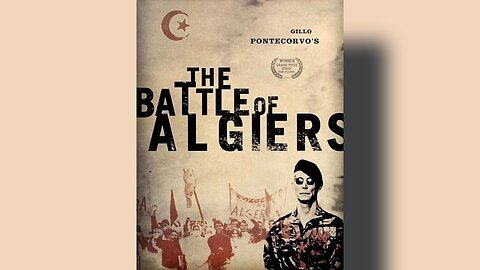
The Battle of Algiers (Italian: La battaglia di Algeri) is a 1966 war film co-written and directed by Gillo Pontecorvo. Audio in French and Algerian with English subtitles (click on CC for subtitles).
The film won the Golden Lion at the Venice Film Festival and was nominated for three Academy Awards (in non-consecutive years, a unique achievement): Best Foreign Language Film in 1966, and Best Screenplay (Gillo Pontecorvo and Franco Solinas) and Best Director (Gillo Pontecorvo) in 1968.
The film is based on events undertaken by rebels during the Algerian War (1954–1962) against the French government in North Africa, the most prominent being the eponymous Battle of Algiers, the capital of Algeria. It was shot on location in a Roberto Rossellini-inspired newsreel style: in black and white with documentary-type editing to add to its sense of historical authenticity, with mostly non-professional actors who had lived through the real battle. The film's score was composed by Pontecorvo and Ennio Morricone. It is often associated with Italian neorealist cinema.
The film concentrates mainly on revolutionary fighter Ali La Pointe during the years between 1954 and 1957, when guerrilla fighters of the FLN went into Algiers. Their actions were met by French paratroopers attempting to regain territory. The highly dramatic film is about the organization of a guerrilla movement and the illegal methods, such as torture, used by the French to stop it. Algeria succeeded in gaining independence from the French, which Pontecorvo addresses in the film's epilogue.
The film has been critically acclaimed. Both insurgent groups and state authorities have considered it to be an important commentary on urban guerrilla warfare. A subject of sociopolitical controversy, the film was not screened for five years in France; it was eventually released in 1971.
Sound – both music and effects – perform important functions in the movie. Indigenous Algerian drumming, rather than dialogue, is heard during a scene in which female FLN militants prepare for bombings. In addition, Pontecorvo used the sounds of gunfire, helicopters and truck engines to symbolize the French methods of battle, while bomb blasts, ululation, wailing and chanting symbolize the Algerian methods. Gillo Pontecorvo wrote the music for The Battle of Algiers, but because he was classified as a "melodist-composer" in Italy, he was required to work with another composer as well; his good friend Ennio Morricone collaborated with him. The solo military drum, which is heard throughout the film, is played by the famous Italian drummer Pierino Munari.
Pontecorvo chose to cast non-professional Algerians. He chose people whom he met, picking them mainly on appearance and emotional effect (as a result, many of their lines were dubbed). The sole professional actor of the movie was Jean Martin, who played Colonel Mathieu; Martin was a French actor who had worked primarily in theatre. Pontecorvo wanted a professional actor, but one who would not be familiar to most audiences, as this could have interfered with the movie's intended realism. Martin had been dismissed several years earlier from the Théâtre National Populaire for signing the manifesto of the 121 against the Algerian War. Martin was a veteran; he had served in a paratroop regiment during the Indochina War and he had taken part in the French Resistance. His portrayal had autobiographical depth.
Saadi Yacef, who plays El-Hadi Jaffar, and Samia Kerbash, who plays Fathia, were both members of the FLN and Pontecorvo is said to have been greatly inspired by their accounts. The actors credited are:
Jean Martin as Colonel Philippe Mathieu
Saadi Yacef as El-Hadi Jafar
Brahim Haggiag as Ali La Pointe
Tommaso Neri as Captain Dubois
Samia Kerbash as Fathia
Ugo Paletti as a Captain
Fusia El Kader as Halima
Franco Moruzzi as Mahmoud
Mohamed Ben Kassen as Little Omar
1
comment
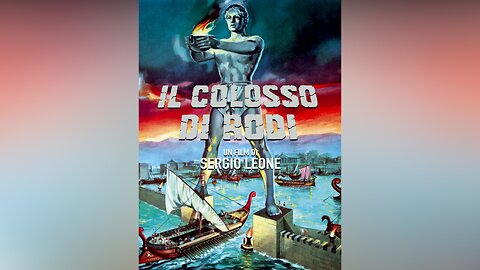
Il Colosso di Rodi/The Colossus of Rhodes - Sergio Leone Film (1961-ENG SUB)
Adaneth - Cinema&TV
The Colossus of Rhodes (Italian: Il Colosso di Rodi) is a 1961 Italian sword and sandal film co-written and directed by Sergio Leone. Audio in Italian with English subtitles (click on CC for subtitles).
The film is set during the time following Alexander the Great’s death (323 BC) but before the rise of the Roman Empire (27 BC), known as the Hellenistic era. It is a fictional account of the island of Rhodes during its classical period in the late third century BC before coming under Roman control, using the Colossus of Rhodes as a backdrop for the story of a war hero who becomes involved in two different plots to overthrow a tyrannical king: one by Rhodian patriots and the other by Phoenician agents.
Although no physical references of the original Helios Colossus are known to exist, the structure is rendered in this film as being an Etruscan image of the god Apollo following the kouros style of sculpture, with a slight “archaic smile.” It is about 300 feet high (nearly three times the height of its historical counterpart) and holds a bowl at chest level with elbows raised outward, straddling the harbor entrance.
The film was Leone's first work as a credited director, in a genre where he already had worked before (as the replacement director for The Last Days of Pompeii and as a secondary director for both Ben-Hur and Quo Vadis). It is perhaps the least known of the seven films he officially directed, and is the only one without an Ennio Morricone score.
Leone filmed exterior scenes at the Laredo harbour, Cantabria, the Bay of Biscay, the Manzanares el Real and Ciudad Encantada at Cuenca.
Cast & Characters:
Rory Calhoun – Darios
Lea Massari – Diala
Georges Marchal – Peliocles
Conrado San Martín – Thar
Ángel Aranda – Koros
Mabel Karr – Mirte
Mimmo Palmara – Ares
Roberto Camardiel – King Serse
Alfio Caltabiano – Creonte
George Rigaud – Lissipu
Félix Fernández – Carete
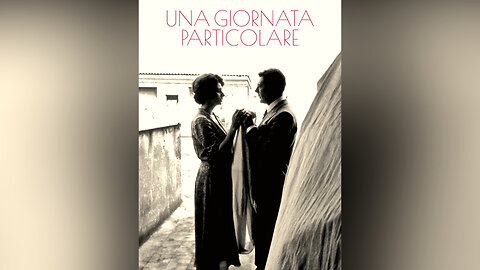
Una giornata particolare/A Special Day (Film 1977 - ENG SUB)
Adaneth - Cinema&TV
A Special Day (Italian: Una giornata particolare) is a 1977 period drama film directed and co-written by Ettore Scola, produced by Carlo Ponti, and starring Sophia Loren and Marcello Mastroianni. Audio in Italian with English subtitles (Click on CC for subtitles).
Italian cinema dream team Sophia Loren and Marcello Mastroianni are cast against glamorous type and deliver two of the finest performances of their careers in this moving, quietly subversive drama from Ettore Scola. Though it’s set in Rome on the historic day in 1938 when Benito Mussolini and the city first rolled out the red carpet for Adolf Hitler, the film takes place entirely in a working-class apartment building, where an unexpected friendship blossoms between a pair of people who haven’t joined the festivities: a housewife and mother tending to her domestic duties and a radio broadcaster awaiting deportation. Scola paints an exquisite portrait in muted tones, a story of two individuals helpless in the face of Fascism’s rise.
The film premiered at the 1977 Cannes Film Festival. It earned several accolades and nominations, including David di Donatello Awards for Best Director (Scola) and Best Actress (Loren), a Golden Globe for Best Foreign Language Film, and two Oscar nominations, for Best Foreign Language Film and Best Actor (Mastroianni).
In 2008, the film was included on the Italian Ministry of Cultural Heritage’s 100 Italian films to be saved, a list of 100 films that "have changed the collective memory of the country between 1942 and 1978."
Cast & Characters:
Sophia Loren as Antonietta Taberi
Marcello Mastroianni as Gabriele
John Vernon as Emanuele Taberi
Françoise Berd as Pauletta, the caretaker
Patrizia Basso as Romana Taberi
Tiziano De Persio as Arnaldo Taberi
Maurizio Di Paolantonio as Fabio Taberi
Antonio Garibaldi as Littorio Taberi
Vittorio Guerrieri as Umberto Taberi
Alessandra Mussolini as Maria Luisa Taberi
Nicole Magny as Officer's Daughter
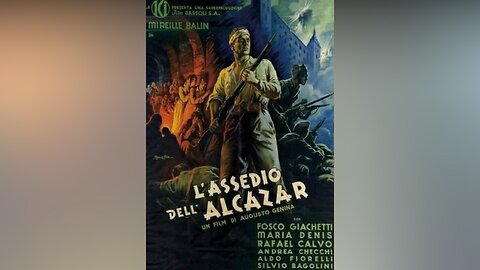
L'Assedio dell'Alcazar/The Siege of the Alcazar (Film 1940-ENG SUB)
Adaneth - Cinema&TV
The Siege of the Alcazar or L'Assedio dell'Alcazar is a 1940 Italian war film directed by Augusto Genina about the famous siege of the Alcázar during the Spanish Civil War, set in Toledo, Spain. Audio in Italian with English subtitles (click on CC for subtitles).
The day the Spanish Civil War breaks out, Colonel Jose Moscardó, a veteran of the war in Africa, arrives in Madrid to prepare for his trip to Berlin with the Spanish delegation that is going to participate in the Olympic Games. Learning of the military uprising, he returns quickly to Toledo. As commander of the fortress at Alcazar, Moscardó has no doubts and at seven o'clock in the morning of July 21,1936, announces which side of the conflict he's on. Aware of the precariousness of the situation he is in, he digs in at Alcázar with 1,800 people, where they resist constant attacks and bombings until the arrival of Nationalist troops on September 27.
One of the first post-Civil War films, The Siege of the Alcázar was filmed in the Roman studios of Cinecittà for the interiors and in Toledo for the exteriors. There were two versions, in Italian and Spanish, both directed by the Italian Augusto Genina. In the Italian version all three non-Italian actors (Mireille Balin, Rafael Calvo and Carlos Muñoz) spoke their lines in Italian. They were dubbed by Italian actors afterwards. The Siege of the Alcazar was one of the most successful films of the period. It won the Mussolini Cup in Venice Film Festival for being the Best Italian Film.
The Italian version was released in Italy in August 1940. The Spanish version of the film, known as "Sin novedad en el Alcázar" was released in Spain in October 1940. After the war, the film was re-released in Italy under the new title 'Alcazar' with significant cuts. All references to the involvement of Italy in the Spanish Civil War as well as the cruelty of the Republicans were excised to avoid any political debate.
Cast & Characters:
Fosco Giachetti : Captain Vela
Mireille Balin : Carmen Herrera
María Denis : Conchita Álvarez
Rafael Calvo Ruiz de Morales : Colonel José Moscardó Ituarte
Carlos Muñoz : Colonel Moscardò's son
Aldo Fiorelli: Francisco
Andrea Checchi: Perro
Carlo Tamberlani: Captain Vincenzo Alba
Sivio Bagolini: Paolo Montez
Checco Rissone: radiotelegrafista
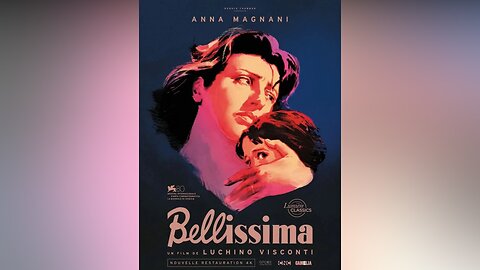
Bellissima - Luchino Visconti, Anna Magnani (Film 1951 - MULTISUB)
Adaneth - Cinema&TV
Bellissima is a 1951 Italian drama film directed by Luchino Visconti and starring Anna Magnani, Walter Chiari and Tecla Scarano. Audio in Italian with English, French and Spanish subtitles (click on CC for subtitles).
Bellissima centers on a working-class mother in Rome, Maddalena, who drags her young daughter to Cinecittà Studios to attend an audition for a new film by Alessandro Blasetti. Maddalena's efforts to promote her daughter grow increasingly frenzied.
Alessandro Blasetti, a contemporary film director, appears as himself. Keeping in with the tradition of Italian neorealism a number of roles went to members of the public. Magnani played a part in their selection, approving of Gastone Renzelli a butcher who was cast as her husband. The film's sets were designed by Gianni Polidori. It was shot at the Cinecittà Studios, which appear prominently in the film. Anna Magnani won the award of Nastro d'Argento for Best Actress.
In 2008, the film was included on the Italian Ministry of Cultural Heritage’s 100 Italian films to be saved, a list of 100 films that "have changed the collective memory of the country between 1942 and 1978."
Cast & Characters:
Anna Magnani as Maddalena Cecconi
Walter Chiari as Alberto Annovazzi
Tina Apicella as Maria Cecconi
Gastone Renzelli as Spartaco Cecconi
Tecla Scarano as Tilde Spernanzoni
Lola Braccini as the photographer's wife
Arturo Bragaglia as the photographer
Nora Ricci as the laundry girl
Vittorina Benvenuti
Linda Sini as Mimmetta
Teresa Battaggi as a mother
Gisella Monaldi as a concierge
Amalia Pellegrini
Corrado Mantoni as radio announcer
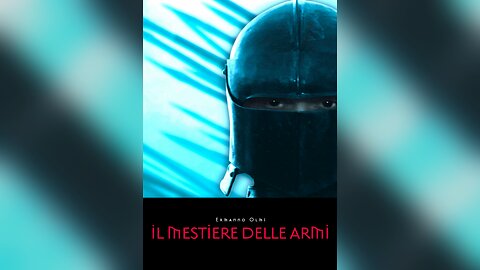
Il Mestiere delle Armi/The Profession of Arms (Film 2001 - MULTI SUB)
Adaneth - Cinema&TV
The Profession of Arms (Italian: Il mestiere delle armi) is a 2001 Italian film directed by Ermanno Olmi. Audio in Italian with subtitles in English, Spanish and Italian (click on CC for subtitles).
The film tells the story of the last days of the leader Giovanni delle Bande Nere, pseudonym of Ludovico di Giovanni De' Medici, an Italian condottiero in the service of the Papal State during the Italian wars in the first half of the 16th century.
After the formation of the League of Cognac between the Papacy, France and the Republic of Venice against the excessive power of Charles V, King of Spain and Emperor of the Holy Roman Empire, an imperial army of Lutheran lansquenets under the command of the veteran Georg von Frundsberg descends into Italy with the aim of sacking Rome and punishing the Pope. The inferior papal armies, commanded by Giovanni de' Medici, try to chase them in the midst of a harsh winter.
Giovanni delle Bande Nere's profession of arms is now surpassed by new instruments of death: firearms like the cannons of Georg von Frundsberg's army, against which armor is no match. It is not just a technological innovation in the art of war, but a crisis of those values that once inspired combat; individual courage or the skill of the strategist no longer counts; there are no longer hand-to-hand combats where the bravest wins, death now comes from afar and leaves you no escape; what matters are technical skills, knowing how to use the new weapons and, above all, having money to buy the new powerful and expensive artillery. General Georg von Frundsberg's falconets mark the end of an era: the Middle Ages and the age of knights and their castles had long since ended under the blows of cannons that soon put an end to the long feudal sieges.
Filming took place from January 17 to April 7, 2000, mainly in Bulgaria, as well as in the following Italian locations:
- Basilica of Sant'Andrea in Mantua, where the body of Giovanni delle Bande Nere is exposed;
- Rocca Sforzesca in Soncino;
- Ducal Palace in Mantua, residence of Frederick II in the film;
- House of the Blessed Osanna Andreasi, home of Frederick's lover;
- Palazzo Barbò in Torre Pallavicina, where Giovanni's bedside is set up.
Cast & Characters:
Hristo Zhivkov - Giovanni de Medici
Sergio Grammatico - Federico Gonzaga
Dimitar Rachkov - Luc'Antonio Cuppano
Fabio Giubbani - Matteo Cusastro
Sasa Vulicevic - Pietro Aretino
Desislava Tenekedjieva - Maria Salviati de Medici
Sandra Ceccarelli - Nobildonna di Mantova
Franco Andreani - Ambasciatore di Carlo V
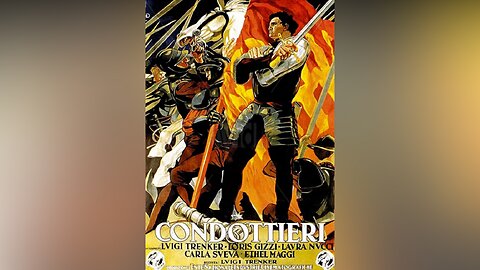
Condottieri (Film 1937-ENG SUB)
Adaneth - Cinema&TV
Condottieri (English: leaders, warloards, captains) is a 1937 Italian historical drama film directed by Luis Trenker and starring Trenker, Loris Gizzi and Laura Nucci. Audio in Italian with English subtitles.
It portrays the life of Giovanni de' Medici, a celebrated condottiere of the 16th century. The film is the first Italian-German production, co-directed by Giacomo Gentilomo and Anton Giulio Majano. A separate German-language version was also made. The German version was co-directed by Werner Klingler. The film's elaborate sets were designed by Virgilio Marchi and Erich Grave, while Herbert Ploberger produced the costumes.
Shot in black and white, with the aesthetic photography of Carlo Montuori, accompanied by music with a martial flavour, the film is in fact a collage of historical episodes featuring the leader Giovanni dalle Bande Nere. There are several spectacular action sequences, with the use of masses of stage sets and soldiers on horseback in quantity, particularly at the opening and closing of the film. To follow a stylistic and historical coherence that was not only formal, the production availed itself of the military expertise of Lieutenant Colonel Enrico Pezzi, who for the organization of the war scenes was able to count on units of the State Armed Forces.
The film had several locations: the interiors were shot in the Cines studios in Rome and in those of Tobis Cinema-Film A.G. in Berlin, Germany, while for the exteriors different settings were chosen: at the Torrechiara castle, in Torrechiara, a hamlet of Langhirano (province of Parma), and at the Gradara castle (province of Pesaro and Urbino), in Sassolungo, Sella Group and Marmolada (Dolomites), Colle Santa Lucia (province of Belluno), Arco and Riva del Garda (Lake Garda, province of Trento), Verona, San Gimignano, Florence, Venice, Padua.
Cast & Characters:
Luis Trenker as Giovanni de' Medici
Loris Gizzi as Malatesta
Laura Nucci as Tullia delle Grazie
Carla Sveva [fr; it] as Maria Salviati
Ethel Maggi [it] as Caterina Sforza
Mario Ferrari as Cesare Borgia
Angelo Ferrari
Giulio Cirino as Rüschli
Sandro Dani as D'Argentière
Tito Gobbi as Nino
Augusto Marcacci as Daniello
Nino Marchetti as Corrado
Lando Muzio as Pedro
Ernesto Nannicini
Umberto Sacripante as Sanzio
Carlo Tamberlani as Duke of Urbino
Gino Viotti as Pope
Giuseppe Addobbati as Duke of Imola
Friedl Trenker as Giovanni
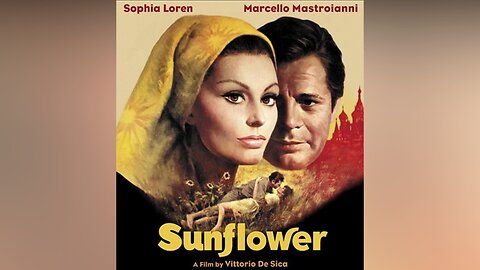
I Girasoli/Sunflower (Film 1970 - ENG SUB)
Adaneth - Cinema&TV
Sunflower (Italian: I girasoli) is a 1970 drama film directed by Vittorio De Sica. Audio in Italian with English subtitles.
An international co-production of Italy, France, the Soviet Union and the United States. Henry Mancini's soundtrack was nominated for an Oscar.
The film tells the story of an Italian woman leading a desperate search for her husband, a soldier considered missing in action in Russia during World War II.
Cast & Characters:
Sophia Loren as Giovanna
Marcello Mastroianni as Antonio
Lyudmila Savelyeva as Masha (Maria)
Galina Andreyeva as Valentina, Soviet official
Anna Carena as Antonio's mother
Germano Longo as Ettore
Nadya Serednichenko as Woman in sunflower fields
Glauco Onorato as Returning soldier
Silvano Tranquilli as Italian worker in Russia
Marisa Traversi as Prostitute
Gunars Cilinskis as Russian Ministry Official
Carlo Ponti, Jr. as Giovanna's baby
Pippo Starnazza as Italian official
Dino Peretti
Giorgio Basso
2
comments

Io, Don Giovanni (Film 2009-ENG SUB)
Adaneth - Cinema&TV
Io, Don Giovanni (English: I, Don Giovanni) is a 2009 Spanish-Italian-Austrian drama film directed by Carlos Saura. Audio in Italian with English subtitles.
A drama loosely based on the life of 18th century Italian opera librettist and poet Lorenzo da Ponte, who collaborated with Mozart on his "Don Giovanni" opera.
Cast & Characters:
Lorenzo Balducci: Lorenzo da Ponte
Lino Guanciale: Wolfgang Amadeus Mozart
Emilia Verginelli: Annetta
Tobias Moretti: Giacomo Casanova
Ennio Fantastichini: Antonio Salieri
Ketevan Kemoklidze: Adriana Ferraresi Del Bene/Donna Elvira
Sergio Foresti: Leporello
Borja Quiza: Don Giovanni
Carlo Lepore: Il Commendatore
Francesca Inaudi: Costanza Mozart
Franco Interlenghi: Padre di Annetta
Cristina Giannelli: Caterina Cavalieri
1
comment
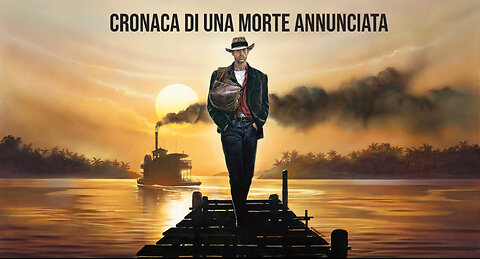
Cronaca di una morte annunciata/Chronicle of a Death Foretold (Film 1987-ENG SUB)
Adaneth - Cinema&TV
Chronicle of a Death Foretold (Italian: Cronaca di una morte annunciata, Spanish: Crónica de una muerte anunciada) is a drama film directed by Francesco Rosi. Audio in Italian with English subtitles.
The film was adapted by Tonino Guerra from the eponymous novella by the Colombian Nobel Prize-winning author Gabriel García Márquez. It tells, in the form of a pseudo-journalistic reconstruction, the story of the murder of Santiago Nasar by the Vicario twins. It stars Rupert Everett, Ornella Muti, Anthony Delon, Gian Maria Volonté and Irene Papas. The film premiered at Cannes film festival in May 1987.
While many of the actors are unknown to American audiences, Chronicle of a Death Foretold has a cast of international European stars: the film displays the talent of the veterans Irene Papas and Gian Maria Volonté. However, the casting was notable for its use of upcoming young European actors: Ornella Muti, as the beautiful and mysterious Angela Vicario who motivates the drama, Anthony Delon (son of Alain Delon) as the man she blames, and Rupert Everett.
Cast & Characters:
Ornella Muti ... Angela Vicario
Rupert Everett ... Bayardo San Román
Gian Maria Volonté ... Cristobal Bedoya
Anthony Delon ... Santiago Nasar
Lucia Bosé ... Placida Linero
Irene Papas ... Angela's mother
Sergi Mateu ... Young Cristóbal
Vicky Hernández ... Clotilde Armaneta
Alain Cuny ... Widower Xius
Carolina Rosi ... Flora Miguel
Edgardo Román ... Faustino Santos
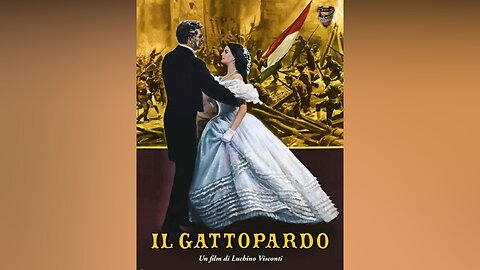
Il Gattopardo aka The Leopard (Film 1963-MULTI SUB)
Adaneth - Cinema&TV
The Leopard (Italian: Il Gattopardo meaning "The Serval") is a 1963 Italian epic period drama film by director Luchino Visconti, based on Giuseppe Tomasi di Lampedusa's novel of the same title. Audio Italian with subtitles in; Italian, English, French, Russian, Spanish.
It stars Burt Lancaster, Claudia Cardinale, Alain Delon, Serge Reggiani, Mario Girotti, and Pierre Clementi. Screenplay and adaptation: Suso Cecchi D'Amico, Pasquale Festa Campanile, Enrico Medioli, Massimo Franciosa and Luchino Visconti. Music by Nino Rota. Luchino Visconti won the Palme d'Or at the 1963 Cannes Film Festival.
Plot Summary:
Set in Sicily at the time of the Bourbon sunset, the novel is based on the family of Giuseppe Tomasi di Lampedusa and in particular on his ancestor, Prince Fabrizio Salina. When the aristocratic Salina family finds themselves spending their holidays in Donnafugata's summer residence, the mayor of the town, the ambitious Don Calogero Sedara, tries to get into the prince's favor. It is during the meeting between these two families that Tancredi, Don Fabrizio's affectionate nephew, is immediately fascinated by Angelica, the beautiful daughter of Don Calogero. Just as these family plots are consumed, the time comes to vote for the annexation of Sicily to the Kingdom of Sardinia, a difficult decision that forces the prince to a profound reflection and an awareness of the historical moment that his generation is crossing.
The same year he finished 8½ (1963), Nino Rota dusted off an old symphony of his own composition, he proposed it to Luchino Visconti for this film, the director loved it, and it became the score for this fresco of the social and political changes in Sicily in the midst of the 19th century. The editor Mario Serandrei had given Visconti as a present the sheet music of an unpublished waltz by Giuseppe Verdi that he had found in one drawer of an old chest he bought in a flea market. Rota added this composition to the long final ball sequence.
Cast & Characters:
Burt Lancaster as Don Fabrizio Corbera, Prince of Salina
Claudia Cardinale as Angelica Sedara / Bertiana
Alain Delon as Tancredi Falconeri, Don Fabrizio's nephew
Paolo Stoppa as Don Calogero Sedara, Mayor of Donnafugata
Rina Morelli as Princess Maria Stella of Salina, Don Fabrizio's wife
Romolo Valli as Father Pirrone
Terence Hill (billed as Mario Girotti) as Count Cavriaghi
Pierre Clémenti as Francesco Paolo
Lucilla Morlacchi as Concetta
Giuliano Gemma as Garibaldi's General
Ida Galli as Carolina
Ottavia Piccolo as Caterina
https://www.imdb.com/title/tt0057091/?ref_=ttalt_alt_tt
1
comment
Casa Ricordi/House of Ricordi (Film 1954-ENG SUB)
Adaneth - Cinema&TV
Casa Ricordi (House of Ricordi) is a 1954 French-Italian historical biographical melodrama film based on the early history of the Italian music publishing house Ricordi. It is directed by Carmine Gallone and stars Märta Torén, Marcello Mastroianni and Micheline Presle. Audio in Italian with English subtitles.
The film traces the fictionalized history of the great dynasty of music publishers (at first only through scores and then records) Ricordi, which took place throughout the nineteenth century with Giovanni, the founder, and then his son Tito and his grandson Giulio. The film's sets were designed by Mario Chiari. It was shot at the Cinecittà Studios and on location in Milan, Paris and Rome.
The House of Ricordi, great music publishing family of Milan, fed the spark that flamed into the Golden Age of Italian Opera. It unleashed a tide of genius by fostering the careers of some of the greatest composers of all time. The film describes meetings with the great protagonists of Italian opera: from Rossini to Bellini, from Donizetti to Verdi, ending with Puccini at the beginning of the twentieth century, all of whom passed through Ricordi publishers to have their works printed.
Casa Ricordi is a publisher of primarily classical music and opera. Its classical repertoire represents one of the important sources in the world through its publishing of the work of the major 19th-century Italian composers such as Gioachino Rossini, Gaetano Donizetti, Vincenzo Bellini, Giuseppe Verdi, and, later in the century, Giacomo Puccini, composers with whom one or another of the Ricordi family came into close contact. Founded in Milan in 1808 as G. Ricordi & C. by violinist Giovanni Ricordi (1785–1853), the Ricordi company became a totally family-run organization until 1919, when outside management was appointed. Four generations of Ricordis were at the helm of the company, Giovanni being succeeded in 1853 by his son Tito (1811–1888) (who had worked for his father since 1825). Tito's son was Giulio (1840–1912). He had also worked for his father, beginning full-time in 1863, and then took over from 1888 until his death in 1912. Finally, Giulio's son, also named Tito, (1865–1933) replaced his father until 1919. By the 1840s and throughout that decade, Casa Ricordi had grown to be the largest music publisher in southern Europe and in 1842 the company created the musical journal the Gazzetta Musicale di Milano.
Cast & Characters:
Paolo Stoppa as Giovanni Ricordi
Renzo Giovampietro as Tito I Ricordi
Andrea Checchi as Giulio Ricordi
Roland Alexandre as Gioachino Rossini
Roldano Lupi as Domenico Barbaja
Märta Torén as Isabella Colbran
Marcello Mastroianni as Gaetano Donizetti
Micheline Presle as Virginia Marchi
Maurice Ronet as Vincenzo Bellini
Myriam Bru as Luisa Lewis
Nadia Gray as Giulia Grisi
Fosco Giachetti as Giuseppe Verdi
Elisa Cegani as Giuseppina Strepponi
Gabriele Ferzetti as Giacomo Puccini
Danièle Delorme as Maria
Fausto Tozzi as Arrigo Boito
Operas used in the movie:
1. Il barbiere di Siviglia - Composed by Gioachino Rossini (1816)
Sung by Tito Gobbi and Giulio Neri
2. L'elisir d'amore - Composed by Gaetano Donizetti (1832)
3. I puritani - Composed by Vincenzo Bellini (1835)
4. Un ballo in maschera - Composed by Giuseppe Verdi (1859)
5. Otello - Composed by Giuseppe Verdi (1887)
Final aria sung by Mario Del Monaco
6. La bohème - Composed by Giacomo Puccini (1892-1895)
Sung by Renata Tebaldi as Mimi
7. Nabucco - Composed by Giuseppe Verdi
[Opera Excerpt]
Singers: Mario Del Monaco, Tito Gobbi, Renata Tebaldi, Giulio Neri, Italo Tajo, Gianni Poggi, Giulietta Simionato, Gino Mattera, Marinella Meli.
Conductors: Franco Capuana, Gianandrea Gavazzeni, Gabriele Santini, Franco Ferrara;
Choirmaster Giuseppe Conca.
Historical inaccuracies:
- The death of Vincenzo Bellini takes place on the evening of the premiere of the opera I puritani. In reality the opera was performed for the first time on 24 January 1835 but Bellini died on 23 September of that same year.
- In the episode of Verdi, when a bitter Verdi goes to the countryside where he will write Othello, in reality there are still about twenty years left and great successes to tell.
- In the film the date of the first move of the Ricordi headquarters towards the Casa degli Omenoni is indicated as 23 March 1848 by Tito Ricordi who we see hanging the portrait of his late father on a wall. In reality Giovanni Ricordi died only in 1853.
- In the film it is said that Giulio Ricordi fought at the age of sixteen on the barricades of the Five Days of Milan, but in reality in 1848 he was just 8 years old.
2
comments

Nuovo Cinema Paradiso Director's cut (Film 1988)
Adaneth - Cinema&TV
Nuovo cinema Paradiso (literally "New Paradise Cinema") is a 1988 French-Italian coming-of-age drama film written and directed by Giuseppe Tornatore. It was internationally released as Cinema Paradiso in France, Spain, the UK and the US. Audio in Italian with English subtitles.
Set in a small Sicilian town, the film centers on the friendship between a young boy and an aging projectionist who works at the titular movie theatre. This Italian-French co-production stars Philippe Noiret, Jacques Perrin, Leopoldo Trieste, Marco Leonardi, Agnese Nano and Salvatore Cascio. The film score was composed by Ennio Morricone and his son, Andrea, marking the beginning of a collaboration between Tornatore and Morricone that lasted until Morricone's death on 6 July 2020.
In 1988 Rome, Salvatore Di Vita, a famous film director, returns home late one evening, where his girlfriend sleepily tells him that his mother called to say someone named Alfredo has died. Salvatore shies from committed relationships and has not been to his home village of Giancaldo, Sicily in thirty years. As his girlfriend asks him who Alfredo was, Salvatore is not able to fall asleep and flashes back to his childhood.
Credited with revitalizing Italy's film industry, Cinema Paradiso has been cited as one of the greatest films of all time. The ending is considered among the greatest endings in movie history.
It was a commercial success, and won several awards, including the Academy Award for Best Foreign Language Film and the Cannes Film Festival's Grand Prix. It was nominated for 11 BAFTA Awards and won five; including Best Actor for Philippe Noiret, Best Supporting Actor for Salvatore Cascio, Best Original Screenplay, and Best Foreign Language Film, a record for a foreign language feature until it was broken by All Quiet on the Western Front in 2023.
Cast & Characters:
Philippe Noiret as Alfredo
Salvatore Cascio as child Salvatore Di Vita
Marco Leonardi as teenage Salvatore
Jacques Perrin as adult Salvatore
Agnese Nano as Elena Mendola
Brigitte Fossey as adult Elena (extended cut only)
Antonella Attili as Maria Di Vita
Pupella Maggio as old Maria
Enzo Cannavale as Spaccafico
Isa Danieli as Anna
Leopoldo Trieste as Father Adelfio
Roberta Lena as Lia
Nino Terzo as Peppino's father
Leo Gullotta as the Usher
Tano Cimarosa as the Blacksmith
Nicola Di Pinto as the Village Idiot
Cinema Paradiso was shot in director Tornatore's hometown Bagheria, Sicily, as well as Cefalù on the Tyrrhenian Sea.
2
comments
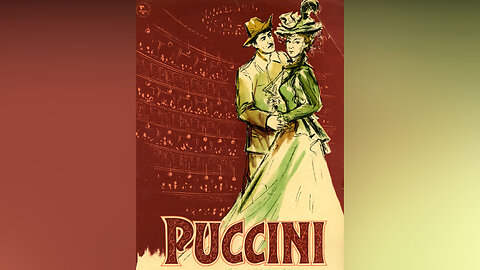
Puccini (Film 1953-ENG SUB)
Adaneth - Cinema&TV
Puccini is a 1953 Italian biographical musical melodrama film directed by Carmine Gallone. Audio in Italian with English subtitles (Click on CC).
The film, shot in Cinecittà in Italian-French co-production, narrates the fictional biography of the composer Giacomo Puccini. It stars actor Gabriele Ferzetti in the role of Giacomo Puccini. Gabriele Ferzetti will return to play Puccini the following year in the film Casa Ricordi, also directed by Gallone.
This biographical story of Puccini spans his creative life from early student days to the height of success, including his early flop Madame Butterfly and his incomplete Turandot. Along the way he encounters three women who change his life.
Cast & Characters:
Gabriele Ferzetti: Giacomo Puccini
Märta Torén: Elvira Puccini
Nadia Gray: Cristina Vernini
Paolo Stoppa: Giocondo
Myriam Bru: Delia
Sergio Tofano: Giulio Ricordi
Mimo Billi: Fanelli
Silvio Bagolini: Gianni
Alessandro Fersen: Padre di Delia
Jacques Famery: Antonio Puccini
Carlo Duse: Arrigo Boito
Piero Palermini: Ferdinando Fontana
Oscar Andriani: Giuseppe Giacosa
René Clermont: Luigi Illica
Mario Feliciani: Enrico
Renato Chiantoni: Filippo Tacchi
Attilio Dottesio: Sampieri
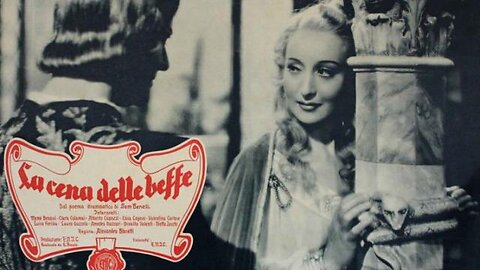
La Cena delle Beffe/The Jester's Supper (Film 1942-ENG SUB)
Adaneth - Cinema&TV
The Jester's Supper or The Supper of the Pranks (Italian:La cena delle beffe) is a 1942 Italian historical film directed by Alessandro Blasetti and starring Amedeo Nazzari, Osvaldo Valenti, Clara Calamai, Valentina Cortese and Luisa Ferida. Audio in Italian with English subtitles (Click on CC).
The film is based on a play of the same title by Sem Benelli, which had later been turned into an opera by Umberto Giordano. Like the play, the film is set in the 15th century Florence of Lorenzo the Magnificent and portrays a rivalry between Gianneto Malespini and Neri Chiaramantesi, that leads to a series of increasingly violent jokes.
It was shot at Cinecittà in Rome partly using sets which had been constructed for Blasetti's earlier The Iron Crown which was set in the same era. A popular catchphrase associated with Nazzari originated in the film: "a plague on anyone who refuses to drink with me!" The film was extremely popular and boosted the career of Clara Calamai in particular. In one scene she has her dress ripped off by Nazzari, briefly exposing her breasts in one of the first topless scenes in Italian cinema. It was one of several films in which Osvaldo Valenti and Luisa Ferida (both executed in 1945 by the partisans) appeared together.
Cast&Characters:
Amedeo Nazzari as Neri Chiaramantesi
Osvaldo Valenti as Giannetto Malespini
Clara Calamai as Ginevra
Alfredo Varelli as Gabriello Chiaramantesi
Valentina Cortese as Lisabetta
Memo Benassi as Il Tornaquinci
Piero Carnabuci as Fazio
Elisa Cegani as Laldòmine
Luisa Ferida as Fiammetta
Alberto Capozzi as Luca
Lauro Gazzolo as Il Trinca
Nietta Zocchi as Cinzia
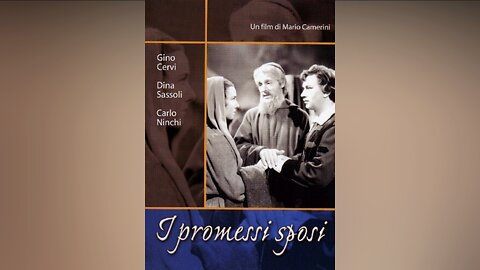
I Promessi Sposi/The Betrothed (Film 1941-ENG & RUSSUB)
Adaneth - Cinema&TV
The Betrothed (Italian: I Promessi Sposi) is a 1941 Italian historical drama film directed by Mario Camerini and starring Gino Cervi, Dina Sassoli and Ruggero Ruggeri. It is an adaptation of the 1827 novel The Betrothed by Alessandro Manzoni. Audio in Italian with English and Russian subtitles (Click on CC).
It was shot at the Cinecittà Studios in Rome and on location around Como. The film's sets were created by the art directors Gastone Medin and Gino Brosio while the costumes were designed by Gino Sensani. The novel was turned into a film again in 1964 and a television miniseries in 1989.
Lombardy, Italy, seventeenth century. Renzo and Lucia's love story is jeopardized by Don Rodrigo, a wicked nobleman, who is interested in Lucia. When she refuses his attentions he has her kidnapped and brought to a convent whose prioress is a nun as wicked as he is. The two youths will have to go through a lot of misfortunes before being reunited and being able to marry.
Partial cast and characters:
Gino Cervi as Renzo Tramagliano
Dina Sassoli as Lucia Mondella
Ruggero Ruggeri as Il cardinale Federigo Borromeo
Armando Falconi as Don Abbondio
Enrico Glori as Don Rodrigo
Carlo Ninchi as L'Innominato
Luis Hurtado as Padre Cristoforo
Evi Maltagliati as La monaca di Monza detta "La Signora"
Ines Cristina Zacconi [it] as Perpetua
Franco Scandurra as Il conte Attilio
Gilda Marchiò as Agnese Mondella, madre di Lucia
Dino Di Luca as Il Griso
Enzo Biliotti as Antonio Ferrer
Lauro Gazzolo as Ambrogio Fusella
Giacomo Moschini as Il dottor Azzeccagarbugli
3
comments

Umberto D. by Vittorio De Sica (Film 1952-ENG SUB)
Adaneth - Cinema&TV
Umberto D. is a 1952 Italian neorealist film directed by Vittorio De Sica. Audio in Italian with English subtitles (click on CC for subtitles.)
The movie was included in TIME magazine's "All-TIME 100 Movies" in 2005. The film's sets were designed by Virgilio Marchi. In 2008, the film was included on the Italian Ministry of Cultural Heritage’s 100 Italian films to be saved, a list of 100 films that "have changed the collective memory of the country between 1942 and 1978."
In an interview where he discussed Diary of a Country Priest, Psycho and Citizen Kane, Ingmar Bergman is quoted as saying, "Umberto D. is ... a movie I have seen a hundred times, that I may love most of all." Martin Scorsese included it on a list of "39 Essential Foreign Films for a Young Filmmaker." Roger Ebert included the film in his selection of Great Movies, writing that "Vittorio De Sica's Umberto D (1952) is the story of the old man's struggle to keep from falling from poverty into shame. It may be the best of the Italian neorealist films-the one that is most simply itself, and does not reach for its effects or strain to make its message clear."
Vittorio De Sica was nominated for the Grand Prix – 1952 Cannes Film Festival. 1955 New York Film Critics Circle Award for Best Foreign Film. Cesare Zavattini was nominated for the Academy Award for Best Story at the 29th Academy Awards in 1957.
Most of the actors were non-professional, including Carlo Battisti who plays the title role of Umberto Domenico Ferrari, a poor elderly man in Rome who is desperately trying to keep his rented room. His landlady (Lina Gennari) is evicting him and his only true friends, the housemaid (Maria-Pia Casilio) and his dog Flike (called 'Flag' in some subtitled versions of the film) are of no help.
Cast & Characters:
Carlo Battisti as Umberto Domenico Ferrari
Maria-Pia Casilio as Maria, the maid
Lina Gennari as Antonia Belloni, the landlady
Ileana Simova as the woman in Umberto's room
Elena Rea as the nun at the hospital
Memmo Carotenuto as a patient at the hospital
Alberto Albari Barbieri as Antonia's friend
Napoleone as Flike [uncredited]
2
comments

Rossini (Film 1942 - ENG SUB)
Adaneth - Cinema&TV
Rossini is a 1942 Italian musical drama film directed by Mario Bonnard. Audio in Italian with English subtitles.
The famous composer's life and his career. His love story with Isabella Colbran, the soprano who was to become his wife and the singer in all his operas up to the unfortunate day she lost her voice.
The film was shot at the Pisorno Studios in Tirrenia. The film's sets were designed by the art director Piero Filippone. starring Nino Besozzi, Paola Barbara, Camillo Pilotto, Armando Falconi and Greta Gonda. It depicts adult life events of Italian composer Gioachino Rossini.
Cast & Characters:
Nino Besozzi as Gioachino Rossini
Paola Barbara as Isabella Colbran
Camillo Pilotto as Domenico Barbaja
Armando Falconi as Ferdinand I of the Two Sicilies
Greta Gonda as Teresa Coralli
Memo Benassi as Ludwig van Beethoven
Cesare Fantoni as Niccolò Paganini
Edoardo Toniolo as Rossini's and Paganini's Friend
Paolo Stoppa as Andrea Leone Tottola
Gildo Bocci as Duke Sforza-Cesarini
Lamberto Picasso as Col. Negri
Giacomo Moschini as Duke Carafa
Gilda Marchiò as Anna Guidarini, Rossini's Mother
Massimo Pianforini as Professor Carpassi
Romolo Costa as Austrian Prince
Vera Ruberti as Viennese Noblewoman
Franco Rondinella as Don Raffaele
Oreste Fares as Giovanni Paisiello
Diana Dei as The Woman under the Rain
Oreste Bilancia as Her Husband
Anna Maria Dionisi as Colbran's Maid
1
comment

Lorenzino de' Medici (Film 1935 - ENG SUB)
Adaneth - Cinema&TV
Lorenzino de' Medici is a 1935 film directed by Guido Brignone. Audio in Italian with English subtitles.
The film is inspired by the events that actually happened in Florence in the first half of the sixteenth century, and already described in the play Lorenzaccio by Alfred de Musset. The film is a romanticised version of the story.
The protagonist Alexander Moissi (who was credited in the titles Italianized as Alessandro Moissi) was an Austrian film actor of Albanian origin, very famous in those years throughout Europe; this was the only film he shot in Italy.
Lorenzino de' Medici (22 March 1514 – 26 February 1548), also known as Lorenzaccio, was an Italian politician, writer, and dramatist, and a member of the Medici family. He was the son of Pierfrancesco II de' Medici or Pierfrancesco il Giovane ("the Younger") and Maria Soderini.
Lorenzino established a close relationship with his cousin Alessandro, who had become lord of Florence in 1530 and duke in 1532. The two were partners in riotous escapades, but the authenticity of their friendship is doubtful and their relationship had more than one dark side. In 1536, the duke sided against Lorenzino in a legal controversy on the inheritance of Pierfrancesco the Elder, Lorenzino's great-grandfather, which caused substantial financial damage to Lorenzino. In the same year, Alessandro married Margaret of Parma, the natural daughter of the Emperor Charles V.
On the evening of 6 January 1537, Lorenzino lured Alessandro to his apartments with the promise of a night of passion, and left him alone pretending that he was going to fetch a woman who had already agreed to meet him. According to most historians, the woman was Caterina Soderini, wife of Leonardo Ginori, but others think it was Laudomia, Lorenzino's sister. In the meantime, Alessandro fell asleep and, having previously sent away his men, he was completely defenseless when Lorenzino came back with his servant Piero di Giovannabate, also known as Scoronconcolo. The two men assaulted the duke with swords and daggers, and Alessandro was killed even though he reacted ferociously and fought with all his might.
Many hypotheses have been proposed to explain the reasons for the murder, from the personal resentment caused by jealousy or patrimonial reasons, to Lorenzino's desire to make a sensational gesture to immortalize his glory. Lorenzino himself, however, stated in his famous Apology - written only a few days after his crime - that he acted for political reasons; he killed the duke to free Florence from the man that many considered to be a tyrant.
The Florentine republican exiles generally had the same explanation; they considered Lorenzino a hero, since in so doing he could have made the reintroduction of the Republic possible. Dominant figures in the republican exiles, such as Benedetto Varchi, even compared Lorenzino's cause and actions to Brutus, the killer of Julius Caesar who held the same republicanism ideal. After the murder, Lorenzino took the horses he had previously prepared and left Florence along with Piero and another servant. Lorenzino reached Venice, where he was welcomed with open arms by the very rich banker Filippo Strozzi, the leader of the exiles, who promised him that he would marry his sons Piero and Roberto to Lorenzino's sisters Laudomia and Maddalena de' Medici. Among the many other exiles that exulted over the duke's death were the famous men of letters Iacopo Nardi and Benedetto Varchi: the latter said that Lorenzino was greater than Brutus. Also the poet Luigi Alamanni praised Lorenzino from France, whereas the sculptor Jacopo Sansovino promised to dedicate a statue to him.
With Alessandro's death, the main branch of the Medici family was extinguished. The lack of a suitable lineal descendant created the conditions for the rise to power of the seventeen-year-old Cosimo, a member of the cadet branch of the family who was chosen as the new duke with the approval of the Holy Roman Emperor Charles V.
After a few days in Venice, Lorenzino decided to go to Mirandola, where he was hosted by Count Galeotto Pico and remained for around two weeks. He then returned to Venice and from there, on 16 February 1537, he left to go to Constantinople, with the Ottoman ambassador in Venice and Giorgio Gritti, son of Doge Andrea. The choice to leave Italy was due partly to the risk of being killed and partly to a diplomatic mission to the Ottoman Sultan Suleiman the Magnificent on behalf of the King of France.
The battle of Montemurlo, won by Cosimo's army, ended the hopes of Filippo Strozzi and the other exiles. Lorenzino's patron Filippo was taken prisoner. He died in 1538 (suicide, according to the official version) after being tortured in the attempt to establish an unlikely connection between him and the Duke's assassination. In September 1537 Lorenzino went to France, to the court of Francis I of France, where he could count on the political support of the king and on the hospitality of many Florentines, especially his maternal uncle, the bishop of Saintes Giuliano Soderini, and the royal treasurer Giuliano Bonaccorsi.
In 1544 Lorenzino returned for good to Venice, where he was in close contact with the other Florentine exiles and established a friendship with the papal legate Giovanni Della Casa. In Venice, a nest of imperial and Medici spies, Lorenzino was much more vulnerable than in France, and the attempts to kill him and revenge the death of Duke Alessandro multiplied. The situation got even more complicated when, between the end of 1547 and the beginning of 1548, almost all the Florentines left Venice and moved to France, thus leaving Lorenzino isolated. Consequently, on 26 February 1548, Lorenzino was murdered in Venice by two hired killers. One of them, Francesco da Bibbona, left a detailed account of the deed which includes precious information on the execution of the murder.
For several centuries, it has been believed that the Medici secretary Giovanni Francesco Lottini had organized the murder, but new research has demonstrated that he played no part in it. Moreover, both his contemporaries and historians of the following centuries have always believed that Lorenzino's assassination had been ordered by Duke Cosimo I, as revenge for the murder of his predecessor. On the contrary, a study by Stefano Dall’Aglio has shown that the entire operation was orchestrated by the Emperor Charles V, who could not forgive the death of his son-in-law, the husband of his daughter Margaret. It was Charles V who explicitly ordered the murder, writing from Augsburg unbeknownst to Cosimo, and gave detailed instructions to his ambassador in Venice, Juan Hurtado de Mendoza, who was in charge of the operation.
Lorenzino was also a writer. In his Apology he defended himself, explaining that he had committed the murder for the love of liberty: he had followed the example of Brutus – one of the assassins of Julius Caesar – and had murdered the duke after pretending he was his faithful servant and friend.
The Apology is considered one of the loftiest examples of Renaissance eloquence and a masterpiece of anti-tyrannical thought. It was written in two subsequent versions, the first of which, not very different from the definitive one, dates back to January 1537, a few days after the murder. He also authored a play entitled Aridosia, written around 1535 and successfully presented in Florence, first at the Spedale dei Tessitori and later at Palazzo Medici.
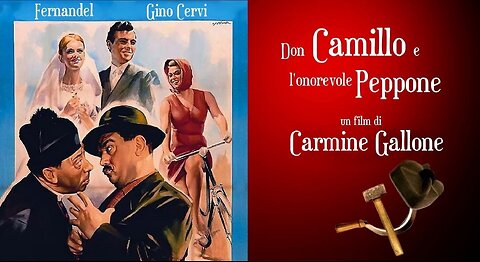
Don Camillo e l'onorevole Peppone/Don Camillo's Last Round (Film 1955-ENG SUB)
Adaneth - Cinema&TV
Don Camillo's Last Round (Italian: Don Camillo e l'onorevole Peppone, French: La grande bagarre de Don Camillo) is a 1955 Italian-French comedy film directed by Carmine Gallone and starring Fernandel, Gino Cervi and Leda Gloria. Audio in Italian with English subtitles (Click on CC).
It was the third of five films featuring Fernandel as the Italian priest Don Camillo and his struggles with Giuseppe 'Peppone' Bottazzi, the Communist mayor of their rural town.
It was shot at the Cinecittà Studios in Rome and on location in Boretto and Brescello in Emilia-Romagna. The film's sets were designed by the art director Virgilio Marchi.
In the small town of Brescello, skirmishes are continuing between the parish priest Don Camillo and the Communist mayor Peppone Bottazzi. After staging a theft of Don Camillo's prized chickens in retribution for a political prank pulled by the priest, Peppone decides to enter the big time of politics by standing for national senator. Peppone has been assisted by a winsome young lady comrade sent from the big city to assist him, but the mayor's wife – suspecting more – complains to Don Camillo, who endeavours to remedy the threatened domestic breakdown. Peppone must the fifth grade exam, the elementary school leving exam ("abolished" in 2003 - 2004).
Cast & Characters:
Fernandel as Don Camillo
Gino Cervi as Giuseppe 'Peppone' Bottazzi
Claude Sylvain as Clotilde
Leda Gloria as La signora Bottazzi, moglie di Peppone
Umberto Spadaro as Bezzi
Memmo Carotenuto as Lo Spiccio
Saro Urzì as Brusco, il parucchiere
Guido Celano as Il maresciallo
Luigi Tosi as Il prefetto
Marco Tulli as Lo Smilzo
Giovanni Onorato as Il Lungo
Don Camillo and Peppone are the fictional protagonists of a series of works by the Italian writer and journalist Giovannino Guareschi set in what Guareschi refers to as the "small world" of rural Italy after World War II. Most of the Don Camillo stories came out in the weekly magazine Candido, founded by Guareschi with Giovanni Mosca. These "Little World" (Italian: Piccolo Mondo) stories amounted to 347 in total and were put together and published in eight books, only the first three of which were published when Guareschi was still alive.
Don Camillo is a parish priest and is said to have been inspired by an actual Roman Catholic priest, World War II partisan and detainee at the concentration camps of Dachau and Mauthausen, named Don Camillo Valota (1912–1998). Guareschi was also inspired by Don Alessandro Parenti, a priest of Trepalle, near the Swiss border. Peppone is the communist town mayor. The tensions between the two characters and their respective factions form the basis of the works' satirical plots.
A series of black-and-white films were made between 1952 and 1965. These were French-Italian coproductions and were simultaneously released in both languages. Don Camillo was played by French actor Fernandel, Peppone by the Italian actor Gino Cervi, quite a Guareschi-lookalike, both tall and bulky with big mustaches. The author of the original stories was involved in the scripts and helped select the main actors. To this day, the films are screened in Europe.
https://en.wikipedia.org/wiki/Don_Camillo_and_Peppone#
4
comments

La Corona di Ferro/The Iron Crown (Film 1941)
Adaneth - Cinema&TV
The Iron Crown (Italian: La corona di ferro) is a 1941 Italian adventure written and directed by Alessandro Blasetti, starring Massimo Girotti and Gino Cervi. Audio in Italian with English subtitles.
The narrative revolves a sacred iron crown and a king who is prophesied to lose his kingdom to his nephew. It blends motifs from several European myths, legends and modern works of popular fiction.
The film won a Coppa Mussolini award, which is the ancestor to the Golden Lion. The film had an unusually large budget and was filmed on elaborate sets at the newly built Cinecittà studios. It stands out in Blasetti's filmography, as several of his most famous films instead were shot on location and used non-professional actors. The Iron Crown belongs to what is sometimes regarded as a tetralogy of films by Blasetti which deal with mythological themes. The other three films are Ettore Fieramosca from 1938, Un'avventura di Salvator Rosa from 1940 and The Jester's Supper from 1942.
The Italian actress Vittoria Carpi in an uncredited role shows a bare breast for moments in the film, and may have been the first actress to do so in an Italian sound film. However, the credit for this is normally given to Clara Calamai in Blasetti's next film, La cena delle beffe (1941), probably because Calamai is the protagonist of that film.
Luisa Ferida, who plays Kavaora, mother of Tundra & Tundra, and Osvaldo Valenti who plays Eriberto, were a couple in real life. They were both stars of the Italian cinema of the period. Luisa Ferida was one of divas in Italian cinema during decade 1935-1945 and she was the highest paid movie star of that period. In 1939, while working on Un Avventura di Salvator Rosa (1940), directed by Alessandro Blasetti, she met the actor Osvaldo Valenti. The pair became romantically involved and had a son.
They are remembered for their tragic death; in fact during the period of anti-fascist vendettas, immediately after Italian Civil War, they were assassinated, as was later proved by the Milan Court of Appeal, by shooting following a summary trial carried out by some partisans: she was pregnant when she was shot with her lover, the actor Osvaldo Valenti, as accused of alleged and hypothetical participation in war crimes and torture in connection with so-called Koch gang, facts of which she was then deemed innocent after the war. Valenti, who was a member of Decima Flottiglia MAS, had been linked with many Fascist officials - most notably the infamous Pietro Koch, the infamous leader of the Koch gang, a group notorious for its anti-partisan activity in the Republic of Salò - and personalities for years and he eventually joined the Italian Republic of Salò, and for this reasons he was on the partisans' hit list. He was finally arrested in Milan, alongside a pregnant Ferida in April 1945. They were both sentenced to be executed and shot immediately, without any proper trial.
Cast & Characters:
Elisa Cegani as the mother of Elsa & Elsa
Luisa Ferida as Kavaora, mother of Tundra & Tundra
Rina Morelli as the wise old woman
Gino Cervi as Sedemondo, the king of Kindaor
Massimo Girotti as Licinio & Arminio, his son
Osvaldo Valenti as Eriberto
Paolo Stoppa as Trifilli
Primo Carnera as Klasa, the servant of Tundra
Dina Perbellini as Elsa's nurse
Blaise Pascal (Film 1972)
Adaneth - Cinema&TV
Blaise Pascal is a 1972 television film directed by Roberto Rossellini. Audio in Italian with English subtitles.
Cast & Characters
Pierre Arditi: Blaise Pascal
Rita Forzano: Jacqueline Pascal
Giuseppe Addobbati: Étienne Pascal
Christian De Sica: luogotenente
Livio Galassi: Jacques il servo
Bruno Cattaneo: Adrien Dechamps
Plot Summary: In France, towards the beginning of 1650, the young Blaise Pascal is a very skilled and intelligent scholar who lives by studying the principles of mathematics and mechanics already introduced by René Descartes (better known as Descartes), the inventor of the Cartesian plane and above all promoter of a philosophy that encompasses the characteristics of the unconscious and of the essence that acts freely (God) and of the being that is forced to end and that does not act freely (living creatures, especially man). As his first work, he publishes an essay on geometry and mathematics in which he explains the conics that would form a star not of five but of six points. However Pascal is not fully understood by his peers, due to his precocious genius. He struggles to understand the natural world around him, in addition to an inner quest for religious faith.
6
comments

Cento giorni a Palermo - One Hundred Days in Palermo (Film 1984)
Adaneth - Cinema&TV
One Hundred Days in Palermo (Italian: Cento giorni a Palermo) is a 1984 non-fiction film directed by Giuseppe Ferrara with Giuseppe Tornatore as screenplay writer. Audio in Italian with English subtitles.
The film is a France/Italy coproduction and tells about the last hundred days in the life of the Italian "Generale dei Carabinieri" and anti-mafia highest authority Carlo Alberto Dalla Chiesa as prefect of Palermo, the capital of the Italian island of Sicily. Dalla Chiesa's life ended with his barbaric murder, shot by the machine guns of a mafia squad (along his wife and his bodyguard) on September 3, 1982.
Cast & Characters:
Lino Ventura as General Carlo Alberto Dalla Chiesa
Giuliana De Sio as Emanuela Setti Carraro
Lino Troisi as Pio La Torre
Stefano Satta Flores as Captain Fontana
Arnoldo Foà as Virginio Rognoni
Andrea Aureli
Accursio Di Leo
Adalberto Maria Merli

Il Primo Re/The First King: Birth of an Empire (2019 Film- ENG SUB)
Adaneth - Cinema&TV
Il Primo Re (also known as Romulus & Remus: The First King), is a 2019 Italian historical drama film directed by Matteo Rovere. Written by Filippo Gravino, Francesca Manieri, Matteo Rovere. Photography by Daniele Ciprì, Music by Andrea Farri. Audio in proto-italic language with English subtitles.
Set before the founding of Rome in 750 BC, Romulus and Remus, two shepherds and loyal brothers, end up taking part to a journey that will lead one of them to be the founder of the greatest nation ever seen.
The film portrays a struggle between power and pietas, as represented by the two brothers. Ultimately, power is shown to become order only when submitted to the will of the gods. The director had no intention to comment on contemporary politics, but said that the myth's theme of love and hubris "talks to us through symbols that we can interpret in the light of our current time".
All spoken dialogue is in proto-italic language, reconstructed by a group of semiologists thanks to epigraphs, tombs and objects that were contemporary to the time period which Romulus and Remus were imagined to have lived. The idea to make the film in archaic Latin came from a desire to make the characters sound ancestral, which would help the audience to attune themselves to the story. The language was created by a team from the Sapienza University of Rome led by professor Donatella Gentili. The team studied archaic Latin and "fleshed it out" with help from the reconstructed Proto-Indo-European language.
The film was shot entirely with natural light and on location, Lazio region (Wood of Foglino and the municipalities of Nettuno, Viterbo and Manziana.) VFX is used at minimum. The only exception is the big opening sequence. Two visual influences were the films Valhalla Rising (2009) and Apocalypto (2006).
Romanzo di una strage/Piazza Fontana: The Italian Conspiracy (Film 2012 - ENG SUB)
Adaneth - Cinema&TV
Romanzo di una strage (internationally released as Piazza Fontana: The Italian Conspiracy) is a 2012 Italian historical drama film directed by Marco Tullio Giordana. It is loosely based on the book Il segreto di Piazza Fontana by Paolo Cucchiarelli. Audio in Italian with English subtitles.
The film deals with the reconstruction of the Piazza Fontana bombing that took place in Milan December 12, 1969, and of the tragic events that ensued, from the death of Giuseppe Pinelli, which occurred in mysterious circumstances during an interrogation, to the death of the Commissioner Luigi Calabresi, who had led the investigation.
Cast & Characters:
Valerio Mastandrea: Luigi Calabresi
Pierfrancesco Favino: Giuseppe Pinelli
Bob Marchese: the President Judge Carlo Biotti
Fabrizio Gifuni: Aldo Moro
Omero Antonutti: Giuseppe Saragat
Laura Chiatti: Gemma Calabresi
Stefano Scandaletti: Pietro Valpreda
Michela Cescon: Licia Pinelli
Giorgio Colangeli: Federico Umberto D'Amato
Luigi Lo Cascio: Judge Paolillo
Giorgio Tirabassi: the professor
Giorgio Marchesi: Franco Freda
Denis Fasolo: Giovanni Ventura
Gianni Musy: confessor of Moro
Luca Zingaretti: the doctor
Francesco Salvi: Cornelio Rolandi
Corrado Invernizzi: Judge Pietro Calogero

Cadaveri eccellenti - Illustrious Corpses (Film 1976)
Adaneth - Cinema&TV
llustrious Corpses (Italian: Cadaveri eccellenti) is a 1976 Italian-French thriller film directed by Francesco Rosi and starring Lino Ventura, based on the novel Equal Danger (Italian title: Il contesto) by Leonardo Sciascia (1971). Audio in Italian with English subtitles.
The film starts with the murder of Investigating Judge Vargas in Palermo, amongst a climate of demonstrations, strikes and political tension between the Left and the Christian Democratic government. The subsequent investigation failing, the police assign Inspector Rogas (Lino Ventura), a man with a firm faith in the integrity of the judiciary, to solve the case. While he is starting his investigation, two judges are killed. All victims turn out to have worked together on several cases.
Its title refers to the surrealist game, Cadavre Exquis, invented by André Breton, in which the participants draw consecutive sections of a figure without seeing what the previous person has drawn, leading to unpredictable results, and is meant to describe the meandering nature of the film with its unpredictable foray into the world of political manipulations, as well as the ("illustrous") corpses of the murdered judges.
The film triggered a lot of controversy at its release, especially for the joke pronounced in the last part of the film by the communist party secretary "Truth is not always revolutionary", which is used by Rosi to denote the silence of the opposition to the prevailing and much often unpunished corruption.
Cast & Characters:
Lino Ventura as Inspector Amerigo Rogas
Tino Carraro as Chief of Police
Marcel Bozzuffi as The lazy
Paolo Bonacelli as Dr. Maxia
Alain Cuny as Judge Rasto
Maria Carta as Madame Cres
Luigi Pistilli as Cusan
Tina Aumont as The prostitute
Renato Salvatori as Police Commissary
Paolo Graziosi as Galano
Anna Proclemer as Nocio's wife
Fernando Rey as Security Minister
Max von Sydow as Supreme Court president
Charles Vanel as Varga

Casta Diva ( 1954 Film - ENG Sub)
Adaneth - Cinema&TV
Casta Diva is a 1954 Italian-French biographical melodrama film directed by Carmine Gallone. Audio in Italian with English subtitles (Click on CC for subtitles).
The film tells the fictionalized biography of the famous Italian Opera Composer Vincenzo Bellini, who lived in the 19th century and died at the age of 34. The film is a remake of Gallone's 1935 film with the same name.
The film made use of the collaboration of the orchestra and chorus of the Teatro dell'Opera di Roma. The film contains excerpts from the operas of Vincenzo Bellini, Gaetano Donizetti and Niccolò Paganini, arrangement by Renzo Rossellini.
Cast & Characters:
Antonella Lualdi as Maddalena Fumaroli
Nadia Gray as Giuditta Pasta
Maurice Ronet as Vincenzo Bellini
Fausto Tozzi as Gaetano Donizetti
Jacques Castelot as Ernesto Tosi
Marina Berti as Beatrice Turina
Renzo Ricci as Giudice Fumaroli
Jean Richard as Fiorillo
Paola Borboni as Miss Monti
Lauro Gazzolo as Domenico Barbaja
Danilo Berardinelli as Niccolò Paganini
Renzo Giovampietro as Saverio Mercadante
Camillo Pilotto as Rettore Conservatorio
Luigi Tosi as Felice Romani
Dante Maggio as Il pazzariello
Nino Vingelli as Il guappo
Carthage in Flames (Film 1960)
Adaneth - Cinema&TV
Carthage in Flames (Italian: Cartagine in fiamme) is a 1960 Italian historical drama film directed by Carmine Gallone. It was shot at the Cinecittà Studios in Rome. The film's sets were designed by the art director Guido Fiorini. Audio in English.
Carthage in Flames was among the most expensive epic adventure films produced in Italy during the 1960s. It is based on the 1908 novel of the same title by Emilio Salgari. The film depicts the last of the Punic Wars between the Roman Republic and Carthage.
Cast & Characters:
Pierre Brasseur as Sidone
Daniel Gélin as Phegor
Anne Heywood as Fulvia
Aldo Silvani as Hermon
Ilaria Occhini as Ophir
Paolo Stoppa as Astarito
José Suárez as Hiram
Terence Hill as Tsour
Gianrico Tedeschi as Eleo
Edith Peters as Sarepta
Cesare Fantoni as Assian
Erno Crisa as Asdrubak
Antonio Wisemané as Polacco
Nicolini Roberto as Cesare

I banchieri di Dio - Il caso Calvi | The Bankers of God - The Calvi Affair (Film 2002)
Adaneth - Cinema&TV
The Bankers of God: The Calvi Affair (Italian: I banchieri di Dio also known as The God's Bankers) is an Italian drama film directed in 2002 by Giuseppe Ferrara. Audio in Italian with English subtitles.
The film tells the story of the scandal of Banco Ambrosiano, mainly related to the figure of Roberto Calvi. The Clearstream scandal exploded as a case full of intricate affairs involving the financial world, the Vatican, the Masonic Lodge P2, the Italian Secret Service, the Secret Intelligence Service, the Italian politics, the Mafia and the Banda della Magliana. The movie narrates in detail all these connections, trying to reconstruct events and plots.
Cast & Characters:
Omero Antonutti as Roberto Calvi
Giancarlo Giannini as Flavio Carboni
Rutger Hauer as Bishop Paul Marcinkus
Alessandro Gassman as Francesco Pazienza
Pamela Villoresi as Clara Calvi
Vincenzo Peluso as Silvano Vittor
Pier Paolo Capponi as Roberto Rosone
Franco Diogene as Luigi Mennini
Camillo Milli as Licio Gelli
Franco Olivero as Michele Sindona

Le Conseguenze dell'Amore/The Consequences of Love (Film 2004-ENG SUB)
Adaneth - Cinema&TV
Consequences of Love (Italian: Le Conseguenze dell'Amore) is a 2004 Italian psychological thriller film written and directed by Paolo Sorrentino. Audio in Italian with English subtitles. It stars Toni Servillo, Olivia Magnani, Adriano Giannini, Gianna Paola Scaffidi, and Raffaele Pisu. The film competed at the 2004 Cannes Film Festival. It won five David di Donatello awards including Best Film, Best Director and Best Actor. It was also the first film to achieve widespread critical acclaim for Sorrentino.
Titta Di Girolamo is a middle-aged loner who has spent the last eight years living in an upmarket hotel in Lugano, Switzerland. Every day he puts on his suit and wanders around, avoiding contact with people. In the morning, he solves the chess puzzles in the paper and in the evening he plays Grabber with a bankrupt aristocratic couple who are marooned in the hotel they used to own. Occasionally, he rings his family in Italy but his wife is always reluctant to talk, and his grown-up children despise him. He develops feelings for Sofia, the beautiful and stylish waitress at the bar of the hotel but he refuses to speak to her because, in his shyness, he fears that love would complicate his monotone but quiet life. The reasons behind Titta's strange existence gradually become apparent.
2
comments

Il Marchese del Grillo (Film 1981-ENG SUB)
Adaneth - Cinema&TV
Il Marchese del Grillo ("The Marquess Del Grillo", internationally released as The Marquis of Grillo) is a 1981 Italian historical comedy drama film directed by Mario Monicelli, starring Alberto Sordi as the title character. Audio in Italian with English subtitles.
The film depicts early nineteenth-century episodes in the life of a nobleman in Rome. Loosely based on folkloric accounts of the real Onofrio del Grillo (who lived in the eighteenth century), this character plays a number of pranks, one even involving Pope Pius VII. The famous line "Io sò io, e voi non siete un cazzo" (literally "I am who I am, and you are fucking nobody"), is appropriated from Belli's 1831 sonnet, "The Sovrans of the Old World".
The film won two David di Donatello, four Nastri d'Argento in 1982. At the 32nd Berlin International Film Festival Mario Monicelli won the Silver Bear for Best Director.
2
comments
Nell'anno del Signore/In The Year of Our Lord (Film 1969-ENG SUB)
Adaneth - Cinema&TV
Nell'anno del Signore (English release title: The Conspirators) is a 1969 Italian historical (part comedy) drama film written and directed by Luigi Magni and starring Nino Manfredi, Enrico Maria Salerno and Claudia Cardinale. Audio in Italian with English subtitles.
It is based on the actual story of the capital execution of two Carbonari in papal Rome. The film's sets were designed by the art director Carlo Egidi. Location shooting took place around Rome. The soundtrack for the movie was composed by Armando Trovajoli.
Cast & Characters:
Nino Manfredi as Cornacchia
Enrico Maria Salerno as Colonel Nardoni
Claudia Cardinale as Giuditta Di Castro (dubbed by Rita Savagnone)
Robert Hossein as Leonida Montanari (dubbed by Giuseppe Rinaldi)
Renaud Verley as Angelo Targhini (dubbed by Massimo Turci)
Ugo Tognazzi as Cardinal Agostino Rivarola
Alberto Sordi as the friar
Franco Abbina as Prince Filippo Spada (dubbed by Franco Latini)
Britt Ekland as Princess Spada
Pippo Franco as Bellachioma (dubbed by Pino Locchi)
Stefano Oppedisano as a drunken boy
La Meglio Gioventù/The Best of Youth (Act II - ENG SUB)
Loading 2 comments...
-
 3:28:47
FreshandFit
14 hours agoShe CLAIMS She's A High Value Woman. But Gets A RUDE Awakening...
220K56 -
 1:51:20
Badlands Media
12 hours agoBaseless Conspiracies Ep. 162 – Kubrick, Eyes Wide Shut & the Elites Behind the Mask
79.4K26 -
 59:03
59:03
Inverted World Live
7 hours agoWhat Now? | Ep. 152
86.9K35 -
 2:57:51
TimcastIRL
7 hours agoShots Fired At Timcast Studio, Man Arrested For Stalking Benny, Loomer, Matt Walsh | Timcast IRL
269K307 -
 3:03:45
Decoy
7 hours agoIt's happening
44.5K7 -
 26:14
26:14
Jasmin Laine
12 hours agoBREAKING: Liberals Caught Cutting SECRET Deal to Rewrite Speech Laws
29K30 -
 17:33
17:33
Navy Media
10 hours ago $5.88 earnedChinese Fighter Jet Flies TOO CLOSE to US Navy Destroyer – BIG MISTAKE
35.4K6 -
 51:11
51:11
Jamie Kennedy
6 hours agoAre We All Being Played? Comedy, Politics, Sports & The Illusion of Control | Ep 234 HTBITY
28.2K -
 8:38:36
SpartakusLIVE
9 hours ago#1 Challenge MASTER brings YOU Monday Motivation
61.4K1 -
 5:01:09
Drew Hernandez
1 day agoTIMCAST IRL STUDIO COMPOUND SHOT AT & TRUMP COMPLAINS ABOUT RINOS STALLING HIM
51K28