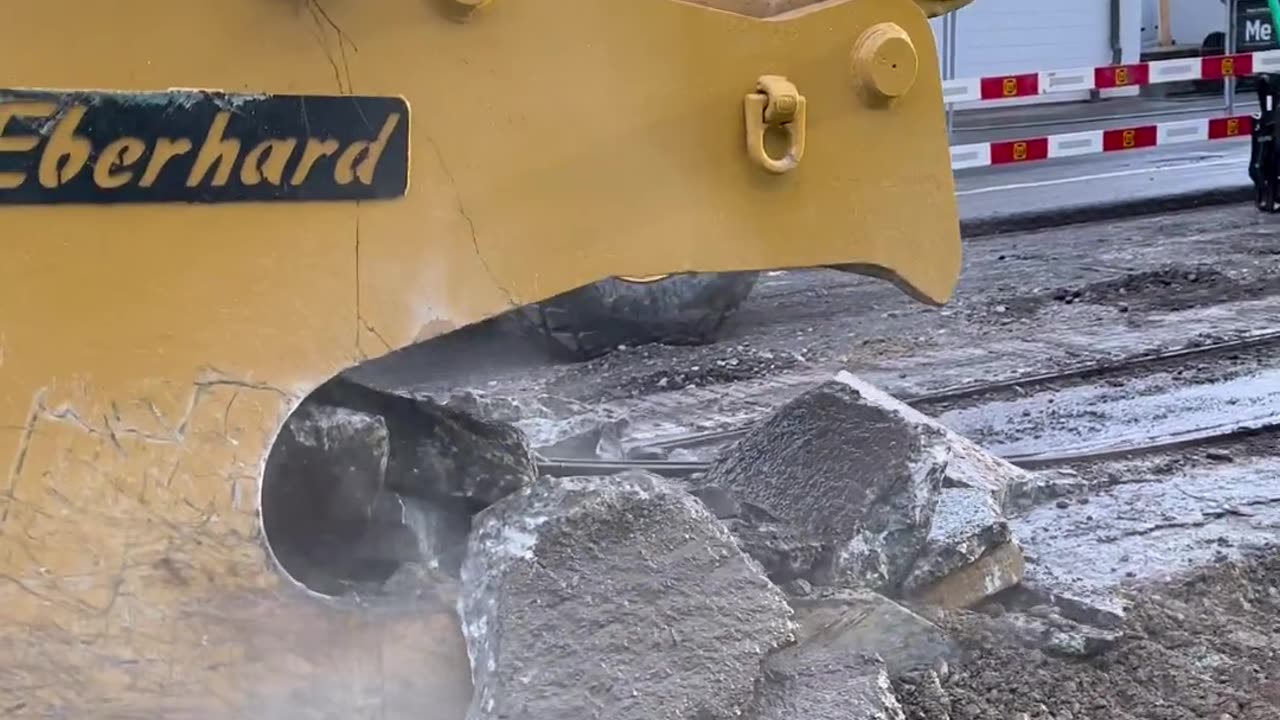
𝐑𝐢𝐩𝐩𝐢𝐧𝐠 𝐨𝐮𝐭 𝐭𝐫𝐚𝐜𝐤𝐬...𝐛𝐢𝐠𝐠𝐞𝐬𝐭 𝐞𝐱𝐜𝐚𝐯𝐚𝐭𝐨𝐫 𝐜𝐫𝐞𝐝𝐢𝐭 𝐭𝐨 : 𝐛𝐢𝐠_𝐦𝐚𝐜𝐡𝐢𝐧𝐞𝐫𝐲
Ripping is a process of breaking up rock and soil with a large tooth or teeth attached to the back of a bulldozer.
Where feasible, ripping is generally preferred over blasting because it is considerably less expensive; ripping costs are typically 50 to 65% less than blasting. Ripping is also significantly less dangerous than blasting and requires fewer permits and special precautions. Ripping can be done in close proximity to populated areas or other places where blasting noise and vibrations are restricted. However, ripping is limited to soft to moderately firm, fractured rock and construction of low-angle cut slopes and shallow, near vertical cuts. In dense rock formations, light blasting is sometimes performed before ripping.
Once the material is loosened by ripping, an excavator can be used to remove it and perform slope sculpting (see below). Ripping gives the contractor a lot of freedom to aesthetically enhance a slope by adding additional contour and allowing for revegetation in certain areas.
The teeth on rippers can leave scar marks on the rock after excavation. In most cases, these can removed using the same procedure used to remove drill hole traces. In soft and/or massive rock, the contractor may use a jet of high-pressure water or a vibratory compactor, known as a plate bucket, which is attached to an excavator or loader to remove the scars.
Ripping is usually done in one direction, but in very tough materials ripping in a grid pattern will increase excavation efficiency. The pass spacing is determined by the end use of the material (fill, aggregate, waste, etc.) and the capacity of the excavating equipment. In most cases, it is best to maximize ripping depth, but in stratified formations it may be best to rip along the natural layers.
Ripping is generally done in the same direction that loading will take place (i.e., parallel to the plane). However, when the material exhibits a foliation or bedding plane, ripping perpendicular to the plane produces much better fracturing.
Ripping Equipment
There are basically two types of rippers: the pull- (or tow-) type ripper and the integral bulldozer- mounted ripper. In rock excavation, a bulldozer-mounted ripper as shown in Figure 21 works better than a pull-type ripper because it can exert greater downward pressure.
Rippers also come in single- and multi-toothed configurations. Single-toothed rippers are used for difficult ripping work, where maximum ripping depth is required and/or the material is dense. Multi-toothed rippers, which can use up to five teeth, are used for softer ground or for secondary purposes such as breaking up already ripped ground.
-
 13:40
13:40
ARFCOM News
16 hours ago $0.12 earnedHis Wife Got Cancer So They Took His Guns + DoJ's 2A Rights Division + Trump Slump Continues
3.09K4 -
 13:19
13:19
Degenerate Jay
16 hours agoThis Fallout: New Vegas Discovery Could Change Everything
4.89K -
 33:35
33:35
ArturRehi
19 hours agoNERVES OF STEEL - American Fighters Are not Easy to Frighten in Ukraine
3.54K1 -
 LIVE
LIVE
BEK TV
22 hours agoTrent Loos in the Morning - 12/03/2025
218 watching -
 LIVE
LIVE
The Bubba Army
21 hours agoTRUMP SAYS NO MORE INCOME TAX? - Bubba the Love Sponge® Show | 12/03/25
1,319 watching -
 LIVE
LIVE
FyrBorne
12 hours ago🔴Battlefield REDSEC Live M&K Gameplay: Testing Sleeper Loadouts
114 watching -
 28:54
28:54
ZeeeMedia
16 hours agoREAL ID Non-Compliance Fees from 2026 & WW3 Escalation | Daily Pulse Ep 154
9.66K31 -
 LIVE
LIVE
PudgeTV
3 hours ago🔴 Sea of Thieves - Gaming on Rumble | The Three Rumskateers Go Sailing Again!!
204 watching -
 LIVE
LIVE
Midnight In The Mountains™
1 hour agoMorning Coffee w/ Midnight & The Early Birds of Rumble | Pudge Made me LATE! |
101 watching -
 LIVE
LIVE
Pickleball Now
4 hours agoLive: IPBL 2025 Day 3 | Nonstop Action from India’s Biggest Pickleball League
80 watching