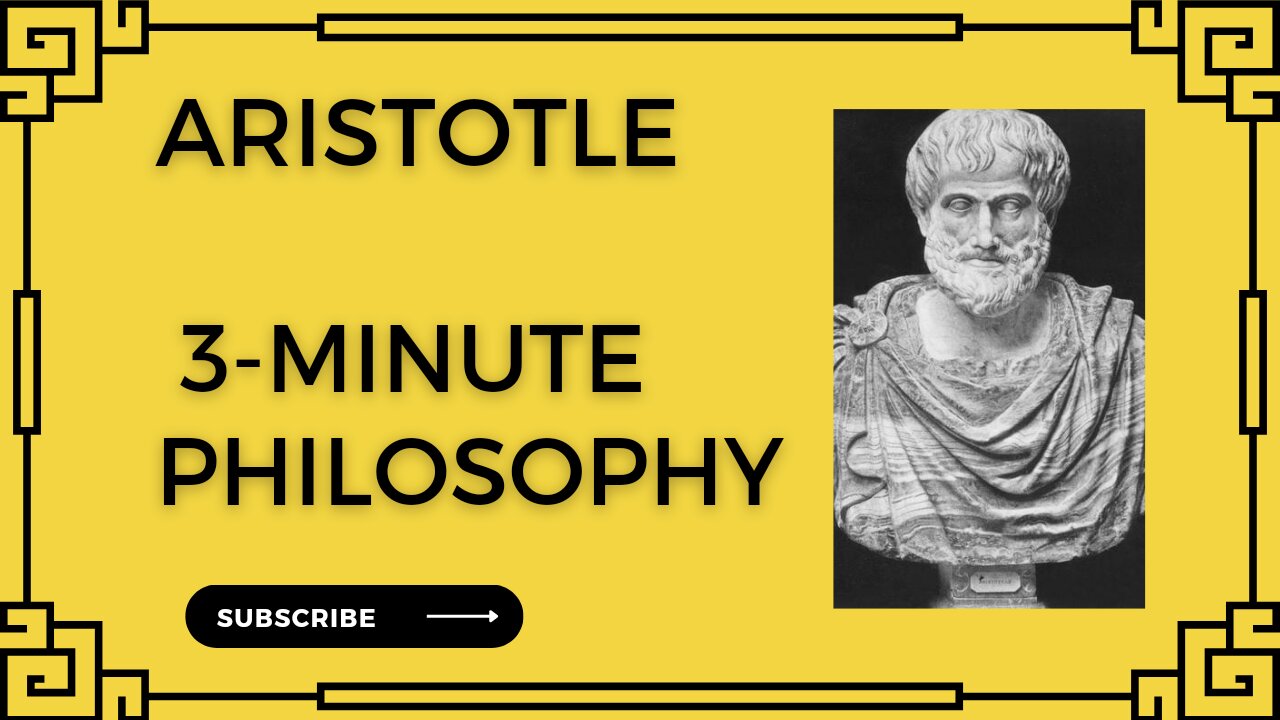
Aristotle: Virtue Theory | 3-Minute Philosophy | Crash Course - Peak Intrigue
Aristotle was born in 384 BCE in the ancient Greek city of Stagira. His father was a court physician to the Macedonian king, and as a result, Aristotle grew up in a privileged environment with access to the best education of his time.
After completing his education in Athens, where he studied under the great philosopher Plato, Aristotle began teaching at the Academy in Athens. However, he eventually parted ways with Plato and founded his own school, the Lyceum, in 335 BCE.
The Lyceum was a place of intense intellectual activity, with Aristotle and his students engaging in research, discussion, and debate on a wide range of topics, from politics and ethics to biology and metaphysics.
One of Aristotle's most significant contributions to philosophy was his emphasis on empirical observation and analysis. Unlike his predecessors, who relied on pure reason to understand the world, Aristotle believed that we should rely on our senses to gain knowledge about the natural world.
For Aristotle, everything in the natural world had a specific purpose or function, and by studying the purpose or function of an object, we could gain a deeper understanding of its essence. This approach is known as teleology, and it is central to Aristotle's philosophy.
Aristotle's teleological approach to nature is perhaps most evident in his biological work. He was one of the first to classify animals based on their shared characteristics, and he believed that every organism had a specific purpose or function in the ecosystem.
Aristotle's emphasis on teleology extended beyond the natural world to human society as well. He believed that every individual had a specific purpose or function within society, and that fulfilling that purpose was essential for human flourishing.
Aristotle also believed that the best way to achieve happiness and fulfillment was through the pursuit of virtue. He believed that there were certain virtues that were essential for a good life, such as courage, honesty, and justice, and that cultivating these virtues was essential for personal growth and social harmony.
In addition to his philosophical work, Aristotle also made significant contributions to the fields of logic and rhetoric. He developed a system of syllogistic reasoning that is still used today, and he wrote extensively on the art of persuasion.
Despite his many contributions to philosophy and science, Aristotle's life was not without controversy. He was accused of impiety and fled Athens in 322 BCE, spending the final years of his life in exile. He died in 322 BCE at the age of 62.
In conclusion, Aristotle's contributions to philosophy and science have had a lasting impact on Western thought. His emphasis on empirical observation and teleology laid the groundwork for modern science, and his ideas about virtue and personal fulfillment continue to influence our understanding of ethics and happiness.
-
 LIVE
LIVE
MissesMaam
2 hours agoPlayin' Fallout New Vegas *For the 1st Time* 💚✨
137 watching -
 2:14:16
MattMorseTV
4 hours ago $26.85 earned🔴Vance just FLIPPED the SCRIPT.🔴
50.7K160 -
 20:33
20:33
Amy Dangerfield
7 hours ago $10.83 earnedWhy Everyone Is Talking about Clavicular & Looksmaxxing
42.4K35 -
 LIVE
LIVE
SpartakusLIVE
5 hours agoBANISHED to The SHADOW REALM || The People UNITE to UNBAN SPARTAKUS
774 watching -
 LIVE
LIVE
Primes Gaming Channel
2 hours agoVibe Check: Tell me about your week (I'm listening).
85 watching -
 1:09:35
Total Horse Channel
2 hours agoThe Documentary of Thunder | Denver Broncos Mascot
10.2K -
 3:08:56
Vitaminsmore
4 hours agoDay 8 of Ys IX: Monstrum Nox!
6.23K -
 1:28:14
Sarah Westall
4 hours agoThis Study Just Changed Everything: Nanotechnology Found in Humans
20.4K3 -
 LIVE
LIVE
Cewpins
3 hours agoChill Smoke Sesh: weed & dabs🔥6-Year Twitch Partnerversary Friday!!🍃420💨 !MJ !giveaway
33 watching -
 LIVE
LIVE
Drew Hernandez
21 hours agoPAM BONDI FAILS TO SECURE DON LEMON'S ARREST?
566 watching