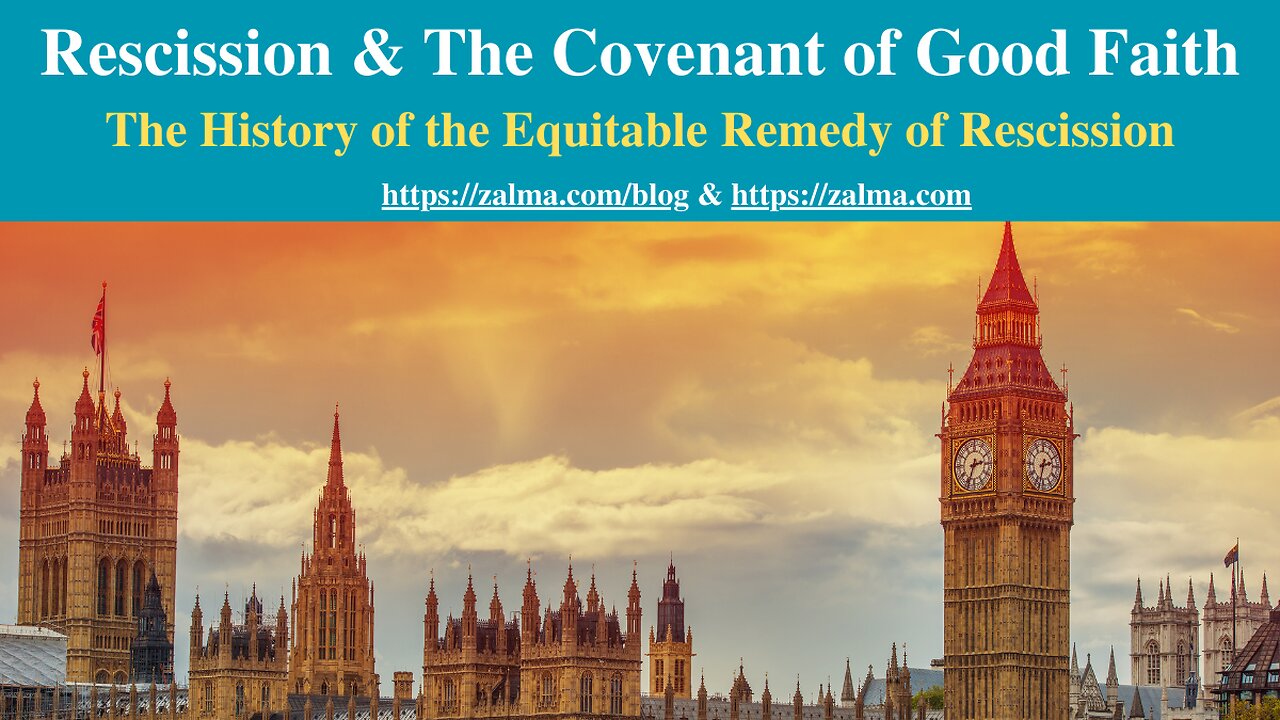
The History of the Equitable Remedy of Rescission
Rescission & The Covenant of Good Faith
The covenant of good faith and fair dealing was first reported in 1766 in the British House of Lords in Carter v. Boehm, S.C. 1 Bl.593, 3 Burr 1906, 11th May 1766, when Lord Mansfield decided against the insurer who claimed he was deceived by the insured because the insurer was not deceived and knew more about the risks than did the insured.
Lord Mansfield noted that the policy broker, who produced the memorandum given by the governor's brother (the plaintiff and insured) to him: and the use made of these instructions was to show that the insurance was made for the benefit of Governor Carter, and to insure him against the taking of the fort by a foreign enemy. The insurer contended that the plaintiff ought to have discovered the weakness and absolute indefensibility of the fort. In this case, as against the insurer, he was obliged to make such a discovery, though he acted for the governor.
Lord Mansfield noted that the special facts, upon which the contingent chance is to be computed lie most commonly in the knowledge of the insured only: the underwriter trusts to his representation and proceeds upon confidence that he does not keep back any circumstance in his knowledge, to mislead the underwriter into a belief that the circumstance does not exist, and to induce him to estimate the risk, as if it did not exist. Keeping back such circumstance is, Lord Mansfield concluded, a fraud. Therefore, the policy is void.
Even if the suppression of material facts should happen through mistake, without any fraudulent intention; yet still the underwriter is deceived, and the policy is void; because the risk run is really different from the risk understood and intended to be run, at the time of the agreement. The policy would equally be void against the underwriter, if he concealed; as, if he insured a ship on her voyage, which he privately knew to be arrived: and an action would lie to recover the premium.
Good faith forbids either party by concealing what he privately knows, to draw the other into a bargain, from his ignorance of that fact, and his believing the contrary.
The policy insured against the risk of the loss for Fort Marlborough, from being destroyed by, taken by, or surrendered unto, any European enemy, between the 1st of October 1759, and 1st of October 1760. It was underwritten on the 9th of May 1760. The underwriter knew at the time, that the policy was to indemnify, to that amount, Roger Carter the Governor of Fort Marlborough, in case the event insured against should happen.
Lord Mansfield noted that the underwriter who knew Carter to be the governor, at the time he took the premium--and the plaintiff proved without contradiction, that the fort was only intended and built with an intent to keep off the country and that the only security against European ships of war, consisted in the difficulty of the entrance and navigation of the river, for want of proper pilots.
That the general state and condition of the said fort, and of the strength thereof, was, in general well known, by most persons conversant or acquainted with Indian affairs, or the state of the Company's factories or settlement; and could not be kept secret or concealed from persons who should endeavor by proper inquiry, to inform themselves.
The computation of the risk depended upon the chance, “whether any European power would attack the place by sea.” If they did, it was incapable of resistance. The underwriter at London, in May 1760, could judge much better of the probability of the contingency, than Governor Carter could at Fort Marlborough, in September 1759. He knew or might know everything which was known at Fort Marlborough in September 1759. The contingency, therefore, which the underwriter insured against is “whether the place would be attacked by an European force; and not whether it would be able to resist such an attack, if the ships could get up the river.”
Lord Mansfield found that there was no imputation upon the governor, as to any intention of fraud. The reason for the rule against concealment is, to prevent fraud and encourage good faith. If the defendant's objections were to prevail, Lord Mansfield concluded, the rule of concealment would be turned into an instrument of fraud.
The underwriter, here, knowing the governor to be acquainted with the state of the place; knowing that he apprehended danger, and must have some ground for his apprehension; being told nothing of either set of facts; signed the policy, without asking a question.
Lord Mansfield found that an ethical underwriter with knowledge of the risks being taken, equal to or better than that of the person insured, could not, in good faith, claim that material facts were concealed from him because utmost good faith required the underwriter to use his superior knowledge to favor the insured.
The attempt at rescission failed but, simultaneously the 1766 decision setting forth the covenant of good faith and fair dealing implied in every contract of insurance has survived to this day as an effective tool for insurers to defeat attempts at insurance fraud. And the “marine rule” first enunciated by Lord Mansfield, that a misrepresentation or concealment of material fact, whether intentionally or innocently made, is a basis for rescission if the underwriter, the risk taker, is deceived.
(c) 2023 Barry Zalma & ClaimSchool, Inc.
Subscribe and receive videos limited to subscribers of Excellence in Claims Handling at locals.com https://zalmaoninsurance.locals.com/subscribe.
Consider subscribing to my publications at substack at https://barryzalma.substack.com/publish/post/107007808
Go to Newsbreak.com https://www.newsbreak.com/@c/1653419?s=01
Barry Zalma, Esq., CFE, is available at http://www.zalma.com and [email protected]
Follow me on LinkedIn: www.linkedin.com/comm/mynetwork/discovery-see-all?usecase=PEOPLE_FOLLOWS&followMember=barry-zalma-esq-cfe-a6b5257
Write to Mr. Zalma at [email protected]; http://www.zalma.com; http://zalma.com/blog; daily articles are published at https://zalma.substack.com. Go to the podcast Zalma On Insurance at https://podcasters.spotify.com/pod/show/barry-zalma/support; Follow Mr. Zalma on Twitter at https://twitter.com/bzalma; Go to Barry Zalma videos at Rumble.com at https://rumble.com/c/c-262921; Go to Barry Zalma on YouTube- https://www.youtube.com/channel/UCysiZklEtxZsSF9DfC0Expg; https://creators.newsbreak.com/home/content/post; Go to the Insurance Claims Library – https://zalma.com/blog/insurance-claims-library.
-
 7:40
7:40
Barry Zalma, Inc. on Insurance Law
1 year agoLoss of Inventory by Bankruptcy
198 -
 2:16:21
Side Scrollers Podcast
19 hours agoTwitch has a SERIOUS Problem + Leaflit’s VIRAL Interview + More | Side Scrollers
47K16 -
 21:55
21:55
GritsGG
15 hours agoMega Win Streak On Warzone! Over 4100 Wins on BO6 WZ!
9.33K1 -
 20:22
20:22
The Pascal Show
1 day ago $3.41 earnedARE THEY IGNORING HER?! Is The White House & FBI Ignoring Candace Owens' A**assination Claims?!
34.1K19 -
 1:00:45
TruthStream with Joe and Scott
1 day agoMondays with Matt Geiger from Verity Metals: Gold, Silver, The Housing Market and more. Live 12/1 6pm pacific #519
15.3K1 -
 2:17:46
The Connect: With Johnny Mitchell
3 days ago $14.96 earnedA Sitdown With The Real Walter White: How An Honest Citizen Became A Synthetic Drug Kingpin
85.7K2 -
 2:40:08
PandaSub2000
12 hours agoDEATH BET | Solo Episode 01 (Edited Replay)
10.9K1 -
 LIVE
LIVE
Lofi Girl
3 years agolofi hip hop radio 📚 - beats to relax/study to
486 watching -
 2:03:38
Inverted World Live
10 hours agoSatanic Pedophile Network in Australia | Ep. 149
235K56 -
 3:34:45
TimcastIRL
10 hours agoCandace Owens Implies TPUSA KILLED Charlie Kirk, Claims Failed Bibi Deal Cost MILLIONS | Timcast IRL
236K192