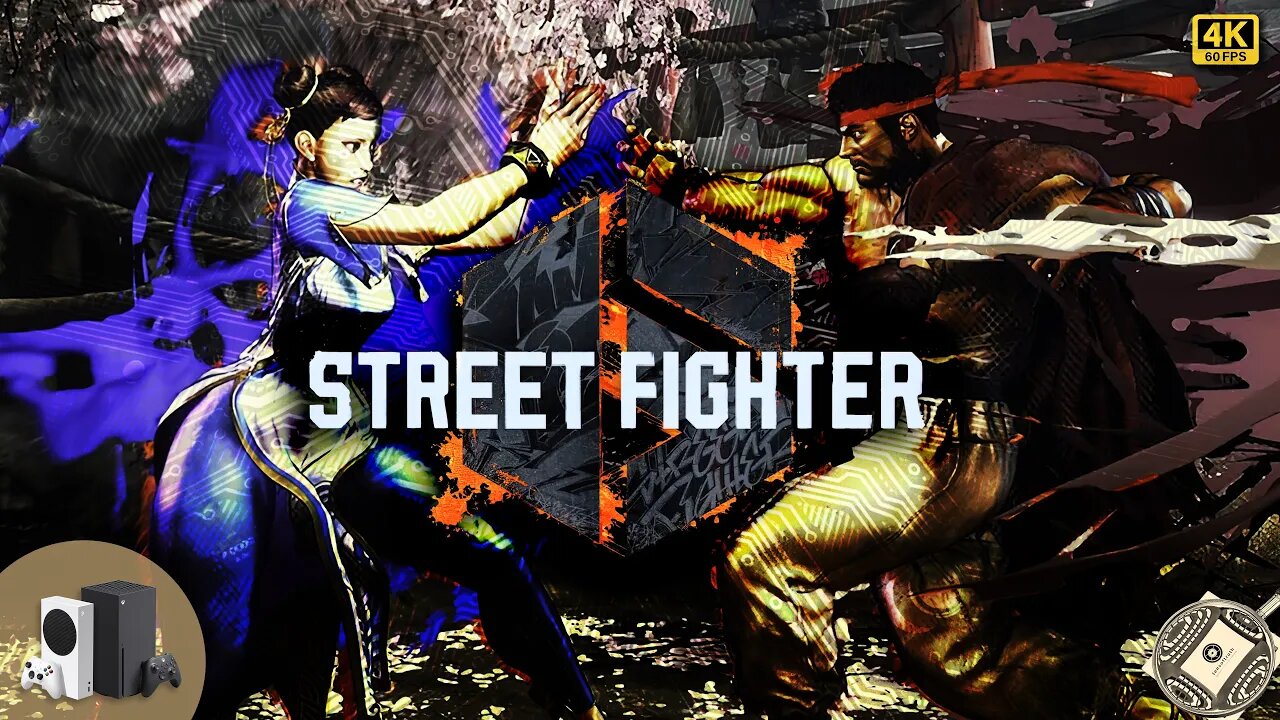
Street Fighter 6 Final Release (Fighting Ground Mode) - Tech Analysis on Xbox Series X/S
Analysis of performance and image quality of Street Fighter 6 on Xbox Series X/S.
If you're interested in getting to know the game better, watch this video on a partner channel and see a little more running in the Xbox Series S:
Meu Series S gameplay:
youtu.be/KHwEVzSZxOI
Index:
Intro 00:00
Frame Rate 00:19
Resolution 02:24
Reflections 03:32
Shadows 04:14
Textures 04:56
Loading 05:37
Xbox Series S Tech Specs 06:11
Xbox Series X Tech Specs 06:21
Technical dictionary:
- AMD FidelityFX™ Super Resolution (FSR):
FidelityFX Super Resolution (FSR) is used to upsample an input image into a higher resolution. There are two versions of FSR with distinctive upscaling technique and image quality.
FSR 1 is a spatial upscaler based on the Lanczos algorithm* requiring an anti aliased lower resolution image.
FSR 2 and 2.1 is a temporal upscaler based on a modified Lanczos* requiring an aliased lower resolution image and utilising the temporal data (such as motion vectors and frame history) and then applies its own anti aliasing pass which replaces the game's temporal anti-aliasing solution.
Quality Preset Scale Factor Render Scale
Performance 2.0x 50.0% (e.g. for 4k: 1080p upscale to 2160p with FSR)
Balanced 1.7x 58.8% (e.g. for 4k: 1270p upscale to 2160p with FSR)
Quality 1.5x 66.6% (e.g. for 4k: 1440p upscale to 2160p with FSR)
* The Lanczos algorithm is an iterative algorithm invented by Cornelius Lanczos that is an adaptation of power methods to find eigenvalues and eigenvectors of a square matrix or the singular value decomposition of a rectangular matrix. It is particularly useful for finding decompositions of very large sparse matrices.
- Cube Mapping Reflections:
A Cubemap is a collection of six square textures that represent the reflections on an environment. The six squares form the faces of an imaginary cube that surrounds an object; each face represents the view along the directions of the world axes (up, down, left, right, forward and back). Cubemaps are often used to capture reflections or “surroundings” of objects; for example skyboxes and environment reflections often use cubemaps.
- Screen Space Reflections (SSR):
Screen space reflections (SSR): a more expensive technique that traces reflection rays in screen space (as opposed to world space in e.g. ray tracing). This is done for each rendered pixel of the reflected surface, using the surface normal and scene depth.
The disadvantage is that objects not captured in the rendered frame cannot appear in the reflections, which results in unresolved intersections and incomplete reflection image.
- Ray-Traced Reflections
Ray-Traced Reflections is a more accurate ray-traced solution to Screen Space Reflection technique (that traces reflection rays in screen space), ray tracing traces reflection rays in world space.
The disadvantage of the technique using ray tracing is the need for a dedicated hardware for accelerating the calculations needed to perform the feature.
- Shadow Mapping
Shadow mapping or shadowing projection is a process by which shadows are added to 3D computer graphics. This concept was introduced by Lance Williams in 1978, in a paper entitled "Casting curved shadows on curved surfaces."[1] Since then, it has been used both in pre-rendered and realtime scenes in many console and PC games. Shadows are created by testing whether a pixel is visible from the light source, by comparing the pixel to a z-buffer or depth image of the light source's view, stored in the form of a texture.
- Simple Shadow Mapping
Simplest possible implementation of Shadow Mapping, without any smoothing or additional features.
- Soft Shadows Mapping
Soft shadows are typically rendered in games by using shadow mapping and Percentage Closer Filtering with a uniform kernel size. The Percentage-Closer Soft Shadows (PCSS) algorithm computes a variable kernel size based on the distance between the relative position of the receiver point, an approximation of the blocker, and the area light.
- Ray-traced Shadows
Ray-traced shadows are generated by tracing the path of rays sampled from a light source. Ray-traced shadows are more accurate than shadow-mapped shadows. All ray-traced shadows are world space shadows.
Facebook Group:
https://m.facebook.com/groups/14589692844998
-
 LIVE
LIVE
The Dan Bongino Show
2 hours agoThe Epstein Files, Guthrie Update, and Obama on Aliens? (Ep. 2453) - 02/16/2026
70,124 watching -
 1:32:33
Graham Allen
2 hours agoThe Truth About Candace Owens: She Wanted a War… Here’s My Response
153K405 -
 LIVE
LIVE
Badlands Media
9 hours agoBadlands Daily: 2/16/26
3,253 watching -
 1:28:43
MTNTOUGH Fitness
8 hours agoAron Snyder: The Real Reason Most Hunters Fail in the Backcountry | MTNPOD #155
3.31K2 -
 1:00:12
BonginoReport
14 hours agoMedicaid Fraud Bombshell and Marco Rubio’s Generational Speech | Episode 226 – (02/16/26) VINCE
134K83 -
 LIVE
LIVE
LFA TV
14 hours agoLIVE & BREAKING NEWS! | MONDAY 2/16/26
2,543 watching -
 1:13:12
Chad Prather
14 hours agoThe Narrow Gate: Asking, Seeking, Knocking Your Way Into Life
64.4K38 -
 7:17
7:17
China Uncensored
22 hours ago🚨 China Threatens Retaliation After Panama HUMILIATION
22.9K22 -
 2:06:18
BEK TV
3 days agoTrent Loos in the Morning - 2/16/2026
45.1K2 -
 1:32:17
Man in America
17 hours agoSatanic Ritual Abuse Survivor Exposes Epstein, the Vatican & Who Runs the World
409K326