Seasons
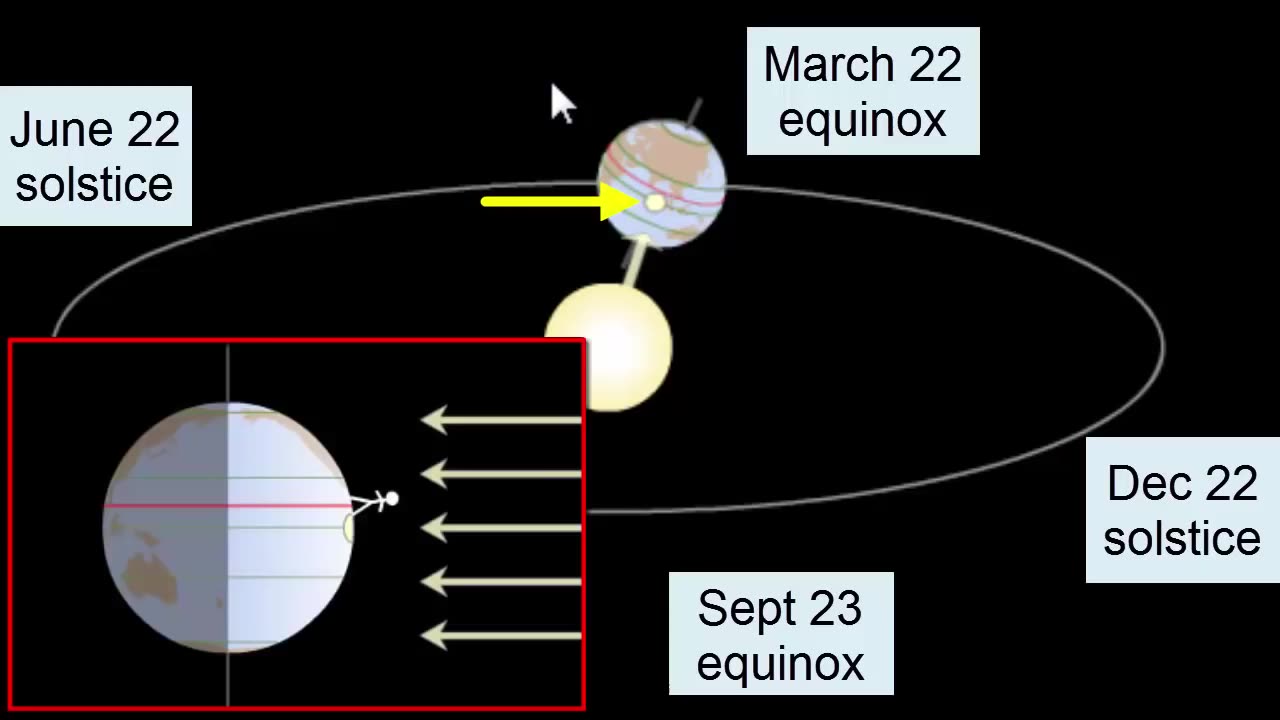
Review of the causes of the seasons in the northern and southern hemispheres and impacts of Earth's seasons on daily light cycles and heat input. Includes descriptions of solstices and equinoxes. Designed for an introductory oceanography course at City College of San Francisco.
**This video comes in the middle of the semester, so there may be terms with which the audience is unfamiliar. For a full playlist, refer to the Oceanography playlist on the Earth Rocks! YouTube Channel.
Air-Sea Interactions Series:
Part I: Seasons
Part II: Relative Humidity
Part III: Atmospheric Gases, Heats, and Pressures
Part IV: Atmospheric Circulation
Part V: Weather Phenomena
If you are an earth science enthusiast and would like to support our ongoing video development and engage with us behind the scenes...
Or if you are a student and would like access to interactive lessons built around these videos...
you can do so by JOINING the Earth Rocks! YouTube Channel:
/ @earthrocks .
Thank you!
Additional notes:
The images in this video are not drawn to scale, because to do so, we couldn't see the Earth and Sun in the same image. The Sun is actually 109 times greater in width (diameter) than the Earth. That means that when they were drawn next to each other, the Earth would be 1/109th the height of the Sun. We wouldn't see it on the screen.
The distance between the Earth and the Sun is actually about 23,400 times the Earth's diameter. That means that when drawn next to each other as shown in the top image of the video, the Earth would actually appear smaller than a pin hole (you'd need to line up 23,400 of them next to each other to reach the Sun).
Earth rotates around its own axis once every 23 hours and 56 minutes. It takes another 4 minutes more rotation to face the Sun again. So when we talk about a day = 24 hours, we are really saying the time it takes to return us to facing the Sun. (Technically called a "solar day.") Multiply 4 minutes per day by 1/2 a year and you get about 12 hours. By the time we get to the other side of Earth's orbit, we are about 12 hours rotated from where we were on the other side. The result is that noon always ends up with us almost directly under the Sun depending on where you live in a time zone. We don't notice this 12-hour rotation unless we look at the stars in the sky (the "fixed objects" against which we can see our motion). That's why we see different constellations at night depending on the time of the year.
-
 13:32
13:32
China Uncensored
18 hours agoChina Just Messed Up BIG
1.2K7 -
 25:32
25:32
RealReaper
19 hours ago $0.06 earnedThe New Witcher Movie - The Rats Is Unbearably Cringe
38 -
 11:29
11:29
ARFCOM Reviews
16 hours ago $0.09 earnedSmith & Wesson Making a Comeback || S&W Model 19 No Lock
96 -
 2:55
2:55
Canadian Crooner
2 years agoPat Coolen | Christmas Blues
56.4K3 -
 11:26
11:26
stateofdaniel
2 days agoGavin Newsom DESTROYS His Presidential Ambitions with a SINGLE Photo
60.4K39 -
 23:40
23:40
Nikko Ortiz
14 hours agoYou Wont Survive Earths Coldest Village...
80.6K17 -
 8:51
8:51
MattMorseTV
12 hours ago $9.48 earnedTrump’s $12 Billion COUNTER-PUNCH.
21.7K53 -
 2:04:48
Side Scrollers Podcast
20 hours agoRIP Blabs + Hasan ROASTED at Streamer Awards + Xbox HUMILIATED... Again + More | Side Scrollers
79.4K18 -
 2:46:29
MetatronGaming
3 days agoNo I'm Not Human PART 1
13.8K2 -
 20:04
20:04
GritsGG
16 hours agoNew Factory POI is TOUGH! Most Winning Player's POV!
15.1K