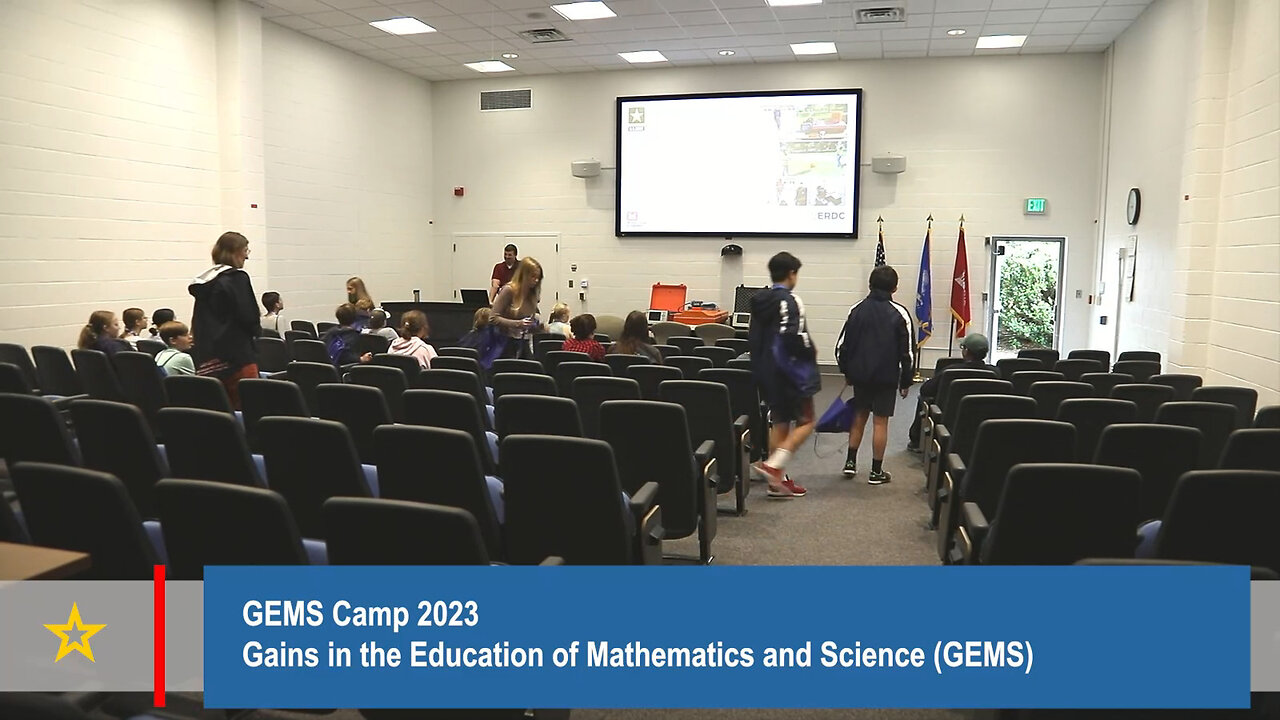
GEMS Camp
Credit: Joseph Bara | Date Taken: 08/07/2023
Gains in the Education of Mathematics and Science (GEMS) CRREL conducted its first on-site Gains in the Education of Mathematics and Science (GEMS) Summer Camp Program in the week of June 26 – 30, 2023, entitled Exploring Weather, Climate, and the Environment. This event was provided to 7th and 8th grade students participating from New Hampshire, Vermont, Massachusetts, North Carolina, and New York who have a great interest in science and technology. CRREL provided twelve Science and Engineering (S&E) experts to execute a full week of activity, including ten modules, practical skills and interaction with science tools and equipment, and presentations from each team of participants. The GEMS Camp Program serves to provide students with hands-on activities and team building skills while having fun learning about science and technology. Soil not Dirt Soil is a great habitat for living organisms. Some of the organisms are so small that you can’t even see them. Come learn how to make batteries out of soil! We will make terrestrial microbial fuel cells, measure how much power they produce, understand how water affects them, and grow some of the soil organisms that are doing the job. This module is appropriate for any student who likes hands on experience in the laboratory. Ground Penetrating Radar Ground Penetrating Radar (GPR) is a non-destructive geophysical technique used to image the subsurface. GPR transmits electromagnetic waves into the subsurface, which reflect off features as electrical properties of the subsurface change. GEMS Camp students took turns to tow the antenna and look at the data on the control unit. Searching for macroinvertebrates from stream beds To teach students about the importance of aquatic insects in streams and the health of water sheds and streams in their local environment, students sift through leaf packs that have been resting on the stream bed for a few weeks to determine the number and type of macroinvertebrates they find. Students used magnifying glasses and microscopes to count and identify the aquatic insects they have found in their leaf packs and discussed how this data can be used to understand changes in aquatic insect communities and water quality.
-
 1:10:23
Graham Allen
3 hours agoTensions ERUPT At AMFEST, Is Our Party Too Far Gone?
118K534 -
 LIVE
LIVE
Caleb Hammer
2 hours agoThis Has Never Happened Before | Financial Audit
266 watching -
 LIVE
LIVE
The Big Mig™
3 hours agoTrump Drops Bombshell: Weed Reclassified to Schedule III
2,749 watching -
 23:17
23:17
The Car Edition Ltd
8 hours ago $0.69 earnedFord Fiesta 1.4 Titanium Full Overhaul | Suspension, Brakes, Tyres & Engine Repair - The Car Edition
12.4K -
 LIVE
LIVE
Wendy Bell Radio
7 hours agoHouston, We Have A Problem
5,881 watching -
 1:06:37
Chad Prather
18 hours agoHearing God, Confronting Deception, and Walking in Spirit-Filled Authority
90.8K22 -
 2:20:42
Game On!
20 hours ago $5.90 earnedNFL Week 16 BEST BETS Revealed NOW!
56K7 -
 1:01:24
Crypto Power Hour
14 hours ago $3.68 earnedHow Crypto Address Poisoning Attacks Work
45.2K8 -
 9:03
9:03
Tactical Advisor
17 hours agoWhy You Should Get a Suppressor Before 2026
40.1K12 -
 17:47
17:47
Degenerate Jay
1 day ago $2.11 earnedThis Game Deserved 2025 Game Of The Year - Dispatch
31.3K1