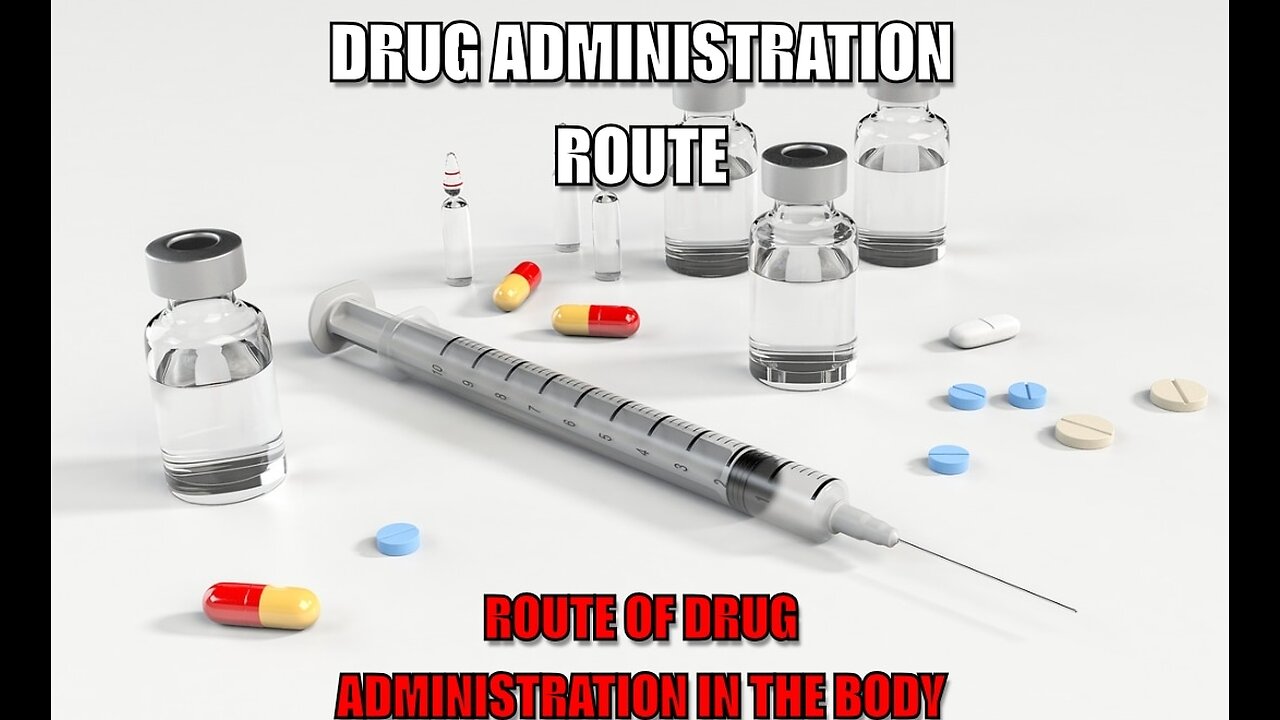
Route of Drug Admistration| Drug Admistration By Different Route |2023
medication administration route is often classified by the location at which the drug is administered, such as oral or intravenous. The choice of routes in which the medication is given depends not only on convenience and compliance but also on the drug’s pharmacokinetics and pharmacodynamic profile. Therefore it is crucial to understand the characteristics of the various routes and associated techniques. Many interprofessional healthcare team members are involved in administering medications to patients.
Go to:
Anatomy and Physiology
Enteral Route of Medication
Oral administration of medication is a convenient, cost-effective, and most commonly used medication administration route. The primary site of drug absorption is usually the small intestine, and the bioavailability of the medication is influenced by the amount of drug absorbed across the intestinal epithelium. The first-pass effect is an important consideration for orally administered medications. It refers to the drug metabolism whereby the drug concentration is significantly diminished before it reaches the systemic circulation, often due to the metabolism in the liver.
A sublingual or buccal route is another form of the enteral route of medication administration that offers the benefit of bypassing the first-pass effect. By applying the drug directly under the tongue (sublingual) or on the cheek (buccal), the medication undergoes a passive diffusion through the venous blood in the oral cavity, which bypasses the hepatic portal vein and flows into the superior vena cava. Compared to sublingual tissue, which has highly permeable mucosa with rapid access to the underlying capillaries, buccal tissue is less permeable and has slower drug absorption.[1]
A rectal route is another enteral route of medication administration, and it allows for rapid and effective absorption of medications via the highly vascularized rectal mucosa. Similar to sublingual and buccal routes, rectally administered medications undergo passive diffusion and partially bypass the first-pass metabolism. Only about half of the drug absorbed in the rectum directly goes to the liver.[2]
Parenteral Route of Medication
Intravenous injection is the most common parental route of medication administration and can bypass the liver's first-pass metabolism. Given their superficial location on the skin, peripheral veins provide easy access to the circulatory system and are often utilized in the parenteral administration of medications. The upper extremity is usually the preferred site for intravenous medication as it has a lower incidence of thrombophlebitis and thrombosis than the lower limbs. The median basilic or cephalic veins of the arm or the metacarpal veins on the hand's dorsum are commonly used. In the lower extremity, the dorsal venous plexus of the foot can be used.
An intramuscular medication route can be administered in different body muscles, including the deltoid, dorsogluteal, ventrogluteal, rectus femoris, or vastus lateralis muscles. Although the dorsogluteal site, or the buttock's upper outer quadrant, is a common site chosen traditionally for intramuscular injections by healthcare professionals, it poses a potential risk of injury to the superior gluteal artery and sciatic nerve.[3] On the other hand, the ventrogluteal site, or the anterior gluteal site, targets the gluteus medius muscle and avoids these potential complications; thus, it is recommended.
Subcutaneous injections are another form of the parental route of medication and are administered to the layer of skin referred to as cutis, just below the dermis and epidermis layers. Subcutaneous tissue has few blood vessels; therefore, the medications injected undergo absorption at a slow, sustained rate. Subcutaneous medication can be administered to various sites, including the upper arm's outer area and abdomen, avoiding a 2-inch circle around the navel, the front of the thigh, the upper back, or the upper buttock area behind the hip bone.
The intraarterial route is not commonly used for drug administration. Injection of contrast material after an arterial puncture is done for angiography. The other uses of this route are for administering regional chemotherapeutic agents and treating malignant tumors of the brain.
Other Routes of Medication
A transnasal drug route facilitates drug absorption by passive diffusion across the single-layered, well-vascularized respiratory epithelium directly into the systemic circulation.
An inhaled medication is delivered rapidly across the large surface area of the respiratory tract epithelium. Drugs absorbed into the pulmonary circulation enter directly into the systemic circulation via the pulmonary vein, bypassing the first-pass metabolism. The particle size of the inhaled medication is usually 1 to 10 µm for effective delivery.
-
 1:14:37
Flyover Conservatives
1 day agoHow to Win 2026 Before It Starts — Clay Clark’s Goal-Setting Blueprint | FOC Show
30.7K1 -
 12:52
12:52
The Kevin Trudeau Show Limitless
2 days agoBeyond Good And Bad: The Hidden Reality Code
69.8K21 -
 1:03:11
BonginoReport
9 hours agoBrown U Security Failures EXPOSED - Nightly Scroll w/ Hayley Caronia (Ep.201)
149K40 -
 51:09
51:09
Patriots With Grit
5 hours agoWill A.I. Replace Doctors? | Dr. Stella Immanuel MD
21K4 -
 4:10:32
Nerdrotic
10 hours ago $14.43 earnedHollywood's DOOMSDAY! WB FIRESALE! - Friday Night Tights 385 w Zachary Levi
81.5K18 -
 12:25:53
LFA TV
22 hours agoLIVE & BREAKING NEWS! | FRIDAY 12/19/25
202K29 -
 1:08:59
Edge of Wonder
7 hours agoNASA’s Intergalactic Spacecraft, Real Dwarves Spotted & Research Roundup
27.1K6 -
 1:21:27
Kim Iversen
10 hours agoPutin Says Russia is Ready for WAR With Europe
47K103 -
 1:24:41
The Daily Signal
8 hours ago $7.24 earned🚨BOMBSHELL: 315,000+ Illegal Ballots in Georgia, Terrorists Released, Rubio Slashes Foreign Aid
35.7K11 -
 1:53:45
The Mike Schwartz Show
11 hours agoTHE MIKE SCHWARTZ SHOW Evening Edition 12-19-2025
25.1K4