Solar Odyssey: Unveiling the Marvels of 133 Days on the Sun
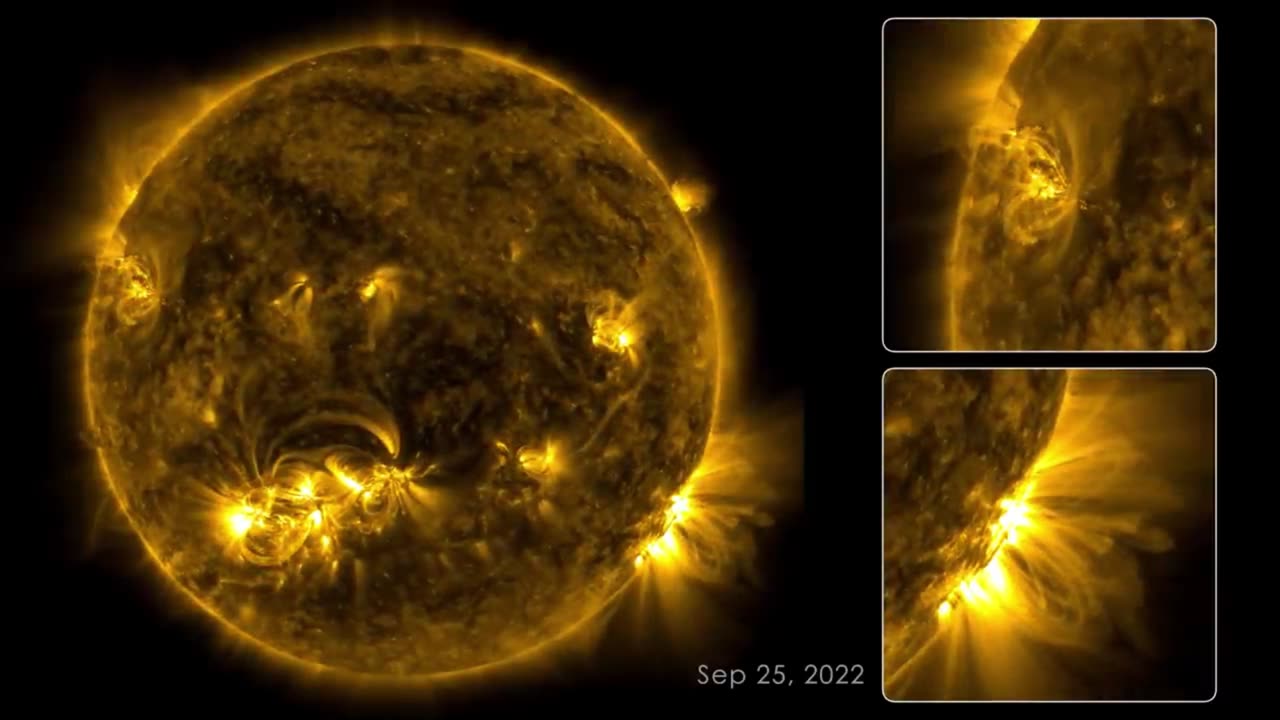
On the left side of the frame is the full circle of the Sun. It appears in a golden yellow color, but splotchy and with thin yellow wisps extending from the surface. Some areas are very bright and others almost black. The whole Sun rotates steadily, with one full rotation taking 12 minutes in this time lapse. There are usually only a few bright regions visible at a time and they shift and flash like small fires. From these regions there are wispy loops reaching up above the surface that rapidly change shape and size.
On the right side of the frame are two white-outlined squares with enlargements of interesting regions of the Sun.
This video chronicles solar activity from Aug. 12 to Dec. 22, 2022, as captured by NASA’s Solar Dynamics Observatory (SDO). From its orbit in space around Earth, SDO has steadily imaged the Sun in 4K x 4K resolution for nearly 13 years. This information has enabled countless new discoveries about the workings of our closest star and how it influences the solar system.
With a triad of instruments, SDO captures an image of the Sun every 0.75 seconds. The Atmospheric Imaging Assembly (AIA) instrument alone captures images every 12 seconds at 10 different wavelengths of light. This 133-day time lapse showcases photos taken at a wavelength of 17.1 nanometers, which is an extreme-ultraviolet wavelength that shows the Sun’s outermost atmospheric layer: the corona. Compiling images taken 108 seconds apart, the movie condenses 133 days, or about four months, of solar observations into 59 minutes. The video shows bright active regions passing across the face of the Sun as it rotates. The Sun rotates approximately once every 27 days. The loops extending above the bright regions are magnetic fields that have trapped hot, glowing plasma. These bright regions are also the source of solar flares, which appear as bright flashes as magnetic fields snap together in a process called magnetic reconnection.
While SDO has kept an unblinking eye pointed toward the Sun, there have been a few moments it missed. Some of the dark frames in the video are caused by Earth or the Moon eclipsing SDO as they pass between the spacecraft and the Sun. Other blackouts are caused by instrumentation being down or data errors. SDO transmits 1.4 terabytes of data to the ground every day. The images where the Sun is off-center were observed when SDO was calibrating its instruments.
SDO and other NASA missions will continue to watch our Sun in the years to come, providing further insights about our place in space and information to keep our astronauts and assets safe.
-
 12:31
12:31
Robbi On The Record
7 hours ago $4.70 earnedWhy Nothing Feels Real Anymore | The Science, Culture, and Spiritual War Behind the Fog
35.3K9 -
 18:42
18:42
Navy Media
7 hours agoHouthis ATTACK the Wrong U.S. Fighter Jet – Then THIS Happened…
36.6K40 -
 40:24
40:24
MetatronGaming
1 day agoSomething is REALLY Wrong with this apartment...
28.3K2 -
 LIVE
LIVE
SpartakusLIVE
7 hours agoHUGE NEW UPDATE - Aim Assist NERF, New META, New MOVEMENT || #1 King of Content
830 watching -
![battlefield 6 with the crew! [RGMT CONTENT Mgr. | RGMT GL | GZW CL]](https://1a-1791.com/video/fwe2/7f/s8/6/w/D/y/F/wDyFz.0kob.19.jpg) 2:32:26
2:32:26
XDDX_HiTower
5 hours ago $3.14 earnedbattlefield 6 with the crew! [RGMT CONTENT Mgr. | RGMT GL | GZW CL]
34.1K -
 2:28:57
Nikko Ortiz
7 hours agoVirtual Reality Milsim... | Rumble LIVE
38.1K4 -
 4:46:02
StevieTLIVE
6 hours agoNEW UPDATE Warzone WINS w/ The Fellas
18.3K -
 9:00:32
Dr Disrespect
15 hours ago🔴LIVE - DR DISRESPECT - WARZONE x BLACK OPS 7 - SEASON 1 INTEGRATION
152K7 -
 1:25:00
Sam Tripoli
7 hours ago $3.30 earnedPunch Drunk Sports LIVE!
24.1K2 -
 55:45
55:45
MattMorseTV
7 hours ago $16.32 earned🔴Trump scores 3 VICTORIES in ONE DAY.🔴
28.8K44