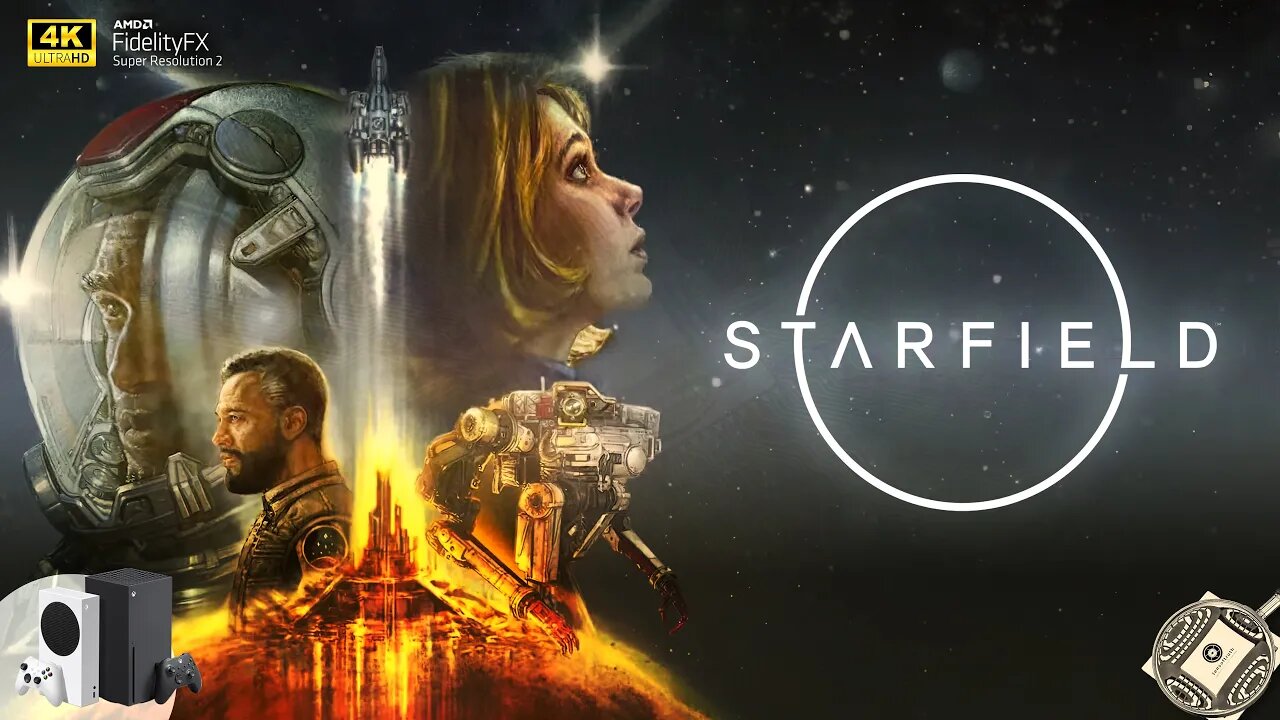
STARFIELD "Early Access" Tech Analysis on Xbox Series S and Series X - 4K
Analysis of performance and image quality of STARFIELD on Xbox Series S/X.
Index:
Intro 00:00
Frame Rate - Xbox Series S 00:09
Resolution 02:14
Draw Distance 03:22
Reflections 04:04
Frame Rate - Xbox Series X 04:46
Shadows 06:51
Textures 07:32
Loading 08:14
Conclusions 09:19
Xbox Series S Tech Specs 11:13
Xbox Series X Tech Specs 11:23
Technical dictionary:
- Draw Distance:
In computer graphics, draw distance (render distance or view distance) is the maximum distance of objects in a three-dimensional scene that are drawn by the rendering engine. Polygons that lie beyond the draw distance will not be drawn to the screen.
- AMD FidelityFX™ Super Resolution (FSR):
FidelityFX Super Resolution (FSR) is used to upsample an input image into a higher resolution. There are two versions of FSR with distinctive upscaling technique and image quality.
FSR 1 is a spatial upscaler based on the Lanczos algorithm* requiring an anti aliased lower resolution image.
FSR 2 and 2.1 is a temporal upscaler based on a modified Lanczos* requiring an aliased lower resolution image and utilising the temporal data (such as motion vectors and frame history) and then applies its own anti aliasing pass which replaces the game's temporal anti-aliasing solution.
Quality Preset Scale Factor Render Scale
Performance 2.0x 50.0% (e.g. for 4k: 1080p upscale to 2160p with FSR)
Balanced 1.7x 58.8% (e.g. for 4k: 1270p upscale to 2160p with FSR)
Quality 1.5x 66.6% (e.g. for 4k: 1440p upscale to 2160p with FSR)
* The Lanczos algorithm is an iterative algorithm invented by Cornelius Lanczos that is an adaptation of power methods to find eigenvalues and eigenvectors of a square matrix or the singular value decomposition of a rectangular matrix. It is particularly useful for finding decompositions of very large sparse matrices.
- Cube Mapping Reflections:
A Cubemap is a collection of six square textures that represent the reflections on an environment. The six squares form the faces of an imaginary cube that surrounds an object; each face represents the view along the directions of the world axes (up, down, left, right, forward and back). Cubemaps are often used to capture reflections or “surroundings” of objects; for example skyboxes and environment reflections often use cubemaps.
- Screen Space Reflections (SSR):
Screen space reflections (SSR): a more expensive technique that traces reflection rays in screen space (as opposed to world space in e.g. ray tracing). This is done for each rendered pixel of the reflected surface, using the surface normal and scene depth.
The disadvantage is that objects not captured in the rendered frame cannot appear in the reflections, which results in unresolved intersections and incomplete reflection image.
- Ray-Traced Reflections
Ray-Traced Reflections is a more accurate ray-traced solution to Screen Space Reflection technique (that traces reflection rays in screen space), ray tracing traces reflection rays in world space.
The disadvantage of the technique using ray tracing is the need for a dedicated hardware for accelerating the calculations needed to perform the feature.
- Shadow Mapping
Shadow mapping or shadowing projection is a process by which shadows are added to 3D computer graphics. This concept was introduced by Lance Williams in 1978, in a paper entitled "Casting curved shadows on curved surfaces."[1] Since then, it has been used both in pre-rendered and realtime scenes in many console and PC games. Shadows are created by testing whether a pixel is visible from the light source, by comparing the pixel to a z-buffer or depth image of the light source's view, stored in the form of a texture.
- Simple Shadow Mapping
Simplest possible implementation of Shadow Mapping, without any smoothing or additional features.
- Soft Shadows Mapping
Soft shadows are typically rendered in games by using shadow mapping and Percentage Closer Filtering with a uniform kernel size. The Percentage-Closer Soft Shadows (PCSS) algorithm computes a variable kernel size based on the distance between the relative position of the receiver point, an approximation of the blocker, and the area light.
- Ray-traced Shadows
Ray-traced shadows are generated by tracing the path of rays sampled from a light source. Ray-traced shadows are more accurate than shadow-mapped shadows. All ray-traced shadows are world space shadows.
-
 5:41:23
Misfits Mania
5 days ago $915.46 earnedMISFITS MANIA: Fight Night
3.26M -
 52:08
52:08
Man in America
10 hours agoThe Sinister Plan to Crush Small Business — and Put You Under Corporate Rule
54.7K22 -
 1:11:28
Sarah Westall
11 hours agoNewsmax Fired Me on Air! What Gets You Fired These Days w/ Dennis Michael Lynch
41.4K22 -
 54:31
54:31
OFFICIAL Jovan Hutton Pulitzer Rumble
10 hours agoReview Of The Con In Progress!
55.2K16 -
 2:32:35
IsaiahLCarter
1 day ago $6.88 earnedRageaholics Anonymous || APOSTATE RADIO 038 (w/RAZ0RFIST)
40.3K7 -
 1:13:11
vivafrei
15 hours agoEARLY HOLIDAY STREAM! Kirk / TPUSA Internet Pile-On CONTINUES! Minnesota Fraud! Georgia Faud & MORE!
114K152 -
 12:34
12:34
Robbi On The Record
18 hours ago $12.10 earnedThe Strange Origins of Santa Claus | The Real History of Santa & Christmas
99.8K62 -
 40:57
40:57
TacticalAdvisor
14 hours agoUnboxing Tactical Box/Best Sniper Upgrade | Vault Room Live Stream 049
93.7K7 -
 33:15
33:15
TampaAerialMedia
20 hours ago $5.67 earnedFort Myers Beaches 2025 - North Captiva, Sanibel, Estero, & Bonita Springs - Recovery from Ian
55.2K6 -
 46:22
46:22
Degenerate Plays
20 hours ago $3.41 earnedI Completely Crashed Out During This Mission - GTA Online : Part 12
51.5K1