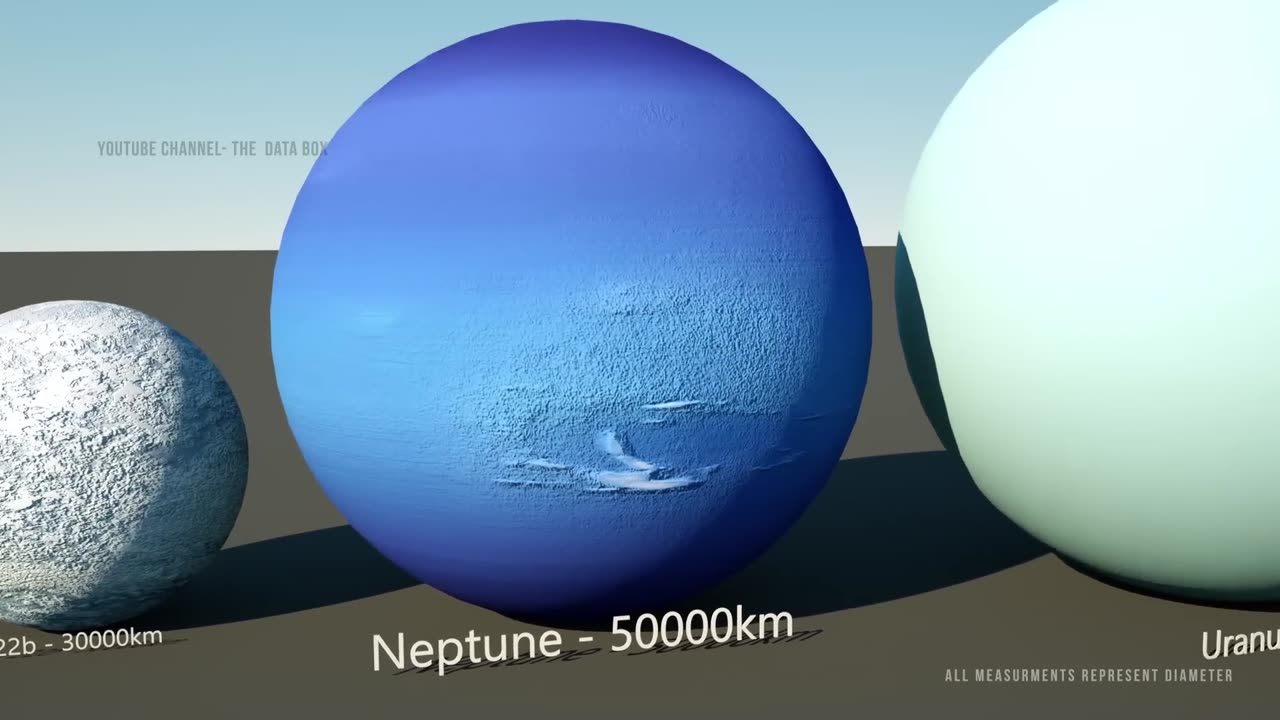
Universe Size 3D comparison | Solar System |
Certainly! Imagine you're on a cosmic journey, and you want to compare the sizes of various celestial objects in our universe in 3D. Let's start small and work our way up:
1. **Earth**: We begin our journey on our home planet. Earth is about 12,742 kilometers (7,918 miles) in diameter, a familiar place where life thrives.
2. **Moon**: Our moon is Earth's faithful companion, measuring about 3,474 kilometers (2,159 miles) in diameter. It orbits relatively close to us.
3. **Mars**: The Red Planet, Mars, is roughly half the size of Earth, with a diameter of 6,779 kilometers (4,212 miles). It's a potential future destination for human exploration.
4. **Jupiter**: Moving beyond our neighboring planets, we encounter the gas giant Jupiter. It dwarfs all others with a colossal diameter of 139,822 kilometers (86,881 miles). You could fit over 1,300 Earths inside it!
5. **Sun**: As we journey further out, we approach our star, the Sun. It's enormous, with a diameter of approximately 1.4 million kilometers (870,000 miles). The Sun's immense gravity holds our solar system together.
6. **Solar System**: The solar system is a vast expanse. If we consider the distance from the Sun to Pluto (formerly the ninth planet), it's about 7.5 billion kilometers (4.7 billion miles) at its farthest. Picture this immense space filled with planets, asteroids, and comets.
7. **Milky Way Galaxy**: Zooming out even further, we encounter our galaxy, the Milky Way. It spans about 100,000 light-years, containing billions of stars, including our Sun. It's like a cosmic city of stars.
8. **Local Group**: Our Milky Way is just one of many galaxies in our local group. This group includes about 54 other galaxies, like Andromeda, Triangulum, and more, all gravitationally bound together.
9. **Virgo Supercluster**: Our local group is part of an even larger structure called the Virgo Supercluster. It contains hundreds of galaxy groups and spans over 110 million light-years across.
10. **Observable Universe**: Finally, we contemplate the entire observable universe. It's a staggering expanse, estimated to be about 93 billion light-years in diameter. Beyond this limit, we cannot see, but it's a reminder of the vastness of our cosmos.
This 3D comparison helps us appreciate the immense scales of objects in our universe, from the smallest planets to the grandest superclusters, highlighting the wonder of the cosmos.
-
 20:19
20:19
MetatronHistory
2 days agoThe Mystery of Catacombs of Paris REVEALED
7.29K2 -
 21:57
21:57
GritsGG
17 hours agoBO7 Warzone Patch Notes! My Thoughts! (Most Wins in 13,000+)
11.6K -
 2:28:08
PandaSub2000
11 hours agoMyst (Part 1) | MIDNIGHT ADVENTURE CLUB (Edited Replay)
8.02K -
 1:12:43
TruthStream with Joe and Scott
5 days agoJason Van Blerk from Human Garage: Reset your life with Fascial Maneuvers,28 day reset, Healing, Spiritual Journey, Censorship, AI: Live 12/3 #520
17.1K4 -
 24:21
24:21
The Pascal Show
1 day ago $8.98 earned'CHALLENGE ACCEPTED!' TPUSA Breaks Silence On Candace Owens Charlie Kirk Allegations! She Responds!
38.1K23 -
 17:41
17:41
MetatronGaming
2 days agoI should NOT Have taken the elevator...
12.4K2 -
 LIVE
LIVE
Lofi Girl
3 years agolofi hip hop radio 📚 - beats to relax/study to
533 watching -
 1:20:23
Man in America
14 hours agoHow Epstein Blackmail & FBI Cover-Ups Are Fracturing MAGA w/ Ivan Raiklin
199K38 -
 2:13:49
Inverted World Live
10 hours agoSolar Storms Ground 1000 Planes | Ep. 151
115K10 -
 2:54:08
TimcastIRL
10 hours agoJ6 Pipe Bomb Suspect ARRESTED, Worked With BLM, Aided Illegal Immigrants | Timcast IRL
265K147