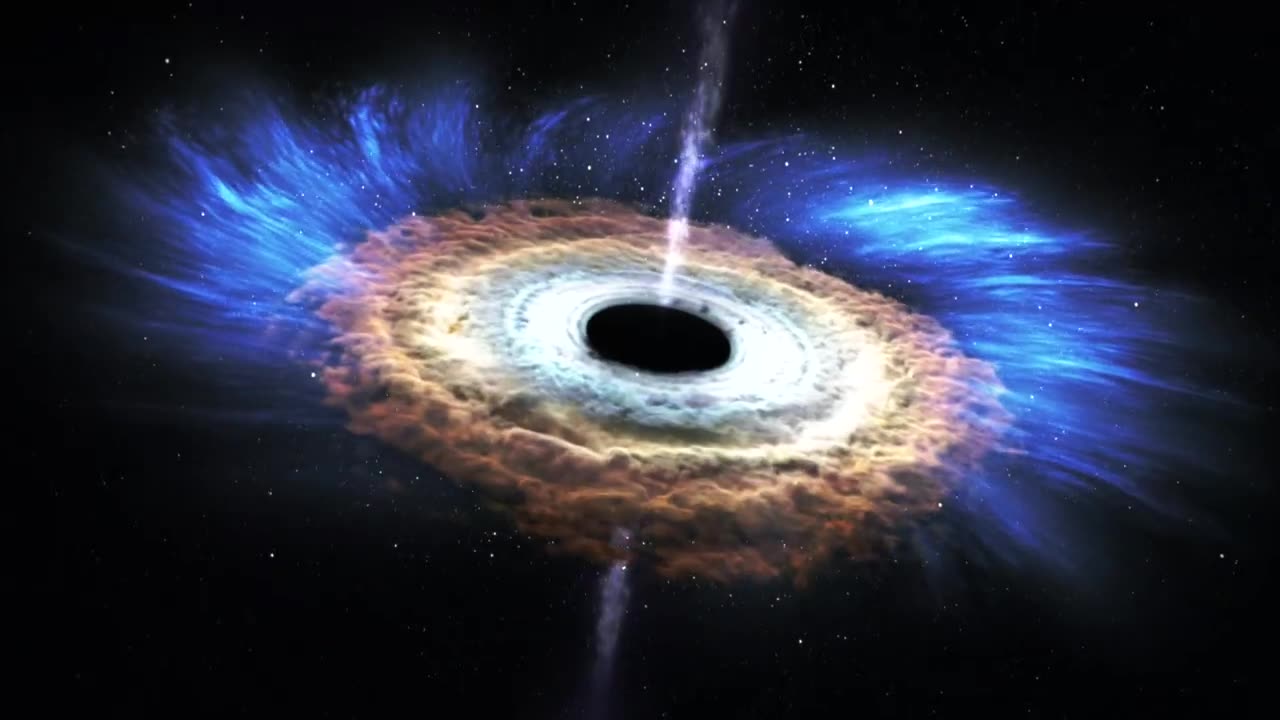
NASA Massive Black Hole Shreds Passing Star
This artist's rendering illustrates new findings about a star shredded by a black hole. When a star wanders too close to a black hole, intense tidal forces rip the star apart. In these events, called "tidal disruptions," some of the stellar debris is flung outward at high speed while the rest falls toward the black hole. This causes a distinct X-ray flare that can last for a few years. NASA's Chandra X-ray Observatory, Swift Gamma-ray Burst Explorer, and ESA/NASA's XMM-Newton collected different pieces of this astronomical puzzle in a tidal disruption event called ASASSN-14li, which was found in an optical search by the All-Sky Automated Survey for Supernovae (ASAS-SN) in November 2014. The event occurred near a supermassive black hole estimated to weigh a few million times the mass of the sun in the center of PGC 043234, a galaxy that lies about 290 million light-years away.
Astronomers hope to find more events like ASASSN-14li to test theoretical models about how black holes affect theirThis artist's rendering illustrates new findings about a star shredded by a black hole. When a star wanders too close to a black hole, intense tidal forces rip the star apart. In these events, called "tidal disruptions," some of the stellar debris is flung outward at high speed while the rest falls toward the black hole. This causes a distinct X-ray flare that can last for a few years. NASA's Chandra X-ray Observatory, Swift Gamma-ray Burst Explorer, and ESA/NASA's XMM-Newton collected different pieces of this astronomical puzzle in a tidal disruption event called ASASSN-14li, which was found in an optical search by the All-Sky Automated Survey for Supernovae (ASAS-SN) in November 2014. The event occurred near a supermassive black hole estimated to weigh a few million times the mass of the sun in the center of PGC 043234, a galaxy that lies about 290 million light-years away.
Astronomers hope to find more events like ASASSN-14li to test theoretical models about how black holes affect theirThis artist's rendering illustrates new findings about a star shredded by a black hole. When a star wanders too close to a black hole, intense tidal forces rip the star apart. In these events, called "tidal disruptions," some of the stellar debris is flung outward at high speed while the rest falls toward the black hole. This causes a distinct X-ray flare that can last for a few years. NASA's Chandra X-ray Observatory, Swift Gamma-ray Burst Explorer, and ESA/NASA's XMM-Newton collected different pieces of this astronomical puzzle in a tidal disruption event called ASASSN-14li, which was found in an optical search by the All-Sky Automated Survey for Supernovae (ASAS-SN) in November 2014. The event occurred near a supermassive black hole estimated to weigh a few million times the mass of the sun in the center of PGC 043234, a galaxy that lies about 290 million light-years away.
Astronomers hope to find more events like ASASSN-14li to test theoretical models about how black holes affect their
-
 LIVE
LIVE
Badlands Media
8 hours agoBadlands Daily: 12/4/25
1,722 watching -
 LIVE
LIVE
Matt Kohrs
11 hours agoLive Trading Stock Market Open (Futures & Options) || The Matt Kohrs Show
711 watching -
 LIVE
LIVE
Wendy Bell Radio
5 hours agoEnemy of the State
7,426 watching -
 LIVE
LIVE
LadyDesireeMusic
7 minutes agoLive Piano Music & Convo
29 watching -
 22:53
22:53
Bearing
2 hours agoABSOLUTE KAREN ANNIHILATION!! 💥 Kaceytron VS Ethan Klein (Lex Jewthor) 💀
5091 -
 13:21
13:21
Upper Echelon Gamers
10 hours agoPrediction Markets - Beating the Experts
2441 -
 1:07:36
Chad Prather
19 hours agoThe Power You Cannot Buy: Motives, Power, and the Making of a True Disciple
59.8K21 -
 LIVE
LIVE
LFA TV
12 hours agoLIVE & BREAKING NEWS! | THURSDAY 12/04/25
3,063 watching -
 1:59:55
The Chris Salcedo Show
12 hours ago $3.54 earnedDispelling Narrative Over Facts On Racism
14.8K2 -
 16:09
16:09
T-SPLY
18 hours agoFederal Agents Arrest Non Citizen Police Officer — Department Hires Him BACK!
40.7K41