NASA Animation Sizes Up the Biggest Black Holes
A previous version of this video mislabeled the orbit of Saturn as the orbit of Jupiter.
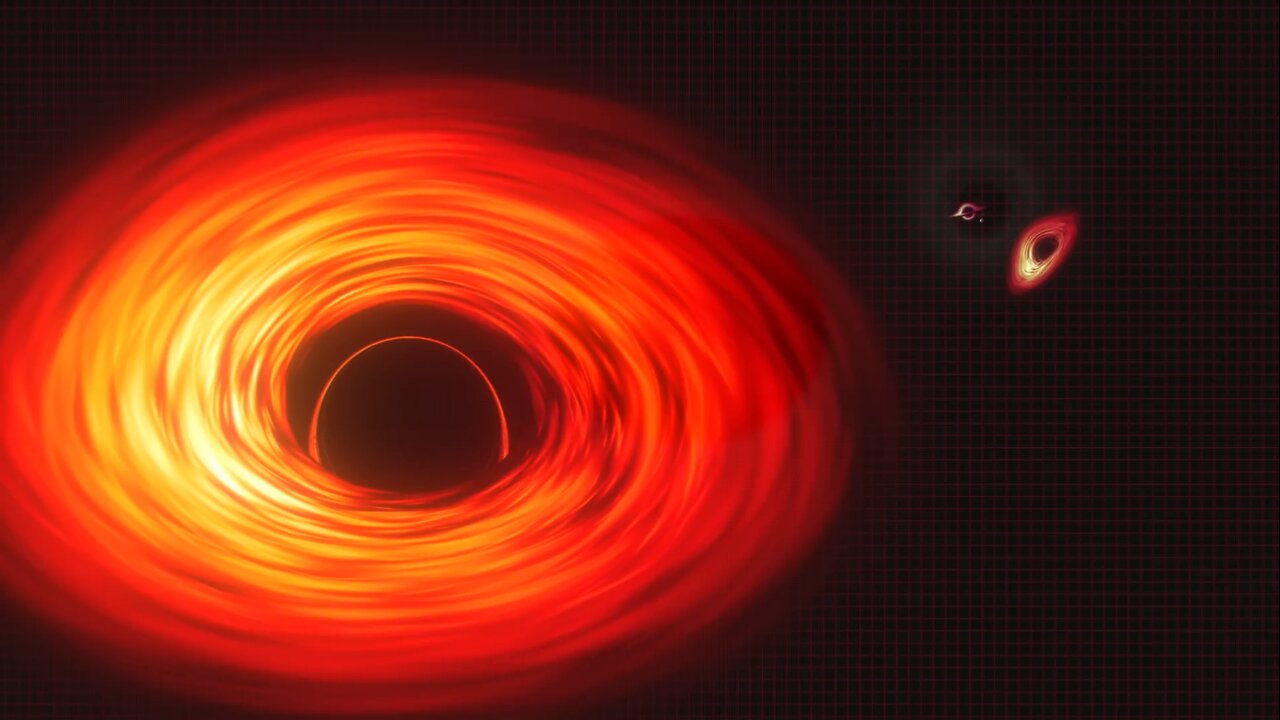
This new NASA animation highlights the “super” in supermassive black holes. These monsters lurk in the centers of most big galaxies, including our own Milky Way, and contain between 100,000 and tens of billions of times more mass than our Sun.
Any light crossing the event horizon – the black hole’s point of no return – becomes trapped forever, and any light passing close to it is redirected by the black hole’s intense gravity. Together, these effects produce a “shadow” about twice the size of the black hole’s actual event horizon.
The animation shows 10 supersized black holes that occupy center stage in their host galaxies, including the Milky Way and M87, scaled by the sizes of their shadows. Starting near the Sun, the camera steadily pulls back to compare ever-larger black holes to different structures in our solar system.
First up is 1601+3113, a dwarf galaxy hosting a black hole packed with the mass of 100,000 Suns. The matter is so compressed that even the black hole’s shadow is smaller than our Sun.
The black hole at the heart of our own galaxy, called Sagittarius A* (pronounced ay-star), boasts the weight of 4.3 million Suns based on long-term tracking of stars in orbit around it. It’s shadow diameter spans about half that of Mercury’s orbit in our solar system.
The animation shows two monster black holes in the galaxy known as NGC 7727. Located about 1,600 light-years apart, one weighs 6 million solar masses and the other more than 150 million Suns. Astronomers say the pair will merge within the next 250 million years.
At the animation’s larger scale lies M87’s black hole, now with a updated mass of 5.4 billion Suns. Its shadow is so big that even a beam of light – traveling at 670 million mph (1 billion kph) – would take about two and a half days to cross it.
The movie ends with TON 618, one of a handful of extremely distant and massive black holes for which astronomers have direct measurements. This behemoth contains more than 60 billion solar masses, and it boasts a shadow so large that a beam of light would take weeks to traverse it.
Music credit: "In the Stars" from Universal Production Music
Credit: NASA's Goddard Space Flight Center Conceptual Image Lab
#nasa #space #spacex #astronomy #science #universe #moon #cosmos #galaxy #earth #mars #astronaut #astrophysics #stars #elonmusk #astrophotography #physics #iss #apollo #photography #hubble #flatearth #isro #esa #rocket #spaceexploration #solarsystem #art #naturalnusantara #cosmology #hole
-
 29:38
29:38
Stephan Livera
2 days ago $2.23 earnedDay 2 - Stephan Livera hosts Plan B Podcast in Lugano
6.75K1 -
 1:01:47
vivafrei
16 hours agoLive from Lugano Plan B in Switzerland w/ Efrat Fenigson and Prince Filip Karađorđević!
52.6K2 -
 46:40
46:40
Bitcoin Infinity Media
1 day ago $6.84 earnedBitcoin Infinity Academy at Plan B Forum 2025
29.2K3 -
 18:12:15
Side Scrollers Podcast
1 day ago🔴SIDE SCROLLERS SUB-A-THON🔴FINAL DAY!🔴Craig Makeover + US Dart Throw + More!
566K32 -
 2:05:58
TimcastIRL
14 hours agoSHOTS FIRED, Leftists ATTACK Coast Guard & Feds In SHOCK Terror Attack | Timcast IRL
271K195 -
 1:07:25
Man in America
19 hours agoThe BRICS War on the Dollar Just Hit Endgame—What's Next Changes EVERYTHING
63.9K17 -
 3:23:45
SOLTEKGG
10 hours ago🔴LIVE - Community Game Night - GIVEAWAY
50.5K4 -
 8:22:30
SpartakusLIVE
13 hours ago#1 Friday Night HYPE, viewers GLUED to the screen
74.8K1 -
 55:50
55:50
NAG Podcast
11 hours agoAda Lluch: BOLDTALK W/Angela Belcamino
40.2K3 -
 2:45:31
VapinGamers
8 hours ago $20.77 earnedKellan Graves - Fallen - Game Review and Game KeyGiveaway - !rumbot !music
37.2K1