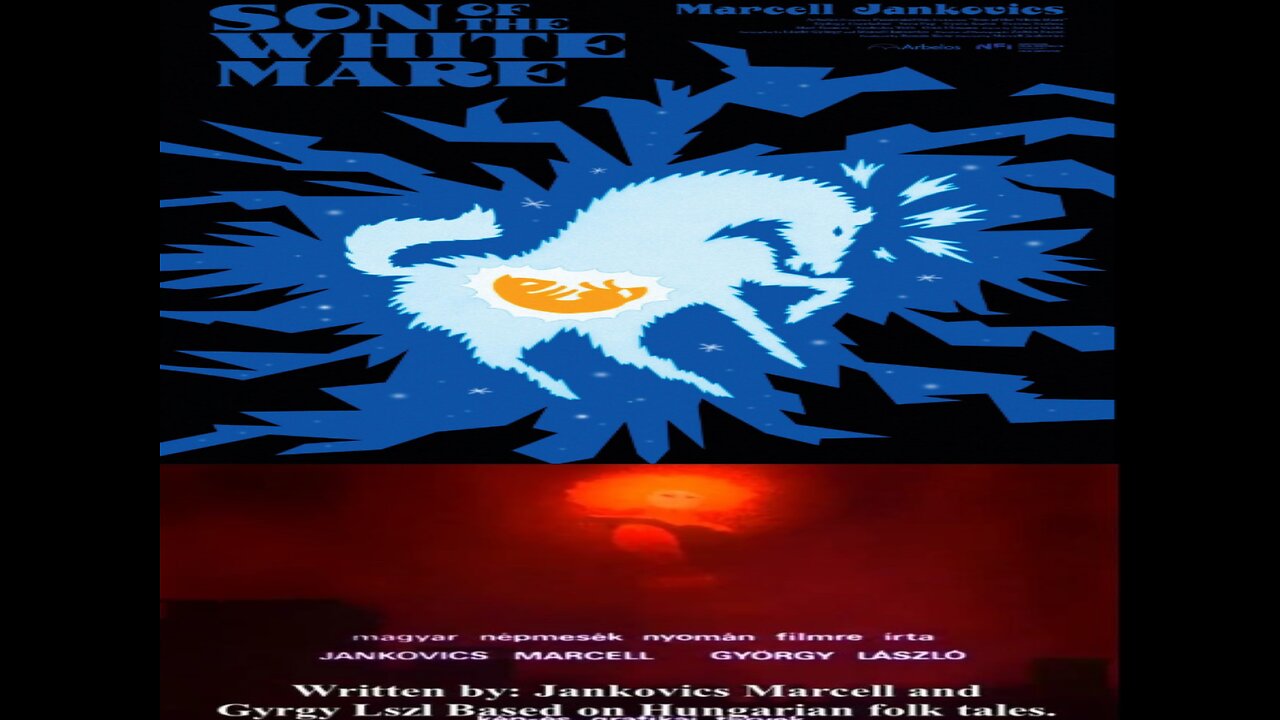
Fehérlófia - Son of the White Mare - 1981
In this dreamlike Hungarian folk myth, a horse goddess gives birth to three powerful brothers who set out into the Underworld to save three princesses from three evil dragons and reclaim their ancestors' lost kingdom.
Director
Marcell Jankovics
Writers
László György Marcell Jankovics
The movie is a pastiche of many similar Hungarian and Eurasian folk tales and owes much to the myths of ancient Magyars, Scythians and Avarians. According to the Hungarian Ethnographic Lexicon, there are at least 50 different forms of this story, but the film was mostly based on "Fehérlófia" (as penned by poet László Arany) and "Fanyüvö, Vasgyúró, Hegyhengergetö" (by Gyula Illyés). One common criticism against the film is that the story, characters and its perceived messages are different from Arany's version of Fehérlófia. Director Marcell Jankovics confirmed that his aim wasn't to make a faithful adaptation of any single fable, but to create his own version. Most of the differences between the versions are detailed in the movie's FAQ section, but here are some notable ones:
In Arany's version, Fehérlófia (Son of the White Mare) and Fanyüvö (Treeshaker or Treetearer) are separate characters, and Fehérlófia kills all three of his servants, including the weak Fanyüvö at the end for their betrayal. In Illyés's version, Fanyüvö is the powerful main hero who only has two companions whom he spares at the end, but he has human parents. The film meshes these two into one and even combines their names: Fanyüvö Fehérlófia. Jankovics stated he had based the characters more on the story's second version because he believed viewers would be bored if each task had to be repeated four rather than three times.
Other differences include expanding on the backstory of the world, its rulers, the princesses and the dragons, and combining the fable with the myth of the World Tree. In most other versions of the tale, none of these have any background. The film's first 14 or so minutes are not part of the stories, this scene was a unique addition.
In the film, Fehérlófia's parents are deities, the Rain King and the Snow Queen, and the Hétszünyö Kapanyányimonyók (Seven-Hearted Lobahobgoblin) is the King in disguise. The folk tales contain no such connotations; the Goblin is a villain, and the King is a human unrelated to the main characters.
Depending on the version, the hero's mother is either a human woman or a horse without an explicit backstory, though sometimes, she's a cow or a sheep.
Certain scenes or quotes were also taken from other versions of the tale. In specific, the scene of Vasgyúró (alternatively named Ironkneader, Ironrubber or Irontemperer in English) forging a sword for Fanyüvö adapts the creation scene of Vasgyúró's ax that was left out from the film.
-
 LIVE
LIVE
Adam Does Movies
4 hours agoTalking Movies + Ask Me Anything - LIVE
40 watching -
 2:12:14
TheSaltyCracker
2 hours agoWar Crimes ReeEEStream 12-03-25
36.5K96 -
 1:31:59
Glenn Greenwald
4 hours agoTrump Administration Claims to Save Hundreds of Millions of Lives by Blowing Up Drug Boats; Ethan Klein's Unhinged Vengeance & Lawsuits Against Other YouTubers: With Taylor Lorenz | SYSTEM UPDATE #553
82.3K99 -
 19:14
19:14
MetatronCore
19 hours agoHow Propaganda works on your Brain
1.12K2 -
 LIVE
LIVE
Joker Effect
1 hour agoWHO IS TYSON HOCKLEY?! What does the IRL streaming space look like? WHY IS EVERYONE SUEING EACHOTHER
304 watching -
 2:48:40
Barry Cunningham
4 hours agoLIVE BREAKING NEWS: Erika Kirk and TPUSA Have Had It With Candace Owens | Where Are The Children?
35.8K49 -
 15:30
15:30
IsaacButterfield
18 hours ago $0.39 earnedViolent Immigrant Crime Is Exploding in Australia
3.38K14 -
 8:37
8:37
DBoss_Firearms
8 hours agoHow hard is it to shoot with a G-Flex Trigger?
1.5K -
 1:05:17
BonginoReport
5 hours agoWhite House Claps Back At Sabrina Carpenter - Nightly Scroll w/ Hayley Caronia (Ep.189)
108K27 -
 1:06:50
TheCrucible
6 hours agoThe Extravaganza! EP: 69 (12/03/25)
77.9K18