How Your Body Gets Rid of Medications
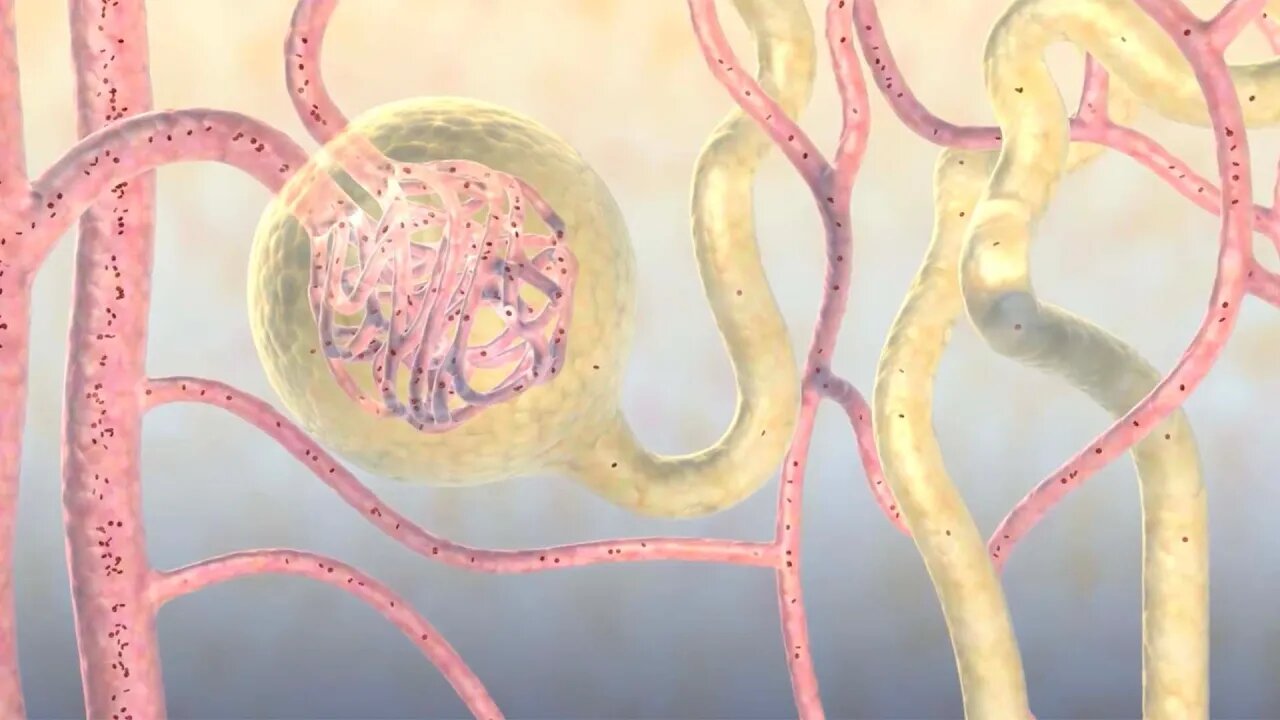
MEDICAL ANIMATION TRANSCRIPT: The body filters drugs from the bloodstream and eliminates them in a multi-step process called medication excretion. The kidneys are the major route for drug elimination. Most drugs exit the body either unchanged or as drug metabolites in urine. Generally, health professionals refer to the ability of the kidneys to filter blood as renal function. Nephrons, the functional and anatomical units of the kidney, filter blood, regulate fluid volume and pH, and control levels of electrolytes in the body. Each nephron contains a renal corpuscle and renal tubule. The renal corpuscle includes the Bowman capsule and glomerulus. And the renal tubule is composed of the proximal tubule, loop of Henle, distal tubule, and collecting duct. Each component plays a role in renal drug excretion, a four-step process that allows the kidneys to filter and eliminate drugs from the body. These steps are: glomerular filtration, passive tubular reabsorption, active tubular secretion, and excretion. Blood flows into the glomerulus via a blood vessel larger in diameter than the vessel draining blood from the glomerulus. This difference in diameter creates the high blood pressure necessary to filter wastes from the blood. The glomerulus functions as a molecular sieve. Waste materials in water pass through the sieve, while most normal proteins and cells are kept in the bloodstream. Glomerular filtration removes low-molecular-weight drugs from the bloodstream. The process of passive reabsorption of water, solutes, and ions begins in the proximal tubule, continues in the Henle loop, and ends in the distal and collecting ducts. Water-soluble drugs stay in the tubule, while unionized and lipid-soluble drugs are primarily reabsorbed across renal tubules. After reabsorption, lipid-soluble drugs travel through the bloodstream to the liver where certain liver enzymes, such as the cytochrome P450 enzyme complex, metabolize them into more water-soluble forms. Here we show an example of this process through the metabolism of pentobarbital. Some drugs are not filtered from the blood via the glomerulus. Instead, special anionic and cationic pumps in the walls of the renal tubule actively transport the drugs from the blood into the tubules and collecting duct. Urine from the collecting ducts travel through the ureters where it is collected and stored in the urinary bladder until elimination from the body. Although the kidneys are the major route for drug elimination, medication excretion can also occur in lactating women through their breast milk, exhalation through the lungs, release into bile, and elimination through saliva and sweat.
#MedicationExcretion #DrugElimination #kidneys
ANM10007
-
 LIVE
LIVE
Drew Hernandez
22 hours agoTYLER ROBINSON APPEARS IN COURT IN PERSON LAUGHING?
1,319 watching -
 24:17
24:17
Robbi On The Record
2 hours agoDating Apps and Period Apps Are Playing the Same Game | ft Cybersecurity Girl
2.11K4 -
 59:39
59:39
efenigson
1 day agoCash Controls, App-Store Censorship & the Battle for Privacy - Lea Petrasova | Ep. 110
70 -
 2:47:01
Laura Loomer
4 hours agoEP161: Oh Brother! Ilhan Under Investigation For Immigration Fraud??
12.1K3 -
 LIVE
LIVE
Akademiks
3 hours ago21 Savage x Big Bank interview Reaction. 21 savage album drops at midnight.
1,210 watching -
 2:38:47
TimcastIRL
4 hours agoErika Kirk Tells Candace Owens STOP, Candace Says NO | Timcast IRL
295K175 -
 LIVE
LIVE
Alex Zedra
3 hours agoLIVE! New Game | Cursed Companions
416 watching -
 52:12
52:12
T-SPLY
3 hours agoMembers of Congress MELTDOWN Over Federal Agents and Arrests!
12.1K13 -
 2:45:28
Barry Cunningham
6 hours agoLIVE BREAKING NEWS: President Trump Speech at the Congressional Ball | AlphaWarrior Interview
40.9K29 -
 LIVE
LIVE
DLDAfterDark
3 hours ago $0.45 earnedDan Crenshaw Suing Shawn Ryan - Gun Talk With A Stranger - 300BLK VS 556 for PDW
299 watching