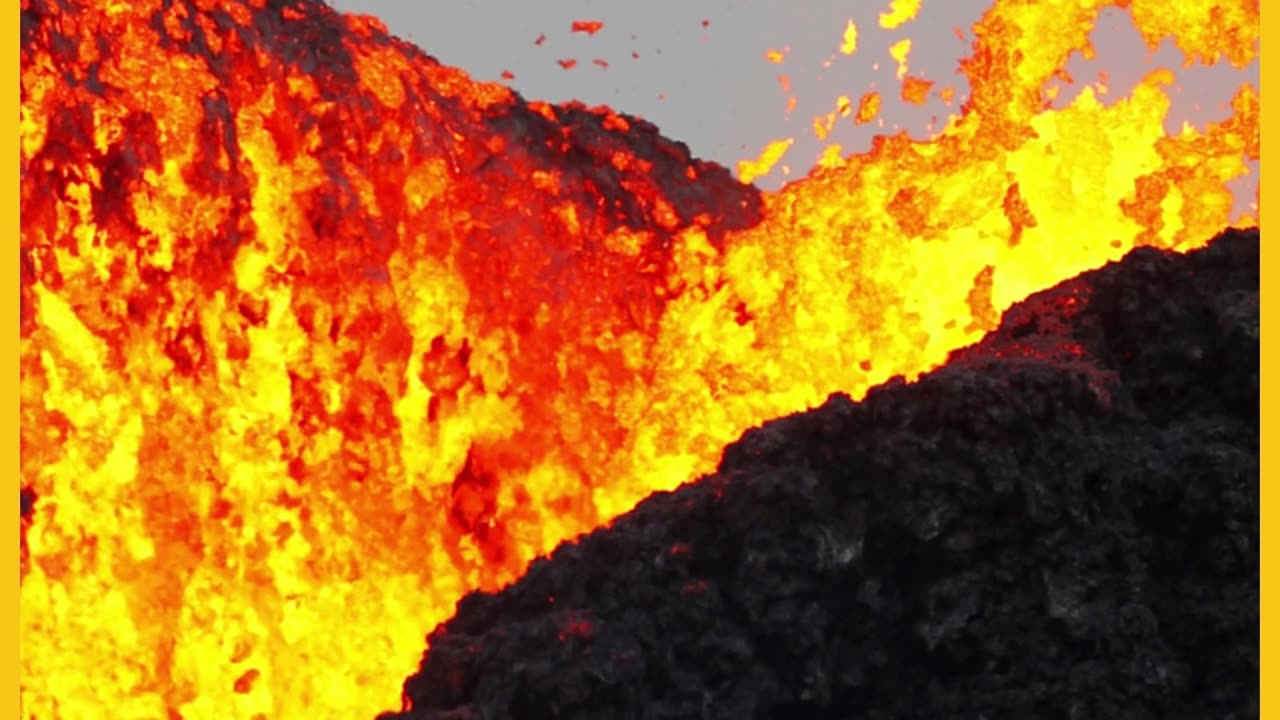
Where Volcanos come from
Music by Suspenseful Cinematic Sting
View more by SUBMORITY from pixabay and Cool Revenge
Jeremy Blake.
Editor's Note: This article originally appeared in the October 2005 issue of Scientific American.
In May 1972 a worker at a nuclear fuel–processing plant in France noticed something suspicious. He had been conducting a routine analysis of uranium derived from a seemingly ordinary source of ore. As is the case with all natural uranium, the material under study contained three isotopes— that is to say, three forms with differing atomic masses: uranium 238, the most abundant variety; uranium 234, the rarest; and uranium 235, the isotope that is coveted because it can sustain a nuclear chain reaction. Elsewhere in the earth’s crust, on the moon and even in meteorites, uranium 235 atoms make up 0.720 percent of the total. But in these samples, which came from the Oklo deposit in Gabon (a former French colony in west equatorial Africa), uranium 235 constituted just 0.717 percent. That tiny discrepancy was enough to alert French scientists that something strange had happened. Further analyses showed that ore from at least one part of the mine was far short on uranium 235: some 200 kilograms appeared to be missing— enough to make half a dozen or so nuclear bombs.
A volcano is a rupture in the crust of a planetary-mass object, such as Earth, that allows hot lava, volcanic ash, and gases to escape from a magma chamber below the surface. On Earth, volcanoes are most often found where tectonic plates are diverging or converging, and because most of Earth's plate boundaries are underwater, most volcanoes are found underwater. For example, a mid-ocean ridge, such as the Mid-Atlantic Ridge, has volcanoes caused by divergent tectonic plates whereas the Pacific Ring of Fire has volcanoes caused by convergent tectonic plates. Volcanoes can also form where there is stretching and thinning of the crust's plates, such as in the East African Rift and the Wells Gray-Clearwater volcanic field and Rio Grande rift in North America. Volcanism away from plate boundaries has been postulated to arise from upwelling diapirs from the core–mantle boundary, 3,000 kilometers deep within Earth.
-
 LIVE
LIVE
Steven Crowder
2 hours ago🔴Trump Blasts Third Worlders: No More Welcoming Our Conquerors
53,771 watching -
 LIVE
LIVE
The Rubin Report
56 minutes agoCharlie Kirk’s Chilling Warning Goes Viral After New Footage of National Guard Shooting Released
1,473 watching -
 1:01:11
VINCE
2 hours agoThis Scandal Is Much Bigger Than Most Know | Episode 178 - 12/01/25 VINCE
150K87 -
 LIVE
LIVE
LFA TV
16 hours agoLIVE & BREAKING NEWS! | MONDAY 12/01/25
3,928 watching -
 LIVE
LIVE
Benny Johnson
1 hour ago🚨Trump Announces Ilhan Omar Will Be THROWN OUT of Country, Reporters GASP as Somali FRAUD Exposed
5,806 watching -
 LIVE
LIVE
Badlands Media
8 hours agoBadlands Daily – Dec. 1, 2025:
4,012 watching -
 LIVE
LIVE
Caleb Hammer
1 hour agoHe's Back... | Financial Audit
229 watching -

Rethinking the Dollar
1 hour agoSilver Panic 2025: The Sell-Off No One Saw Coming
-

The Big Mig™
3 hours agoHope For Colorado w/ Candidate, Veteran, Hope Scheppelman
6.61K8 -
 1:36:20
Graham Allen
3 hours agoDems Wants To Charge SECWAR Of “War Crimes” and Trump Says The “R” Word!!!!
103K616