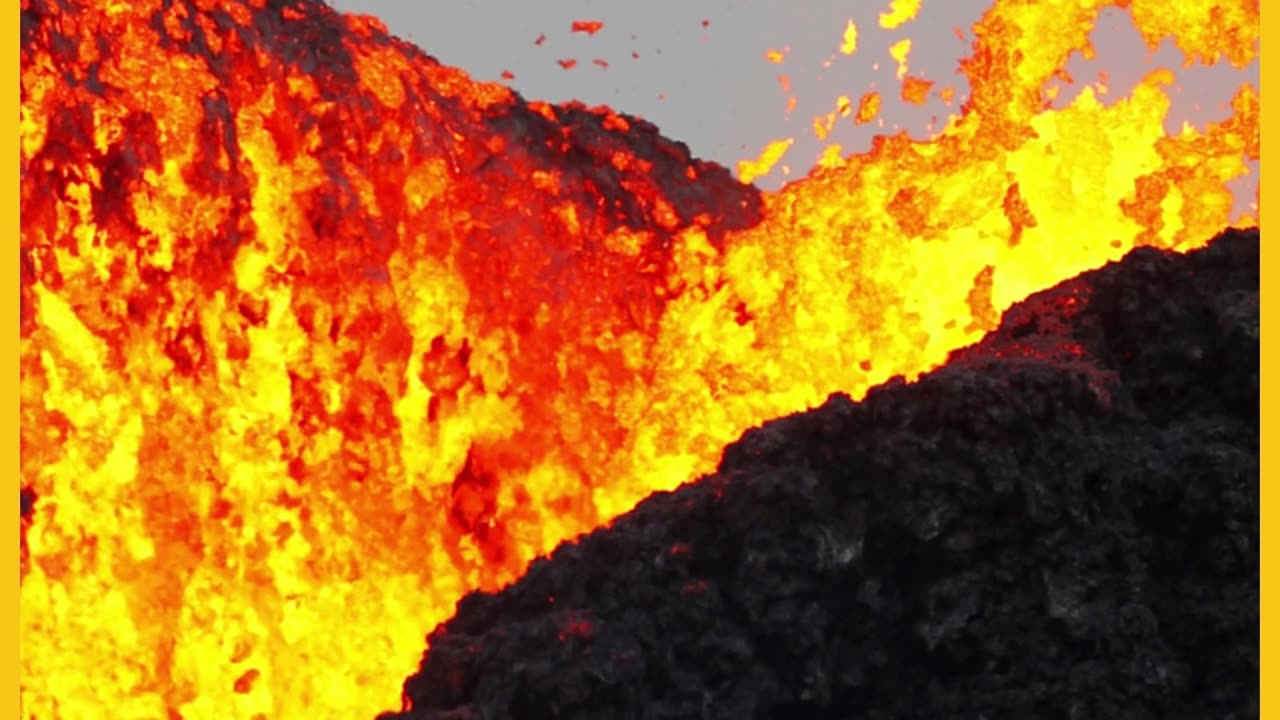
Where Volcanos come from
Music by Suspenseful Cinematic Sting
View more by SUBMORITY from pixabay and Cool Revenge
Jeremy Blake.
Editor's Note: This article originally appeared in the October 2005 issue of Scientific American.
In May 1972 a worker at a nuclear fuel–processing plant in France noticed something suspicious. He had been conducting a routine analysis of uranium derived from a seemingly ordinary source of ore. As is the case with all natural uranium, the material under study contained three isotopes— that is to say, three forms with differing atomic masses: uranium 238, the most abundant variety; uranium 234, the rarest; and uranium 235, the isotope that is coveted because it can sustain a nuclear chain reaction. Elsewhere in the earth’s crust, on the moon and even in meteorites, uranium 235 atoms make up 0.720 percent of the total. But in these samples, which came from the Oklo deposit in Gabon (a former French colony in west equatorial Africa), uranium 235 constituted just 0.717 percent. That tiny discrepancy was enough to alert French scientists that something strange had happened. Further analyses showed that ore from at least one part of the mine was far short on uranium 235: some 200 kilograms appeared to be missing— enough to make half a dozen or so nuclear bombs.
A volcano is a rupture in the crust of a planetary-mass object, such as Earth, that allows hot lava, volcanic ash, and gases to escape from a magma chamber below the surface. On Earth, volcanoes are most often found where tectonic plates are diverging or converging, and because most of Earth's plate boundaries are underwater, most volcanoes are found underwater. For example, a mid-ocean ridge, such as the Mid-Atlantic Ridge, has volcanoes caused by divergent tectonic plates whereas the Pacific Ring of Fire has volcanoes caused by convergent tectonic plates. Volcanoes can also form where there is stretching and thinning of the crust's plates, such as in the East African Rift and the Wells Gray-Clearwater volcanic field and Rio Grande rift in North America. Volcanism away from plate boundaries has been postulated to arise from upwelling diapirs from the core–mantle boundary, 3,000 kilometers deep within Earth.
-
 LIVE
LIVE
Lofi Girl
3 years agolofi hip hop radio 📚 - beats to relax/study to
4,498 watching -
 3:28:47
FreshandFit
13 hours agoShe CLAIMS She's A High Value Woman. But Gets A RUDE Awakening...
220K50 -
 1:51:20
Badlands Media
12 hours agoBaseless Conspiracies Ep. 162 – Kubrick, Eyes Wide Shut & the Elites Behind the Mask
79.4K25 -
 59:03
59:03
Inverted World Live
6 hours agoWhat Now? | Ep. 152
86.9K32 -
 2:57:51
TimcastIRL
7 hours agoShots Fired At Timcast Studio, Man Arrested For Stalking Benny, Loomer, Matt Walsh | Timcast IRL
269K292 -
 3:03:45
Decoy
6 hours agoIt's happening
44.5K7 -
 26:14
26:14
Jasmin Laine
11 hours agoBREAKING: Liberals Caught Cutting SECRET Deal to Rewrite Speech Laws
29K30 -
 17:33
17:33
Navy Media
9 hours ago $5.88 earnedChinese Fighter Jet Flies TOO CLOSE to US Navy Destroyer – BIG MISTAKE
35.4K6 -
 51:11
51:11
Jamie Kennedy
6 hours agoAre We All Being Played? Comedy, Politics, Sports & The Illusion of Control | Ep 234 HTBITY
28.2K -

SpartakusLIVE
8 hours ago#1 Challenge MASTER brings YOU Monday Motivation
61.4K1