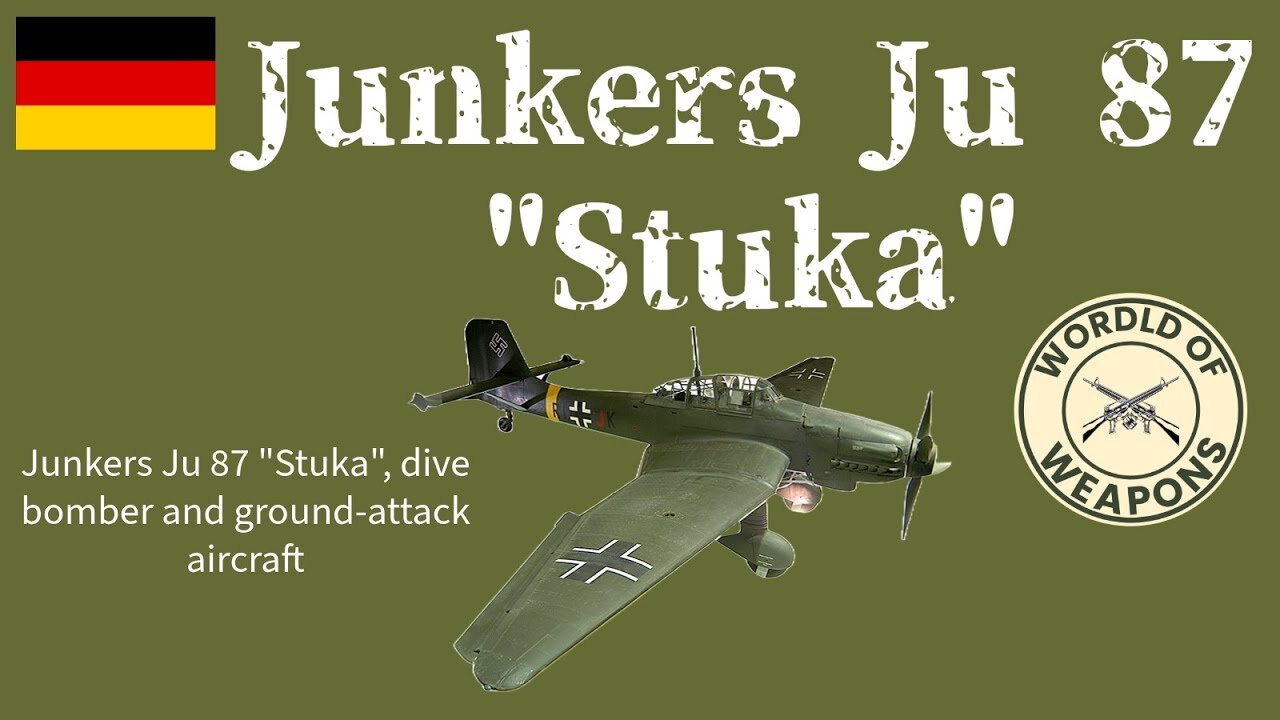
Ju 87 "Stuka" 🇩🇪 The terror of Europe’s skies
Junkers Ju 87 "Stuka", dive bomber and ground-attack aircraft
1.Introduction 00:00
2.Wings 01:16
3.Weapon System 02:05
4.Engine 02:32
5.Diving procedure 03:45
6.Deployment 06:22
The Junkers Ju 87, popularly known as the "Stuka", from the German word for dive-bomber (Sturzkampfflugzueg), is a German dive bomber and ground-attack aircraft. Designed by Hermann Pohlmann, it first flew in 1935. The Ju 87 made its combat debut in 1937 with the Luftwaffe's Condor Legion during the Spanish Civil War between 1936 and 1939 and served the Axis in World War 2 from beginning to end.
The aircraft is easily recognizable by its inverted gull wings and fixed spatted undercarriage. Upon the leading edges of its faired main gear legs were mounted ram-air sirens known as Jericho trumpets, which became a propaganda symbol of German air power and of the so-called Blitzkrieg victories of between 1939 and 1942, as well as providing Stuka pilots with audible feedback as to speed. The Stuka's design included several innovations, including automatic pull-up dive brakes under both wings to ensure that the aircraft recovered from its attack dive even if the pilot blacked out from the high g-forces, or suffered from target fixation.
The wing was the most unusual feature. It consisted of a single central section and two outer sections installed using four universal joints. The center section had a large negative dihedral (anhedral) and the outer surfaces a positive dihedral.
The offensive armament was two 7.92 mm (.312 in) MG 17 machine guns fitted one in each wing outboard of undercarriage, operated by a mechanical pneumatics system from the pilot's control column. The rear gunner/radio operator operated one 7.92 mm (.312 in) MG 15 machine gun for defensive purposes.
The engine and propeller had automatic controls, and an auto-trimmer made the aircraft tail-heavy as the pilot rolled over into his dive, lining up red lines at 60°, 75° or 80° on the cockpit side window with the horizon and aiming at the target with the sight of the fixed gun. The heavy bomb was swung down clear of the propeller on crutches prior to release.
The Ju 87 operated with considerable success in close air support and anti-shipping roles at the outbreak of World War II. It led air assaults in the invasion of Poland in September 1939. Stukas proved critical to the rapid conquest of Norway, the Netherlands, Belgium, and France in 1940. Though sturdy, accurate, and very effective against ground targets, the Stuka was, like many other dive bombers of the period, vulnerable to fighter aircraft. During the Battle of Britain of 1940–1941, its lack of maneuverability, speed, or defensive armament meant that it required a heavy fighter escort to operate effectively.
Diving procedure:
Flying at 4,600 m (15,100 ft), the pilot located his target through a bombsight window in the cockpit floor. The pilot moved the dive lever to the rear, limiting the "throw" of the control column. The dive brakes were activated automatically, the pilot set the trim tabs, reduced his throttle and closed the coolant flaps. The aircraft then rolled 180°, automatically nosing the aircraft into a dive. Red tabs protruded from the upper surfaces of the wing as a visual indicator to the pilot that, in case of a g-force induced black-out, the automatic dive recovery system would be activated. The Stuka dived at a 60–90° angle, holding a constant speed of 500–600 km/h (310–370 mph) due to dive-brake deployment, which increased the accuracy of the Ju 87's aim.
When the aircraft was reasonably close to the target, a light on the contact altimeter (an altimeter equipped with an electrical contact which triggers at a preset altitude) came on to indicate the bomb-release point, usually at a minimum height of 450 m (1,480 ft). The pilot released the bomb and initiated the automatic pull-out mechanism by depressing a knob on the control column. An elongated U-shaped crutch located under the fuselage swung the bomb out of the way of the propeller, and the aircraft automatically began a 6g pullout. Once the nose was above the horizon, dive brakes were retracted, the throttle was opened, and the propeller was set to climb. The pilot regained control and resumed normal flight. The coolant flaps had to be reopened quickly to prevent overheating. The automatic pull-out was not liked by all pilots.
Physical stress on the crew was severe. Human beings subjected to more than 5g in a seated position will suffer vision impairment in the form of a grey veil known to Stuka pilots as "seeing stars". They lose vision while remaining conscious; after five seconds, they black out. The Ju 87 pilots experienced the visual impairments most during "pull-up" from a dive.
-
 1:15
1:15
World Of Weapons
1 year agoScorpion silent pistol 🇬🇪 The georgian special forces silent weapon
69 -
 LIVE
LIVE
Akademiks
2 hours agoMeg Thee Stallion spent $2 mil on lawyers to win $59k vs Milagro! 50 Cent BURIES Diddy. SNAKES HIM!
1,029 watching -
 LIVE
LIVE
SpartakusLIVE
3 hours agoI'M BACK from Florida || The RETURN to the Spartan Stronghold
316 watching -

Joker Effect
1 hour agoWhy is everything so DIFFICULT?! Cuffem, Gypsy Crusader, WVAGABOND is getting SUED?! IDuncle is mad!
6.65K -
 DVR
DVR
Flyover Conservatives
21 hours agoInside the Kill Zones: Kidnappings, Camps & the War on Nigerian Christians Exposed - Judd Saul | FOC Show
12.2K1 -
 1:02:35
MattMorseTV
3 hours ago $0.53 earned🔴We just got the CONFIRMATION.🔴
27.2K47 -
 1:24:52
Glenn Greenwald
5 hours agoTrump Admin Preparing for New Regime-Change War Against Venezuela; Who Should Win Anti-Semite of the Year? See the Top 10 Finalists | SYSTEM UPDATE #551
106K58 -
 23:12
23:12
Jasmin Laine
7 hours agoCBC TURNS on Carney—Poilievre Speech Goes VIRAL, ROASTS Canada’s Elites
21.9K17 -
 1:16:21
The Daily Signal
6 hours ago $0.21 earned🚨BREAKING: Tim Walz Self-Destructs Over BILLIONS in Fraud Under His Watch, War Crime Allegations
20.5K7 -
 9:08
9:08
China Uncensored
8 hours agoIndia And China Are Headed To Another War
7.82K9