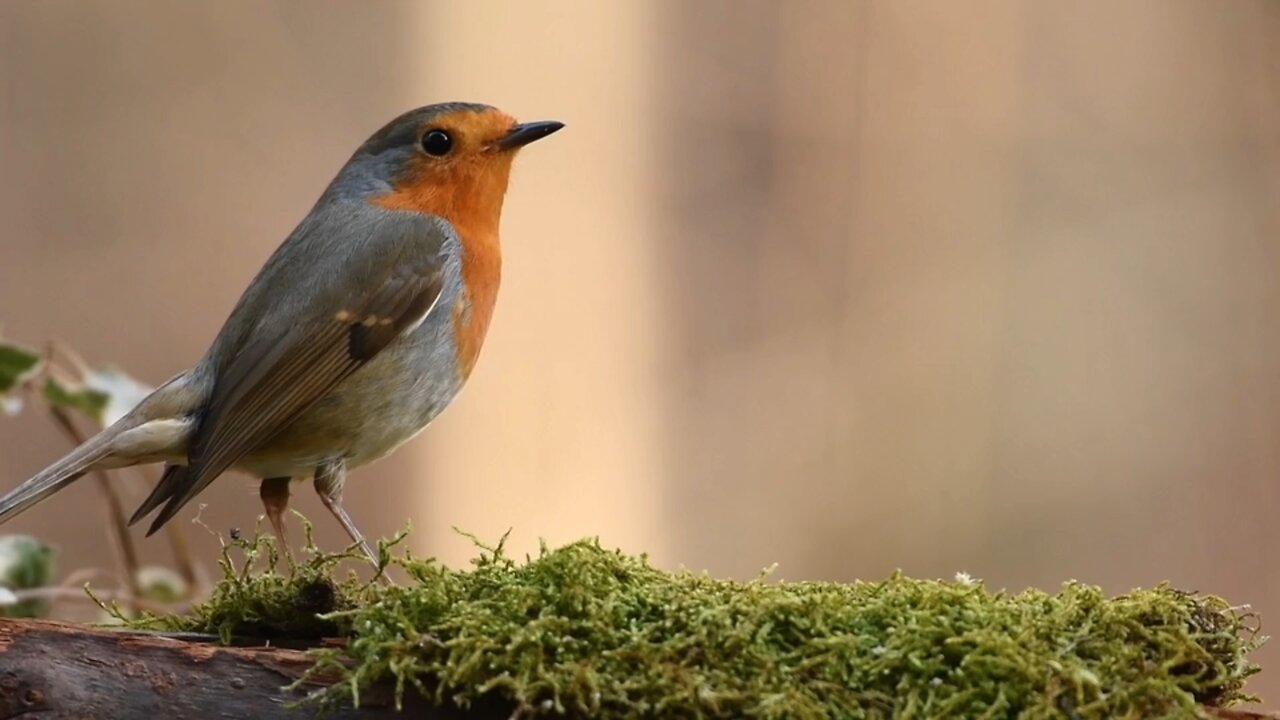
"The European Robin: A Tale of Song and Survival"
The European robin (*Erithacus rubecula*) is a small, insectivorous songbird native to Europe, western Asia, and parts of North Africa. Known for its distinctive orange-red breast and face, the robin is a familiar and beloved bird across its range, often associated with winter and Christmas in European culture.
### Key Features:
- **Size**: The European robin is small, measuring about 12.5–14 cm (5–5.5 inches) in length, with a wingspan of 20–22 cm (8–9 inches).
- **Plumage**: Its most striking feature is the bright orange-red breast, extending up to the face and throat. The rest of the body is mainly brown with a white belly.
- **Song**: The robin's song is a sweet, warbling melody, which is often heard year-round but is particularly prominent in the spring and autumn.
### Behavior and Habitat:
- **Habitat**: Robins are highly adaptable and can be found in a variety of habitats, including woodlands, gardens, parks, and hedgerows. They are particularly fond of areas with dense undergrowth where they can forage for insects and worms.
- **Behavior**: European robins are territorial and can be quite aggressive towards intruders, especially during the breeding season. They are also known for their curious and bold nature, often approaching humans closely, especially when food is involved.
- **Diet**: Their diet primarily consists of insects, worms, spiders, and other invertebrates. In winter, they may also eat berries and seeds when insect prey is scarce.
### Cultural Significance:
- The European robin is a symbol of Christmas in many European countries, often featured on holiday cards and decorations.
- It has a strong presence in folklore and literature, frequently depicted as a friendly, helpful bird.
- The robin is the national bird of the United Kingdom.
### Breeding:
- Robins typically breed from April to June, with females laying 4-6 eggs per clutch. The nest is usually built in a hidden, sheltered location, such as a tree hole, wall crevice, or among dense vegetation.
- Both parents take part in feeding the chicks, which fledge around 14 days after hatching.
### Conservation:
- The European robin is currently listed as a species of Least Concern by the IUCN, meaning it is not at immediate risk of population decline. Its adaptability and widespread presence help ensure its survival across its range.
This bird's charming appearance and melodious song make it a favorite among birdwatchers and nature enthusiasts across Europe.
-
 1:01:47
Timcast
4 hours agoTrump Orders "Complete Blockade" of Venezuela, Potential Act of WAR
139K113 -
 2:53:04
Steven Crowder
6 hours agoVanity Fair's Susie Wiles Hit Piece: Who's To Blame PLUS Special Guest Jillian Michaels
465K643 -
 12:52
12:52
The Kevin Trudeau Show Limitless
5 hours agoBeyond Good And Bad: The Hidden Reality Code
5.78K4 -
 28:25
28:25
The Boomer Effect
5 hours agoBridging the Divide: Manchin on Politics, Principles, & People First
6.01K -
 LIVE
LIVE
The Illusion of Consensus
2 hours ago $0.89 earnedYou’re Healing The Wrong Way - Meditation, Trauma & Awakening EXPLAINED | Loch Kelly
51 watching -
 1:17:06
The Rubin Report
5 hours agoLeftist Insults Jillian Michaels on Piers Morgan & It Gets Brutal Fast
68K29 -
 1:23:36
Sean Unpaved
4 hours agoMike McDaniel & Dolphins BENCH Tua Tagovailoa For Quinn Ewers! | UNPAVED
23.2K -
 3:12:33
Misfits Mania
18 hours ago $29.40 earnedANDREW TATE VS CHASE DEMOOR OFFICIAL OPEN WORKOUT
216K24 -
 LIVE
LIVE
LFA TV
18 hours agoLIVE & BREAKING NEWS! | WEDNESDAY 12/17/25
1,407 watching -
 LIVE
LIVE
SternAmerican
1 day agoFINAL ELECTION INTEGRITY CALL OF 2025 – WEDNESDAY, DECEMBER 17 | 1:00 PM EST
164 watching