
Ronald Reagan: The Great Communicator | 5-Minute Videos | PragerU

PragerU
Few presidents have connected with the American people like Ronald Reagan did. Through a combination of persuasion and policy, our 40th president turned a depressed nation into a confident one. Scott Walker, former governor of Wisconsin and president of Young America's Foundation, explains how he did it.
If you like this video, we have a whole series on the men who shaped America, check it out here:https://l.prageru.com/3PO4MzS
Follow PragerU on social media!
Instagram ➡️ (https://www.instagram.com/prageru/)
X/Twitter ➡️ (https://twitter.com/prageru)
Facebook ➡️ (https://www.facebook.com/prageru/)
YouTube ➡️ (https://www.youtube.com/@PragerU)
TikTok ➡️ (https://www.tiktok.com/@prageru)
6.88K
views
10
comments
George Washington: A General without an Army | 5-Minute Videos | PragerU
PragerU
If George Washington helped to shape America, what shaped George Washington? Historian Edward Lengel explores Washington’s early history: the events that defined him and ultimately made him America’s “indispensable man.”
9.55K
views
3
comments
Jimmy Carter: Farmhouse to White House |5-Minute Videos | PragerU
PragerU
After the Watergate scandal, Jimmy Carter had the perfect campaign slogan: “I’ll never lie to you.” No one questioned his character; only his policies. He thought he could change the world. But the world ended up changing him. Historian Tevi Troy tells the story of the 39th President’s rise and fall.
7.18K
views
7
comments
Lyndon B. Johnson and the Vietnam War | 5-Minute Videos
PragerU
Lyndon B. Johnson wanted to wage a war on poverty. Instead, he waged a war halfway around the world in Vietnam. That conflict defined him, his presidency, and the decade of the 1960s. Historian Bill Whittle tells the story.
5.69K
views
7
comments
Lyndon B. Johnson: The Not-So-Great Society | 5-Minute Videos
PragerU
Lyndon B. Johnson created hundreds of social programs to "cure" poverty. But who would administer those programs? And how exactly would they work? No one seemed to know. No one seemed to care. The goal was noble, and that’s all that mattered. Renowned historian Amity Shlaes explains.
Get our content ad-free! Download the PragerU app!
👉https://prageru.onelink.me/3bas/rumble
4.85K
views
7
comments
John F. Kennedy: Young President in Crisis | 5 Minute Videos
PragerU
With John F. Kennedy at the helm, everything seemed possible—economic prosperity, progress toward racial equality, and even putting a man on the moon. But it all came crashing down in an instant. Larry Elder details the incredible career and legacy of JFK.
Script:
Everything about John F. Kennedy, the 35th President of the United States, was appealing: his good looks, his glamorous wife Jackie, their picture book children, Caroline and John Jr.
JFK personified how America wanted to see itself: youthful, forward-looking, confident.
But Kennedy had his doubters.
Did he have the maturity and experience to lead the most powerful nation on earth?
Early on, it seemed the answer was no. Within three months of taking office, he botched his first major foreign policy test, a poorly planned attempt to overthrow the communist government in Cuba. The failure, now known as the Bay of Pigs fiasco, was an international embarrassment.
His meeting in Vienna in June 1961 with Soviet leader Nikita Khrushchev didn’t help matters. Khrushchev pushed Kennedy around like a playground bully.
These early failures might have broken a lesser man, but Kennedy, a World War II Navy combat veteran turned out to be made of very stern stuff. The next confrontation with the Communists would be different.
That confrontation happened in October 1962. Khrushchev, thinking he could intimidate Kennedy again, ordered the secret installation of nuclear-armed missiles in Cuba, just 90 miles from the Florida coast.
Kennedy ordered a blockade of the island, insisting that the missiles be immediately removed. What ensued was a high-stakes standoff—the Cuban Missile Crisis. Kennedy’s advisors estimated 80 million Americans would die if war broke out. The Soviets could expect even worse losses.
The world held its breath.
This time, it was the Soviet dictator who blinked. The missiles were removed.
The world breathed a huge sigh of relief, and America could get on with its seemingly limitless future because there would actually be a future.
7.91K
views
3
comments

John F. Kennedy: A Star Is Born | 5 Minute Videos

PragerU
With his movie star looks and beautiful young family, John F. Kennedy was the picture-perfect president of the television era. But some critics said he was too young and inexperienced to be president in a dangerous Cold War world. Were they right? Larry Elder recounts the remarkable political ascent of JFK.
Script:
On the morning of November 22, 1963, the United States was at the peak of its power. It dominated the world in every respect—militarily, economically, and culturally. Nothing seemed out of America’s reach, even the moon.
The man guiding the ship of state was movie-star handsome, youthful (only 46), and always seemed to know what to say and how to say it.
That man was John F. Kennedy, the 35th president of the United States.
JFK was born just outside of Boston on May 29, 1917, the second of nine children. His father, Joe Kennedy, made a fortune trading stocks, selling whiskey, and financing movies. A noted philanderer, his affair with actress Gloria Swanson was the stuff of Hollywood legend.
He parlayed his financial success into political success, eventually serving as Franklin Roosevelt’s ambassador to Great Britain.
Joe expected much from his sons, but most especially from his eldest son, Joe, Jr.
When young Joe died in Europe during World War II, the burden of the father’s ambitions fell on his second son.
But there was no certainty that John, known to his family and friends as “Jack,” would survive the war.
Some months earlier, when his PT boat was rammed by a Japanese destroyer in the South Pacific, it was assumed that he and his entire crew had been killed. But through Kennedy’s heroic efforts, all but two were rescued.
For his bravery, Jack was awarded the Purple Heart.
Living up to his father’s expectations and using the connections of his maternal grandfather, John “Honey Fitz” Fitzgerald—a former mayor of Boston—Kennedy was elected as a Democrat to Congress in 1946.
Kennedy was just 29.
But he already had his eyes on a bigger prize. In 1952 he was elected to the U.S. Senate.
One year later, he married the beautiful socialite, Jacqueline Bouvier. Their wedding was the major event of the 1953 social season. There were 700 guests at the ceremony and 1,200 at the reception.
With his new wife and new Senate seat, Kennedy was making all the right moves. Bored by the endless committee meetings in Congress, he focused on increasing his national profile, traveling around the country, giving speeches, and appearing on talk shows to discuss current events.
With his distinct Boston accent, he developed a dynamic speaking style which, coupled with his good looks and beautiful young family, made him picture-perfect for the new age of television.
He positioned himself as a centrist on domestic policy and a staunch anticommunist on foreign policy.
By 1960, he was ready to make his presidential move. While his critics argued that, at age 43, he was too young and inexperienced for the nation’s highest office, Kennedy argued that it was time for a new generation to take charge.
With his shrewd and loyal brother Bobby running his campaign, Kennedy won the Democratic nomination. But the race against Richard Nixon, Dwight Eisenhower’s vice president, would prove to be much tougher.
Dwight Eisenhower: A General Keeps the Peace | 5-Minute Videos | PragerU
PragerU
The 1950s are widely regarded as a period of undisputed American greatness. The United States dominated the world in almost every respect, from science to culture, from John Wayne westerns to commercial aviation. What was Dwight Eisenhower’s role in this decade of prosperity? John Yoo, Professor of Law at the University of California, Berkeley, has the answer.
Script:
When Dwight Eisenhower, or “Ike,” as he was universally known, was elected the 34th president of the United States in 1952, the American people weren’t exactly sure who they had voted for.
He ran as a Republican, but was he a conservative? A moderate? A liberal?
Ultimately, it didn’t really matter. The decorated World War II general who had waged war now promised to wage peace. And the voters trusted he would keep that promise.
Their trust was not misplaced. His first major act as president was to resolve the conflict in Korea that had begun in 1950 and cost America 36,000 lives.
Here’s how he did it: he made it clear to the Chinese, North Korea’s patron, that if they didn’t agree to a cease-fire, he would not hesitate to use nuclear weapons.
Soon after, an agreement was reached, drawing a line between North and South Korea at the 38th parallel. That agreement stands to this day.
Would Eisenhower have actually followed through on his threat? We’ll never know, but that was the whole point.
“After Ike made peace in Korea,” Eisenhower biographer Jean Smith wrote, “not a single American died in combat for the next eight years.”
Throughout his time in office, he was urged to use American military power to resolve conflicts. And for eight years he resisted.
In 1953, the French wanted him to come in on their side in Vietnam.
In 1955, Chiang Kai-shek, the ruler of Taiwan, wanted America’s help to take on Communist China.
In 1956, the Hungarians wanted him to back their revolt against Soviet rule
Each supplicant made a good case for American intervention. Each time, Eisenhower refused to commit American troops. If he didn’t see a clear path to victory, the risk, in his mind, was greater than the reward.
And even though he said he was prepared to use nuclear weapons, he greatly feared their destructive power.
To that end, he sought a treaty with the Soviets to end the arms race. He proposed that the US would open up all its military facilities to Russian inspection—provided the Soviets did the same. But the Soviet leader Nikita Khrushchev declined. He dismissed the proposal as an American trick to spy on the Soviet Union. It wasn’t a trick. Eisenhower really meant it.
If Khrushchev wouldn’t make a deal, Eisenhower would do what he had to do: make sure that America’s nuclear capacity far outstripped the Soviets.
But while he recognized the Soviet threat, he didn’t blindly accept the advice of his military chiefs. As a career soldier, he knew that the armed services always assumed the worst about an adversary’s capabilities—the better to boost their budgets. But Eisenhower never took the bait. In fact, he trimmed portions of the military budget repeatedly during his tenure. He famously worried about what he coined the “military-industrial complex”.
He brought the same pragmatism to the domestic front. His philosophy here was not much different than his foreign policy philosophy: if he could keep the country out of war—in this case, political war —everything else would take care of itself.
See the rest: https://l.prageru.com/4cvqxhs
Follow PragerU on social media!
Instagram ➡️ (https://www.instagram.com/prageru/)
Twitter ➡️ (https://twitter.com/prageru)
Facebook ➡️ (https://www.facebook.com/prageru/)
4.91K
views
Dwight Eisenhower: War Hero to President
PragerU
As the Korean War intensified, war-weary Americans turned to a new leader, General Dwight D. Eisenhower, the hero of World War II, to bring them peace. “Ike,” as he was known to everyone, didn’t disappoint them.
Script:
The Allies defeated the Axis powers—Germany and Japan—in World War II in no small part because of America’s brilliant generals—men like George Marshall, George Patton, Douglas MacArthur, Omar Bradley, and Dwight Eisenhower.
Of that illustrious group, only one—Eisenhower—reached America's highest office, serving as the 34th president of the United States.
What made him stand out among his contemporaries?
Dwight David Eisenhower was born on October 14, 1890. Young Dwight, or “Ike” as he came to be known to everyone, was the third of seven children—all boys.
Of his childhood, the future president would later say, “We were very poor, but the glory of America is that we didn't know it...”
Looking for a ticket out of his hometown of Abilene, Kansas, Ike entered the U.S. Military Academy at West Point in 1911. He did little to distinguish himself academically, focusing more on football than his studies.
Upon graduating as a second lieutenant, he was posted to Fort Sam Houston in San Antonio, Texas. There, he met the petite, vivacious, and charming Mamie Doud. The daughter of a prosperous businessman, Mamie was used to cooks and servants but gave it all up for the spartan life of a military spouse when she married Ike in 1916. She would spend the next two decades moving from one dreary Army base to the next. But as long as she was with her husband, she was happy. “Ike was my career,” she said years later.
When America entered World War I in 1917, Eisenhower, to his frustration, was ordered to remain stateside to train others for combat. It was a bitter blow, and it set the pattern of Eisenhower’s life for twenty years. As others rose to senior positions, his career stalled. He seemed destined to serve great men, not to be one.
From 1935 to 1939, Eisenhower worked as Douglas MacArthur’s top aide in the Philippines, where they helped train the local army, giving the young man from Abilene his first real taste of international politics.
MacArthur was an extremely difficult personality who almost drove Ike to his wit’s end.
See the rest: https://l.prageru.com/3zdWVqn
Follow PragerU on social media!
Instagram ➡️ (https://www.instagram.com/prageru/)
Twitter ➡️ (https://twitter.com/prageru)
Facebook ➡️ (https://www.facebook.com/prageru/)
5.89K
views
3
comments
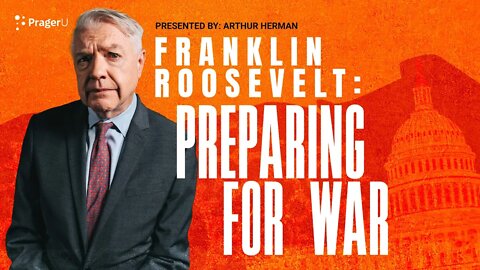
Franklin Roosevelt: Preparing for War
PragerU
In 1940, Nazi Germany overran France. Britain looked to be the next target. President Franklin Roosevelt knew he had to prepare America for war. But how? Arthur Herman, senior fellow at the Hudson Institute and author of Freedom's Forge, tells the amazing story.
SUBSCRIBE 👉 https://www.prageru.com/join
#fdr #roosevelt #ww2
Script:
In May 1940 the Nazi Blitzkrieg was overrunning France. Great Britain would be next.
British Prime Minister, Winston Churchill sent a telegram to the American President, Franklin Roosevelt.
“I trust you realize,” Churchill wrote, “the voice and the force of the United States may count for nothing if they are withheld too long.”
Roosevelt was a former Assistant Secretary of the Navy and a student of naval strategy. If Hitler were to take control of Britain, he would take control of the Atlantic. This, Roosevelt knew, would pose a grave threat to America.
Roosevelt also knew America wasn’t ready for war—not psychologically (most Americans didn’t want to get involved in a conflict on the other side of the ocean) and not militarily.
The United States had the world’s eighteenth largest army. Hungary and even Holland had bigger armies, while Hitler commanded the most advanced military machine ever seen.
The Army’s Chief of Staff General George Marshall told Roosevelt that if Hitler overran Europe and landed seven divisions on the East Coast, there was nothing anyone could do to stop him.
With all this staring Roosevelt in the face, it would have been irresponsible for the Commander in Chief not to arm the United States for war.
But how?
Many in his administration believed then, as many Americans believe now, that the only way to deal with an extreme crisis was to give the government as much power and authority as possible.
But FDR had the insight to realize that a massive wartime buildup during what was still peacetime wouldn’t succeed unless he harnessed the productive power of American business; that is to say, American free market capitalism.
The federal government could help coordinate industry’s efforts; it could make sure resources like steel and aluminum got to the places where they were most needed, but otherwise the government would have to back off.
To the president who had created an alphabet soup of Federal agencies to dig the country out of the Great Depression, this was about as un-Roosevelt as you could get.
But to his everlasting credit, the President realized that what he and the Democrats had tried with the Depression and failed—to manage the economy through government decree—wasn’t going to work when it came to preparing for war.
The man Roosevelt called for help was General Motors CEO William Knudsen, a Danish-born immigrant who had worked his way up from the Brooklyn shipyards to head the largest automobile company in the world.
Knudsen told the president that if he gave him 18 months, America would have more planes, tanks, and warships than it would know what to do with.
Roosevelt gave Knudsen what he wanted. In one of his most famous radio speeches in December 1940, a year before Pearl Harbor, the President told the American people that “we must be the great arsenal of democracy.” He backed up his words with action.
For the full script, visit: https://www.prageru.com/video/franklin-roosevelt-preparing-for-war
1
comment

Woodrow Wilson: World War I and the League of Nations | 5 Minute Video
PragerU
In his first term as president, Woodrow Wilson sought to transform America. In his second term, he sought to transform the world. RJ Pestritto, professor of politics at Hillsdale College, describes how this once-obscure academic became one of America’s most influential presidents.
📲 Download the FREE PragerU app: https://prageru.onelink.me/3bas/vgyxvm79
Script:
For over a hundred years, the United States of America had relied on the genius of individuals to solve problems. It was often chaotic but incredibly productive, leading to the greatest economic expansion in world history.
For Woodrow Wilson, the 28th president of the United States, the time had come to bring order to that chaos. That would mean less freedom for the individual, but, at least in theory, more equality across society.
It was an exchange that perfectly fit into his progressive worldview: that the government should be active in every aspect of American life.
In a remarkable first term, Wilson laid the groundwork for this transformation of America.
In his second term, Wilson sought to transform the world.
The First World War — 1914 to 1918 — gave him the opportunity.
Initially, Wilson did everything he could to keep the nation out of that war. In fact, the reason he won his re-election in 1916 was his promise not to send American boys to fight on another continent.
But within two years, over two million Americans would be on that continent. Over a hundred thousand would die.
German aggression, specifically its submarine warfare that killed hundreds of Americans, made it very difficult for Wilson to keep the nation out of the war.
The final straw was the infamous “Zimmermann Telegram” in which the German government promised to help Mexico reclaim much of the Southwest if Mexico would stir up trouble along the Rio Grande.
On April 2, 1917, Wilson asked for a declaration of war. Congress gave it to him four days later.
If Wilson believed the government was supreme during peacetime, how much more so during wartime? To supercharge the war effort, Wilson essentially took control of the US economy. He nationalized whole industries, rationed food and fuel, fixed prices, and raised the top income tax rate to 77%.
Civil liberties were severely curtailed. Criticism of the war was essentially forbidden. Violators were imprisoned under the Espionage and Sedition Acts of 1917 and 1918. German composers like Bach and Beethoven were banned, teaching the German language in schools was prohibited, and sauerkraut was renamed “liberty cabbage.”
To his credit, Wilson left the prosecution of the war to his generals, and America did indeed turn the tide in favor of the Allies.
On November 11, 1918, the Germans, unable to counter America’s economic and military might, agreed to stop fighting.
Peace was at hand.
But what would that peace look like?
As always, Wilson had a vision. He called it the Fourteen Points.
The key point was the creation of an international League of Nations.
Wilson was so committed to this idea that he decided to go to Europe personally and negotiate the peace agreement. Europeans greeted him as a conquering hero, lining the streets wherever he went.
Wilson’s impulse was to give Germany generous peace terms. He wanted what he called “peace without victory.” But the French and British saw things much differently. Having suffered so grievously, they wanted Germany severely punished.
Wilson thought that was a terrible mistake, but eventually yielded. It was a price he was willing to pay to get the Allies to agree to his League of Nations.
But while Wilson had sold the League to the Europeans, he couldn’t sell it to Congress.
Republicans and even some Democrats were leery that the League required member nations to counter “external aggression” against “all members.” They feared this could lead to endless American involvement in foreign wars.
Wilson brushed aside their concerns and took his case directly to the American people, convinced that once they understood it, they would embrace it. The speaking tour took everything Wilson had and more.
On October 2, 1919, he suffered a massive stroke, rendering him partially paralyzed.
See the rest: https://l.prageru.com/4aFRYnT
Subscribe to PragerU Kids ➡️ (https://www.youtube.com/@PragerUKids)
Subscribe to Real Talk with Marissa Streit ➡️ (https://www.youtube.com/@realtalkwith...)
Subscribe to PragerU Shorts ➡️ (https://www.youtube.com/@PragerUShorts)
Follow PragerU on social media!
Instagram ➡️ (https://www.instagram.com/prageru/)
Twitter ➡️ (https://twitter.com/prageru)
Facebook ➡️ (https://www.facebook.com/prageru/)
7.53K
views
3
comments
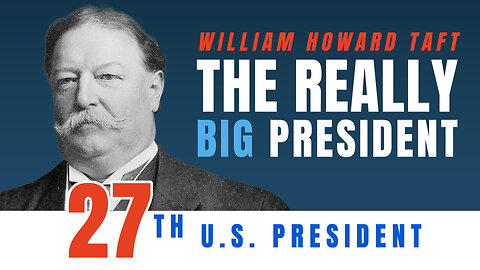
William Howard Taft: The Really Big President | 5-Minute Videos | PragerU
PragerU
William Howard Taft served as both the President of the United States and the Chief Justice of the Supreme Court — the only man to ever do so. Richard Lim, host of the This American President podcast, recounts the unique career of America’s 27th president.
If you like this video, we have a whole series on the men who shaped America, check it out here:https://l.prageru.com/3PO4MzS
Follow PragerU on social media!
Instagram ➡️ (https://www.instagram.com/prageru/)
X/Twitter ➡️ (https://twitter.com/prageru)
Facebook ➡️ (https://www.facebook.com/prageru/)
YouTube ➡️ (https://www.youtube.com/@PragerU)
5.36K
views
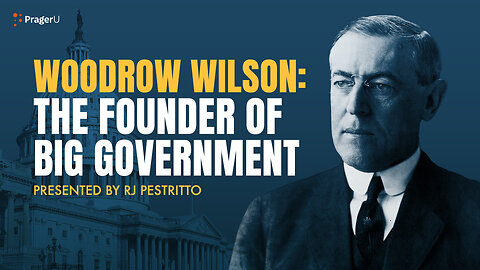
Woodrow Wilson: The Founder of Big Government | 5 Minute Video
PragerU
As America’s 28th president, Woodrow Wilson greatly expanded the size and scope of the federal government. How did he do it, and why? RJ Pestritto, professor of politics at Hillsdale College, answers this important question.
📲 Download the FREE PragerU app: https://prageru.onelink.me/3bas/vgyxvm79
Script:
Few American leaders have stirred more controversy than Woodrow Wilson, the 28th president of the United States. Many admire him, many don’t. But one point on which everyone agrees is his profound impact on American history.
The reasons for the controversy and the impact are one and the same.
Wilson and his generation of leaders were the first to challenge the founding principles of the country. It’s not an exaggeration to say that Wilson turned them upside down.
As expressed in the Declaration of Independence, the Founders believed that individuals are born with certain unalienable rights. And they framed the Constitution to protect those rights.
For Wilson, the time of individual rights had passed. In his view, 18th-century America had little relevance to early 20th-century America. The country, now much bigger and more complex, required the guidance of a benevolent government.
America had literally outgrown the Founders.
Wilson’s philosophy — of which he was a leading proponent — was known as Progressivism. And Wilson proudly called himself a Progressive.
Where did Wilson get these ideas? From the place where he spent most of his life: the halls of academia. He was the only US president to come into office with a Ph.D.
Born in Staunton, Virginia on December 28, 1856, Woodrow Wilson had two ambitions: to teach and to write. He received his undergraduate degree from Princeton with the vague notion that he would become a lawyer. But like another, earlier president, John Quincy Adams, Wilson found the law much too arid for his active mind. To the chagrin of his father, he returned to academia to get an advanced degree at Johns Hopkins.
There his thinking took form. He was deeply influenced by Charles Darwin’s new theory of evolution. At Hopkins this theory was applied to government: just as a species must adapt — or progress — to survive, so must a government. Not to recognize this would be to hold America back, to stunt its growth, or, to close the metaphor, risk extinction.
This was one of the major themes in Wilson’s Ph.D. thesis, which he turned into an influential book titled “Congressional Government: A Study in American Politics.” This book launched his academic career, which culminated in his appointment as president of Princeton in 1902.
As happy as he was at Princeton, Wilson longed to put his progressive ideas to the test, hence his move into politics. There his rise was truly meteoric. In 1910, he ran successfully for governor of New Jersey as a Democrat. Once in office, he surprised everyone with his impressive political skills, scoring one policy victory after another, while also fighting New Jersey’s notoriously corrupt political machine.
Reforming workers’ compensation, limiting how much money corporations could spend on elections, and putting utilities under state supervision were only three of the progressive ideas he pushed through the legislature. His success attracted the attention of Progressives nationwide. In 1912, the Democratic Party, desperate to end a sixteen-year losing streak, turned to Wilson as its nominee.
The chances of Wilson winning that election against a united Republican Party were slim, but the electoral calculus changed dramatically when former Republican president Teddy Roosevelt decided to run against his own hand-picked successor, the current Republican President, William Taft.
TR’s campaign was the most successful third-party run in American history, but all it accomplished was to split the Republicans and give Wilson an easy victory. He won with 42% of the popular vote, the lowest percentage since Lincoln.
In just three years, Wilson had risen from president of Princeton to President of the United States.
As he did as governor, he immediately went to work.
See the rest: https://l.prageru.com/3vGqGyA
Subscribe to PragerU Kids ➡️ (https://www.youtube.com/@PragerUKids)
Subscribe to Real Talk with Marissa Streit ➡️ (https://www.youtube.com/@realtalkwith...)
Subscribe to PragerU Shorts ➡️ (https://www.youtube.com/@PragerUShorts)
Follow PragerU on social media!
Instagram ➡️ (https://www.instagram.com/prageru/)
Twitter ➡️ (https://twitter.com/prageru)
Facebook ➡️ (https://www.facebook.com/prageru/)
6.21K
views
9
comments
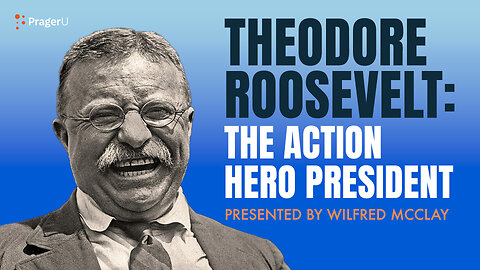
Theodore Roosevelt: The Action Hero President | 5-Minute Videos | PragerU
PragerU
The time had come for America to take its place among the great nations of the world. There was no better man to lead this charge than Theodore Roosevelt. Wilfred McClay, professor of history at Hillsdale College, chronicles the complex career of America’s 26th president.
If you like this video, we have a whole series on the men who shaped America, check it out here:https://l.prageru.com/3PO4MzS
Follow PragerU on social media!
Instagram ➡️ (https://www.instagram.com/prageru/)
X/Twitter ➡️ (https://twitter.com/prageru)
Facebook ➡️ (https://www.facebook.com/prageru/)
YouTube ➡️ (https://www.youtube.com/@PragerU)
7.47K
views
5
comments

Herbert Hoover: Success or Failure? | 5-Minute Videos | PragerU
PragerU
Herbert Hoover, the 31st President of the United States, succeeded at almost everything he did. Yet he is best remembered for one failure: the Great Depression. Is that legacy justified? Historian Kenneth Whyte examines the evidence.
If you like this video, we have a whole series on the men who shaped America, check it out here:https://l.prageru.com/3PO4MzS
Follow PragerU on social media!
Instagram ➡️ (https://www.instagram.com/prageru/)
X/Twitter ➡️ (https://twitter.com/prageru)
Facebook ➡️ (https://www.facebook.com/prageru/)
YouTube ➡️ (https://www.youtube.com/@PragerU)
9.26K
views
3
comments
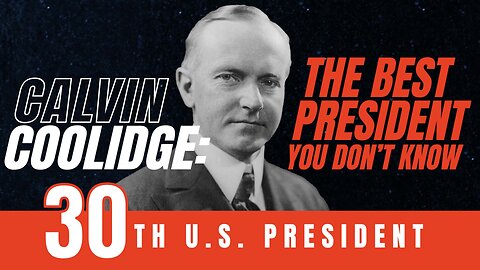
Calvin Coolidge: The Best President You Don't Know | 5 Minute Videos | PragerU
PragerU
Americans today place enormous pressure on presidents to do “something" when there is a national crisis. But our 30th president Calvin Coolidge did “nothing” ...other than shrink the government. The result? America's economy boomed. Is there a lesson to be learned? Renowned historian Amity Shlaes thinks there is.
Watch more from PragerU’s American Presidents 5-Minute Video series: https://l.prageru.com/3PO4MzS
Follow PragerU on social media!
Instagram ➡️ (https://www.instagram.com/prageru/)
X ➡️ (https://twitter.com/prageru)
Facebook ➡️ (https://www.facebook.com/prageru/)
YouTube ➡️ (https://www.youtube.com/@PragerU)
5.32K
views
6
comments

Warren Harding: The Least Appreciated President | 5-Minute Vidoes | PragerU
PragerU
Warren Harding is not regarded as one of our most successful presidents. He’s more likely to be remembered for his scandals than his accomplishments. But given the problems he had to confront — massive war debt, high unemployment, and skyrocketing inflation — is this harsh appraisal fair? Renowned historian Amity Shlaes takes a fresh look at our 29th president.
If you like this video, we have a whole series on the men who shaped America, check it out here:https://l.prageru.com/3PO4MzS
Follow PragerU on social media!
Instagram ➡️ (https://www.instagram.com/prageru/)
X/Twitter ➡️ (https://twitter.com/prageru)
Facebook ➡️ (https://www.facebook.com/prageru/)
YouTube ➡️ (https://www.youtube.com/@PragerU)
8.99K
views
4
comments
Think America’s Founding Fathers Were Just Old Men in Wigs? Think Again! | Short Clips | PragerU
PragerU
Get FREE access to our Founding Fathers 101 video series and uncover the truths about America’s beginnings: https://l.prageru.com/3PO4MzS
8.67K
views
2
comments
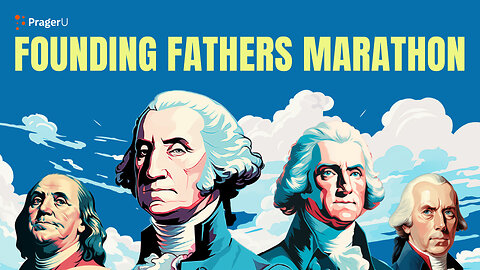
The Founding Presidents | 5 Minute Video | Marathon | PragerU
PragerU
The first five presidents of the United States are known as the Founding presidents: Washington, Adams, Jefferson, Madison, and Monroe. Who were they? What made them exceptional? And why are their stories so relevant to us today?
If you like this video, we have a whole series on the men who shaped America, check it out here:https://l.prageru.com/3PO4MzS
10.3K
views
6
comments
Why We Created the American Presidents Series | Short Clips | PragerU
PragerU
The best way to learn history is through biography and the best way to learn American history is through the biographies of the presidents. Meet the men who shaped the nation—5-minute biographies of the American presidents: https://l.prageru.com/4aTRUSv
11.7K
views
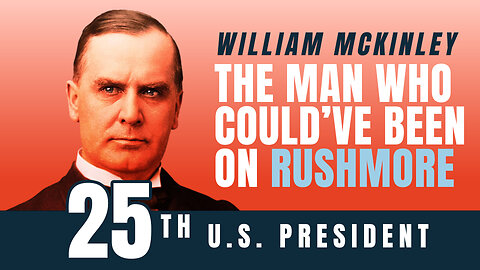
William McKinley: The Man Who Could’ve Been on Rushmore | 5-Minute Videos | PragerU
PragerU
As much as anyone, William McKinley laid the foundation for US dominance in the 20th century. Why, then, is America’s 25th president given such little credit for his accomplishments? Jason R. Edwards, professor of history at Grove City College, sets the record straight.
If you like this video, we have a whole series on the men who shaped America, check it out here:https://l.prageru.com/3PO4MzS
8.85K
views
3
comments
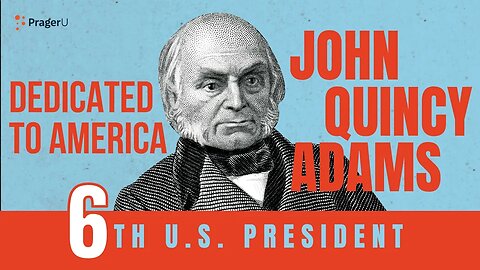
John Quincy Adams: Dedicated to America
PragerU
John Quincy Adams, the son of the second President of the United States, became the sixth President of the United States. But the road to that prize was anything but smooth. Jane Hampton Cook, author of American Phoenix, tells how this formidable and intimidating man overcame every obstacle in his path.
SUBSCRIBE 👉 https://www.prageru.com/join
Script:
Imagine your father expected you to grow up to be President of the United States.
Now imagine you did.
That was John Quincy Adams.
His father, John Adams, was a leading figure in the American Revolution and the second President of the United States.
That’s a lot to live up to.
But John Quincy did it… and more.
Born on July 11, 1767, near Boston, he grew up in a time of turmoil. At the age of seven, in 1775, he watched the Battle of Bunker Hill from a hilltop near his family home.
In 1778, Congress sent his father to Paris to help convince the French to support the American War of Independence. John Quincy traveled with him – a ten-year-old diplomat in training.
And what a training it was.
For the next seven years, in addition to France, John Quincy lived in Great Britain, the Netherlands, Russia, and Sweden, learning first-hand the art of diplomacy.
By the time he returned to the United States in 1785 at the age of 18, he had absorbed not only the customs of these countries but learned to speak their languages as well.
After graduating from Harvard, he took up the law. But reading legal documents all day bored him to tears. The world was changing fast, and he wanted to be in the middle of it.
Which is right where he landed.
George Washington — who always had a keen eye for exceptionally talented young men — appointed him the American ambassador to the Netherlands. That subsequently led him to the court of Russian Czar Alexander I, and then to the court of British King George III.
He reached the peak of his diplomatic career in 1814, when he negotiated the end of the disastrous War of 1812, between Great Britain and the United States.
Although the British as the stronger power, had the leverage, Adams and his colleagues held their ground. The final settlement, named the Treaty of Ghent after the Belgian city where it was signed, was essentially a wash for the British, but a victory for the Americans, who, from their point of view, had defeated the British a second time.
Adams now stood alone as America’s foremost diplomat.
When his friend James Monroe became president in 1817, he appointed Adams Secretary of State. The two men forged a highly productive partnership.
Their most lasting accomplishment was the Monroe Doctrine, issued in 1823. The doctrine announced that America would not permit European colonization in the Western Hemisphere. Although the doctrine bears the name of the fifth president, it originated with his Secretary of State. It remains a fundamental principle of American foreign policy.
Adams’ many accomplishments made him the logical successor to Monroe.
But the hero of the War of 1812, Andrew Jackson, begged to differ. In the 1824 presidential election, Jackson ran against Adams.
Jackson won the popular vote but couldn’t secure a majority in the Electoral College. This forced the decision as to who would be the next president into the House of Representatives.
When Henry Clay, the influential Speaker of the House, threw his support to Adams, the son of the second president became the sixth president.
Adams had achieved his ultimate goal.
It brought him nothing but misery.
His ambitious agenda — to build a national system of roads and canals, establish a national university, and expand foreign trade — got nowhere.
Jackson’s allies in Congress — soon to call themselves Democrats — blocked him at every turn.
The presidency revealed Adams’ weakness as a politician. Brilliant and forward-looking, he was a man for the people, but not a man of the people. In the 1828 election — a rematch with Jackson — Adams, opted to remain above the fray. But that was the style of yesterday. This time the charismatic general won easily.
Adams left the White House a dejected figure, lamenting, “The Sun of my political life sets in the deepest gloom.”
As it turned out, a new phase of his illustrious career was beginning.
For the full script, visit: https://www.prageru.com/video/john-quincy-adams-dedicated-to-america
2.55K
views
1
comment
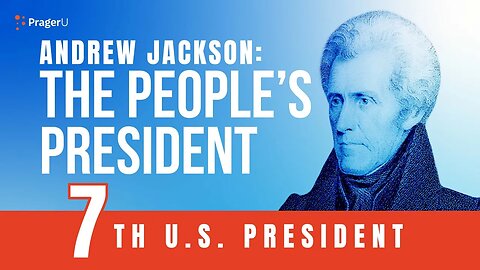
Andrew Jackson: The People’s President
PragerU
Both revered and reviled in his own time, the seventh President of the United States Andrew Jackson never backed down from a fight. His “my way or the highway” approach made “Old Hickory” as ruthless with his veto pen as with his dueling pistol. Allen Guelzo, Distinguished Research Scholar in the James Madison Program at Princeton University, tells Jackson’s story.
Watch PragerU's American Presidents series: https://l.prageru.com/3IjUsLU
SUBSCRIBE 👉 https://www.prageru.com/join
Script:
No American President has been more beloved and reviled than Andrew Jackson, the seventh President of the United States. This was as true during his own day as it is in ours.
Andrew Jackson was born in South Carolina on March 15, 1767. He was barely ten years old when the American Revolution broke out. The war claimed the lives of his two brothers and his mother, leaving Jackson orphaned, alone, and with a bitter hatred for all things British.
In time, he would get his revenge.
Tall with sharp features topped by a thatch of red hair, Jackson always made an impression. In 1788, after a brief study of the law, he wangled an appointment as a district attorney in Tennessee, then known as the Southwest Territories, began investing in land and slaves, and earned an appointment as major general of the Tennessee militia. Though he had no formal military training, he was a natural leader. The men under his command would follow him anywhere. And if they didn’t, he might hang them. He fought numerous duels. He killed a man, Charles Dickinson, in one. That was Jackson.
As Jackson’s investments and military reputation advanced, so did his political interests. He served in Congress when Tennessee became a state in 1796 and later briefly as senator. His politics were decidedly Jeffersonian. He believed that owning land was the only real wealth; that industry, commerce, and banking were financial traps that ultimately benefited the rich at the expense of everyone else.
In 1812, a new war broke out between the United States and Great Britain. The conflict was a disaster in almost every respect for the ill-prepared Americans. But it ended on a high note thanks to Jackson. Sporting the nickname “Old Hickory” (hickory being a notoriously hard wood) and commanding a hastily assembled army at New Orleans, Jackson won a terrific victory over a British invasion force in 1815. That victory made Jackson the most celebrated man in America.
By 1824, Jackson was ready for a run at the presidency. His two most serious opponents were the Speaker of the House, Henry Clay, and the secretary of state, John Quincy Adams.
Jackson won the popular vote but did not secure a majority in the electoral college, which, according to the Constitution, threw the election into the House of Representatives. There, Clay’s sudden endorsement of Adams swung the chamber and the presidency to Adams.
An infuriated Jackson, convinced that Adams and Clay had colluded against him in a “corrupt bargain,” declared his intention to run again in 1828. This time he beat Adams in a landslide.
As president, he applied his characteristic ruthlessness to the federal budget, slashing infrastructure projects he did not believe were the province of the national government. When the national bank came up for recharter in 1832, he vetoed it.
Jackson, who harbored a lifelong distrust of bankers, insisted that the nation’s assets should be distributed to financial institutions throughout the United States rather than concentrated in one location. Was he right? No. This decision led to the financial depression of 1837. But Jackson never doubted himself. That was Jackson.
Old Hickory’s most controversial decision came in 1830. The issue was tariffs. South Carolina, represented by Jackson’s own vice president John Calhoun, insisted that tariffs be lowered because they favored manufacturing and commercial interests at the expense of Southern plantations. Calhoun assumed Jackson, a Southern planter himself, would agree. Otherwise, Calhoun warned, South Carolina would assert its state sovereignty and nullify the collection of federal tariffs within its boundaries.
But Jackson regarded South Carolina’s nullification threat as an attack on the Constitution -- and on his authority as president. The states had voted themselves into a federal Union in 1788, Jackson insisted, and no single state or group of states could defy it.
For the full script, visit: https://www.prageru.com/video/andrew-jackson-the-peoples-president
4.89K
views
9
comments
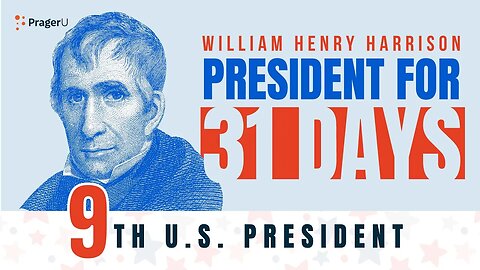
William Henry Harrison: President for 31 Days
PragerU
Watch PragerU's American Presidents series: https://l.prageru.com/3IjUsLU
William Henry Harrison, the first Whig president, died shortly after taking office. Though he didn’t live long enough to enact his ambitious agenda, it would be a serious mistake to underestimate his contribution to the American story. Richard Lim, host of the This American President podcast, explains why Harrison matters.
SUBSCRIBE 👉 https://www.prageru.com/join
Script:
The 1840 presidential election featured one of the most famous political slogans in American history. You may have heard of it: “Tippecanoe and Tyler, too!”
The “Tyler” of the slogan was John Tyler, the vice-presidential candidate.
But who was Tippecanoe?
It wasn’t a person. It was the site of a famous battle. The general who won that battle was William Henry Harrison, the man who became the ninth president of the United States.
Born into a leading Virginia family on February 9th, 1773, his father, Benjamin Harrison V, was one of the fifty-six men who signed the Declaration of Independence.
William, the youngest of seven children, grew up on the family’s large estate. But when his father died suddenly, the cushy life of his youth quickly became a memory. Like most Virginia planters, the estate was more debt than profit. And at 18, William was on his own.
He joined the army and was posted to the Northwest Territory – an area that includes what is now Ohio, Indiana, Illinois, Michigan, Wisconsin, and Minnesota.
Harrison quickly established himself as a brave soldier and competent administrator. In 1801, when Harrison was just 27, President John Adams appointed him governor of the entire region – an office Harrison would hold for 12 years.
As governor, Harrison was a passionate promoter of westward expansion. He negotiated seven treaties with the tribes of the region, acquiring about 50 million acres of land for the United States in the process.
While many of the Indians adapted to changing circumstances and melded into the new settlements and towns, some refused to. These gathered under the banner of the Shawnee chief Tecumseh.
In November 1811, Tecumseh’s warriors, led by his brother Tenskwatawa, launched a surprise attack on Harrison’s forces near the Tippecanoe River in what is now Indiana. After taking initial losses, Harrison and his men turned the tide and emerged victorious. The Battle of Tippecanoe made Harrison a national hero.
But his greatest triumph was yet to come.
And Tecumseh was again his nemesis. During the War of 1812 the Indian chief aligned himself with the British. At the Thames River near modern Detroit, the two forces faced off. Harrison prevailed. Tecumseh died in the battle. The victory provided a major morale boost for the American people during a war in which victories were few and far between.
His hero status secured, Harrison settled in North Bend, Ohio. He capitalized on his military record to get himself elected to Congress in 1816 and then to the Senate in 1824.
By 1829, the American political landscape had dramatically changed. The Founding generation was gone, and the era of modern political parties had begun. Politics was no longer a game for the elites. As the population of the country grew and voting rights expanded, the “common man” demanded to be heard.
The man who recognized this better than anyone was the new president, Andrew Jackson. The hero of the Battle of New Orleans wrote the political playbook of the 19th century: the rough man of humble beginnings rises against all odds to great heights.
Jackson’s political opponents, the Whigs, fought him throughout his two presidential terms, and got nowhere. But when Jackson stepped down in 1837, and his vice president, Martin Van Buren, took the top spot, the Whigs saw their chance. It also helped that the country had fallen into a major financial crisis: the Panic of 1837.
Taking a page out of Jackson’s playbook, the Whigs turned to Harrison, who, like Jackson, was a military hero.
But that wasn’t quite enough. They had to rewrite Harrison’s biography. No longer was he a Virginia patrician. Now he was a hard drinking log cabin frontiersman.
The strategy worked. The 68-year-old Harrison easily defeated Van Buren in the 1840 election, becoming the first Whig president. He was also, at that time, the oldest man to reach the highest office.
Eager to prove that he was hardy enough to do the job, he insisted on delivering a two-hour long inaugural address — to this day, the longest ever given — without a hat, coat, or gloves on a freezing March afternoon.
For the full script, visit: https://www.prageru.com/video/william-henry-harrison-president-for-31-days
4.3K
views
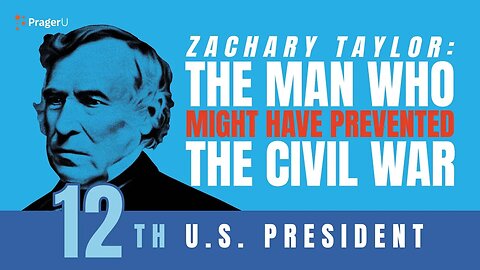
Zachary Taylor: The Man Who Might Have Prevented the Civil War
PragerU
He was a slave owner who opposed the expansion of slavery; a president who despised politics and politicians. That was Zachary Taylor—“Old Rough and Ready.” Joseph Fornieri, Professor of Political Science at the Rochester Institute of Technology, tells the story of this walking contradiction.
Script:
Zachary Taylor, the 12th president of the United States, was so indifferent to politics that he never voted until his own election in 1848.
A career military man, “Old Rough and Ready,” as he was affectionately known, was weathered, stocky, and bow-legged in appearance. He was obstinate, easily insulted, and quick-tempered in character. These are not traits that usually make for a successful politician. But then again, he never wanted to be a politician. Until he did.
The son of a Revolutionary War veteran, Zachary Taylor was born in Orange County, Virginia on November 24, 1784. Inspired by his father’s military exploits, Taylor joined the army in 1808. He spent the bulk of the next forty years protecting the frontier against hostile Indians. Steadily rising from the rank of lieutenant to brigadier general, he fought in the War of 1812, the Black Hawk War of 1832, and the Second Seminole War in 1837.
The Mexican-American War in 1846 was a turning point in Taylor’s life. In a matter of months, he went from a respected but obscure soldier to a national hero.
Here’s how it happened.
In January of 1846, President James Polk sent Taylor into the disputed border territory of Texas and Mexico. The idea was that the presence of American troops would pressure the Mexican government into accepting Polk’s offer to buy California. But Mexico wasn’t interested.
So, Polk was stuck.
Things became unstuck when Mexican forces fired on Taylor’s men near the town of Palo Alto, killing 11. That’s all Polk needed to ask Congress to declare war, which it did on May 12.
At that moment, the war rested on Taylor’s shoulders. Despite being vastly outnumbered, he won the battle of Palo Alto and went on to score impressive victories at Monterrey and Buena Vista. Ulysses S. Grant, a recent West Point graduate, who took part in the campaign said of Taylor: “No soldier could face either danger or responsibility more calmly than he… He was known to every soldier in his army, and was respected by all.”
The Mexican War ended in February 1848 with the US acquiring not only California but vast swaths of land in the American Southwest. Within weeks of the end of the war, the Whig Party, which had done so well with war hero William Henry Harrison, saw Taylor as their ticket back to the White House.
Taylor was intrigued, but he didn’t see himself as a party man. “I am a Whig, but not an ultra Whig,” he said. “If elected I would not be the mere President of a party—I would endeavor to act independent of party….”
That was good enough for the Whigs. In short order, they nominated Taylor to be their standard bearer. He went on to defeat Lewis Cass, a Democratic senator from Michigan, in the general election.
Being a war general was hard. But being President was harder.
For one thing, the Mexican-American War had reignited the slavery debate. How would all this new territory be integrated into the Union? What part would be slave; what part would be free?
The political balance stood precariously at 15 free states and 15 slave states. Any additional states would tip the scales one way or the other. How would this be resolved?
For the full script, visit: https://l.prageru.com/3LvHRZ7
2.21K
views
2
comments

Franklin Pierce: A Torn President in a Torn Country
PragerU
SUBSCRIBE 👉 https://www.prageru.com/join
Franklin Pierce, America’s 14th President, had two simple goals: keep his party together and keep his country calm through the storm of the slavery debate. Simple, but not easy. Joseph Fornieri, Professor of Political Science at the Rochester Institute of Technology, explains how Pierce’s leadership (or lack thereof) pushed America toward civil war.
Script:
By all accounts, Franklin Pierce, the 14th President of the United States was a fine person: charming, caring, deeply empathetic. These are all characteristics you want in a friend—and Pierce had many—but they don’t necessarily make for a strong leader. Unfortunately, Pierce’s appointment with history came when such a leader was sorely needed. Try as he might to fill the role, Pierce couldn't do it.
Franklin Pierce was born November 23, 1804, in Hillsborough, New Hampshire. Raised in the shadow of his prominent father, Benjamin, a Revolutionary War hero, Franklin began his political career shortly after graduating from Bowdoin College in 1824.
He was a political natural. In addition to his good looks, he was an eloquent speaker. Gifted with a photographic memory, he almost always spoke without notes, connecting directly to his audience. He won his first election in 1829 to the New Hampshire State Legislature. In 1832 he was elected to Congress, and by 1837, he was a US senator, the youngest member at the time.
The overriding political issue of the day was slavery. To understand Pierce, we need to understand his position on this issue. While not a slave owner himself, Pierce believed that the Constitution committed the federal government to protecting slavery. Not surprisingly, Pierce’s position endeared him to his Southern colleagues. This support was key to his political career.
By 1842, Pierce was ready to leave Washington. He needed to make more money and care for his chronically ill wife. He did both without ever truly leaving politics. In fact, he became more influential during this period by becoming the Democratic Party boss of his home state of New Hampshire. He might have happily stayed there were it not for the outbreak of the Mexican-American War in 1846.
The Americans won that war decisively, acquiring vast new territories in the west, including California. But the victory also had the unintended consequence of stirring up the slavery issue. What would happen to these new territories? Would they become slave or free?
After fierce debates, the Compromise of 1850 resolved the issue—or so it seemed. California would be admitted into the union as a free state while the status of the new territories of New Mexico and Utah would be determined at a later, unspecified time. And that’s where things stood when Franklin Pierce, through an improbable series of circumstances, became America’s 14th President.
For the full script, visit: https://l.prageru.com/46mtsH2
#president #history
2.43K
views
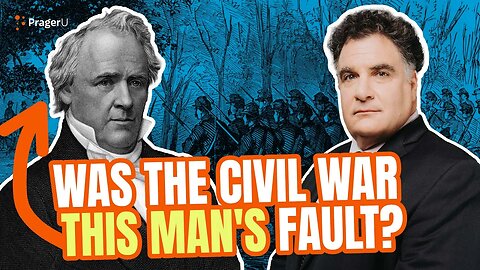
James Buchanan: A Legacy of Failure
PragerU
SUBSCRIBE 👉 https://www.prageru.com/join
When James Buchanan—America’s 15th president—took office, the country was ready to explode over the issue of slavery. Buchanan thought he could avert civil war. Instead, his every action (and inaction) made it inevitable.
Script:
James Buchanan should have been prepared to be president. He had served as a congressman, a senator, a cabinet member, and an ambassador. He certainly wanted the job. He sought the office four times.
But when he finally achieved his ambition in 1856 and became the fifteenth president of the United States, his impressive resume did him little good. When he left office in 1861, the country was on the brink of civil war.
James Buchanan was born in a log cabin on April 23, 1791, in Cove Gap, Pennsylvania. His Irish-born father, James Senior, lived the classic early 19th-century immigrant story: he worked hard, lived frugally, and prospered. He and his American-born wife, Elizabeth, had great ambitions for their son, James Junior, and with the exception of a few stumbles—like getting kicked out of college for drunkenness—he didn’t disappoint them.
Pursuing a legal career, young James moved to Lancaster, Pennsylvania, where he took a strong interest in local affairs. Elected to Congress in 1820 as a Federalist, he switched his allegiance to the newly-formed Democratic Party in 1824, becoming a devoted follower of Andrew Jackson.
He supported states’ rights, a strict reading of the Constitution, and was sympathetic to Southern interests, including, of course, slavery. Northerners with such inclinations were known by their political opponents as “doughfaces,” men who were overly deferential to Southern grievances. Buchanan was more than happy to return the insult. He despised Northern abolitionists who, he believed, threatened the stability of the Union with their “extremist” views.
In 1844, he took his first run at the Democratic presidential nomination. He lost to former Tennessee governor James Polk. In 1848, he lost to Michigan Senator Lewis Cass. In 1852, he lost yet again, this time to New Hampshire’s Franklin Pierce. In 1856, the stars finally aligned. Buchanan won the Democratic nomination and then the presidency by defeating legendary explorer and abolitionist John Frémont of the newly-formed, anti-slavery Republican Party.
For the full script, visit: https://l.prageru.com/43N1Msf
#history #civilwar #president
1.26K
views
1
comment

Young Abe: From Log Cabin to White House
PragerU
Abraham Lincoln was born in a log cabin in the middle of nowhere. He had almost no formal schooling but rose to become the 16th President of the United States. Allen Guelzo, author of Abraham Lincoln: Redeemer President, shares the remarkable journey of this remarkable man.
SUBSCRIBE 👉 https://www.prageru.com/join
Script:
If the best of America could be embodied in one man, that man would be Abraham Lincoln, the 16th President of the United States.
Born on February 12, 1809, Lincoln lived his early years in a log cabin with a dirt floor. He described his childhood and adolescence in Kentucky and later Indiana in bleak terms, as “the backside of this world.”
His father, Thomas Lincoln, didn’t see much practical value in formal education and his son received almost none.
But young Lincoln’s instincts pointed in an entirely different direction. He devoured every book he could get his hands on. And, aided by a near-photographic memory, he retained everything he read. His goal was always (what he called) “improvement.”
At age 19, now 6 feet 4 inches tall, he worked on flatboats carrying cargo down the Mississippi river finally settling as a store clerk in New Salem, Illinois. There, Lincoln quickly established a reputation for good humor, scrupulous honesty, and a fierce determination “to make the most of himself.”
In 1832, following a stint in the state militia, he decided to pursue a legal career.
Like many lawyers, he was drawn to politics. In 1834, he won election to the state legislature.
Lincoln endorsed the tenets of the Whig party, which had been organized by Senator Henry Clay as a breakaway from the dominant Democratic party. Clay and the Whigs supported policies which would build national commercial infrastructure like roads and canals, create a national bank to stimulate investment and expansion into the west, and build tariffs around struggling American industries to protect them from foreign competition.
For many Northern Whigs like Lincoln, slavery was also an issue; and in 1837, Lincoln made his first public statement against slavery, condemning it as “founded on injustice and bad policy.”
In 1846, Lincoln was elected to Congress to represent the newly created Seventh District in central Illinois. What he hoped would be the start of a career in national politics quickly fizzled. Lincoln criticized President James Polk, a Democrat, for goading Mexico into war. It was a principled but unpopular stance and cost him re-election.
View full script: https://l.prageru.com/3RmutKb
#president #history
8.26K
views
2
comments
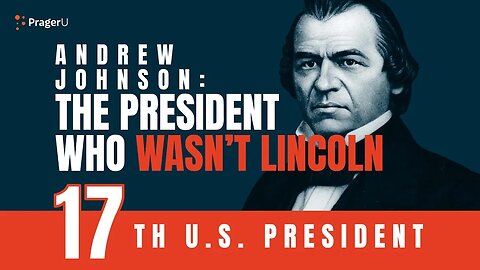
Andrew Johnson: The President Who Wasn’t Lincoln
PragerU
Abraham Lincoln had been assassinated. To take the reins of power at this tumultuous moment required a man of compassion, discernment, and discipline. Was Lincoln’s vice president, Andrew Johnson, that man? Allen Guelzo of Princeton University has the answer.
SUBSCRIBE 👉 https://www.prageru.com/join
Script:
It was April 1865. The Civil War was finally over. An exhausted, bloodied nation breathed a deep sigh of relief…
Then, suddenly, shockingly, President Abraham Lincoln was dead, felled by an assassin’s bullet while watching a play.
To take the reins of power at this tumultuous moment required a great man, a man of compassion, discernment, and discipline. Andrew Johnson, Lincoln’s vice president, was not that man.
This is not to say he didn’t have virtues. He did. He just didn’t have the stuff it took to meet the moment.
Born into abject poverty on December 29, 1808, Johnson was apprenticed — “sold” would be more accurate — to a tailor at the age of 10. Legally bound to serve until he was 21, he ran away after five years. He eventually settled in Greeneville, Tennessee, where he set up his own tailor’s shop and prospered.
In 1834, he was elected mayor of Greeneville. From there, he climbed steadily up the political ladder; the state legislature in 1835, the US Congress in 1843, Governor in 1853, and the Senate in 1857. He was still serving as U.S. Senator for Tennessee in 1861 when the Civil War broke out.
Although Johnson was a Democrat and a slaveowner himself, when Tennessee left the Union to join the break-away Confederacy and defend legalized slavery, Johnson denounced his state’s secession on the floor of the Senate.
“I will not give up this Government,” he thundered in December 1860. “No; I intend to stand by it, and I entreat every man throughout the nation who is a patriot…to come forward, that the Constitution shall be saved, and the Union preserved.”
After Union military forces occupied large parts of Tennessee in 1862, Lincoln tagged Johnson as the state’s provisional military governor. It was a shrewd move on the president’s part: it demonstrated to Southerners and Democrats that they were welcomed as full partners with Lincoln’s Republican party in restoring the Union.
Johnson himself joined hands with Lincoln’s policies by freeing his own slaves in 1863.
View the full script here: https://l.prageru.com/3ZuWnp1
#president #history #educational
7.19K
views
2
comments

Ulysses S. Grant: The General Who Saved the Union
PragerU
No American led a more eventful life than Ulysses S. Grant, the 18th President of the United States and the Union Army's most celebrated general. Civil War historian Garry Adelman tells Grant’s amazing story.
SUBSCRIBE 👉 https://www.prageru.com/join
More American Presidents: https://l.prageru.com/3seceMM
Script:
The year was 1862. America was in the depths of the Civil War.
Looking back, it’s easy to believe that a Union victory was inevitable. The North had more money, more population, more industry.
But no one thought that at the time. In the first year of the war, it looked as if the South would win. A series of high-profile victories in the east convinced many that Confederates were better fighters, under better leaders.
Where would President Lincoln find a battlefield general who could do for the Union what Robert E. Lee was doing for the Confederacy—lead it to victory?
The man he found, the man who saved the Union, was Ulysses S. Grant. He wasn’t Lincoln’s first choice—or second, or third. In fact, when the war started in 1861, Lincoln had no idea who Ulysses S. Grant was. Hardly surprising, since at that time, Grant was selling hats to farmers’ wives in a small town in Illinois.
His rise to glory is one of the most amazing stories in American history.
Born in Ohio on April 27, 1822, Grant had no ambition to be a soldier. His father pushed him into it, thinking he wasn’t suited for much else. Grant’s West Point career wasn’t especially distinguished, either. But during the Mexican-American war (1846-1848), Grant proved himself to be an officer of unusual ability. He was cool under fire, daring, but rarely reckless. Even more important: the men under his command trusted him.
After that war, Grant returned to St. Louis to marry his fiancée, Julia Dent, the daughter of a slave-owning Missouri farmer. Grant was never happier than when he was with Julia. And he was never unhappier than when he was not. Unfortunately, in this period Army life forced them to be separated, sometimes for many months.
To assuage his loneliness, Grant started to drink. While in a distant posting in Northern California a thousand miles from Julia, his drinking got the better of him. He resigned his army commission to avoid an embarrassing court-martial.
It was downhill from there, one business venture failing after another. By 1860, thoroughly humiliated with no money and no prospects, he was back working for his father in the small town of Galena, Illinois.
Then, the Civil War happened.
The Union was in desperate need of experienced soldiers. Grant volunteered. His leadership skills were immediately obvious. He quickly advanced through the ranks.
In a little more than six months, he scored two major victories at Fort Henry and Fort Donelson, along the Tennessee and Cumberland Rivers. He followed these up with victory in the largest battle in American history up to that time—the Battle of Shiloh—making him a true Union hero in a cause that was starved for heroes.
There was nothing flashy about Grant’s generalship. All he did was win.
View the full script: https://l.prageru.com/3QAKlrB
#history #usa #politics
7.02K
views
3
comments

Rutherford B. Hayes: The Most Disputed President
PragerU
The election of Rutherford B. Hayes remains the single most disputed presidential outcome in American history—even more than the elections of the 21st century. What happened, and what were the consequences?
SUBSCRIBE 👉 https://www.prageru.com/join
Script:
On election night 1876, Rutherford B. Hayes, the Republican candidate for president, went to bed firmly convinced he had lost.
Four months later, he walked into the White House as the 19th president of the United States. His ultimate victory remains the single most disputed presidential outcome in American history–more than Bush v. Gore in 2000, more than Trump v. Biden in 2020.
Hayes, the youngest of five children, was born on October 4, 1822, in a small town near Columbus, Ohio. His father had died two months earlier. His bachelor uncle, Sardis Birchard, a businessman and banker, became his guardian and surrogate father.
Like so many young Americans of his day, “Rud,” as he was called, was imbued with a tireless work ethic. He was a conscientious student, graduating from Kenyon College in Ohio in 1842 at the top of his class. Thanks to his uncle’s generosity, he graduated from Harvard Law School, where he also excelled.
By 1849, Hayes had started a successful law practice in the rapidly growing city of Cincinnati. Strongly opposed to slavery, he defended many runaway slaves in court.
When the Civil War broke out, Hayes was nearly 40, married, a father of three with a fourth on the way, and a leading figure in southern Ohio. He had everything to lose and nothing to gain by volunteering for the Union cause. But he did so anyway.
His leadership qualities were immediately recognized by his superiors and the soldiers under his command.
Hayes saw action at the Battles of Antietam, Winchester, and Cedar Creek, among others. Badly wounded in the first of those battles, he stayed on the field issuing orders. Had his men not carried him to safety, he would have died.
Entering the war without any military experience, he left it as a general. He also left it as a member of Congress, being elected by his fellow Ohioans in 1864.
In 1867, he resigned his congressional seat to run for governor of Ohio, his status as a war hero helping him carry the day.
After taking office in 1868, he pushed hard for black voting rights, first in his home state and then nationally by supporting the ratification of the Fifteenth Amendment. A popular governor, he was elected to two more terms.
With the 1876 election looming and the Grant Administration mired in financial scandals, the party needed a candidate free of any taint of corruption–and Hayes fit the bill.
But the election was an uphill battle.
First, Hayes faced a formidable opponent, the Democratic governor of New York, Samuel Tilden.
Second, the Republican Party had been losing votes in the South because the Democrats were making it increasingly difficult for blacks to vote.
The election indeed turned out to be a photo finish. The New York Times reported that Tilden had won 184 electoral votes–just one vote short of victory–while Hayes captured 181. The wildcards were South Carolina, Louisiana, and… Florida.
Sound familiar?
A stalemate ensued, with each side bitterly accusing the other of cheating. Without any precedent or guidance from the Constitution, Congress set up a commission to settle the issue.
Finally, in February 1877, after some of the nastiest mudslinging in American history, the commission decided for Hayes. Congress ratified the decision on March 2. But many Democrats never accepted the result as legitimate, and perpetually referred to Hayes as “Rutherfraud.”
View full script: https://l.prageru.com/3uqbFQK
#president #history #education
2.61K
views
1
comment

Gerald Ford: Healing a Divided Country | 5 Minute Videos | PragerU
PragerU
When Richard Nixon resigned as President following the Watergate scandal, America was in a bad way. The nation needed a leader who could mend the country’s divisions. Was Gerald Ford that leader? Political commentator Hugh Hewitt has an answer.
5.64K
views
3
comments
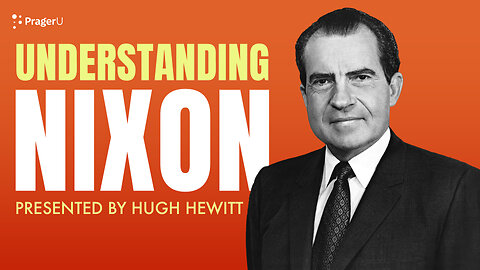
Understanding Nixon | 5 Minute Videos | PragerU
PragerU
The majority of Americans remember our 37th President Richard Nixon for one thing and one thing only: the Watergate scandal. But there’s much more to the man than that. Like him or not, he was one of the most significant figures of the 20th century.
5.66K
views
3
comments
George H. W. Bush: Read My Lips | 5 Minute Videos | PragerU
PragerU
On the heels of a military victory in Iraq, a successful conclusion of the Cold War, and an 89% approval rating, President George H. W. Bush should have sailed effortlessly into a second term. But it didn’t work out that way. What happened? Presidential historian Tevi Troy explains.
9.6K
views
16
comments
James A. Garfield: The Great President Who Never Was | 5-Minute Video | PragerU
PragerU
James Garfield, the 20th President of the United States, had all the makings of a great president. So why didn’t he become one? Louis Picone, author of The President Is Dead!, answers this tragic question.
If you like this video, we have a whole series on the men who shaped America, check it out here: https://l.prageru.com/3PO4MzS
8.81K
views
2
comments
Chester Alan Arthur: The President Who Didn't Want to Be President | 5-Minute Video | PragerU
PragerU
Chester Alan Arthur loved being vice president: parties galore, and no responsibilities. But after the death of James Garfield, Arthur had to face the music. How did he react? Daily Wire Host Michael Knowles tells Arthur’s unique story.
11.9K
views
2
comments
Benjamin Harrison: One Term Wonder | 5-Minute Video | PragerU
PragerU
How could one president accomplish so much in such a short amount of time and not be reelected to a second term? Louis Picone, author of The President Is Dead!, explains the brief yet impactful presidency of Benjamin Harrison.
Presidents Day is coming up, we have a lot of great content. Check it out here 👉https://l.prageru.com/3PO4MzS
9.64K
views
4
comments
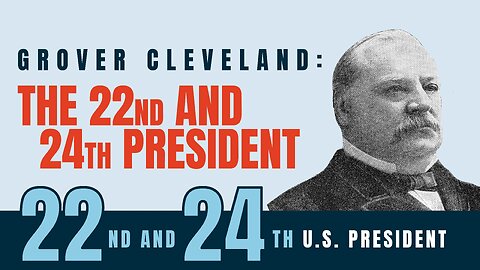
Grover Cleveland: The 22nd and 24th President | 5-Minute Videos | PragerU
PragerU
Can a president who lost reelection return to the White House for a nonconsecutive term? One man did just that. Wilfred McClay, professor of history at Hillsdale College, shares the remarkable life and career of Grover Cleveland.
Presidents Day is coming up, we have a lot of great content. Check it out here 👉https://l.prageru.com/3PO4MzS
9.36K
views
2
comments
Lyndon B. Johnson and the Vietnam War | 5-Minute Videos
Loading 7 comments...
-
 7:44
7:44
PragerU
13 days agoTop 5 Stories of 2025: 1/2/26
6.11K1 -
 31:39
31:39
Robbi On The Record
4 days ago $4.73 earnedA Firsthand Account of Nigeria’s Christian Genocide | Judd Saul
21.8K6 -
 56:27
56:27
Flyover Conservatives
23 hours agoThe Dark Economics Behind Organ Transplants, Plastics, and Human Health - Kim Bright | FOC Show
23.1K -
 LIVE
LIVE
Drew Hernandez
21 hours agoLEFTIST TERRORISTS RAID & LOOT FEDERAL LAW ENFORCEMENT VEHICLES: STILL NO INSURRECTION ACT
968 watching -
 42:43
42:43
Sarah Westall
4 hours agoThe Psychological War Online - How They Target You | Eric Meder
21.4K1 -
 LIVE
LIVE
DLDAfterDark
2 hours ago $0.01 earnedBadge Cam Shootings - Let's Watch Some Semi Precious Metals Fly!
228 watching -
 2:16:00
megimu32
3 hours agoOTS: THEY STOLE THAT… AND IT STILL WASN’T BETTER!
20.6K4 -
 1:33:50
Precision Rifle Network
1 day agoGuns & Grub - New Guns!
16.1K5 -
 1:02:27
Glenn Greenwald
5 hours agoADL Demands More Censorship of Tucker, Hasan Piker, Nick Fuentes, and More; Plus: Glenn's Debate About Iran on Piers Morgan | SYSTEM UPDATE #567
103K127 -
 2:24:24
Barry Cunningham
4 hours agoLIVE TONIGHT: President Trump and NHL Champions Florida Panthers | Nick Shirley Video
56.2K20