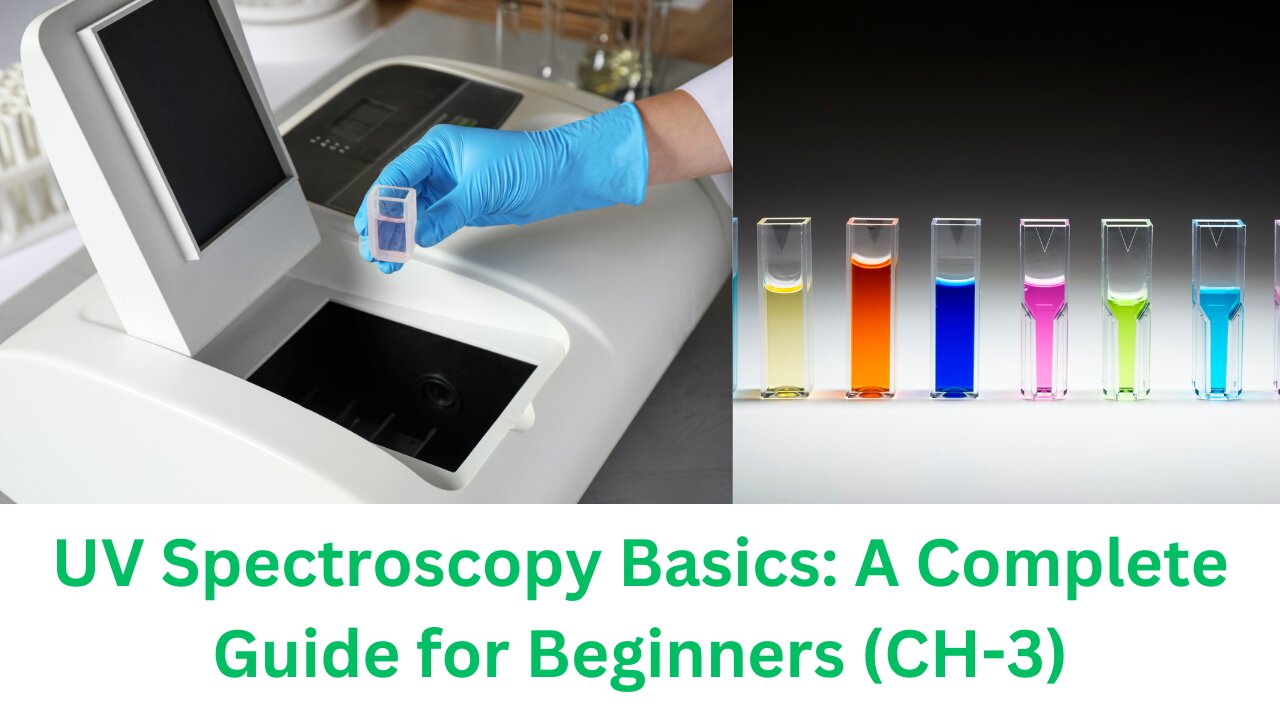
UV spectroscopy (Chapter 3)
UV Spectroscopy (Ultraviolet Spectroscopy) is an analytical technique used to measure the absorbance or transmittance of UV light by a substance. It operates within the UV region of the electromagnetic spectrum, specifically between 200 and 400 nanometers. UV spectroscopy is widely used in chemistry, biology, and environmental sciences due to its ability to provide valuable information about the molecular structure, concentration, and behavior of different substances.
Key Principles of UV Spectroscopy
Absorption of UV Light: Molecules absorb UV light at specific wavelengths, causing electrons to transition from a ground state to an excited state. The specific wavelengths and intensities of absorbed light depend on the electronic structure of the molecule, particularly the types of bonds and functional groups present.
Electronic Transitions: UV spectroscopy primarily involves electronic transitions, such as π to π*, n to π*, and σ to σ* transitions. These transitions occur in various types of chemical bonds, such as double bonds or lone pairs, and are useful in identifying unsaturated compounds or those with aromatic rings.
Beer-Lambert Law: UV spectroscopy often uses the Beer-Lambert Law to determine the concentration of an analyte in a solution. According to this law, the absorbance of a substance is directly proportional to its concentration and the path length of the UV light through the sample. This makes UV spectroscopy an effective tool for quantitative analysis.
Applications of UV Spectroscopy
Identifying Compounds: UV spectroscopy is valuable in identifying organic compounds with conjugated systems, such as aromatic rings, which have distinct absorption patterns.
Quantitative Analysis: It is used to determine the concentration of compounds in a solution, especially in pharmaceuticals, biochemistry, and environmental monitoring.
Quality Control and Purity Testing: UV spectroscopy helps assess the purity of chemical compounds and detect contaminants, making it essential in industries like pharmaceuticals and food production.
Studying Reaction Kinetics: Researchers use UV spectroscopy to monitor reaction rates and study kinetic behavior by observing changes in absorbance over time.
Advantages of UV Spectroscopy
Non-Destructive: UV spectroscopy is a non-destructive method, meaning the sample remains intact after analysis.
Quick and Simple: It provides rapid results and requires minimal sample preparation.
High Sensitivity: UV spectroscopy is highly sensitive and can detect even small concentrations of analytes.
In summary, UV spectroscopy is a versatile, fast, and effective tool for identifying and quantifying compounds, offering a deep insight into molecular structures and behaviors across diverse scientific fields.
-
 3:20:27
MissesMaam
6 hours agoStardew Co-Op 💚✨
17.8K -
 1:32:46
Glenn Greenwald
8 hours agoHillary Blames TikTok for Anti-Israel Sentiment; MAGA Sycophants Gain Pentagon Press Access; Who Should Win Anti-Semite of the Year? See the Top 10 Finalists | SYSTEM UPDATE #552
128K97 -
 56:12
56:12
Flyover Conservatives
1 day ago100% Chance the Grid Fails: Why No One Is Fixing It (and How Easy It Is) - Tommy Waller | FOC Show
31.5K10 -
 LIVE
LIVE
JDubGameN
6 hours agoStarlink Network Test Stream! | Road to 100 Followers
944 watching -
 2:17:31
The Daily Signal
9 hours ago $8.32 earned🚨BREAKING: Tennessee Congressional Election Results, Minneapolis Police to "Intervene" Against ICE,
38.2K6 -
 1:52:47
megimu32
5 hours agoON THE SUBJECT: Christmas Vacation Is UNTOUCHABLE!
24K4 -
 59:56
59:56
Sarah Westall
6 hours agoNeurostrike, Cognitive Targeting & the New Tech Arms Race w/ Professor Armin Krishnan
18.9K4 -
 2:52:28
Nikko Ortiz
8 hours agoNo More Gear Fear... | Rumble LIVE
26.7K1 -
 5:00:51
Razeo
6 hours agoTopside carnage with some fries.,
14.7K -
 1:03:17
BonginoReport
9 hours agoViolent Criminals Run Free in NY & CA - Nightly Scroll w/ Hayley Caronia (Ep.188) - 12/02/2025
130K54