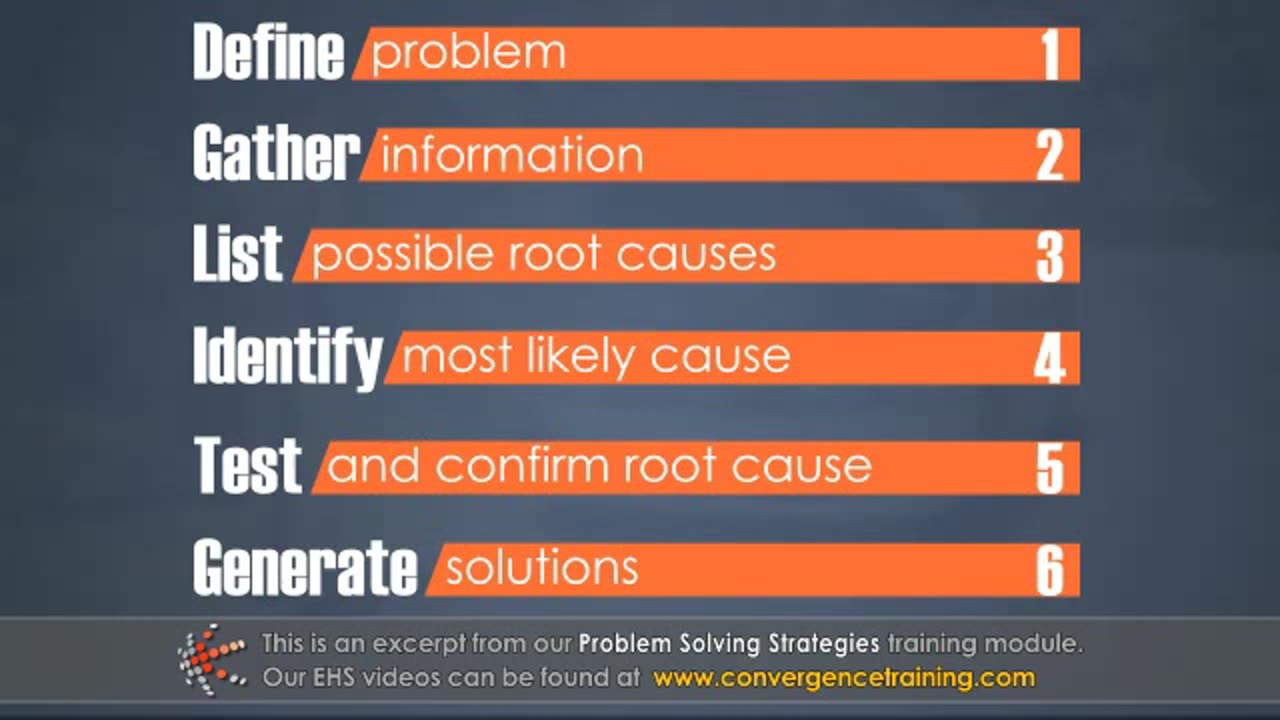
Problem Solving Strategies_2
Here are additional **problem-solving strategies** to complement earlier approaches, focusing on structured, creative, and analytical techniques:
---
### **1. Cause-and-Effect Analysis**
- **Fishbone Diagram (Ishikawa):** Visualize root causes by categorizing them into areas such as Materials, Methods, Machines, People, Environment, and Measurement.
- **5 Whys Technique:** Keep asking "Why?" until you reach the root cause of the problem.
---
### **2. Brainstorming and Ideation**
- **Divergent Thinking:** Generate as many ideas as possible without judgment.
- **Mind Mapping:** Organize ideas visually to explore relationships and new angles.
- **SCAMPER Technique:** Modify an existing solution by **Substituting, Combining, Adapting, Modifying, Putting to other use, Eliminating, or Reversing**.
---
### **3. Pareto Analysis (80/20 Rule)**
- Focus on identifying the 20% of causes that create 80% of the problem's impact.
- Use this analysis to prioritize solutions with the most significant effect.
---
### **4. Systems Thinking**
- Understand the problem within the context of its larger system.
- Identify feedback loops and interactions between components that might affect outcomes.
---
### **5. Decision Matrix (Weighted Scoring)**
- List possible solutions and criteria for evaluation.
- Assign weights to criteria based on importance, and score each solution to choose the most viable option.
---
### **6. SWOT Analysis**
- Evaluate the **Strengths, Weaknesses, Opportunities, and Threats** related to the problem or solution to find a balanced approach.
---
### **7. Simulation and Modeling**
- Use tools like flowcharts, computer models, or simulations to predict outcomes of different solutions.
- Test various scenarios to find the optimal approach.
---
### **8. PDCA Cycle (Plan-Do-Check-Act)**
- **Plan:** Define the problem and propose a solution.
- **Do:** Implement a small-scale solution.
- **Check:** Evaluate results to confirm effectiveness.
- **Act:** Adopt, modify, or discard the solution based on findings.
---
### **9. Collaborative Problem Solving**
- Involve diverse teams to bring multiple perspectives.
- Use structured workshops or problem-solving frameworks like Design Thinking.
---
### **10. Reverse Engineering**
- Start with the desired outcome and work backward to identify steps and requirements for success.
---
### **11. Scenario Analysis**
- Explore "what-if" scenarios to anticipate risks and plan mitigation strategies.
---
### **12. Use Technology and Tools**
- Employ software for project management, root cause analysis, or process simulation to enhance efficiency and accuracy.
---
### **13. Experimentation and Iteration**
- Use trial-and-error approaches with controlled experiments to refine solutions progressively.
---
By combining these strategies with sound judgment and a systematic approach, you can address complex problems effectively and sustainably.
-
 6:54
6:54
HSESafetyInformation
10 months ago6 Must Try Breakfast recipes By Food Fusion
421 -
 22:45
22:45
Jasmin Laine
3 hours agoCTV Tries to Trap Poilievre—Carney HUMILIATED as Trump Reality Destroys Months of Spin
10.3K11 -
 LIVE
LIVE
LFA TV
20 hours agoLIVE & BREAKING NEWS! | TUESDAY 12/16/25
1,182 watching -
 LIVE
LIVE
freecastle
6 hours agoTAKE UP YOUR CROSS- The weapons we fight with are NOT the weapons of the world!
93 watching -
 1:27:39
The Quartering
7 hours agoKash Patel Talks Relationship Amid Manhunt, Trump's New Daughter-In-Law, and Michigan Football Chaos
121K17 -
 1:21:08
DeVory Darkins
5 hours agoScott Bessent issues MAJOR Tax Update as JD Vance takes questions on the economy
134K52 -
 7:31:03
Dr Disrespect
8 hours ago🔴LIVE - DR DISRESPECT - ARC RAIDERS - NEW COLD SNAP UPDATE
72.3K8 -
 19:13
19:13
Neil McCoy-Ward
4 hours agoJapan Just Lit The Fuse (Get Ready...)
21.7K6 -
 1:03:37
Timcast
6 hours agoRepublicans Call For Mass EXPULSION Of Muslims, Travel BAN
200K149 -
 1:14:15
Sean Unpaved
5 hours agoAaron Rodgers & Steelers BOUNCE BACK In WIN vs. Dolphins! | UNPAVED
39.7K6