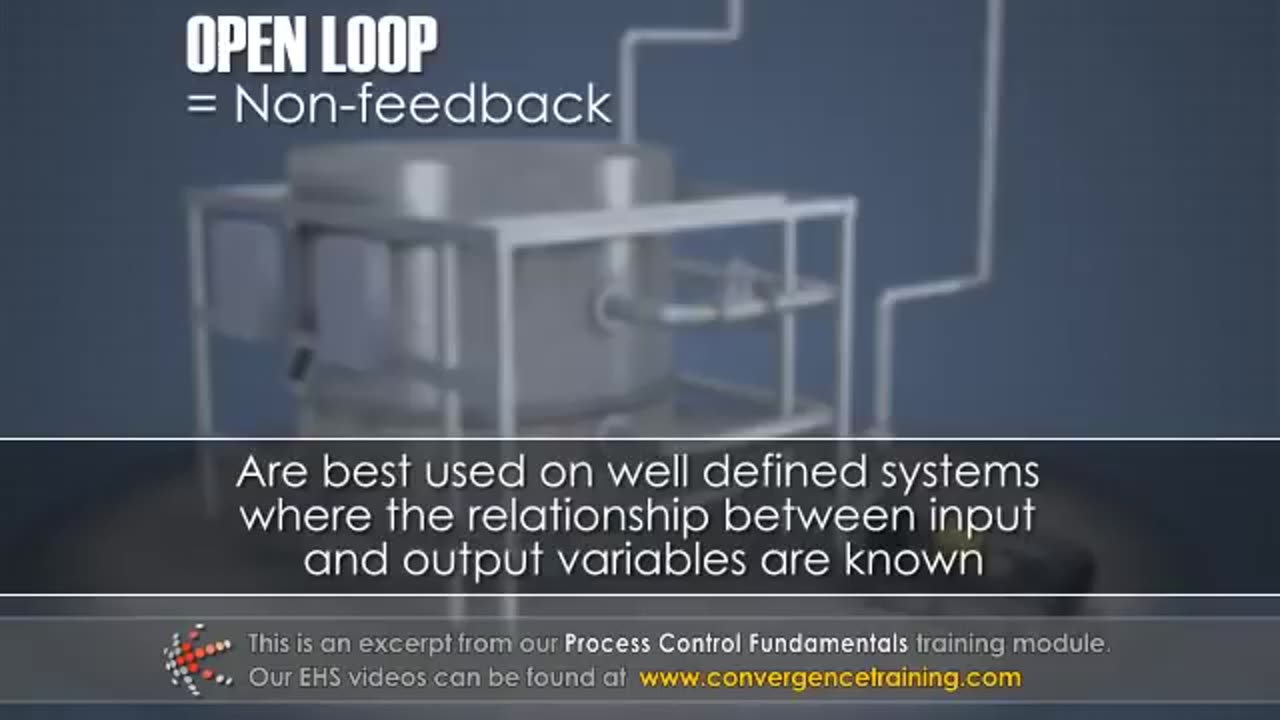
Process Control Fundamentals
**Process control** is a system used to regulate and maintain process variables (e.g., temperature, pressure, flow, level, etc.) within desired ranges to ensure efficiency, safety, and product quality in industrial operations. Here’s an overview of the fundamentals:
---
### **1. Purpose of Process Control**
- **Stability:** Maintain consistent operations and product quality.
- **Efficiency:** Optimize resource usage, such as energy, raw materials, and time.
- **Safety:** Prevent conditions that could lead to equipment damage or hazards.
- **Automation:** Minimize manual intervention, reducing errors and labor costs.
---
### **2. Key Components of a Control System**
1. **Process Variable (PV):** The parameter being measured and controlled (e.g., temperature, flow rate).
2. **Setpoint (SP):** The desired value of the process variable.
3. **Controller:** The device or algorithm that compares the PV to the SP and determines corrective action.
4. **Control Element:** The mechanism that adjusts the process (e.g., a valve or pump).
5. **Sensors/Transmitters:** Devices that measure the PV and send data to the controller.
6. **Actuators:** Devices that physically manipulate the control element (e.g., open/close a valve).
---
### **3. Types of Process Control**
#### **A. Open-Loop Control**
- No feedback is used.
- Control actions are based solely on predefined instructions.
- Example: A timed irrigation system.
#### **B. Closed-Loop Control**
- Feedback is used to adjust the control action.
- Example: A thermostat regulating room temperature.
- Subtypes:
1. **Feedback Control:** Adjusts based on deviations from the SP.
2. **Feedforward Control:** Anticipates changes and adjusts before deviations occur.
---
### **4. Control Strategies**
1. **On/Off Control:** Simplest form, where the control element is either fully on or off.
- Example: Household refrigerators.
2. **Proportional (P) Control:** Output is proportional to the error (difference between PV and SP).
3. **Integral (I) Control:** Eliminates steady-state error by considering the cumulative error over time.
4. **Derivative (D) Control:** Predicts future errors by considering the rate of change of the error.
5. **PID Control:** Combines P, I, and D controls for precise and robust performance.
---
### **5. Process Control Loops**
- **Single-Loop Control:**
- Manages one PV with one controller.
- Example: Controlling tank level with a single valve.
- **Cascade Control:**
- Uses two controllers: one for the main PV and another for a related secondary PV.
- Example: A furnace where the main controller adjusts temperature and the secondary controller adjusts fuel flow.
- **Multivariable Control:**
- Manages multiple interrelated variables simultaneously.
- Example: Chemical reactors.
---
### **6. Process Control Tools**
1. **Control Valves:** Regulate the flow of materials.
2. **Pumps/Compressors:** Adjust pressure or flow.
3. **Programmable Logic Controllers (PLCs):** Automate control processes using digital logic.
4. **Supervisory Control and Data Acquisition (SCADA):** Monitors and controls industrial processes.
5. **Human-Machine Interface (HMI):** Allows operators to interact with the control system.
---
### **7. Key Performance Metrics**
- **Setpoint Tracking:** How well the system maintains the PV at the SP.
- **Response Time:** The time it takes to respond to changes or disturbances.
- **Stability:** The system's ability to avoid oscillations or instability.
- **Accuracy:** How close the PV remains to the SP.
---
### **8. Challenges in Process Control**
- **Nonlinear Processes:** Systems that do not respond predictably.
- **Time Delays:** Lag between input adjustments and observed changes in PV.
- **Disturbances:** External factors like temperature changes or equipment wear.
---
### **9. Applications of Process Control**
- **Manufacturing:** Maintaining consistent product quality.
- **Oil and Gas:** Regulating flow rates and pressures.
- **Power Plants:** Controlling steam generation and turbine speed.
- **Water Treatment:** Managing chemical dosing and filtration.
---
By understanding these fundamentals, you can design, operate, and troubleshoot control systems effectively, ensuring optimal performance in industrial processes.
-
 7:58
7:58
HSESafetyInformation
9 months agoAuthentic Peshawari Rosh _ Namkeen Gosht Recipe __ Traditional KPK and Baluchistan
801 -
 LIVE
LIVE
SpartakusLIVE
6 hours agoNEW Mode - AMPED || Grapple Hooks & BOOSTED Health
2,991 watching -
 6:00:40
GrimmHollywood
6 hours ago🔴LIVE • GRIMM HOLLYWOOD • GRIMMBAS • DAY 0 of 12 • MAX PAYNE 3 JOHN WICK MOD • LAW at 6 PM EST •
26.2K3 -
 2:10:16
TimcastIRL
8 hours agoNEW Epstein Photos Drop, Dems Cherry Pick Photos To Smear Trump | Timcast IRL
179K59 -
 28:11
28:11
Stephen Gardner
7 hours agoTrump’s Genius Move REVEALED!!
19K81 -
 LIVE
LIVE
GritsGG
11 hours agoBO7 Warzone Is Here! Win Streaking! New Leaderboard?
333 watching -
 LIVE
LIVE
Joker Effect
1 hour agoDRAMA NEWS INTERVIEW OF TYSON HOCKLEY! New era of content creation? Will he Box Clav? Networking 101
33 watching -
![tactical pirate setting sail! lets find that booty! [RGMT CONTENT Mgr. | RGMT GL | GZW CL]](https://1a-1791.com/video/fwe2/05/s8/6/c/M/J/H/cMJHz.0kob.14.jpg) LIVE
LIVE
XDDX_HiTower
2 hours ago $0.06 earnedtactical pirate setting sail! lets find that booty! [RGMT CONTENT Mgr. | RGMT GL | GZW CL]
121 watching -
 1:45:59
Glenn Greenwald
9 hours agoGlenn Answers Your Questions On: Looming AI Threats; Controversy Over "Pluribus," Epstein Revelations, CAIR's "Terrorist" Label, and More | SYSTEM UPDATE #558
109K31 -
 LIVE
LIVE
Eternal_Spartan
1 day ago🟢 Eternal Spartan Plays Valheim (Community Server) | USMC Veteran
211 watching