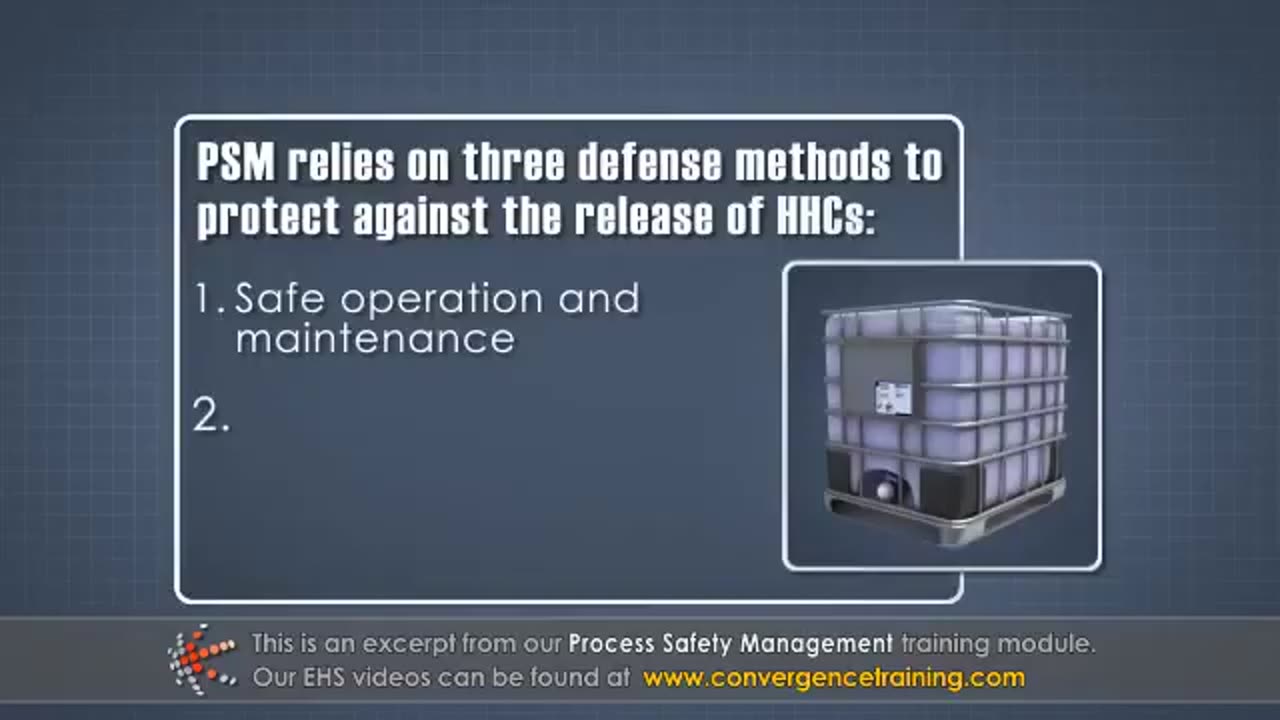
Process Safety Management Training
**Process Safety Management (PSM) Training** is designed to ensure workers understand the principles of preventing releases of hazardous chemicals and maintaining safe operations in processes involving highly hazardous substances. This training aligns with OSHA’s **Process Safety Management Standard (29 CFR 1910.119)** and is critical for industries such as chemical manufacturing, oil and gas, and pharmaceuticals.
---
### **Process Safety Management (PSM) Training Outline**
#### **1. Introduction to Process Safety Management**
- **What is PSM?**
- A systematic approach to managing processes involving highly hazardous chemicals.
- Focused on preventing catastrophic releases and incidents.
- **Why is PSM important?**
- Protects employees, communities, and the environment.
- Ensures compliance with OSHA regulations and industry best practices.
- Overview of OSHA’s **14 Elements of PSM**.
---
#### **2. Overview of Highly Hazardous Chemicals (HHCs)**
- Definition of HHCs:
- Chemicals with high potential for causing significant harm if released.
- Examples of HHCs:
- Flammable gases, toxic substances, and reactive chemicals.
- Recognizing hazardous processes in the workplace.
---
#### **3. Key Elements of the OSHA PSM Standard**
1. **Process Safety Information (PSI):**
- Collecting and maintaining data on hazardous chemicals, process technology, and equipment.
2. **Process Hazard Analysis (PHA):**
- Identifying and evaluating risks through tools like HAZOP or What-If analysis.
- Frequency and team composition for PHA reviews.
3. **Operating Procedures:**
- Developing and maintaining written instructions for safe operation.
- Including emergency shutdown procedures.
4. **Training:**
- Ensuring employees understand their roles in process safety.
- Periodic refresher training requirements.
5. **Mechanical Integrity:**
- Regular inspection, testing, and maintenance of critical equipment.
- Preventing equipment failures that could lead to hazardous releases.
6. **Management of Change (MOC):**
- Controlling risks associated with modifications to processes, equipment, or procedures.
7. **Incident Investigation:**
- Analyzing incidents and near-misses to identify root causes and implement corrective actions.
8. **Emergency Planning and Response:**
- Preparing for and responding effectively to chemical releases or other emergencies.
9. **Compliance Audits:**
- Regularly evaluating PSM program effectiveness and addressing deficiencies.
(Include the remaining OSHA PSM elements, depending on the audience's needs.)
---
#### **4. Hazard Identification and Risk Assessment**
- Identifying potential hazards in processes:
- Chemical reactivity, overpressurization, or equipment failures.
- Assessing and mitigating risks:
- Using tools like Bow-Tie Diagrams or Layer of Protection Analysis (LOPA).
- Importance of safety-critical systems and safeguards.
---
#### **5. Safe Work Practices**
- Examples of safe work practices:
- Lockout/Tagout (LOTO).
- Permit-to-Work (PTW) systems.
- Hot work permits and precautions.
- Ensuring consistency between work practices and operating procedures.
---
#### **6. Emergency Response Preparedness**
- Preparing for emergencies involving hazardous chemicals:
- Developing and practicing emergency action plans.
- Understanding the role of Emergency Response Teams (ERTs).
- Communicating with local emergency responders and community stakeholders.
---
#### **7. Roles and Responsibilities**
- **Employer responsibilities:**
- Implementing and maintaining an effective PSM program.
- Providing resources, training, and tools to manage process safety.
- **Employee responsibilities:**
- Adhering to operating procedures and reporting safety concerns.
- Actively participating in training and safety programs.
---
#### **8. Real-Life Case Studies**
- **Case study examples:**
- The Bhopal disaster (1984) – lessons in chemical safety.
- Texas City Refinery explosion (2005) – importance of mechanical integrity.
- Deepwater Horizon spill (2010) – role of management systems in prevention.
- Discussion of key takeaways and actionable lessons.
---
#### **9. Practical Exercises and Scenarios**
- Conducting a mock Process Hazard Analysis (PHA).
- Role-playing Management of Change (MOC) scenarios.
- Simulating emergency response to a chemical release incident.
---
#### **10. Quiz and Certification**
- Administer a knowledge assessment to test understanding.
- Provide certificates for participants who successfully complete the training.
---
Would you like this training tailored for specific processes or industries? I can also assist in developing presentations, quizzes, or detailed materials for the course.
-
 1:35
1:35
HSESafetyInformation
9 months agoMutton Chops two ways- baked & grilled Recipe by Food Fusion (Eid Recipe)
80 -
 57:27
57:27
Sarah Westall
1 hour agoWhat Congress Isn’t Saying About UFO Disclosure — And 3I/ATLAS w/ Ron James
3.09K1 -
 LIVE
LIVE
GritsGG
2 hours ago#1 Warzone Victory Leaderboard! 203+ Ws !
68 watching -
 LIVE
LIVE
VapinGamers
2 hours ago $0.22 earnedMegaBonk and Risk of Rain 2 - The Flu Cometh! - !rumbot !music
118 watching -
 LIVE
LIVE
Due Dissidence
12 hours agoBari Weiss SLAMMED For Erika Kirk Town Hall, MAGA World COMES FOR Candace, NEW EPSTEIN PHOTOS Drop
1,600 watching -
 1:44:10
Joker Effect
1 hour agoDRAMA NEWS: IDUNCLE nukes his own streaming career! @Antislave, AK, Nokster, RKStackz chime in!
8.41K -
 33:55
33:55
MattMorseTV
3 hours ago $0.57 earned🔴Trump announces MASSIVE LAWSUIT.🔴
25.6K57 -
![Surviving During The Ice Age [15,000 Years Ago]](https://1a-1791.com/video/fwe2/c0/s8/1/g/j/a/I/gjaIz.0kob-small-Surviving-During-The-Ice-Ag.jpg) 11:54
11:54
Forrest Galante
5 hours agoSurviving During The Ice Age [15,000 Years Ago]
48K19 -
 1:45:42
Total Horse Channel
3 hours agoWhat is Vaulting?
10K -
 DVR
DVR
IsaiahLCarter
21 hours ago $0.51 earnedA Night For Parental Rights. || APOSTATE RADIO 037 (w/Erin4ParentalRights, Dr. Travis Morrell)
10K1