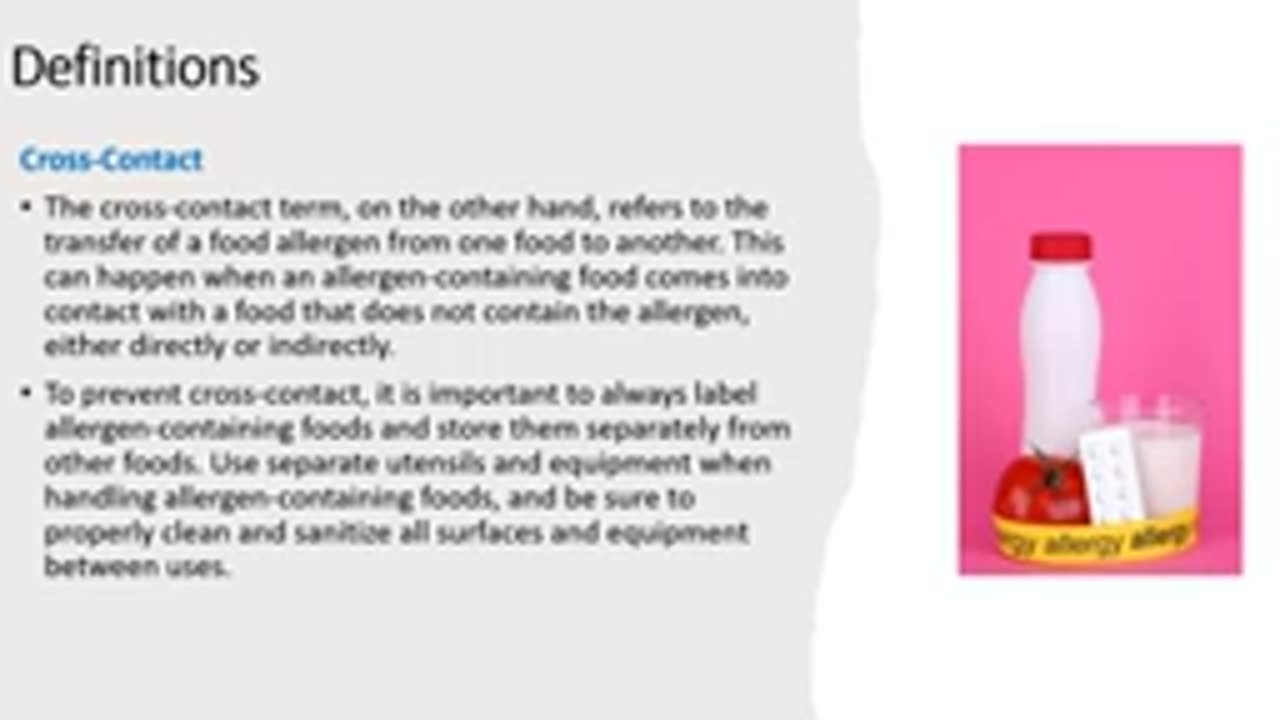
Cross Contact vs Cross Contamination │ Food Safety
### **Cross Contact vs. Cross Contamination in Food Safety**
In the context of food safety, **cross contact** and **cross contamination** are related but distinct terms, and both pose risks to public health, especially for individuals with food allergies or compromised immune systems. Here’s how they differ:
---
### **1. Cross Contact**
**Definition:**
Cross contact occurs when allergens or substances from one food are transferred to another food, typically through shared utensils, equipment, or surfaces. This is a concern mainly for people with food allergies because even trace amounts of an allergen can trigger severe reactions.
**Key Points:**
- Cross contact refers specifically to allergens or food ingredients mixing unintentionally.
- It can occur even if the food items are not physically touching but come into contact via shared equipment or hands.
- For example, using the same knife to cut a peanut butter sandwich and a non-allergic sandwich could result in cross contact, potentially exposing someone with a peanut allergy to trace amounts of peanuts.
**Examples of Cross Contact:**
- Using the same fryer for both gluten-free and gluten-containing foods, which can transfer gluten.
- Preparing allergen-free food on the same cutting board as food containing allergens without proper cleaning.
- Using the same spoon to stir soup containing dairy and a dairy-free soup.
**Preventing Cross Contact:**
- Use dedicated equipment and utensils for allergen-free foods.
- Implement proper cleaning and sanitizing procedures.
- Clearly label foods to ensure consumers are aware of potential allergens.
- Separate preparation areas for foods with allergens and allergen-free foods.
---
### **2. Cross Contamination**
**Definition:**
Cross contamination occurs when harmful bacteria, viruses, or pathogens from one food or surface are transferred to another food. This typically happens through improper handling, storage, or preparation, and is a major concern for foodborne illnesses.
**Key Points:**
- Cross contamination is related to the transfer of **pathogens**, not just allergens.
- It can happen through direct contact or via indirect means such as contaminated equipment, utensils, or surfaces.
- It is particularly important to prevent cross contamination in raw foods like meat, poultry, and seafood, which may carry harmful microorganisms like Salmonella, E. coli, or Listeria.
**Examples of Cross Contamination:**
- Cutting raw chicken on a cutting board and then using the same board to cut vegetables without cleaning it.
- Storing raw meat on a top shelf in the refrigerator and having its juices drip onto ready-to-eat foods.
- Using a cloth towel that has touched raw meat to wipe down countertops or dishes.
**Preventing Cross Contamination:**
- Separate raw and cooked foods to avoid direct contact.
- Store raw foods (especially meats) at the bottom of the refrigerator to prevent juices from dripping onto other foods.
- Clean and sanitize all utensils, cutting boards, and surfaces between uses.
- Use color-coded cutting boards to differentiate between raw meat and ready-to-eat foods.
- Regularly wash hands and wear gloves when handling food, especially raw items.
---
### **Summary of Differences:**
| Aspect | **Cross Contact** | **Cross Contamination** |
|---------------------|-----------------------------------------------------|-----------------------------------------------------|
| **Definition** | Transfer of allergens between foods or surfaces. | Transfer of pathogens (bacteria, viruses) between foods. |
| **Focus** | Allergens, such as peanuts, dairy, or gluten. | Pathogens like Salmonella, E. coli, or Listeria. |
| **Primary Concern** | Food allergies and sensitivities. | Foodborne illness and safety. |
| **Cause** | Shared equipment, utensils, or surfaces. | Improper handling, storage, or preparation. |
| **Examples** | Peanut butter residue on a knife contaminating a non-peanut sandwich. | Raw chicken juice dripping onto vegetables. |
| **Prevention** | Separate utensils, clean surfaces, label allergens. | Separate raw and cooked foods, sanitize equipment. |
---
### **Why the Distinction Matters**
- **Cross contact** is a concern for **allergen management**. For example, those with food allergies could experience severe reactions if allergens are inadvertently transferred to their food.
- **Cross contamination** is a concern for **food safety and hygiene**. Pathogens from raw food can lead to foodborne illnesses if transferred to ready-to-eat food, often through improper handling or cleaning.
Both require vigilance in food handling, proper training for food handlers, and the implementation of food safety protocols to ensure the safety of consumers, whether they are avoiding allergens or harmful pathogens.
-
 1:35
1:35
HSESafetyInformation
9 months agoMutton Chops two ways- baked & grilled Recipe by Food Fusion (Eid Recipe)
80 -
 LIVE
LIVE
SpartakusLIVE
6 hours ago#1 Challenge MASTER brings YOU Monday Motivation
699 watching -
 LIVE
LIVE
Drew Hernandez
22 hours agoTIMCAST IRL STUDIO COMPOUND SHOT AT & TRUMP COMPLAINS ABOUT RINOS STALLING HIM
801 watching -
 LIVE
LIVE
svgames
6 hours ago🟢LIVE - ARC RAIDERS WITH @ZWOGS - BIRTHDAY / ONE YEAR ON RUMBLE
204 watching -
 1:36:51
Glenn Greenwald
7 hours agoTrump's New National Security Doctrine; What Marjorie Taylor Greene's Split with MAGA Reveals About the White House's Political Problems | SYSTEM UPDATE #555
116K45 -
 LIVE
LIVE
GritsGG
11 hours agoBO7 Warzone Is Here! Win Streaking! New Leaderboard?
69 watching -
 LIVE
LIVE
HEXIK
5 hours agoIT HAS BEEN YEARS
33 watching -
 4:32:07
Jorba4
6 hours ago🔴Live-Jorba4- Arc Raiders - Arc Hunting (Day 1)
8.2K -
 5:24:06
JdaDelete
6 hours ago $0.24 earnedMega Man Legends | Episode 1 - A Digger's Story
6.78K -
 8:30:49
Dr Disrespect
13 hours ago🔴TARKOV LIVE - DR DISRESPECT - NO GEAR, NO FEAR
112K7