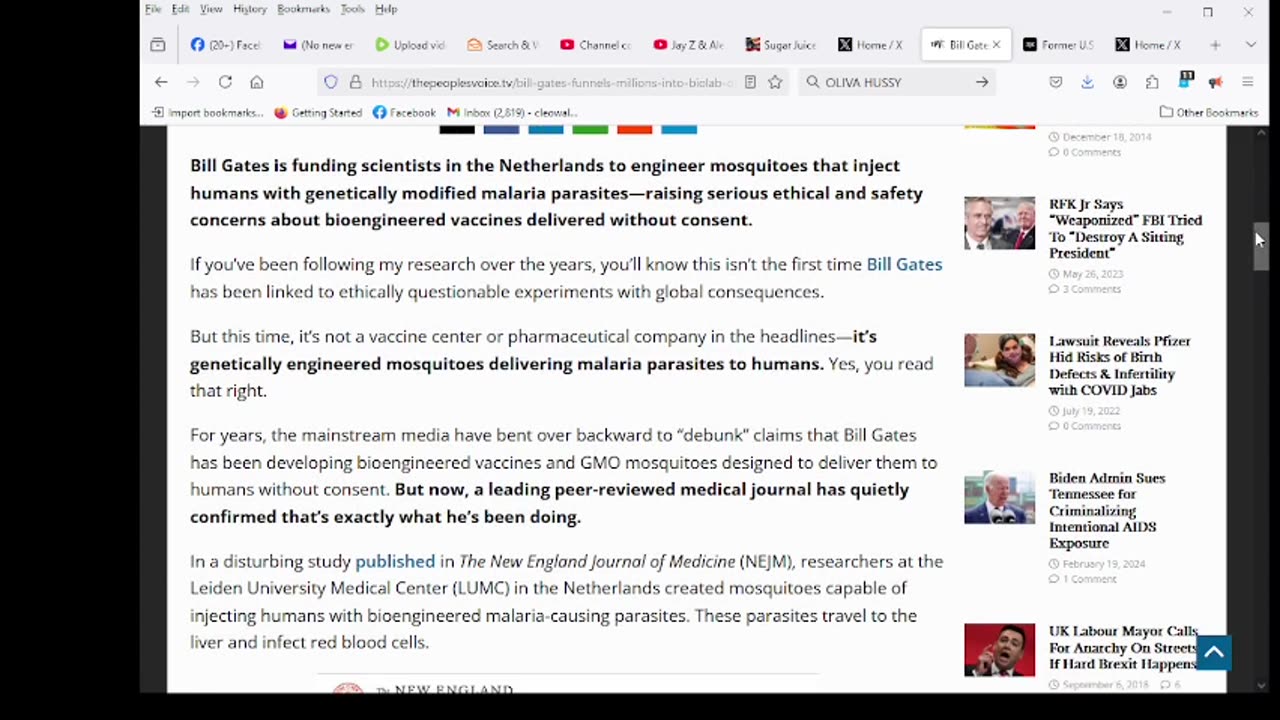
Bill Gates Funnels Millions Into Biolab Developing Mosquito-Delivered Vaccines and GMO Parasites
http://Moreover, two participants (20%) in Stage B showed elevated troponin T levels (18 and 19 ng/mL), exceeding the normal limit of 14 ng/mL. Troponin T is a well-known marker for heart muscle damage or stress, raising concerns about potential cardiac injury. The study authors claim the elevated troponin levels were “unrelated to the trial intervention,” but without elaborating how they knew this. Dr. Richard Bartlett, who has been outspoken on medical safety and ethical concerns in clinical trials, raised critical issues about the study: “The study raises significant red flags,” Dr. Bartlett said. “Tracking participants for just a few weeks is completely inadequate to assess long-term safety or efficacy. We need at least 6 months to a year to properly monitor for parasite infections and evaluate potential complications. Where is the long-term safety data? Without it, we cannot account for late-onset issues or complications that might arise.” Bartlett also questioned the study’s approach to participant safety: “The study fails to address complications and contraindications. What happens if participants have preexisting conditions or unforeseen interactions? These unanswered questions undermine the ability to make safe, informed decisions.” In particular, Bartlett highlighted the study’s findings of elevated troponin levels in some participants. “Elevated troponin levels are highly concerning. Troponin is a specific marker for heart cell damage, not the liver. This points to potential cardiac injury, which was seemingly dismissed without proper investigation. This is a serious safety signal that cannot be ignored,” he explained. Finally, Bartlett addressed the issue of informed consent: “Informed consent is only possible when participants are fully aware of the risks—short-term and long-term. Without robust safety data, this process lacks transparency and accountability. As physicians, it’s our responsibility to demand better safeguards before moving forward with such interventions.” These comments underscore major ethical and scientific concerns about the study’s design and execution. Some argue a moratorium on this type of research is not just necessary—it’s a matter of public safety and ethical responsibility. Without long-term safety data and stricter oversight, we risk setting a dangerous precedent for future experiments that could have far-reaching consequences. Especially in the aftermath of a COVID-19 pandemic that killed over a million Americans, which Congress, the Department of Energy, the FBI, and other intelligence agencies believe was caused by a man-made pathogen.
-
![MAHA News [2.13] RFK on Theo Von, GLYPHOSATE, Hims Peptides Under Scrutiny](https://1a-1791.com/video/fwe2/c1/s8/1/g/R/g/Z/gRgZz.0kob-small-MAHA-News-2.13.jpg) LIVE
LIVE
Badlands Media
13 hours agoMAHA News [2.13] RFK on Theo Von, GLYPHOSATE, Hims Peptides Under Scrutiny
632 watching -
 1:04:11
DeVory Darkins
3 hours agonew report leaves Democrats STUNNED again as Trump economy SURGES
100K45 -
 1:15:31
The Quartering
3 hours agoCANDACE OWENS FINALLY GOES TOO FAR, DISNEY ADMITS FAILURE & DON LEMON FINDS OUT
77.9K112 -
 56:38
56:38
Jeff Ahern
2 hours agoFriday Freak out with Jeff Ahern
7.4K2 -
 38:42
38:42
The White House
4 hours agoPresident Trump Delivers Remarks to Fort Bragg Military Families
14.9K8 -
 1:05:41
The Culture War with Tim Pool
4 hours agoDemocrats LOSE IT!
55.3K32 -
 2:59:48
Wendy Bell Radio
9 hours agoPallets Of Ballots
89.3K116 -
 1:43:28
Steven Crowder
7 hours agoTimothy Gordon Explains: What Womanly Submission Really Means
371K266 -
 1:08:31
Sean Unpaved
4 hours agoTrinidad Chambliss Granted 6TH SEASON Of NCAA Eligibility! | UNPAVED
27.9K2 -
 1:29:11
Timcast
4 hours agoITS OVER | Tim Pool Live
142K119