NASA, NOAA 2024 Ozone Hole Update
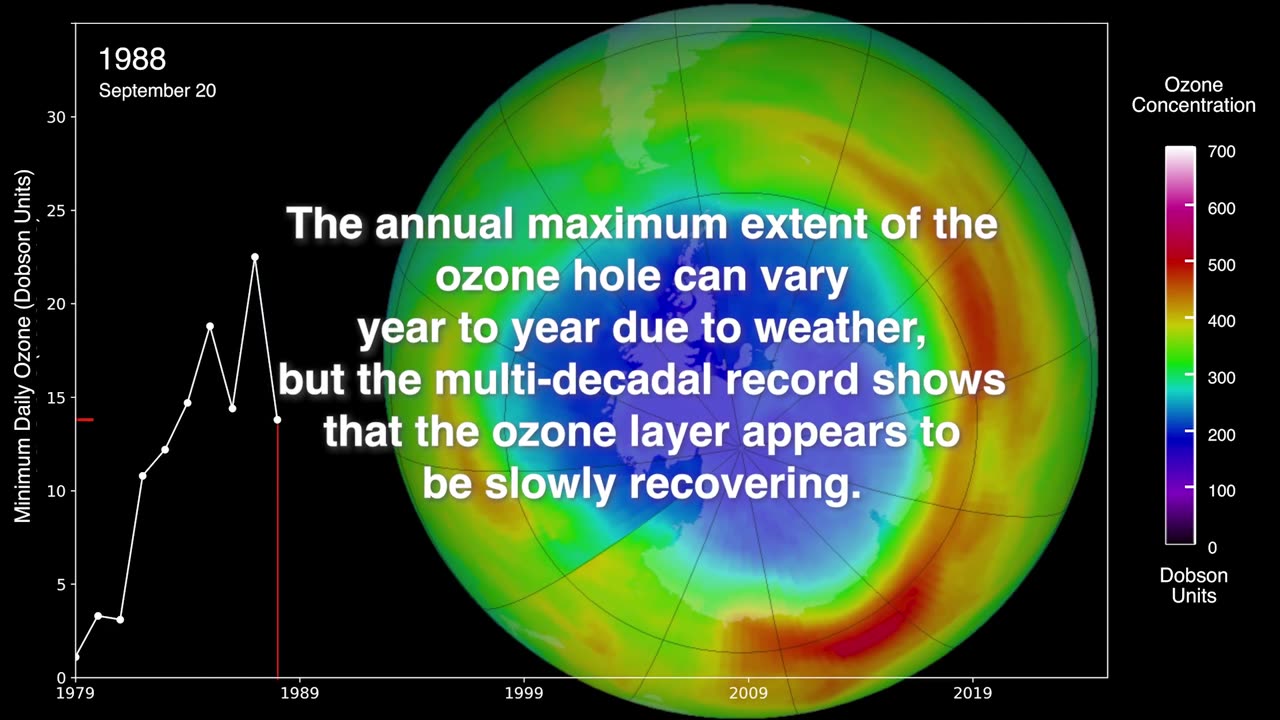
This year, the ozone hole over Antarctica reached its annual maximum extent on September 28th, 2024, with an area of 8.5 million square miles (22.4 square million kilometers.)
The hole, which is actually a region of depleted ozone, was the 20th smallest since scientists began recording the ozone hole in 1979. The average size of the ozone hole between September and October this year was the 7th-smallest since the Montreal Protocol began to take effect.
Universal Music Production: “What Was Reported As Is”
Credit: NASA's Goddard Space Flight Center
Kathleen Gaeta (GSFC AMA): Lead Producer
Paul Newman (NASA GSFC): Lead Scientist
Amy Moran (NASA GSFC): Lead Visualizer
James Riordon (NASA GSFC): Writer
This video can be freely shared and downloaded at https://svs.gsfc.nasa.gov/14711 . While the video in its entirety can be shared without permission, the music and some individual imagery may have been obtained through permission and may not be excised or remixed in other products. For more information on NASA’s media guidelines, visit https://nasa.gov/multimedia/guidelines.
Transcript:
0:00
This year, the ozone hole over Antarctica reached its annual maximum extent on September 28th, 2024,
0:04
With an area of 8.5 million square miles (22.4 square million kilometers).
0:08
0:12
0:16
The hole, which is actually a region of depleted ozone, was the 20th smallest since scientists began recording the ozone hole in 1979.
0:20
0:24
The average size of the ozone hole between September and October this year was the 7th-smallest since the Montreal Protocol began to take effect.
0:28
0:32
The annual maximum extent of the ozone hole can vary year to year due to weather, but the multi-decadal record shows that the ozone layer appears to be slowly recovering.
0:36
0:40
“The weakening we’ve seen in the last two decades shows that international efforts that curbed ozone-destroying chemicals are working.” -Paul Newman, Chief Scientist for Earth Sciences at NASA Goddard
0:44
0:48
NASA and NOAA researchers continue to observe ozone through instruments aboard NASA’s Aura satellite, NOAA-20 satellites, and a joint NASA and NOAA satellite called Suomi-NPP.
0:52
0:56
NASA
-
 3:00:33
TimcastIRL
3 hours agoCandace Owens Says MILITARY INVOLVED In Kirk Killing, Says Tim Pool's Brother Tried To SHOOT HIM
233K180 -
 LIVE
LIVE
Laura Loomer
3 hours agoEP160: THE UNITED STATES OF QATAR
1,074 watching -
 LIVE
LIVE
Drew Hernandez
20 hours agoPRESIDENT TRUMP CONTINUES TO CLASH WITH MTG?
914 watching -
 21:46
21:46
Stephen Gardner
3 hours ago🟢YES! HUGE TRUMP NEWS TODAY!!
9.41K60 -
 LIVE
LIVE
SpartakusLIVE
4 hours agoAim Assist NERFED - I LOVE IT || #1 Spartan Solo Session
284 watching -

Adam Does Movies
9 hours agoBest Sci-Fi Movies! - Live
3.12K1 -
 54:09
54:09
Patriots With Grit
1 hour agoWoke's Destruction of Men | Dr. Gilda Carle
4.65K1 -
 49:00
49:00
MattMorseTV
3 hours ago $0.15 earned🔴Musk is FINALLY talking about it…🔴
28.5K42 -
 1:09:29
Sarah Westall
3 hours agoCDC Lawsuit, Genome Sequencing and Automated Medical Doctors w/ Dr. Nick and Leah Wilson
13.5K -
 LIVE
LIVE
Anthony Rogers
11 hours agoEpisode 392 - This is a Podcast
76 watching