NASA, NOAA 2024 Ozone Hole Update
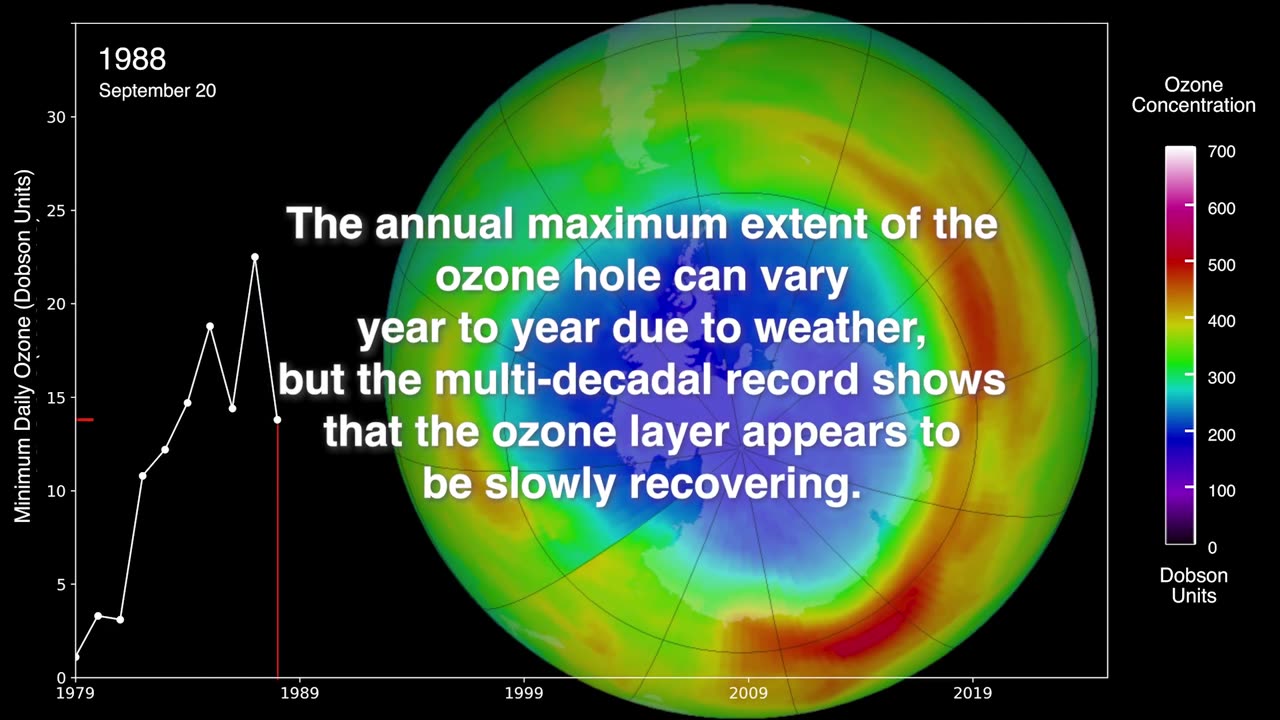
This year, the ozone hole over Antarctica reached its annual maximum extent on September 28th, 2024, with an area of 8.5 million square miles (22.4 square million kilometers.)
The hole, which is actually a region of depleted ozone, was the 20th smallest since scientists began recording the ozone hole in 1979. The average size of the ozone hole between September and October this year was the 7th-smallest since the Montreal Protocol began to take effect.
Universal Music Production: “What Was Reported As Is”
Credit: NASA's Goddard Space Flight Center
Kathleen Gaeta (GSFC AMA): Lead Producer
Paul Newman (NASA GSFC): Lead Scientist
Amy Moran (NASA GSFC): Lead Visualizer
James Riordon (NASA GSFC): Writer
This video can be freely shared and downloaded at https://svs.gsfc.nasa.gov/14711 . While the video in its entirety can be shared without permission, the music and some individual imagery may have been obtained through permission and may not be excised or remixed in other products. For more information on NASA’s media guidelines, visit https://nasa.gov/multimedia/guidelines.
Transcript:
0:00
This year, the ozone hole over Antarctica reached its annual maximum extent on September 28th, 2024,
0:04
With an area of 8.5 million square miles (22.4 square million kilometers).
0:08
0:12
0:16
The hole, which is actually a region of depleted ozone, was the 20th smallest since scientists began recording the ozone hole in 1979.
0:20
0:24
The average size of the ozone hole between September and October this year was the 7th-smallest since the Montreal Protocol began to take effect.
0:28
0:32
The annual maximum extent of the ozone hole can vary year to year due to weather, but the multi-decadal record shows that the ozone layer appears to be slowly recovering.
0:36
0:40
“The weakening we’ve seen in the last two decades shows that international efforts that curbed ozone-destroying chemicals are working.” -Paul Newman, Chief Scientist for Earth Sciences at NASA Goddard
0:44
0:48
NASA and NOAA researchers continue to observe ozone through instruments aboard NASA’s Aura satellite, NOAA-20 satellites, and a joint NASA and NOAA satellite called Suomi-NPP.
0:52
0:56
NASA
-
 LIVE
LIVE
Wendy Bell Radio
4 hours agoWillows Vs Warriors
3,642 watching -
 LIVE
LIVE
Chad Prather
14 hours agoWhen God Breaks Your Barriers: The Power that Reaches Farther Than You Think
3,975 watching -
 LIVE
LIVE
LFA TV
11 hours agoLIVE & BREAKING NEWS! | FRIDAY 12/12/25
3,572 watching -
 25:12
25:12
DeVory Darkins
10 hours agoCongress fails to pass healthcare bill as CNN pulls insane stunt regarding economy
9.02K38 -
 LIVE
LIVE
Game On!
15 hours ago $1.77 earnedPresident Trump Reveals Plan For No Tax On Gambling Winnings!
355 watching -
 56:41
56:41
Crypto Power Hour
13 hours ago $2.35 earnedBitcoin Maxi & Author Natalie Brunell
25.3K8 -
 57:32
57:32
Demons Row
23 hours ago $1.03 earnedBlack 1%er Taa Son Speaks on the Thunderguards MC — Full Interview
8.9K1 -
 10:16
10:16
VSOGunChannel
16 hours ago $1.78 earnedATF is Shutting Down eForms || What You Need to Know
13.7K4 -
 2:05:30
BEK TV
1 day agoTrent Loos in the Morning - 12/12/2025
11K -
 1:05:50
Dialogue works
2 days ago $10.34 earnedCol. Larry Wilkerson: Every Warning Sign Flashing: The U.S. Just Made a Move That Cannot Be Undone
93K32