Hubble Spots Black Hole Beam Causing Stellar Eruptions
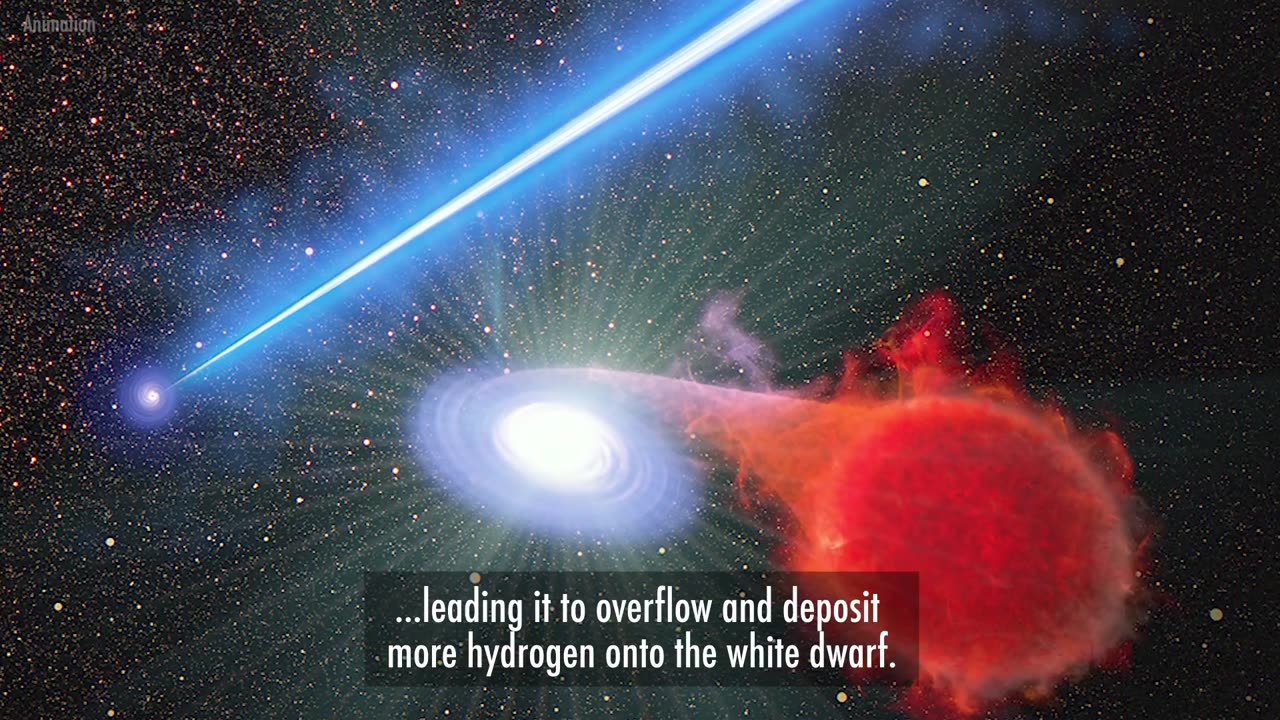
In a surprise finding, astronomers, using NASA’s Hubble Space Telescope have discovered that the jet from a supermassive black hole at the core of M87, a huge galaxy 54 million light years away, seems to cause stars to erupt along its trajectory.
The stars, called novae, are not caught inside the jet, but in a dangerous area near it.
A nova erupts in a double-star system where an aging, swelled-up, normal star spills hydrogen onto a burned-out white dwarf companion star. When the white dwarf has collected a big enough layer of hydrogen, it explodes out into space.
For more information, visit https://nasa.gov/hubble.
Credit: NASA's Goddard Space Flight Center
Paul Morris: Lead Producer
Music Credit:
“Into Orbit” by Laurent Dury [SACEM] via Koka Media [SACEM] and Universal Production Music France, [SACEM] and Universal Production Music.
This video can be freely shared and downloaded at https://svs.gsfc.nasa.gov/14674. While the video in its entirety can be shared without permission, the music and some individual imagery may have been obtained through permission and may not be excised or remixed in other products. Specific details on such imagery may be found here: https://svs.gsfc.nasa.gov/14674. For more information on NASA’s media guidelines, visit https://www.nasa.gov/multimedia/guide....
Transcript
0:00
NASA’s Hubble Space Telescope revealed that a jet of material ejected from a supermassive black hole triggers star eruptions along its path.
0:14
The jet was found at the center of galaxy M87.
0:22
These erupting stars aren’t caught inside the jet, but are dangerously nearby.
0:35
In double-star systems, an aging, swelled-up star spills hydrogen onto a white dwarf companion.
0:45
A white dwarf is a low-mass star that has exhausted all its central nuclear fuel.
0:54
When the white dwarf gathers enough hydrogen it erupts into space, in an event called a nova.
1:07
The white dwarf isn’t destroyed by the nova eruption…
1:12
…instead, it resumes siphoning fuel from its companion, restarting the nova-outburst cycle.
1:22
Hubble observed twice as many novae near the jet compared to other parts of the galaxy.
1:32
The jet is launched by a 6.5-billion-solar-mass black hole.
1:44
Engorged with infalling matter, the black hole shoots a 3,300-light-year-long plasma jet through space at nearly light speed.
1:56
The jet may be pushing hydrogen fuel onto white dwarfs, causing more frequent eruptions.
2:10
It’s also possible that the jet is heating the dwarf's companion star…
2:19
…leading it to overflow and deposit more hydrogen onto the white dwarf.
2:30
After more than 30 years of discoveries…
2:40
…the Hubble Space Telescope continues to uncover new mysteries that surprise astronomers.
2:50
Follow us on social media @NASAHubble
-
 LIVE
LIVE
LFA TV
12 hours agoLIVE & BREAKING NEWS! | WEDNESDAY 12/10/25
3,350 watching -
 LIVE
LIVE
Benny Johnson
57 minutes agoHow The America First Movement Can Win The Midterms | Trump Enters Campaign Mode at MASSIVE Rally...
3,345 watching -
 DVR
DVR
House Republicans
57 minutes agoHouse Republicans Leadership Stakeout
24 -
 1:22:08
Graham Allen
2 hours agoDid the U.S. Military Kill Charlie Kirk?! + Did Erika Kirk Call Out Candace Owens?!
116K726 -
 UPCOMING
Caleb Hammer
20 hours ago100+ Years Of Insane Debt | Financial Audit
1.96K -
 1:21:04
The Kevin Trudeau Show Limitless
55 minutes agoKevin Trudeau Exposes Secret Societies, Media Control & Human Potential (Exclusive Interview)
39 -
 LIVE
LIVE
Badlands Media
9 hours agoBadlands Daily: 12/10/25
3,093 watching -
 LIVE
LIVE
Wendy Bell Radio
6 hours agoENOUGH IS ENOUGH.
7,405 watching -
 1:09:37
Chad Prather
18 hours agoThe God Who Refuses to Let Your Story End
81.5K26 -
 29:24
29:24
Neil McCoy-Ward
4 hours agoYou Won't Believe The 'WARNING SHOTS' Being Fired Between The EU & US Today!!!
6.09K13