Hubble’s Inside the Image: Stephan's Quintet
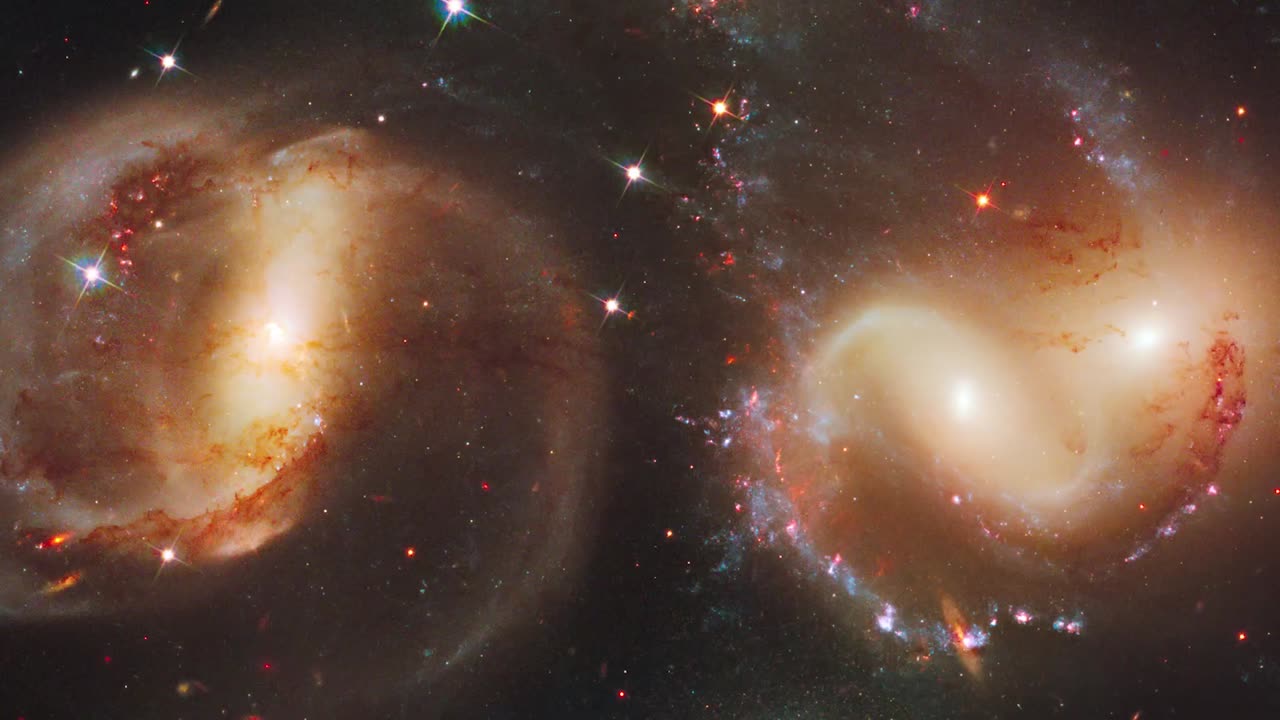
NASA's Hubble Space Telescope has captured an extraordinary image of Stephan's Quintet, a visual grouping of five galaxies that offers a unique glimpse into the dynamics of galaxy interactions.
In this video, Dr. Jennifer Wiseman explores the intricate details of Stephan's Quintet and discusses how Hubble's observations continue to deepen our understanding of galactic behavior and the universe as a whole.
For more information, visit https://nasa.gov/hubble.
Credit: NASA's Goddard Space Flight Center
Producer, Director & Editor: James Leigh
Director of Photography: James Ball
Executive Producers: James Leigh & Matthew Duncan
Production & Post: Origin Films
Video Credits:
Hubble Space Telescope Animation:
ESA/Hubble - M. Kornmesser & L. L. Christensen
Stephan's Quintet Visualization:
NASA, ESA, and G. Bacon, J. DePasquale, F. Summers, and Z. Levay (STScI)
Music Credits:
"Transcode" by Lee Groves [PRS], and Peter George Marett [PRS] via Universal Production Music
"Perennial Ice" by Matthew Nicholson [PRS], and Suki Jeanette Finn [PRS] via Atmosphere Music Ltd. [PRS] and Universal Production Music
This video can be freely shared and downloaded at https://svs.gsfc.nasa.gov/14670. While the video in its entirety can be shared without permission, the music and some individual imagery may have been obtained through permission and may not be excised or remixed in other products. Specific details on such imagery may be found here: https://svs.gsfc.nasa.gov/14670. For more information on NASA’s media guidelines, visit https://www.nasa.gov/multimedia/guide....
Tr0:07
This is a group
0:07
of galaxies known as Stephan's Quintet.
0:11
Quintet meaning five, of course.
0:13
And you can see them here.
0:14
One, two, three, four, five.
0:18
Although, it's really just a visual quintet because it turns out that
0:21
the galaxy here on the left is a lot closer than the other four.
0:26
The other four are at a distance of about 290 million light years away.
0:31
And the nearby one is only about 40 million light years away.
0:35
You can also see its difference in color and details.
0:39
They're still all in our deep universe.
0:41
And they make for a very interesting picture.
0:47
The ones on the right
0:48
are actually gravitationally interacting with each other.
0:52
They are feeling each other's pull,
0:54
and that's creating structural changes in these galaxies.
0:58
You can even see evidence that the spiral structure in these galaxies is becoming
1:03
distorted as they feel each other's gravitational tug.
1:07
It's creating long tails of stars and star formation between the galaxies.
1:12
Because as you have more regions where gas is stirred up and compacted,
1:16
that's the recipe for more clumps of gas in
1:19
each of these galaxies to collapse and form more stars.
1:23
You can see these two are closer in this dance of merging.
1:27
And all of this is evidence of the merging process of galaxies
1:31
that we now know is very common in the history of our universe.
1:35
Galaxies that are close enough to each other will feel each other's
1:38
gravitational pull.
1:40
They'll come toward each other.
1:41
that creates a little dance as they orbit around each other, sometimes
1:45
go through each other and they distort each other structure.
1:49
So you can see this cosmic dance going on right now
1:52
in Stephan's Quintet, and you can see some of the impacts of that.
1:59
So we
2:00
can see that the galaxies are connected to each other.
2:03
Now and they're showing us that merging is an important part
2:07
of forming structure in stars and galaxies.
2:10
We actually believe
2:11
that most galaxies have gone through at least one merger in cosmic history.
2:16
We believe our Milky Way has and will again.
2:20
So we want to watch this dramatic dance so that we understand how galaxies
2:24
have formed and grown over cosmic history, including our own Milky Way.
tanscript
0:07
This is a group
0:07
of galaxies known as Stephan's Quintet.
0:11
Quintet meaning five, of course.
0:13
And you can see them here.
0:14
One, two, three, four, five.
0:18
Although, it's really just a visual quintet because it turns out that
0:21
the galaxy here on the left is a lot closer than the other four.
0:26
The other four are at a distance of about 290 million light years away.
0:31
And the nearby one is only about 40 million light years away.
0:35
You can also see its difference in color and details.
0:39
They're still all in our deep universe.
0:41
And they make for a very interesting picture.
0:47
The ones on the right
0:48
are actually gravitationally interacting with each other.
0:52
They are feeling each other's pull,
0:54
and that's creating structural changes in these galaxies.
0:58
You can even see evidence that the spiral structure in these galaxies is becoming
1:03
distorted as they feel each other's gravitational tug.
1:07
It's creating long tails of stars and star formation between the galaxies.
1:12
Because as you have more regions where gas is stirred up and compacted,
1:16
that's the recipe for more clumps of gas in
1:19
each of these galaxies to collapse and form more stars.
1:23
You can see these two are closer in this dance of merging.
1:27
And all of this is evidence of the merging process of galaxies
1:31
that we now know is very common in the history of our universe.
1:35
Galaxies that are close enough to each other will feel each other's
1:38
gravitational pull.
1:40
They'll come toward each other.
1:41
that creates a little dance as they orbit around each other, sometimes
1:45
go through each other and they distort each other structure.
1:49
So you can see this cosmic dance going on right now
1:52
in Stephan's Quintet, and you can see some of the impacts of that.
1:59
So we
2:00
can see that the galaxies are connected to each other.
2:03
Now and they're showing us that merging is an important part
2:07
of forming structure in stars and galaxies.
2:10
We actually believe
2:11
that most galaxies have gone through at least one merger in cosmic history.
2:16
We believe our Milky Way has and will again.
2:20
So we want to watch this dramatic dance so that we understand how galaxies
2:24
have formed and grown over cosmic history, including our own Milky Way.
-
 2:00:01
TruthStream with Joe and Scott
15 hours agoAdrenochrome, Time Travel and Wormholes! Our most mindbending and mindblowing interview to date!! Premiers 12/9 3pm pacific 6pm eastern
7.76K9 -
 1:41:23
The Michelle Moore Show
17 hours ago'Setting the Record Straight On Many Myths and Lies We've Been Told Concerning Our Health' Guest, Dr. Margaret Aranda: The Michelle Moore Show (Dec 9, 2025)
11.4K4 -
 18:16
18:16
Nikko Ortiz
13 hours agoFighting A War With Pistols...
6.2K -
 1:39:49
PandaSub2000
1 day agoBehemoth - Part I | PSVR 2000 (Edited Replay)
40.3K1 -
 26:03
26:03
GritsGG
14 hours agoWarzone Brought Back This Over Powered Item! Daily Warzone Tips! #warzone=
4.79K -
 LIVE
LIVE
Lofi Girl
3 years agolofi hip hop radio 📚 - beats to relax/study to
596 watching -
 3:08:01
Badlands Media
15 hours agoDEFCON ZERQ Ep. 021: General Flynn - Military Is The Only Way
306K51 -
 3:00:33
TimcastIRL
9 hours agoCandace Owens Says MILITARY INVOLVED In Kirk Killing, Says Tim Pool's Brother Tried To SHOOT HIM
312K382 -
 2:47:33
Laura Loomer
9 hours agoEP160: THE UNITED STATES OF QATAR
68.8K37 -
 4:46:47
Drew Hernandez
1 day agoPRESIDENT TRUMP CONTINUES TO CLASH WITH MTG?
55.1K28