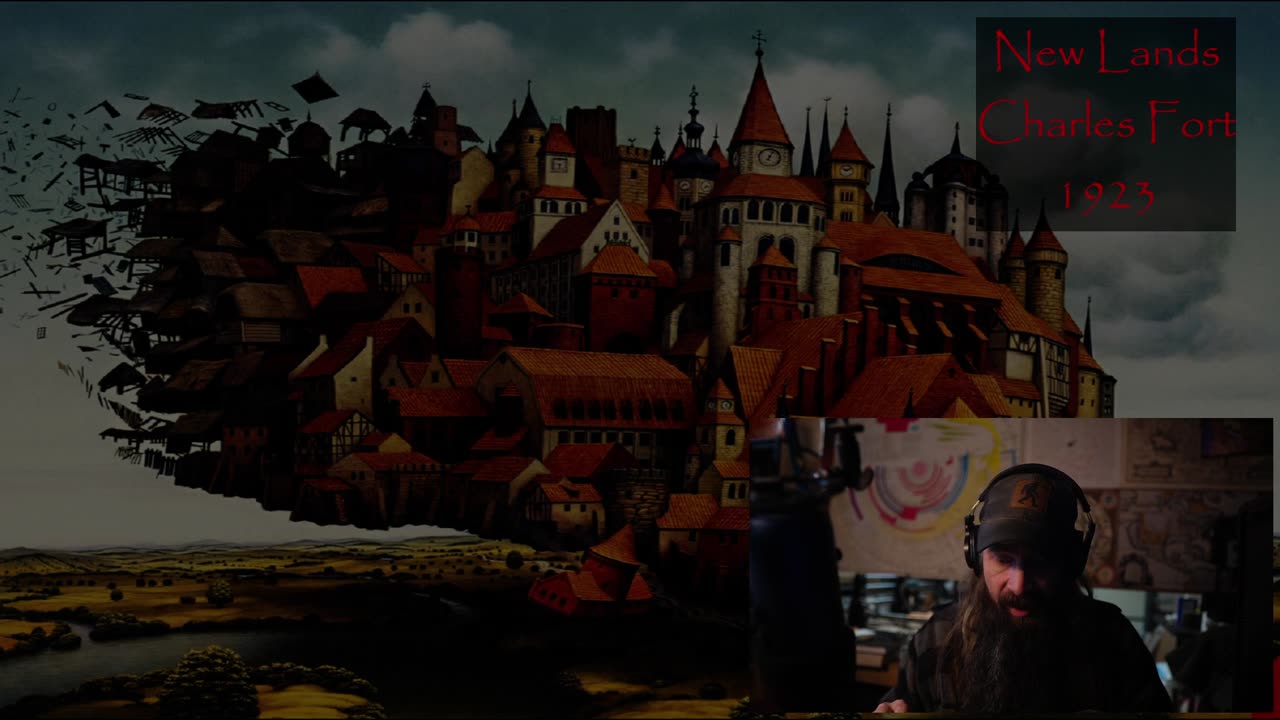
New Lands - C. Fort; 1923 - 25
New Lands - C. Fort; 1923 - 25
The video explores the concept of isolation in development, particularly in the context of astronomy and the understanding of Earth's position in space. It delves into historical astronomical theories, the significance of various celestial phenomena, and challenges conventional beliefs about Earth's movement and the vastness of space.
Key Points:
Isolation in Development
The speaker discusses the functional role of isolation in the growth and development of systems, suggesting that both organisms and scientific knowledge initially exist in isolated states before integration and wider acceptance.
Historical Context of Astronomy
A review of historical astronomical beliefs, highlighting how early astronomers were limited by their understanding. The speaker points to Hegel's outdated concepts and shows how discoveries like that of Ceres highlighted the limitations of prior knowledge.
Earth's Movement and Celestial Phenomena
The speaker posits that many phenomena observed in the sky, such as meteors and explosions, suggest that the Earth may actually be stationary rather than moving through space. This challenges prevailing scientific orthodoxy.
Observed Explosions and Meteorites
The video presents specific historical events of explosions in the sky, arguing for a possible connection between these occurrences and a stationary Earth as opposed to random meteors from distant space.
Challenging Conventional Astronomy
The speaker challenges conventional astronomical principles, suggesting that the fixed positions of celestial phenomena imply a stationary Earth, and that gravitational theories may not be as robust as portrayed.
Implications of Stationary Earth Theory
The implications of considering Earth as stationary lead to a reevaluation of space travel, communication with other worlds, and our understanding of gravity.
-
 LIVE
LIVE
Barry Cunningham
1 day agoLIVE BREAKING NEWS: He's Back!! President Trump Hosts a Rally In Pennsylvania!
1,834 watching -
 LIVE
LIVE
The White House
5 hours agoPresident Trump Delivers Remarks on the Economy
1,697 watching -
 1:02:44
BonginoReport
2 hours ago“Low IQ” Crockett Launches Senate Bid - Nightly Scroll w/ Hayley Caronia (Ep.193)
30.9K38 -
 54:26
54:26
Katie Miller Pod
1 hour agoElon Musk on DOGE, AI, & Are we in a Simulation? | KMP Ep.18
1988 -
 1:02:39
TheCrucible
3 hours agoThe Extravaganza! EP: 72 (12/09/25)
86.7K12 -
 1:50:53
Kim Iversen
3 hours agoNick Fuentes: "Hitler Was Very F**cking Cool" | Candace Owens ENDS Tim Pool
14.5K82 -
 1:46:54
Redacted News
3 hours agoSomething DEVASTATING is about to hit Ukraine, and NATO Puppet Zelensky is to blame | Redacted
123K71 -
 13:17
13:17
Stephen Gardner
4 hours agoWhat Trump Is Doing Right Now That No One Is Talking About!
15.3K18 -
 1:11:06
vivafrei
4 hours agoJan. 6 Suspect "My Little Pony" Obsession? Piers Morgan's Schlock Interview with Fuentes! AND MORE!
130K50 -
 LIVE
LIVE
Dr Disrespect
7 hours ago🔴LIVE - DR DISRESPECT - TARKOV 1.0 - THE VIOLENCE EVOLVES
943 watching