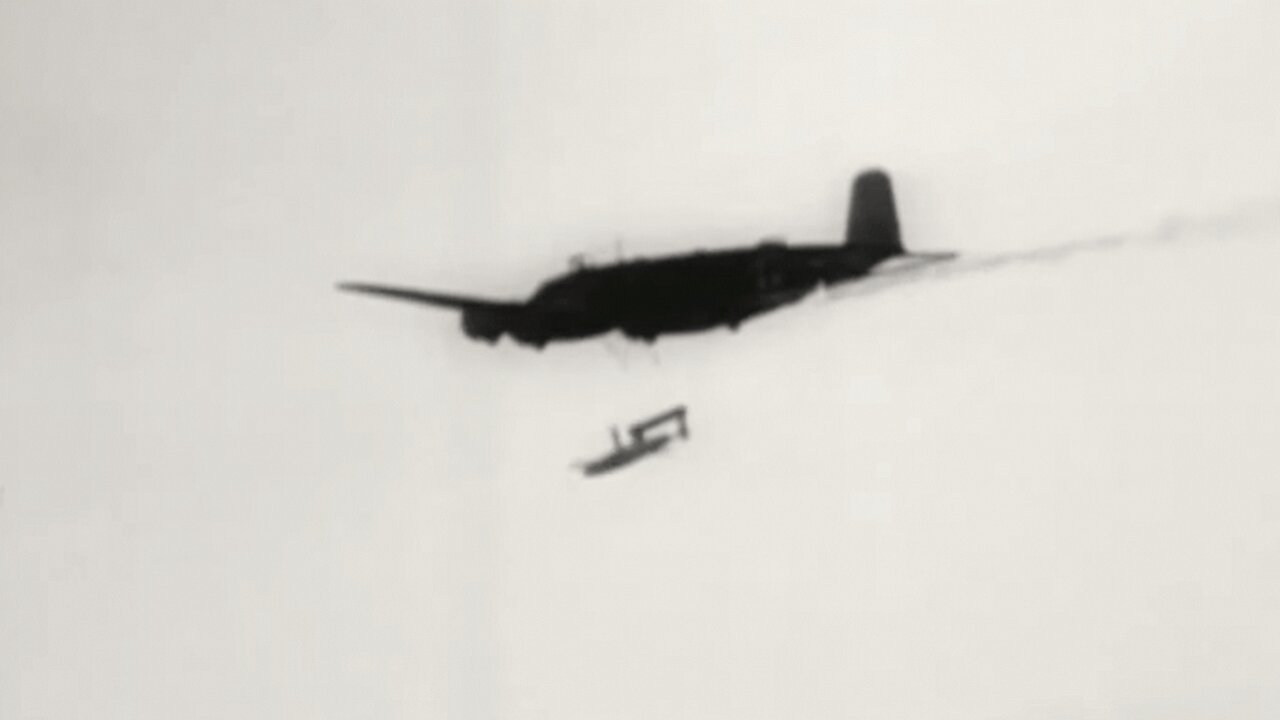
Fieseler Fi 103/V-1 Flying Bomb launch trials during development
In 1935 Paul Schmidt and Professor Georg Hans Madelung submitted a design to the Luftwaffe for a flying bomb. It was an innovative design that used a pulse-jet engine, while previous work dating back to 1915 by Sperry Gyroscope relied on propellers. While employed by the Argus Motoren company, Fritz Gosslau developed a remote-controlled target drone, the FZG 43 (Flakzielgerät-43). In October 1939 Argus proposed Fernfeuer, a remote-controlled aircraft carrying a payload of one ton, that could return to base after releasing its bomb. Argus worked in co-operation with C. Lorenz AG and Arado Flugzeugwerke to develop the project. However, the Luftwaffe declined to award them a development contract. In 1940, Schmidt and Argus began cooperating, integrating Schmidt's shutter system with Argus' atomized fuel injection. Tests began in January 1941, and the first flight made on 30 April 1941 with a Gotha Go 145. On 27 February 1942 Gosslau and Robert Lusser sketched out the design of an aircraft with the pulse-jet above the tail, the basis for the future V-1.
Lusser produced a preliminary design in April 1942, P35 Erfurt, which used gyroscopes. When submitted to the Luftwaffe on 5 June 1942, the specifications included a range of 300 km (186 miles), a speed of 700 km/h (435 mph), and capable of delivering a 500-kilogram (1⁄2-long-ton) warhead. Project Fieseler Fi 103 was approved on 19 June, and assigned code name Kirschkern and cover name Flakzielgerät 76 (FZG-76). Flight tests were conducted at the Luftwaffe's Erprobungsstelle coastal test centre at Karlshagen, Peenemünde-West.
Erhard Milch, State Secretary in the Reich Ministry of Aviation and Inspector General of the Air force, awarded Argus the contract for the engine, Fieseler the airframe, and Askania the guidance system. By 30 August Fieseler had completed the first fuselage, and the first flight of the Fi 103 V7 took place on 10 December 1942, when it was airdropped by a Fw 200.[11] Then on Christmas Eve, the V-1 flew 900 m (1,000 yd), for about a minute, after a ground launch. On 26 May 1943 Germany decided to put both the V-1 and the V-2 into production. In July 1943 the V-1 flew 245 kilometres (152 mi) and impacted within a kilometre (1,100 yards) of its target.
The Wehrmacht first launched the V-1s against London on 13 June 1944, one week after (and prompted by) the successful Allied landings in France. At peak, more than one hundred V-1s a day were fired at southeast England, 9,521 in total, decreasing in number as sites were overrun until October 1944, when the last V-1 site in range of Britain was overrun by Allied forces. After this, the Germans directed V-1s at the port of Antwerp and at other targets in Belgium, launching a further 2,448 V-1s. The attacks stopped only a month before the war in Europe ended, when the last launch site in the Low Countries was overrun on 29 March 1945.
-
 1:30
1:30
hw97karbine
19 days agoRAAF Bristol Beaufighters in action against Japanese targets in New Guinea circa mid 1943
34 -
 1:04:57
Candace Owens
5 hours agoBREAKING NEWS! We Received Photos Of Charlie's Car After The Assassination. | Candace Ep 281
119K298 -
 1:42:25
Redacted News
4 hours agoPutin just did the UNTHINKABLE as US Senators push for war against Russia
154K133 -
 LIVE
LIVE
SpartakusLIVE
1 day agoWZ All Night! || Arc has been UNINSTALLED
209 watching -
 8:32
8:32
Dr. Nick Zyrowski
4 days agoHow Your Butt Shape Determine Metabolic Health - (Surprising Research!)
42.1K13 -
 19:02
19:02
HotZone
5 days ago $5.71 earnedThe Hidden War Inside Israel: Following the Money to Terrorists
41.1K9 -
 33:57
33:57
Stephen Gardner
5 hours agoHOLY CRAP! Trump Just Ordered the UNTHINKABLE on Venezuela – Rubio Demands It!
52.3K46 -
 6:15:38
Dr Disrespect
9 hours ago🔴LIVE - DR DISRESPECT - ARC RAIDERS - SKILL TREE EXPERT
146K7 -
 5:49
5:49
Buddy Brown
8 hours ago $3.75 earnedI Tried to WARN YOU Congress Would SNEAK It In! | Buddy Brown
30.7K23 -
 LIVE
LIVE
LFA TV
23 hours agoLIVE & BREAKING NEWS! | WEDNESDAY 12/17/25
706 watching