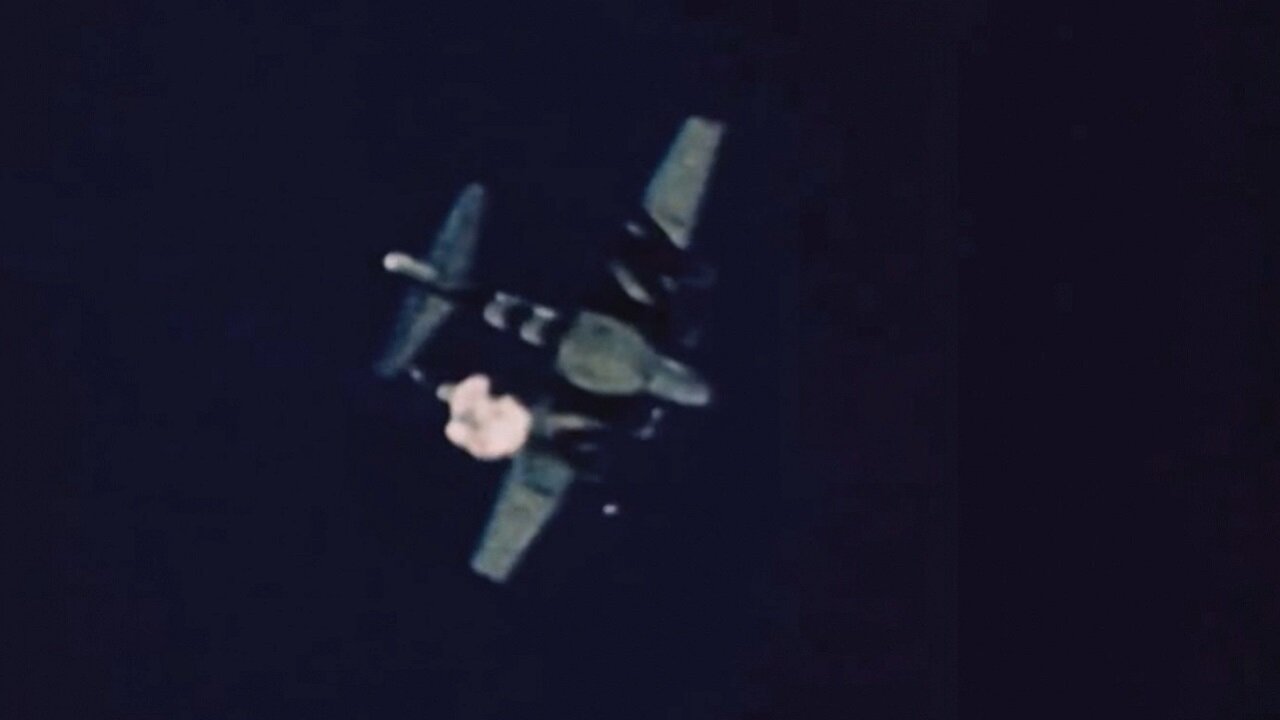
Early AIM-9 Sidewinder inert missile tests targeting QB-17 drones in 1954
After the end of World War II, a large number of B-17G Flying Fortress bombers became surplus to USAAF (and later USAF) requirements. Some of these were converted to unmanned QB-17 configuration, mostly for use as aerial targets. During the same conflict the B-17 helped to win, various researchers in Germany were working infrared guidance systems of various complexity. The most mature development of these, codenamed Hamburg, was intended for use by the Blohm & Voss BV 143 glide bomb in the anti-shipping role. Hamburg used a single IR photocell as its detector along with a spinning disk with lines painted on it, alternately known as a "reticle" or "chopper". The reticle spun at a fixed speed, causing the output of the photocell to be interrupted in a pattern, and the precise timing of the resulting signal indicated the bearing of the target. Although Hamburg and similar devices like Madrid were essentially complete, the work of mating them to a missile had not been carried out by the time the war ended.
In the immediate post-war era, Allied military intelligence teams collected this information, along with many of the engineers working on these projects. Several lengthy reports on the various systems were produced and disseminated among the western aircraft firms, while a number of the engineers joined these companies to work on various missile projects. By the early 1950s, both the US Air Force and Royal Air Force had started major IR seeker missile projects.
The development of the Sidewinder missile began in 1946 at the Naval Ordnance Test Station (NOTS), Inyokern, California, now the Naval Air Weapons Station China Lake, as an in-house research project conceived by William B. McLean. McLean initially called his effort "Local Fuze Project 602" using laboratory funding, volunteer help and fuze funding to develop what they called a heat-homing rocket.
Sidewinder did not receive official funding until 1951 when the effort was mature enough to show to Admiral William "Deak" Parsons, the Deputy Chief of the Bureau of Ordnance (BuOrd). It subsequently received designation as a program in 1952. Originally called the Sidewinder 1, the first live firing was on 3 September 1952. The missile intercepted a drone for the first time on the 11 September 1953. The missile carried out 51 guided flights in 1954, and in 1955 production was authorized.
-
 2:09
2:09
hw97karbine
1 month ago $0.02 earned.50 Browning AN/M2 machinegun headspace adjustment
31 -
 47:57
47:57
Professor Nez
9 hours ago🚨LIVE NOW: President Trump Addresses the Nation from the Oval Office
27.2K25 -
 28:17
28:17
The White House
5 hours agoPresident Trump Delivers an Address to the Nation
66.4K115 -

Drew Hernandez
22 hours agoTRUMP ADDRESSES THE NATION & BONGINO ANNOUNCES FBI DEPARTURE?
50.3K17 -
 2:37:30
Badlands Media
16 hours agoBadlands Media Special Coverage - MY FELLOW AMERICANS the Alpha Warrior Show & Redpill Project
59.6K27 -
 22:54
22:54
Jasmin Laine
11 hours agoMedia MELTS DOWN as Poilievre Surges—Ottawa Loses Control of the Narrative
27.8K14 -
 59:50
59:50
BonginoReport
8 hours agoDan Bongino Is Leaving The FBI - Nightly Scroll w/ Hayley Caronia (Ep.199)
286K252 -
 1:14:51
Kim Iversen
9 hours agoSTILL SHADY: Candace Meets With Erika — She Was Right
167K254 -
 1:04:57
Candace Owens
9 hours agoBREAKING NEWS! We Received Photos Of Charlie's Car After The Assassination. | Candace Ep 281
170K509 -
 1:42:25
Redacted News
9 hours agoPutin just did the UNTHINKABLE as US Senators push for war against Russia
178K174