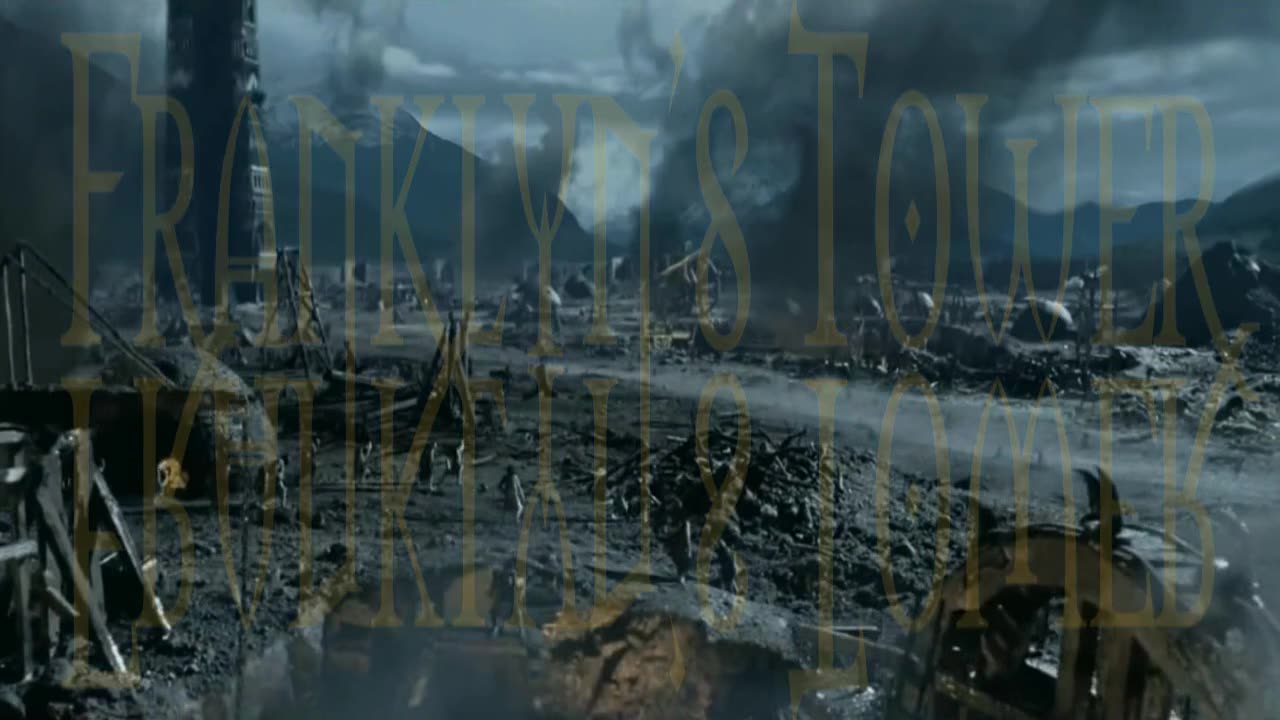
Franklyn's Tower The Grateful Dead
Franklin’s Tower Album: Blues for Allah (1975)
by The Grateful Dead
Garcia “borrowed” the melody for Franklin’s Tower from Lou Reed’s Walk on the Wild Side.
Considering how good the result is, we doubt even the famously curmudgeonly Reed grumbled too much. Hunter’s lyrics are as obtuse as ever, but overall, it’s a slice of pure pop magic.
A lot of ink has been spilled on the topic of Franklyn’s Tower. I’m guilty myself.
But I have found that the most rewarding writing about the song consists of two completely divergent pieces.
The first is by Andrew Shalit, and I was happy to be given permission to point to it from my “Franklin’s Tower” page on the Annotated Lyrics website. Written as a mock-scholarly essay entitled “Roll Away the Dew: An Exegesis of Robert Hunter’s ‘Franklin’s Tower’,” the piece goes into wonderful detail describing Ben Franklin’s supposed process for casting bells, involving a process called “dewing” the bell.
“Franklin postulated that a process which he called ‘dewing’ could be used to improve the production process of large bells. Dewing basically involves exposing the freshly cast bell to large quantities of steam while the bell is still hot. The steam causes a rapid cooling, producing droplet of 'dew' on the bell. After the dew is formed, the bell is rolled between large cotton sheets. He described this process as ‘rolling away the dew.’
“Unfortunately, Franklin's contemporaries had a very hard time understanding his technology. He showed them sample bells, asking him to simply look at the results without trying to understand the process. This was when he uttered the now famous quote, ‘if you get confused, listen to the music play.’”
Worth reading all the way through, definitely. Even more entertaining than the essay itself, perhaps, is the chain of email queries and responses to and from Shalit, in which he continues to develop the ruse. Wonderful!
The second piece about the song is by Hunter himself. He wrote it in response to a piece I posted on my site, written by Jurgen Fauth, entitled “The Fractals of Familiarity and Innovation: Robert Hunter and the Grateful Dead concert experience.” In the Fauth essay, the author refers to some of Hunter’s lyrics as lacking in meaning, using the word “nonsensical.”
Hunter responded with an essay entitled “Fractures of Unfamiliarity & Circumvention in Pursuit of a Nice Time.” In the essay, Hunter addresses Fauth directly:
“Since the concluding remark of your essay stated that the Grateful Dead songs are "meaningless" I choose to reply by explicating one of your examples: "Franklin's Tower." I do this reluctantly because I feel that a straightforward statement of my original intent robs the listener of personal associations and replaces them with my own. I may know where they come from, but I don't know where they've been. My allusions are, admittedly, often not immediately accessible to those whose literary resources are broadly different than my own, but I wouldn't want my listeners' trust to be shaken by an acceptance of the category "meaningless" attached to a bundle of justified signifiers whose sources happen to escape the scope of simplistic reference.” [italics mine.]
He then proceeds to give a line-by-line explication of the lyric. To quote from his essay briefly, here is the first verse:
In another time's forgotten space
your eyes looked through your mother's face
Wildflower seed on the sand and stone
may the four winds blow you safely home.
[You have your mother's eyes, child, the very shape, color and intensity of the eyes that looked through her face so long ago. Borne on the varied winds of chance and change, like a dandelion seed, you may find yourself deposited on barren soil. My wish for you is that the forces that brought you there may sweep you up again and bear you to fertile ground.]
"In another time's forgotten space
your eyes looked through your mother's face."
[Relative immortality of the human species is realized through reproduction. Dominant traits inherited from an ancestor, the lyric suggests, share more than mere similarity with those of the forebear, but are an identity, endlessly reproducible. In other words, when someone says "You have your mother's eyes" they are not speaking in simile nor would it be incorrect to say that "your mother has your eyes," if, in fact, possessiveness is an appropriate term in the context. Poetic license will assume it is, if only for the sake of moving on to the next couplet.]
-
 14:38
14:38
Psychological operations
1 day agoStealin' Blind Eye Easy Livin' Simon The Bullet Freak Uriah Heep
35 -
 DVR
DVR
Chad Prather
14 hours agoWhen Heaven Stands: The Hidden Power of a Faithful Witness
22.2K19 -
 LIVE
LIVE
LFA TV
12 hours agoLIVE & BREAKING NEWS! | TUESDAY 12/02/25
3,455 watching -
 11:36
11:36
tactical_rifleman
11 days agoNever Run Out Of Ammo | Magazine Pez Dispenser | Tactical Rifleman
28.3K3 -
 26:11
26:11
Upper Echelon Gamers
16 hours ago $2.52 earned"Her" Wasn't Fiction - Its Real
9.07K3 -
 3:11
3:11
Canadian Crooner
2 years agoPat Coolen | It's Beginning to Look A Lot Like Christmas
61K17 -
 5:22
5:22
DropItLikeItsScott
1 day ago $2.61 earnedThe GLOCK Killer? Shadow Systems XR920 / Would You Choose It?
10.7K8 -
 2:06:15
BEK TV
1 day agoTrent Loos in the Morning - 12/01/2025
12.6K1 -
 LIVE
LIVE
The Bubba Army
23 hours agoDIDDY'S NEW DOC EXPOSED! - Bubba the Love Sponge® Show | 12/02/25
1,280 watching -
 40:10
40:10
ZeeeMedia
15 hours agoFDA Memo: "Covid-19 Vaccines Have Killed American Children" | Daily Pulse Ep 153
22.8K35